![Senior couple cane declutter boxes living room[1]](https://www.grayingwithgrace.com/wp-content/uploads/2025/12/senior_couple_cane_declutter_boxes_living_room1-e1767121195712.jpg)
Have you ever stood in your doorway, looking at years of accumulated belongings, and felt completely frozen about where to start?
You’re not imagining things. Traditional decluttering advice assumes you have unlimited energy and overlooks something crucial: a lifetime of belongings carries emotional weight that younger people simply haven’t accumulated yet.
But here’s what you need to know: there’s a way to tackle this that actually works for your life stage. No weekend marathons. No guilt about keeping things that matter.
Just 15 minutes a day, one room at a time, over four weeks.
Why Most Decluttering Advice Sets Seniors Up to Fail
The problem isn’t you—it’s the advice itself.
When someone suggests “just spend a Saturday cleaning out the garage,” they’re not accounting for the fact that standing for extended periods might cause knee pain. When decluttering experts treat every object as emotionally neutral, they’re ignoring that your mother’s china pattern carries 50 years of holiday memories.
Traditional approaches also ignore decision fatigue. Making hundreds of keep-or-toss choices in one day is exhausting at any age, but it’s particularly draining when you’re weighing memories and meaning alongside function.
Then there’s the guilt trap. You might feel you “should” be able to move faster or decide more easily. But that’s comparing yourself to people who haven’t lived as full a life as you have—they simply don’t have decades of meaningful possessions to consider.
The truth is: You don’t need to move faster. You need an approach designed for where you are right now.

The Zero-Overwhelm Framework: How This Challenge Actually Works
This approach rests on three core principles that respect your energy, honor your attachments, and build sustainable progress.
The 15-Minute Maximum Rule
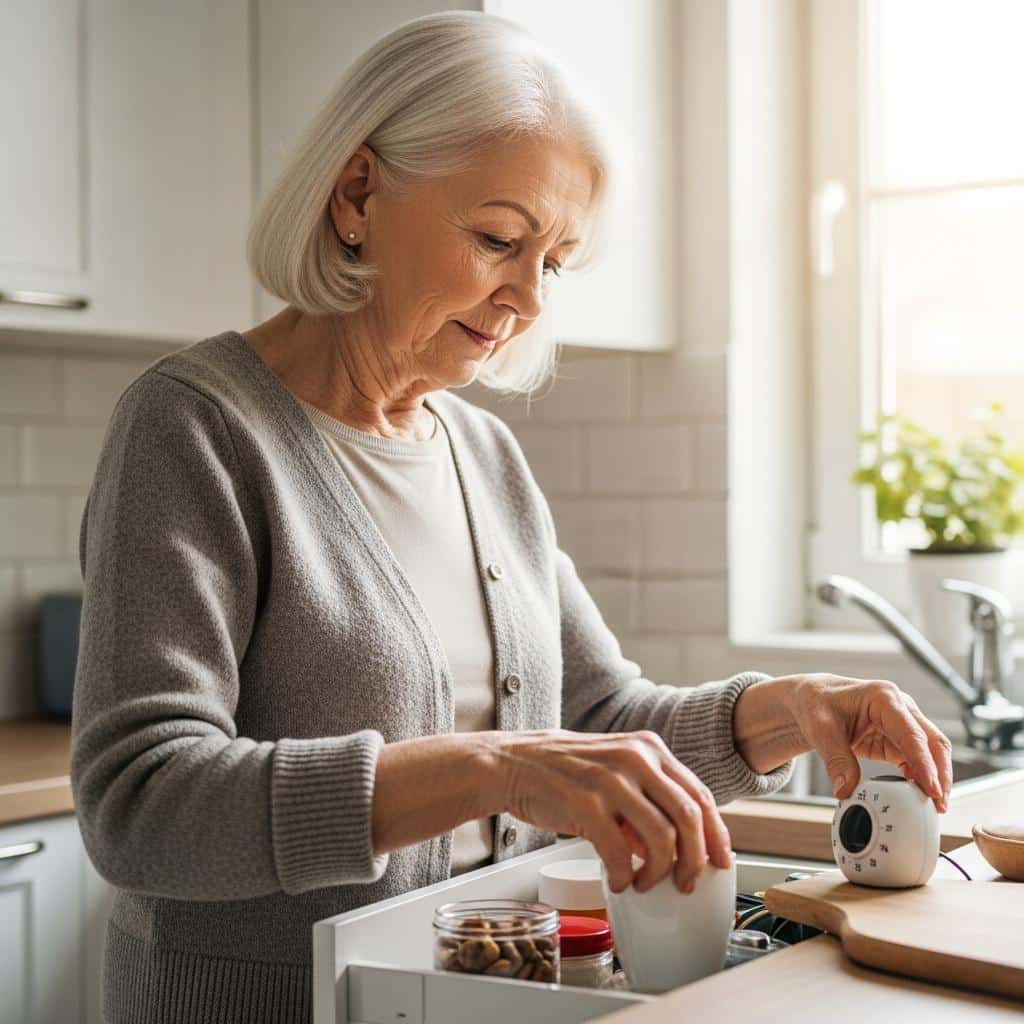
When the timer goes off, you stop—even if you’re mid-task. This prevents exhaustion and preserves energy for tomorrow. You’re playing the long game here, not trying to win a sprint.
One Room at a Time Focus
You’ll give complete attention to a single space before moving on. This eliminates scattered effort and creates visible progress that motivates you to continue.
Built-In Flexibility
Rest days aren’t “cheating”—they’re part of the plan. You can modify the schedule, ask for help, or adjust the pace without any judgment.
Your Simple Three-Box System
Keep three boxes or bags in the room you’re working on: Keep (stays in the room), Donate (goes to charity), and Trash (truly unusable). The boxes stay put all month, so you’re not carrying items around the house.
Decision-Making That Works for Your Life Stage
Forget Marie Kondo’s “spark joy” approach. Instead, ask yourself these practical questions:
Have I used this in the past year? Does it serve my current life, not my past life or future “someday”? Can I safely access and use it given my current mobility?
Here’s a powerful one: If this belonged to someone else, would I choose to keep it?
And the question that frees many people: Do my kids actually want this, or am I just assuming they do?
Managing Your Energy Strategically
Schedule your sessions when you typically feel best—morning if you’re a morning person, afternoon if that’s your strong time. Understanding when your brain is naturally sharpest can help you time these decision-heavy sessions for maximum effectiveness.
You have permission to split the 15 minutes into two shorter sessions if needed. A 10-minute session beats skipping the day entirely.
Rest days are strategic, not indulgent. They’re built into the plan because recovery is part of progress.
Ready to discover more innovative strategies for healthy, comfortable aging? Subscribe to our newsletter for expert-tested tips and product recommendations designed specifically for older adults.

Your 4-Week Room-by-Room Roadmap
This isn’t a rigid checklist—it’s a flexible guide. Swap days as needed, take extra rest days, and adjust the pace to fit your life.
Week 1: Kitchen—The Heart of Daily Life
You’ll start here because you use this space multiple times daily. Improvements immediately impact your life, and quick wins build confidence for the weeks ahead.
Day 1 might focus on expired foods and mystery containers from your refrigerator. Day 2 could tackle duplicate utensils and gadgets you never actually use. Day 3 is perfect for that one drawer—you know exactly which one I’m talking about. If you’re curious about why that “junk drawer” might actually be more genius than cluttered, it’s worth understanding before you clear it completely.
Consider Day 4 for small appliances you haven’t used in a year, and Day 5 for under-sink clutter and ancient cleaning products that might not even be safe anymore. Day 6 is your rest day or catch-up day if you need it.
By Day 7, take a victory lap. Walk through your kitchen and admire clearer counters and easier access to what you actually use.
Week 2: Bedroom and Closet—Your Private Sanctuary
Building on your kitchen success, you’ll tackle the space that should be most restful. This week often brings unexpected relief as you realize how much mental space clutter was occupying. If you’re finding that managing stairs to your bedroom is becoming challenging, this decluttering work might reveal whether a first-floor bedroom conversion makes sense for your situation.
You might approach Day 8 by sorting clothing worn in the past year versus “someday” clothes. Day 9 could focus on seasonal clothing that can be stored elsewhere. Day 10 is ideal for shoes and accessories—keep only what’s comfortable now, not what you hope to wear again someday.
Day 11 might tackle nightstand clutter and expired medications. Speaking of bedroom safety, professional caregivers notice specific hazards that family members often overlook—it’s worth checking if any of those apply to your space.
Day 12 works well for your linen closet or dresser drawers.
Take Day 13 off, then use Day 14 to create a clearer morning routine by organizing what you use daily.
Week 3: Living Spaces—Where Life Happens
This week focuses on the rooms where you spend your time relaxing, reading, and connecting with loved ones. Safety improvements here reduce trip hazards and create easier navigation.
Consider starting Day 15 with coffee table and end table clear-outs. Day 16 might be perfect for bookshelf curation—keep favorites, release the rest. Day 17 works well for creating a mail and paper pile sorting system.
Day 18 could begin photo organizing with just one album or box—don’t try to tackle everything at once. If you’re wondering what to do with decades of family photos, starting with one meaningful collection makes the process manageable.
Day 19 might involve memorabilia decisions using your decision-making framework. Rest on Day 20, then celebrate on Day 21 by enjoying your more spacious, safer living room. The improved navigation and reduced trip hazards you’ve created this week support broader home safety strategies for aging in place.
Week 4: Finishing Touches and Maintenance
The final week ties everything together and sets you up for maintaining your progress.
Day 22 might focus on bathroom products and expired medications. Day 23 works well for your entry closet or coat storage. Day 24 tackles any remaining “catch-all” spaces. Day 25 is perfect for scheduling donation pickup or drop-off.
Use Day 26 to create your simple maintenance system—just a 5-minute daily tidy routine. Day 27 is for rest and reflection on how far you’ve come. Day 28 deserves a celebration ritual—acknowledge your accomplishment in whatever way feels meaningful to you.

Navigating the Emotional Landmines
Let’s talk about the real challenge: it’s not just moving objects. It’s processing feelings, memories, and sometimes grief.
The “My Kids Might Want This” Trap
Here’s the reality: adult children rarely want what we assume they want. The solution? Actually ask them. Send a text with photos if needed. Their “no thanks” releases you from guilt.
If they say “maybe someday,” set a specific deadline for them to collect it. “I need to know by March 1st” is perfectly reasonable.
Honoring Memory Without Keeping Everything
Memory isn’t stored in the object—it’s in you. Sometimes the best way to honor someone’s memory is using or donating their belongings rather than storing them unused.
Consider keeping one meaningful item from a category, then photograph the rest before letting them go. The photo preserves the memory while freeing the space.
The “I Paid Good Money” Guilt
That money was spent years ago. Keeping unused items doesn’t recover it. Someone else could be using and enjoying it now, which actually honors your investment more than leaving it in a closet.
Clearing space has its own value—safety, easier cleaning, less visual stress. These benefits are worth more than items you don’t use.
When Decision Fatigue Hits
Call a trusted friend and describe the item. Their outside perspective often cuts through your mental fog immediately.
Create a “parking lot” box for items you can’t decide about. Revisit it in three months. If you haven’t thought about those items in that time, you have your answer.
Remember: letting go of three things and calling it a win is still real progress.

Making Decluttering Stick: Your Maintenance System
You’ve done the hard work. Now protect the peace and safety you’ve created with simple maintenance habits.
The 5-Minute Daily Tidy
One small surface gets cleared each day. Mail gets sorted immediately—trash, file, or action required, no “maybe later” pile. Follow a “one in, one out” rule for new items.
If you’re working on this challenge with family support, they might appreciate these gentle ways to remind you without nagging about your maintenance routine.
This isn’t about perfection. It’s about preventing the slow creep of clutter from undoing your work.
Monthly Micro-Challenges
On the first Monday of each month, give one drawer or shelf a 15-minute refresh. This small investment prevents you from ever needing another major decluttering project.
The Pre-Purchase Pause
Before acquiring anything new, ask yourself: “Where will this live?” and “What will I release to make room?” This applies especially to gifts and well-meaning family contributions.
You’re allowed to say “no thank you” to items that don’t serve your life right now.
Ready to discover more innovative strategies for healthy, comfortable aging? Subscribe to our newsletter for expert-tested tips and product recommendations designed specifically for older adults.
Your Space, Your Pace, Your Victory
You’ve just learned a system that proves you can make meaningful changes at a pace that respects your energy and honors your emotions.
Your home will be safer, more functional, and more reflective of your current life—not the life you lived 20 years ago or the life you imagine living “someday.”
The skills you’ve built through this challenge—decision-making frameworks, energy management, emotional processing—will serve you far beyond decluttering. You’re not just clearing space. You’re reclaiming peace of mind.
This week, start with just Day 1. Set a timer for 15 minutes and open your refrigerator. Check expiration dates. Toss the mystery containers.
That’s it. That’s your entire assignment.
Mark your calendar for tomorrow’s session. Tell a friend about your plan for gentle accountability.
Then come back and share: What room are you most excited to reclaim? What surprised you most about your first 15-minute session?
Your home should serve your life as it is right now. You deserve that, and you’re absolutely capable of creating it.