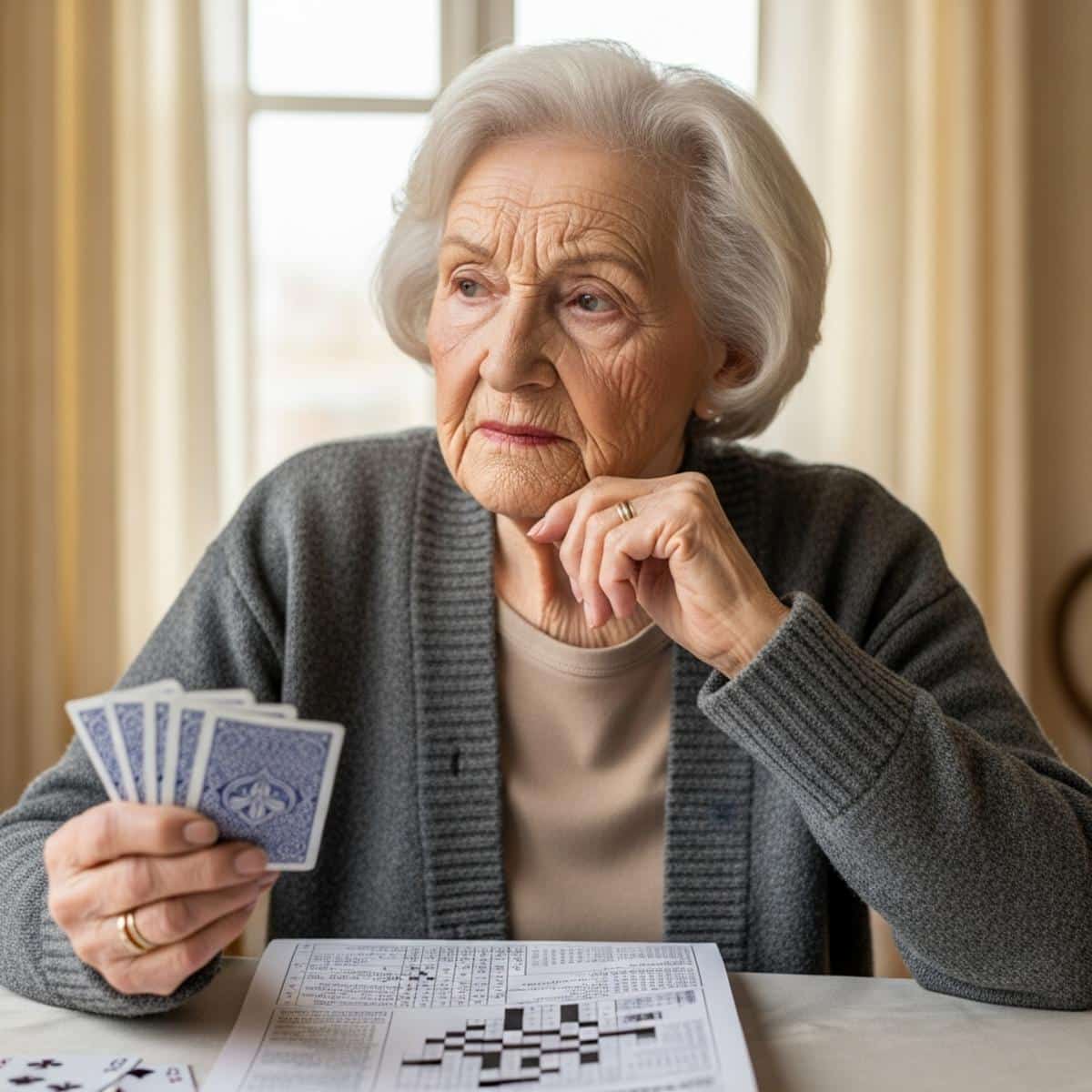
![Older woman bridge card table concentrated[1]](https://www.grayingwithgrace.com/wp-content/uploads/2026/01/older_woman_bridge_card_table_concentrated1-e1769685409148.jpg)
You do your crossword every morning. Coffee in hand, pencil ready, you work through the clues. You’re keeping your brain sharp, right?
That’s what most people think. And crosswords do help—they exercise your recall and keep you engaged. But neurologists have discovered something surprising: there’s a type of activity that works your brain in ways crosswords simply can’t.
The secret?
It’s not about harder puzzles or more obscure trivia. It’s about the kind of thinking these activities require—and the social connection they create. And you might find them more enjoyable than filling in boxes.

Brain-Healthy Card Games: Your Quick-Start Guide
Download your free Quick-Start Guide and discover which brain-healthy card games neurologists recommend, where to find players today, and the exact playing frequency that delivers measurable cognitive benefits—so you can strengthen your brain while actually enjoying yourself.
Why Card Games Beat Crosswords (And What Neurologists Actually Say)
Crosswords exercise what scientists call “crystallized intelligence”—your ability to recall information you already know. You remember that obscure word, dig up that historical fact, retrieve vocabulary from your mental filing cabinet.
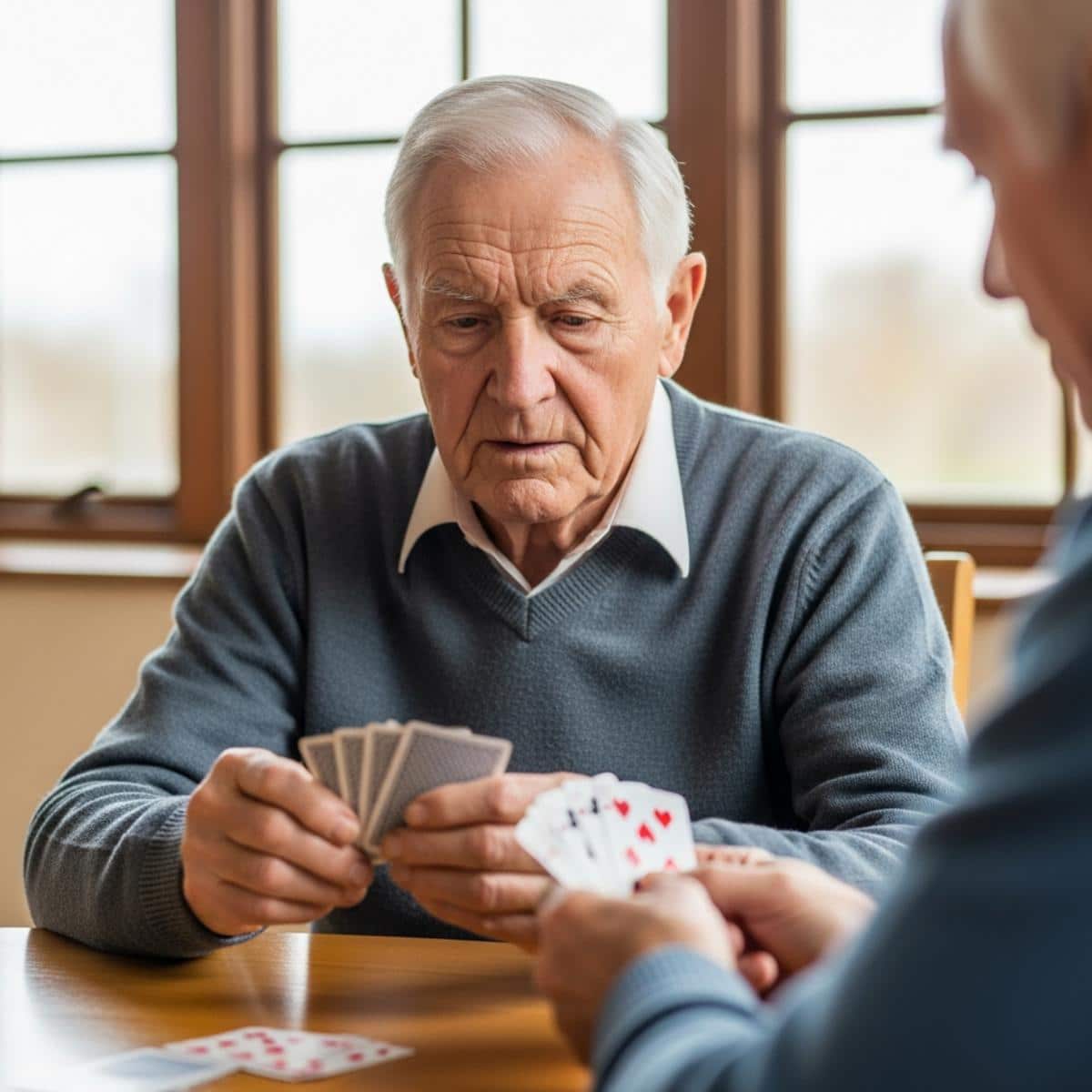
Card games work differently. They engage “fluid intelligence”—your ability to solve new problems in real time, adapt to changing situations, and make decisions with incomplete information.


Dr. Keith A. Josephs from Mayo Clinic has studied cognitive activities extensively. His research shows that games requiring strategic thinking, like Bridge, engage multiple brain systems simultaneously in ways solitary puzzles don’t.
The University of Wisconsin-Madison found that people who regularly play card and board games show greater brain volume in regions critical for memory and thinking skills. The difference? These games force your brain to process new information constantly, not just retrieve stored knowledge.
Think about it: When you play a card game, you’re tracking what’s been played, calculating odds, reading other players, adjusting your strategy, and making split-second decisions. Your brain processes all of this simultaneously while crosswords ask it to search your memory banks one clue at a time.
You’re not abandoning crosswords. You’re adding a more dynamic workout to your cognitive routine—one that exercises different mental muscles and prepares your brain for real-world decision-making.
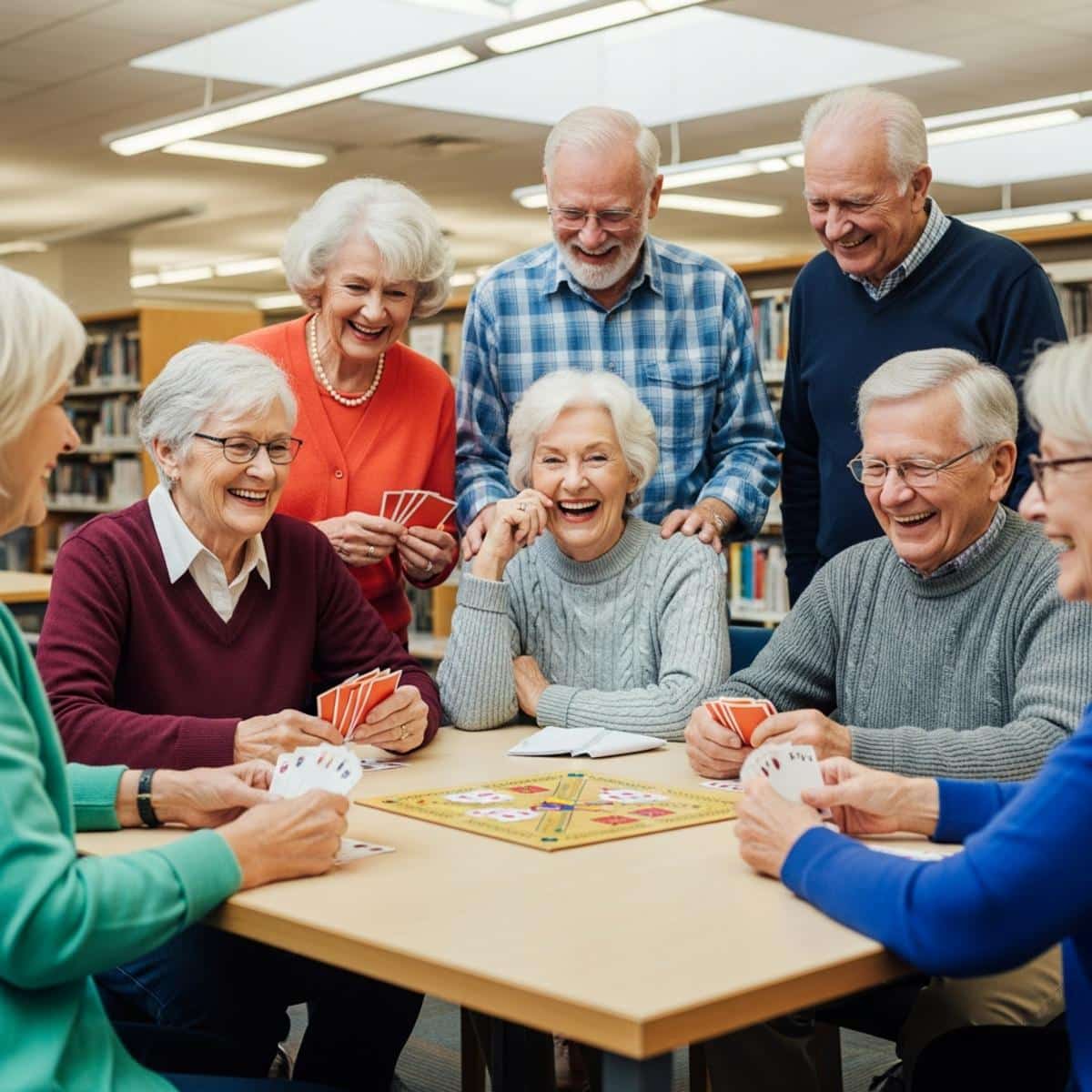
The Missing Ingredient: Social Cognition
Here’s what makes card games especially powerful: the social element isn’t just nice to have. It’s neurologically essential.
When you play cards with others, your brain activates “social cognition”—reading facial expressions, interpreting body language, anticipating others’ moves, communicating with partners. These are complex cognitive processes that solo puzzles never engage.
Research consistently shows that social engagement dramatically improves both cognitive performance and mood. Your brain evolved to be social. When you isolate cognitive work from social interaction, you miss half the workout.
Partnership games like Bridge add another layer. You’re not just playing your own hand—you’re coordinating with a partner, communicating through standardized signals, and working toward a shared goal. That requires perspective-taking, collaborative planning, and constant mental flexibility.
Compare completing a crossword alone at your kitchen table to sitting across from opponents at a card table, reading their expressions, adapting your strategy, celebrating a clever play with your partner. Both engage your mind, but only one exercises your social brain.
This matters especially as you age. Loneliness and isolation are genuine health risks for older adults. Card games combat both while strengthening cognitive function. You don’t need to be naturally outgoing to benefit—the game structure creates the social framework for you.
Ready to discover more innovative strategies for healthy, comfortable aging? Subscribe to our newsletter for expert-tested tips and product recommendations designed specifically for older adults.
The Games Neurologists Specifically Recommend
Not all card games deliver the same cognitive benefits. These four stand out:
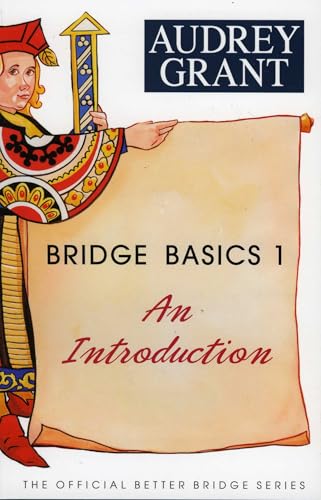
Bridge is the gold standard. Each hand requires you to remember cards played, visualize possible distributions, sequence your plays, coordinate with your partner, and adjust strategy based on opponents’ actions. You’re exercising memory, visualization, logical reasoning, and social coordination simultaneously.
Don’t worry about the complexity. Bridge is simple to learn at a basic level, but offers a lifetime of increasing depth. That progression keeps your brain challenged year after year.



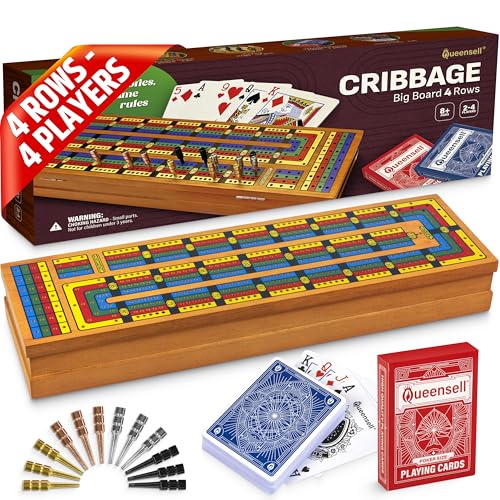
Cribbage sharpens mental math and pattern recognition. You’re constantly calculating points, planning sequences, and making decisions with limited information. The physical cribbage board adds a tactile element that can help anchor memory.



Pinochle combines trick-taking with complex scoring and team coordination. You’re tracking trump cards, communicating with your partner through bids and plays, and planning multiple tricks ahead. It’s particularly good for practicing the kind of multi-step planning that keeps your mind sharp for daily tasks.
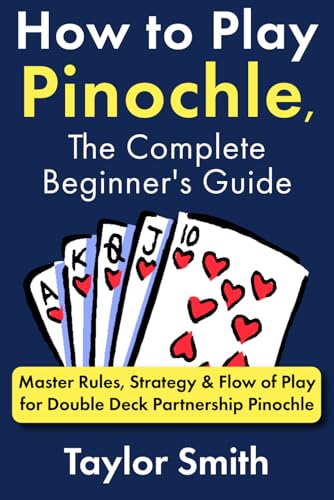
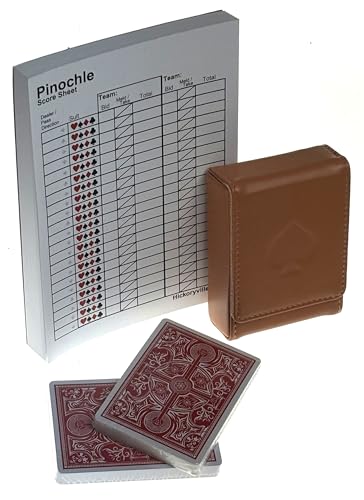


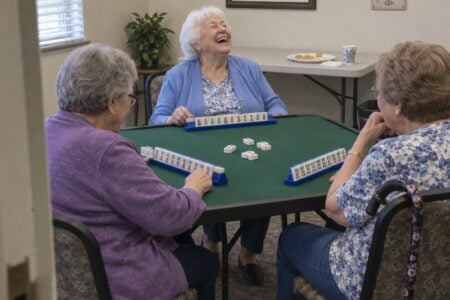
Rummikub (technically tiles, not cards) exercises pattern recognition and adaptive thinking. The constantly changing board means your strategy shifts with every turn. You’re planning moves, spotting patterns, and adjusting to new possibilities—exactly the kind of flexible thinking that declines with age if not exercised.
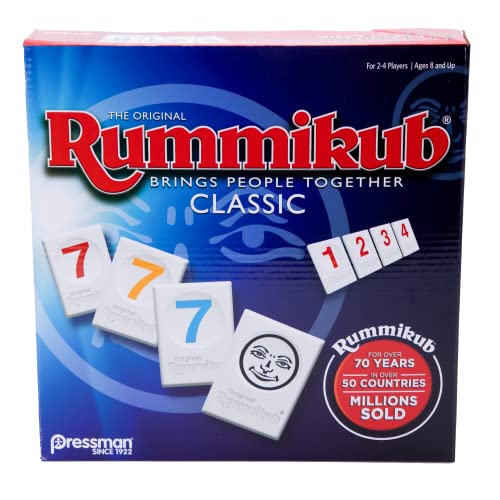
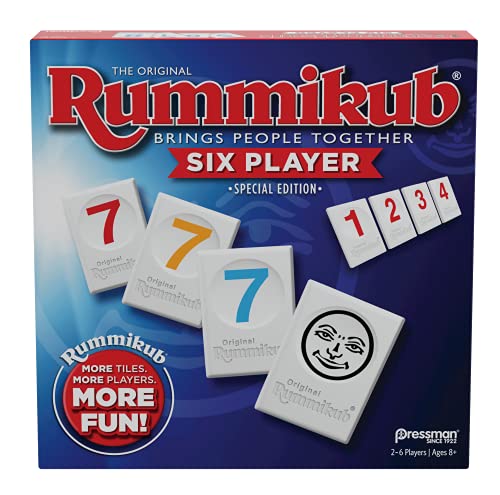
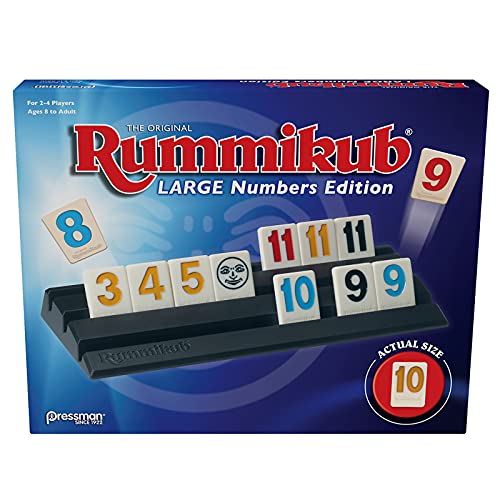


These games work because they engage multiple cognitive systems at once. You’re not just doing memory drills or math problems. You’re combining calculation, strategy, memory, pattern recognition, and social cognition in an integrated workout.
Start with whichever game sounds most appealing. The best brain exercise is the one you’ll actually do regularly, and enjoyment drives consistency.

How Often You Need to Play (And Why Consistency Matters)
Research points to a clear frequency: three times per week.
Studies show measurable cognitive benefits when people engage in challenging card games at least three times weekly. Play less often, and the effects diminish. Play more, and you see continued improvement.
But here’s the key—consistency matters more than marathon sessions. Three 90-minute games spread across the week strengthen your brain more effectively than one six-hour session.
Why? Your brain needs regular stimulation to build and maintain neural connections. Think of it like physical exercise—working out intensely once a week doesn’t build fitness the way consistent moderate exercise does.
The cumulative effect builds over months and years. People who maintain regular card games show slower cognitive decline and better preserve memory and reasoning skills as they age.


The sustainability advantage is real. You’re more likely to stick with an activity you genuinely enjoy. Card games with friends become an anchor in your weekly routine—Tuesday morning Bridge club, Thursday evening Cribbage, Saturday afternoon Pinochle. You show up because you want to see your friends and enjoy the game. The cognitive benefits come along for the ride.
You’re not scheduling brain training that happens to be social. You’re scheduling social time that happens to be excellent for your brain. That reframe makes all the difference in maintaining the habit long-term.
Brain-Healthy Card Games: Your Quick-Start Guide
Download your free Quick-Start Guide and discover which brain-healthy card games neurologists recommend, where to find players today, and the exact playing frequency that delivers measurable cognitive benefits—so you can strengthen your brain while actually enjoying yourself.
Where to Find Games and Players (Starting Today)
Getting started is easier than you think. You have both online and local options.
Free Online Platforms:
• BridgeBase Online offers free Bridge games 24/7 with players worldwide at every skill level. The platform teaches you as you play and matches you with appropriate partners and opponents.
• VIP Games hosts Cribbage, Pinochle, and other card games with clean interfaces designed for older adults. You can play casually or join tournaments.
• Trickster Cards provides simple, ad-free versions of classic card games with the option to play with friends remotely.
Online play offers convenience and lets you learn at your own pace without the pressure of in-person games while you’re still building skills. Some people find tablets with larger screens helpful for extended gaming sessions.
Local Options:
Your library probably hosts card game groups. Call and ask—many run weekly Bridge, Cribbage, or Pinochle clubs specifically for older adults learning the games.
Senior centers almost always have card games. Check your community center’s calendar or stop by to ask about scheduled games.
Meetup.com lists card game groups by location. Search for Bridge, Cribbage, or general card game groups in your area.
Local game stores often know about card clubs and can point you toward beginner-friendly groups.
Most groups welcome complete beginners. Experienced players typically enjoy teaching newcomers—it’s part of the culture of these games. You don’t need to know how to play before showing up. Just mention you’re new and want to learn.
The hybrid approach works well: learn basics online where you can practice without pressure, then join local groups for the full social benefit once you’re comfortable with basic rules.
Staying connected with others becomes increasingly important as you age, and card games create natural opportunities for regular social engagement.
Your Brain Craves This Kind of Challenge
Crosswords are valuable. Keep doing them if you enjoy them. But understand that they’re just one tool in your cognitive health toolkit—and not necessarily the most powerful one.
Card games offer something crosswords can’t: they combine genuine mental challenge with the social engagement your brain needs. They exercise fluid intelligence, not just recall. They prepare your mind for real-world decision-making, not just trivia retrieval. And they combat isolation while strengthening cognition.
Protecting your cognitive health doesn’t require isolated drill-work. It can be genuinely enjoyable social time that happens to be excellent for your brain.
Try one game this week. Download BridgeBase Online and play a few practice hands. Or call your library and ask about card game groups. Or invite neighbors over for an afternoon of Cribbage.
The best brain exercise is the one you’ll actually do. And this one might surprise you by being more fun than you expected.
What card games have you played? Are you interested in trying one of these? Share your experience in the comments—your insights might encourage someone else to take that first step.