![Older woman glow holder nighttime[1]](https://www.grayingwithgrace.com/wp-content/uploads/2026/02/older_woman_glow_holder_nighttime1-e1770642193342.jpg)
You reach for your glasses on the nightstand and hear that sickening clink as they hit the floor. Or worse—you fumble in the dark, knocking over your water glass while trying to locate them among the clutter. It's 2 AM, you need to use the bathroom, and you can't find your glasses to find your glasses.
This frustration happens twice every single day—bedtime and morning—and it's more than annoying. It's a design problem disguised as user error.
Here's the truth: your glasses aren't the problem. You're not careless. The issue is that most nightstand storage solutions weren't designed for the actual moment when you need your glasses—when you're half-awake, the lights are off, and you're reaching without looking.
There's a specific type of holder that solves all these problems at once. And it's simpler than most people think.
{VIDEO_PLACEHOLDER}
The Perfect Bedside Setup Checklist: Never Fumble for Your Glasses Again
Download this printable checklist to create a foolproof bedside setup that puts your glasses exactly where your hand reaches in complete darkness—eliminating 2 AM crashes and the daily frustration of fumbling in the dark.




Why Your Current System Keeps Failing
Let me walk you through the common approaches that seem logical but actually work against you.
The flat tray problem: Glasses slide around every time you set them down. In the dark, you have to pat around the entire surface to locate them. And they require precise placement or they'll end up on the floor.
The drawer solution: Out of sight means you forget them in the morning. Opening a drawer requires two hands and full attention. And it's completely dark inside, so you're fumbling blind anyway.
The 'just set them down' approach: Your glasses end up unstable, easy to knock off with a stray hand gesture. They get buried under books, your phone, tissues, or the TV remote. By morning, they're invisible in the clutter.
Picture this: You wake at 2 AM needing the bathroom. You reach for your nightstand in the dark. With a drawer, you're pulling, searching, hoping. With a cluttered table, you're knocking things over trying to find the right shape by touch.
This isn't about being careless. It's about physics and design working against you when you're at your most vulnerable—half-asleep and unable to see.
The question isn't 'Why do I keep losing my glasses?' It's 'Why hasn't anyone designed a holder for the way I actually use them?'
Someone has.
The Design Features That Actually Work
Effective bedside glasses holders share specific design elements. These aren't nice-to-haves—they're essential features that address how you actually retrieve glasses in low light while half-awake.
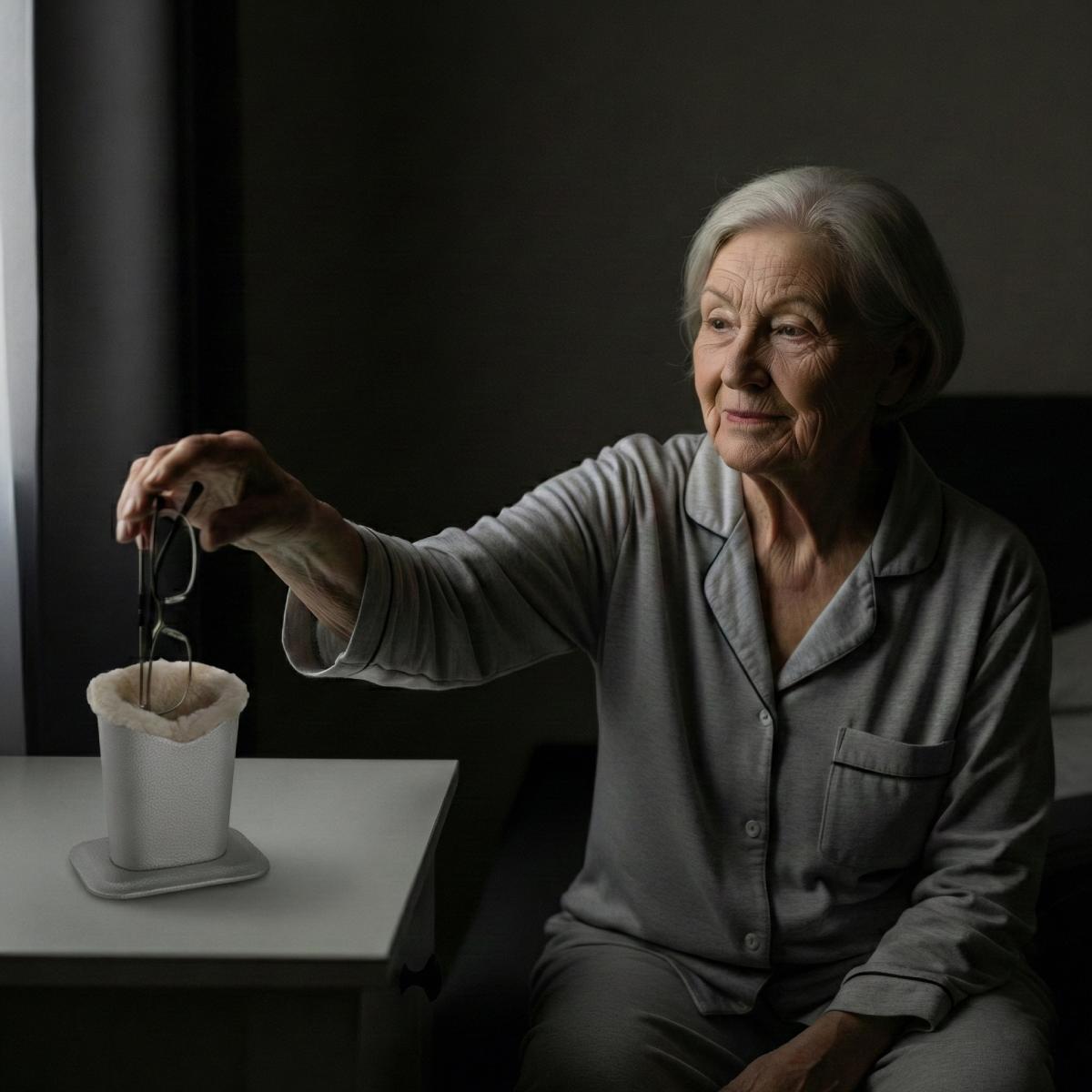
Elevated stand design (2-4 inches high): Your glasses sit visible at a glance, never getting buried under other items. This height keeps them in your line of sight even when sitting up in bed.
Open-front access: You can grab your glasses with one hand without looking. No lids to lift, no covers to slide, no fumbling with openings. Your hand goes directly to the frame.
Non-slip base: The holder itself doesn't slide when you reach for it. Ever knocked over an entire organizer while grabbing your glasses? A proper base prevents that.
Upright positioning: Glasses stand at an angle rather than lying flat. This makes them easier to grab by the temples without adjusting your grip or using both hands.
Adequate surface area: A stable base that won't tip when bumped. The holder should be wider than it is tall, with enough weight distribution to stay put.
Compare the motions: reaching across a cluttered table means your hand sweeps horizontally, knocking things aside, searching by touch. With a proper holder, your hand goes directly to one elevated spot, closes around the familiar frame position, and lifts straight up.
The right holder works with your half-awake state, not against it.
When shopping, measure the holder's base (should be at least 3 inches across), test the stability (tilt it—does it resist tipping?), and verify the opening faces forward when placed on your nightstand. If you're creating a safer bedroom environment overall, the glasses holder is your first line of defense against nighttime fumbling.
These specific measurements matter because they're based on how your arm naturally reaches in the dark.

The Glow-in-the-Dark Solution for Nighttime Visibility
Even with perfect design, there's still the darkness problem. You wake up, reach out, and have to locate the holder itself before you can grab your glasses.
Phosphorescent holders eliminate this entirely.
Here's how they work: The holder material absorbs light during the day—from your bedside lamp, window light, or overhead fixture. At night, it emits a soft glow for hours. No batteries, no plugs, no switches. Just passive charging from ambient light.
The 'beacon effect' means your glasses location is marked even in complete darkness. You know exactly where to reach without turning on a light or disturbing a sleeping partner.
This is particularly helpful for middle-of-the-night bathroom trips when you're disoriented and your eyes haven't adjusted. The gentle glow guides your hand directly to your glasses without fumbling or knocking things over.
Unlike a nightlight, the subtle glow doesn't disturb sleep. It's only bright enough to see when you're looking for it—not bright enough to keep you awake or light up the room.
Ready to discover more practical solutions for comfortable aging? Subscribe to our newsletter for expert-tested tips and product recommendations designed specifically for older adults.

When selecting a glow-in-the-dark holder, look for materials labeled 'photoluminescent' or 'phosphorescent'—these glow longer and brighter than standard 'glow-in-the-dark' plastics. Higher-quality versions will glow for 8-10 hours after just 10 minutes of light exposure.
Place your holder where it gets good light exposure during the day. If your nightstand is always in shadow, the glow won't be as effective. Near a lamp is ideal—the holder charges each time you turn on the light.
This isn't a gadget. It's a simple material choice that solves a real problem. The best part? You'll notice the benefit the very first night.

The Multi-Item Holder Strategy
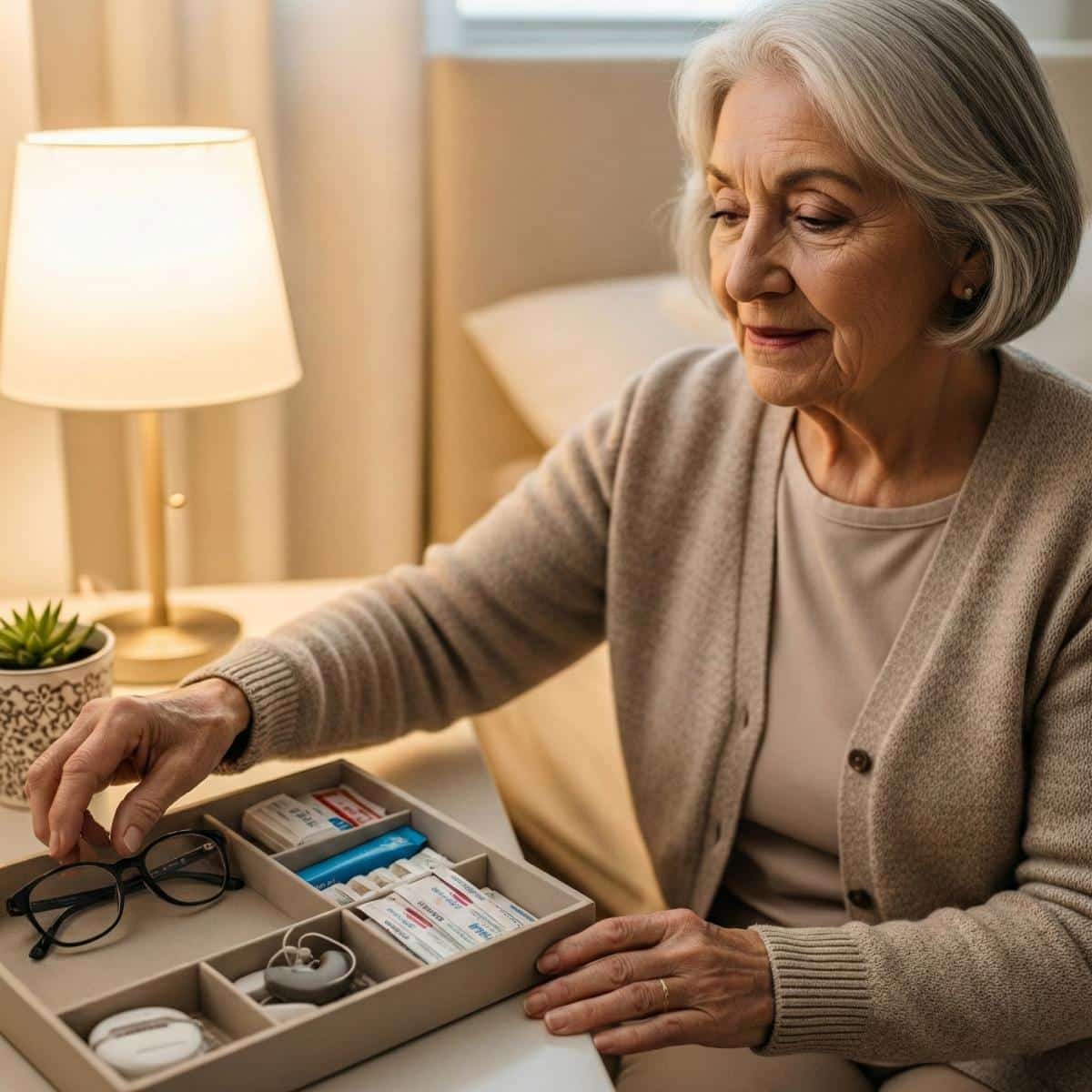
Your glasses aren't the only thing you need at night and first thing in the morning. Your phone, watch, hearing aids, keys, and medications all need to be within arm's reach.
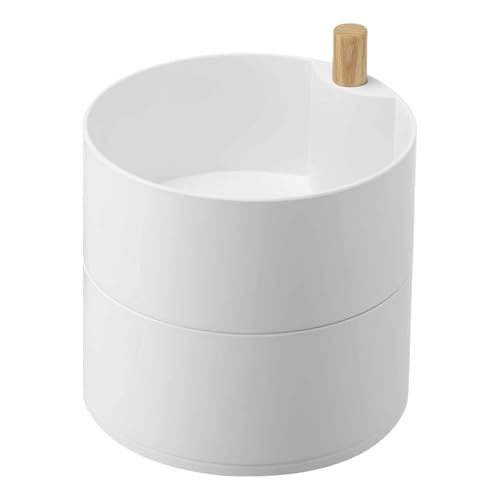
Combined holders with designated slots for multiple items solve a bigger problem than just glasses storage—they give everything a home in one predictable location.
Here's why this matters: When everything has its spot, you only need to remember one reaching location. Your hand goes to the same place every night, and you know exactly where each item sits within that space.
Individual compartments prevent items from tangling or scratching each other. Your watch band won't catch on your glasses frames. Your keys won't scratch your phone screen. Everything stays separated and protected.
This is the 'landing pad' concept—a specific home for everything you need at night and first thing in the morning. When you empty your pockets before bed, everything goes in its designated slot. When you wake up, you know exactly where to reach for each item.
Compare these two scenarios:
Scattered approach: Glasses somewhere on the table, phone charging across the room, watch on the dresser, hearing aids in the bathroom, keys in your pocket. Each morning requires a room-wide scavenger hunt.
Landing pad approach: Everything in one compact organizer. You reach to one spot for glasses. Six inches to the right for hearing aids. Your phone sits charged in its designated slot. Keys in their compartment. Everything ready, every time.
This isn't about being obsessively organized. It's about reducing cognitive load when you're tired or just waking up. Making your bedroom safer and more functional often starts with reducing nighttime confusion.
When choosing a multi-item holder, count how many things you regularly need at your bedside. Don't buy a six-compartment organizer if you only need three spots—excess empty spaces just collect clutter. The goal is right-sized organization, not maximum capacity.


The Positioning Strategy That Makes Everything Easier
The best glasses holder in the world doesn't help if it's positioned wrong. Where you place it matters as much as which one you choose.
Start with arm's reach positioning. Sit up in bed as you naturally would at night. Extend your arm toward your nightstand. Your glasses holder should be exactly where your hand naturally lands—no leaning, no stretching, no dangerous reaching.
Place the holder forward of your lamp base. If it sits behind the lamp, you'll knock the lamp every time you reach for your glasses in the dark. The holder should be the closest item to the edge where you sleep.
But not at the edge. Leave 2-3 inches between the holder and the table edge. This buffer zone prevents the holder from getting knocked off accidentally.
Use a stable surface area—not on top of stacked books, not on an unsteady pile of magazines. The holder needs a flat, stable foundation. If your nightstand has a drawer, place the holder on the top surface, not inside where you can't see it.
The 'same spot every time' rule builds muscle memory. When your glasses are always in the exact same location, your hand learns to reach there automatically. You don't have to think about it, even when you're half-asleep.
Table height relative to bed height affects ease of reach. Ideally, your nightstand should be level with your mattress or slightly higher—never lower. Reaching down requires you to lean over the edge of the bed, which is unstable and dangerous in the dark.
Try the 'sit up' test: While sitting normally in bed (not stretched out flat), can you reach your glasses holder comfortably? If you have to lean dangerously or stretch uncomfortably, reposition the holder closer.
If your nightstand is too far from the bed, consider repositioning furniture for better accessibility or adding a small bedside shelf that attaches to the bed frame itself.
This is smart design thinking applied to your own space. You're not rearranging to be fussy—you're optimizing the most-used reach path in your home.
The Perfect Bedside Setup Checklist: Never Fumble for Your Glasses Again
Download this printable checklist to create a foolproof bedside setup that puts your glasses exactly where your hand reaches in complete darkness—eliminating 2 AM crashes and the daily frustration of fumbling in the dark.

The Testing Period That Confirms It Works
Once you've selected a holder and positioned it strategically, give yourself a two-week testing period to confirm the system works.
For the first three nights, turn off your bedside lamp and practice reaching for your glasses in the dark. Do this while you're still awake and alert, so you're training your muscle memory safely. Your hand should find the holder immediately and extract your glasses smoothly.
If you're fumbling or missing on the first reach, adjust the position slightly. Sometimes moving the holder just two inches forward or back makes all the difference.
Pay attention to morning retrieval too. Do you instinctively reach to the right spot when you first wake up? Or do you have to think about where you put your glasses?
The goal is automatic retrieval—your hand knows where to go without conscious thought. This typically takes 5-7 days of consistent use to develop.
If you find yourself still knocking things over or searching by touch after two weeks, one of three things is happening: the holder design isn't right for your space, the position needs adjustment, or you need a glow-in-the-dark version for better visibility.
Don't settle for 'good enough.' This is a twice-daily action that affects your independence and safety. It should work perfectly, every single time.
Many people find that improving small details in their bedroom setup creates a ripple effect—once the glasses are handled, they notice other inefficiencies they can fix.
Making the Change This Week
Solving the bedside glasses problem isn't about being more careful or trying harder. It's about choosing the right tool and positioning it strategically.
You now know the five essential design features that make a holder actually work: elevated stand, open-front access, non-slip base, upright positioning, and adequate surface area. You understand why phosphorescent materials solve the darkness problem. And you know exactly how to position your holder for automatic, effortless retrieval.
This small change eliminates a twice-daily frustration. It removes the moment of panic when you can't find your glasses to find your glasses. It prevents the embarrassing crashes and fumbling in the dark.
The investment is minimal—most quality holders cost less than a single restaurant meal. The benefit is immediate and permanent.
Here's your action plan for this week:
First, evaluate your current bedside setup. Which design flaw is causing your problem? Scattered placement, inaccessible drawer, or cluttered flat surface?
Second, measure your arm's reach from sitting position in bed. Mark the spot where a holder should sit.
Third, decide if you need a single-item glasses holder or a multi-compartment organizer. Count how many items you regularly need at night.
Fourth, consider whether a glow-in-the-dark version would benefit your specific situation. Do you wake frequently at night? Is your bedroom very dark?
Fifth, order the holder or pick one up this week. Don't wait until the next time you knock your glasses onto the floor.
The people who make this change report the same thing: 'I can't believe I put up with the old way for so long.' The frustration becomes so normal you forget it's solvable.
It is solvable. You just solved it.
Have you found a glasses holder that works perfectly for your setup? Or are you still dealing with the twice-daily frustration? Share your experience in the comments—your solution might help someone else who's searching for the right answer.


![Keep older woman walking lit bedroom pathway night lights[1]](https://www.grayingwithgrace.com/wp-content/uploads/2026/05/KEEP-older_woman_walking_lit_bedroom_pathway_night_lights1-e1779139524852-450x300.jpg)