Sinocare Blood Pressure Monitor Review: Will It Help You?
Nearly half of American adults have high blood pressure — and most of them are managing it between doctor visits with nothing but guesswork and a vague sense of worry.
Sound familiar? Whether you are tracking your own numbers or keeping an eye on an aging parent, you need a home blood pressure monitor you can actually trust. Not one that gives you wildly different readings every time. Not one so complicated it gathers dust in a drawer.
I am Scott Grant, a Certified Senior Advisor (CSA) and Senior Home Safety Specialist (SHSS) at Graying With Grace. I personally evaluated the Sinocare Upper Arm Blood Pressure Monitor — got it out of the box, set it up myself, took multiple readings on camera, and put its features through their paces. What I found surprised me in a few good ways.
In this review, I will walk you through what this monitor does well, where it falls a little short, and whether it is the right fit for your situation. There is a lot to cover, so let us get into it.


Quick Takeaways
- Solves: Unreliable home readings, complicated device interfaces, and juggling shared monitors between family members
- Best for: Older adults managing hypertension, caregivers monitoring aging parents, and couples who both need independent tracking
- Worth it? Yes — for most home users who want accuracy without a learning curve
- Best senior feature: One-button operation with a large, color-coded display anyone can read at a glance
- Biggest limitation: The charging cable is not included, though most homes already have a USB-C cable on hand
How This Could Help You
Imagine this: it is 7 AM, you have just had your coffee, and in about 90 seconds you know exactly where your blood pressure stands — without driving anywhere, waiting in a waiting room, or asking anyone for help. That is the daily reality the Sinocare Upper Arm Blood Pressure Monitor is designed to create.
For older adults living independently, that kind of confidence is genuinely life-changing. You are not waiting until your next appointment to find out if something has been creeping up. You are catching trends early and walking into your doctor’s office with weeks of real data instead of a shrug.
Are you a caregiver living across town from an aging parent? This monitor gives your parent a way to check in on their own health every morning without calling you in a panic. They check, they see the color-coded result, they know whether to call the doctor — all on their own.
The dual-user mode is a quiet hero here. If you and your spouse both need to track blood pressure, you each get your own history, your own 99-reading log, completely separate. No mixing up whose numbers are whose. No arguments. No confusion.
Important Details You Should Know
The monitor itself is compact and lightweight — easy to store in a nightstand drawer or medicine cabinet. It does not require a dedicated shelf or special storage setup.
The cuff adjusts from 8.6 inches to 16.5 inches around the upper arm. As I mentioned in the video, that range covers children through plus-size adults, which means one device genuinely works for the whole household.
The display is 3.6 inches — noticeably larger than many competitors. Numbers are bold and clear, and the color-coding (green for normal, yellow for elevated, red for high) means you do not need to memorize what every combination of numbers means.
Power options are dual: four AAA batteries (included) or a USB-C charging cable (not included). The device is solidly built with a clean, matte black finish that looks modern without being intimidating.
Getting Started
When I opened the box in the video, here is what was inside: the monitor unit, the blood pressure cuff, four AAA batteries, and the owner’s manual. That is it — straightforward and complete (minus the charging cable).
As I demonstrated in the video, setup takes about two minutes. Flip the device over, push open the battery door, drop in the four AAA batteries, and replace the cover. That is the hardest part of the whole process.
You will want to set the date and time if you plan to use the memory and trend-tracking features. As I showed in the video, you press the memory button to cycle through the settings and adjust the year, month, day, and time. It took me about 60 seconds, even when I accidentally cycled past a setting and had to come back around.
If you skip the date and time setup entirely, the device still works perfectly for taking readings — you just will not have time-stamped memory entries. For most casual users, that is fine.
Ready to discover more innovative strategies for healthy, comfortable aging? Subscribe to our newsletter for expert-tested tips and product recommendations designed specifically for older adults.
Features That Matter to You
Let me be direct about what actually matters for daily use — because spec sheets can make anything sound impressive. The Sinocare Upper Arm Blood Pressure Monitor has a few features that genuinely earn their keep.
One-Button Operation
There is exactly one button you press to take a reading. No menus to navigate, no modes to scroll through, no calibration ritual. Press the button, sit still, and the device does everything else.
For anyone with technology anxiety or memory concerns, this is not a small thing. It is the difference between a device that gets used every day and one that gets abandoned after a week.
Posture Detection
This is the feature that genuinely impressed me during my evaluation. When I evaluated this product, I noticed that the monitor checks cuff position as it inflates and will flag you if something is off before it records a reading.
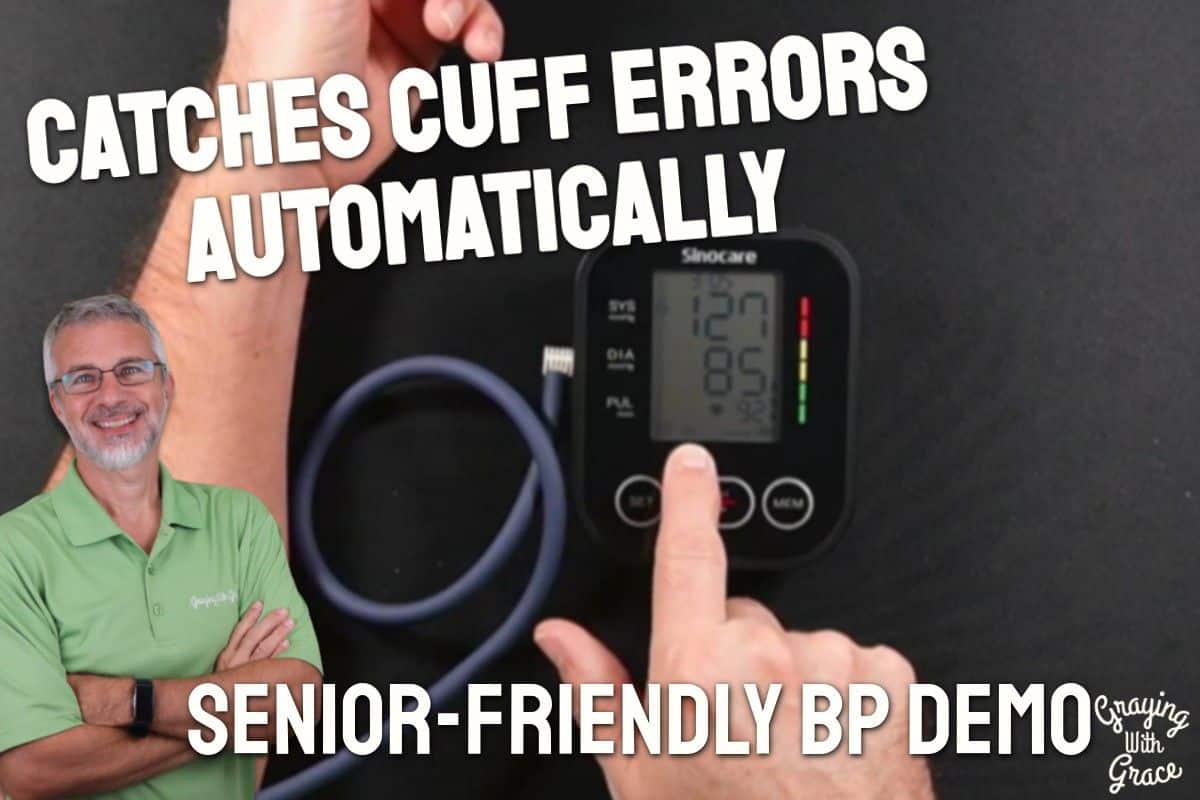
I deliberately simulated movement during one test reading in the video, and the device detected it, flagged the movement on the display, and recalculated. The reading it gave me after that adjustment — 127 over 85 — was closer to my normal than the first attempt when I had been talking during the measurement.
Incorrect posture is the number one reason home blood pressure readings come out artificially high. This feature catches that before it becomes your permanent record.
Irregular Heartbeat Alert
The device will flag a potential irregular heartbeat during a reading and display an alert symbol. This is not a diagnosis — I want to be very clear about that. But it is a prompt to mention something to your doctor that you might otherwise never notice.
Some verified buyers have shared that this alert led them to schedule a cardiology appointment, where an actual arrhythmia was confirmed. That kind of early awareness has real value.
Color-Coded Classification
You get both the number and a color-coded indicator showing whether your reading falls in the normal, elevated, or high range. For older adults who do not want to memorize blood pressure categories, this immediate visual feedback is genuinely reassuring.
Real Life Experience
In the video, you can see that my first reading came back at 133 over 85 with a slightly elevated pulse — which I immediately acknowledged was because I had been talking during the measurement. That is exactly the kind of real-world imperfection that makes this review useful.
When I settled in, stayed still, and followed proper technique on the third attempt, I got 130 over 87 — much more consistent with my normal range. The device was responding accurately to user behavior, which is exactly what you want.
As I demonstrated in the video, the memory function is intuitive. You press the memory button once to see your average reading, then keep pressing to scroll through individual stored readings with their date and time stamps. No complicated menu diving. No tech expertise required.
Daily maintenance is minimal. Wipe the cuff down with a slightly damp cloth if needed, store it in the included storage arrangement, and keep it away from extreme temperatures. There are no filters to replace, no consumables to reorder, and no software to update.
The AAA batteries that come in the box should last several months under normal use. If you charge via USB-C at home, battery drain is not a concern at all. I found the dual power option genuinely practical — charge it on your nightstand all week, then toss four batteries in when you travel.
Will You Be Able to Use It?
Most older adults will be able to use this monitor completely independently. The one-button design removes virtually every barrier that makes other monitors frustrating.
Applying the cuff does require some manual dexterity — you need to wrap it around your upper arm and secure the velcro closure. As I showed in the video, the cuff has a printed guide right on it showing proper placement, which is a thoughtful detail. If arthritis or limited grip strength makes one-handed cuffing difficult, a family member or caregiver can help with that step while the person takes the reading independently.
Vision-impaired users will appreciate the oversized display. In the video, you can see that the numbers are bold enough to read from across a room.
For those with significant memory challenges, the one-button operation is an advantage — but a caregiver may want to help establish the routine and verify the user is selecting the correct user profile (1 or 2) before starting.
Important Considerations
This monitor is not the right choice for someone who needs continuous or clinical-grade monitoring under a physician’s close supervision. For that level of care, your doctor will prescribe or recommend a specific medical device.
The irregular heartbeat alert is a helpful flag, not a diagnosis. If you are prone to health anxiety, it is worth having a conversation with your doctor in advance so you know how to respond calmly if the alert appears, rather than panicking mid-reading.
Blood pressure naturally fluctuates throughout the day — by as much as 10 to 20 points depending on stress, caffeine, activity, and time of day. One elevated reading is not cause for alarm. Always track trends over time and share patterns with your physician.
If you have an arm circumference outside the 8.6 to 16.5 inch range, this cuff will not fit correctly, and an incorrectly sized cuff will give inaccurate readings. Measure your upper arm circumference at the midpoint before purchasing if you have any concerns about fit.
Always consult with your doctor or a qualified healthcare provider before making health-related product decisions, especially if you are managing a diagnosed cardiovascular condition.
Help When You Need It
Sinocare is an established health device brand with a track record in the home monitoring space. Customer support is available through Amazon’s standard channels, including their return and replacement process.
The device comes with a standard manufacturer warranty — check the current listing for specific terms, as these can be updated. If you purchase through Amazon, their buyer protection policies also apply.
Replacement cuffs are available if the original cuff wears out over time. The USB-C port is a universal standard, which means cables and accessories are widely available and inexpensive.
Understanding the Cost
The Sinocare Upper Arm Blood Pressure Monitor sits comfortably in the mid-range of the home blood pressure monitor market. You are getting clinical-comparable accuracy (plus or minus 3 mmHg) at a price point well below what dedicated medical-grade devices typically cost.
When you factor in the cost of a single doctor’s office visit just for a blood pressure check, this monitor pays for itself quickly. Monthly monitoring at home versus quarterly office co-pays is not a difficult calculation.
If budget is a primary concern, there are less expensive single-user monitors without posture detection or dual-user memory. If you need those features — and for most families, you do — this monitor represents strong value for what it delivers.
Making It Work for You
Take your reading at the same time each day — ideally in the morning before coffee and medication, or in the evening before bed. Consistency in timing gives you the most meaningful trend data.
Before every reading: sit down, rest quietly for five minutes, feet flat on the floor, back supported, arm resting at heart level. No talking, no phone scrolling. This is the routine your doctor follows, and it is the routine that makes your home readings trustworthy.
If the posture alert fires, do not ignore it. Readjust your position, wait 60 seconds, and retake the reading. As I showed in the video, the difference between a positioned reading and a poorly positioned one can be significant.
For couples using the dual-user feature: decide who is User 1 and who is User 2, and put a small label on the device if needed. It takes two seconds to select the right profile before starting, and it keeps your health histories clean and separate.
If you are tracking for a doctor’s appointment, use the memory scroll function to review your readings together. Bring the device to your appointment so your physician can see the stored history directly — or simply photograph the screen over several weeks for a quick reference.
Our Recommendation
I am comfortable recommending the Sinocare Upper Arm Blood Pressure Monitor for most older adults and their caregivers. It earns that recommendation on the strength of three things: genuine ease of use, trustworthy accuracy, and features that actually address real daily problems.
It is the right choice if you are managing hypertension at home, sharing a monitor with a spouse or family member, or looking for a device an aging parent can use independently without help or coaching.
It is probably not the right choice if you only need a basic, bare-bones monitor for occasional spot checks and do not need memory storage, posture detection, or dual-user capability. A simpler, less expensive device would serve that narrow use case fine.
But for the vast majority of families I work with — where cardiovascular health is an ongoing conversation, not a one-time event — this monitor is a practical, reliable, and genuinely senior-friendly choice.
Where to Get It
You can find the Sinocare Upper Arm Blood Pressure Monitor on Amazon — check the link for current pricing and availability. Prices can change, and Amazon occasionally runs promotions, so it is worth checking before you buy.
Conclusion
Managing blood pressure at home does not have to be complicated, frustrating, or unreliable. The right device makes it a two-minute habit that quietly protects your health every single day.
The Sinocare monitor delivers clinical-grade accuracy, one-button simplicity, and smart features like posture detection and irregular heartbeat alerts — all wrapped in a package that genuinely works for older adults and their families.
If you have questions about whether this monitor is the right fit for your specific situation, drop them in the comments below. I read every single one, and I am happy to help you figure out the best option for your needs.