Is Forgetting a Medication Dose Really That Dangerous?
Here is a number that stopped me in my tracks: over 125,000 Americans die every year because of medication non-compliance. Not from the diseases themselves, but from simply missing doses or taking the wrong pill at the wrong time.
If you or someone you love manages multiple prescriptions daily, you already know how complicated that juggling act can be. A weekly pill organizer helps, but it still depends entirely on memory, good eyesight, and steady hands.
I am Scott Grant, a Certified Senior Advisor (CSA) and Senior Home Safety Specialist (SHSS) at Graying With Grace. VEXA sent me the VitaMate Pro 21 to evaluate hands-on, and I put it through its paces so you can make a confident, informed decision.
In this review, I will walk you through how it actually works, who it helps most, what its real limitations are, and whether the investment makes sense for your situation.


Quick Takeaways
- Solves: Missed doses, wrong medication confusion, caregiver anxiety, and difficulty opening pill containers with arthritic hands
- Best for: Older adults managing 3 or more daily medications, people with mild cognitive impairment, and long-distance caregivers
- Worth it? Yes, for complex medication routines where a missed dose carries real health consequences
- Best senior feature: The rising pod that physically lifts your dose up to you, no digging required
- Biggest limitation: Needs Wi-Fi and a smartphone for the full caregiver monitoring experience
How This Could Help You
Imagine it is 8:00 AM. You are still in your robe, coffee in hand. Without any action on your part, the VEXA VitaMate Pro 21 Smart Pill Dispenser quietly rotates your morning dose into position, announces “It is time for your medications,” flashes its LED, and sends a notification to your phone.
You press one button. The compartment rises up toward you. You grab your pills, take them, and press the button again. Done.
No squinting at a pill organizer trying to remember if you already took Tuesday morning. No rattling through a bag of bottles. No phone call from a worried daughter asking “Did you take your meds?”
For someone managing diabetes, heart disease, or arthritis alongside a handful of daily prescriptions, that level of automation is genuinely life-changing. It removes the cognitive and physical burden from a task that simply cannot afford to go wrong.
Caregivers benefit enormously too. If your mom forgets her noon dose or someone tampers with the device, you get an instant push notification on your phone, wherever you are in the world. That is real peace of mind, not just a hopeful assumption.
Important Details You Should Know
The VitaMate Pro 21 sits comfortably on a kitchen counter, nightstand, or dresser. It is compact and modern-looking, not the kind of clunky medical device that makes a room feel like a hospital room.
It holds 21 individual compartments organized on a rotating carousel. The number of days between refills depends on how many doses you take per day. Take one dose daily and you get 21 days. Three doses daily gives you a full week before you need to reload.
The device is designed for home use. It is not built for travel, so if you are frequently on the road, you will want a separate travel solution for those trips.
The 2.36-inch HD LCD screen is genuinely easy to read. It displays the current time, which dose number you are on, your next scheduled dose, battery level, and Wi-Fi signal strength all at once.
Getting Started
When you open the box, you will find the main unit, a rechargeable battery, a charging cable, a charging block, the removable medicine containers organized on a color-coded ring system, key rings with a lock key, and the owner’s manual.
As I demonstrated in the video, the very first steps are flipping the unit over, using the included key to unlock the lid, and inserting the battery. It took me about two minutes from opening the box to having the device powered on.
Next, you download the Smart Life app from your app store, create a free account, and pair the device by holding the wheel button for three seconds until it announces “AP mode.” When I evaluated this product, I noticed that the app automatically synced the correct time from my phone the moment it connected, which saved me a manual step I was expecting to take.
Loading the medication compartments does require a little planning. You need to decide how many times per day the person will take medications, because that determines which color-coded ring to use. The rings are labeled 1 through 8 for up to 8 doses per day, and the red-colored sections on higher-frequency rings should always be left empty. The device will not trigger those slots.
From box to fully loaded and ready to dispense, expect about five minutes. That is a genuinely quick setup for a device this capable.
Ready to discover more innovative strategies for healthy, comfortable aging? Subscribe to our newsletter for expert-tested tips and product recommendations designed specifically for older adults.
Features That Matter to You
Let me talk about the features that actually make a difference in daily life, not just the spec sheet.
The rising pod feature on the VEXA VitaMate Pro 21 is the one that consistently impressed me the most during my evaluation. When the scheduled time arrives, you press the button and the entire compartment physically lifts up toward you. No digging your fingers into a small slot, no pinching, no grip strength required. For anyone managing arthritis or reduced hand dexterity, this is a genuine quality-of-life upgrade.
The triple-alert system is also worth highlighting because it works independently of your phone. The device delivers a loud verbal announcement, flashes its LED light, and sends a push notification to the app simultaneously. In the video, you can see that the announcement is audible from across a room and the LED flash is visible even in a well-lit space.
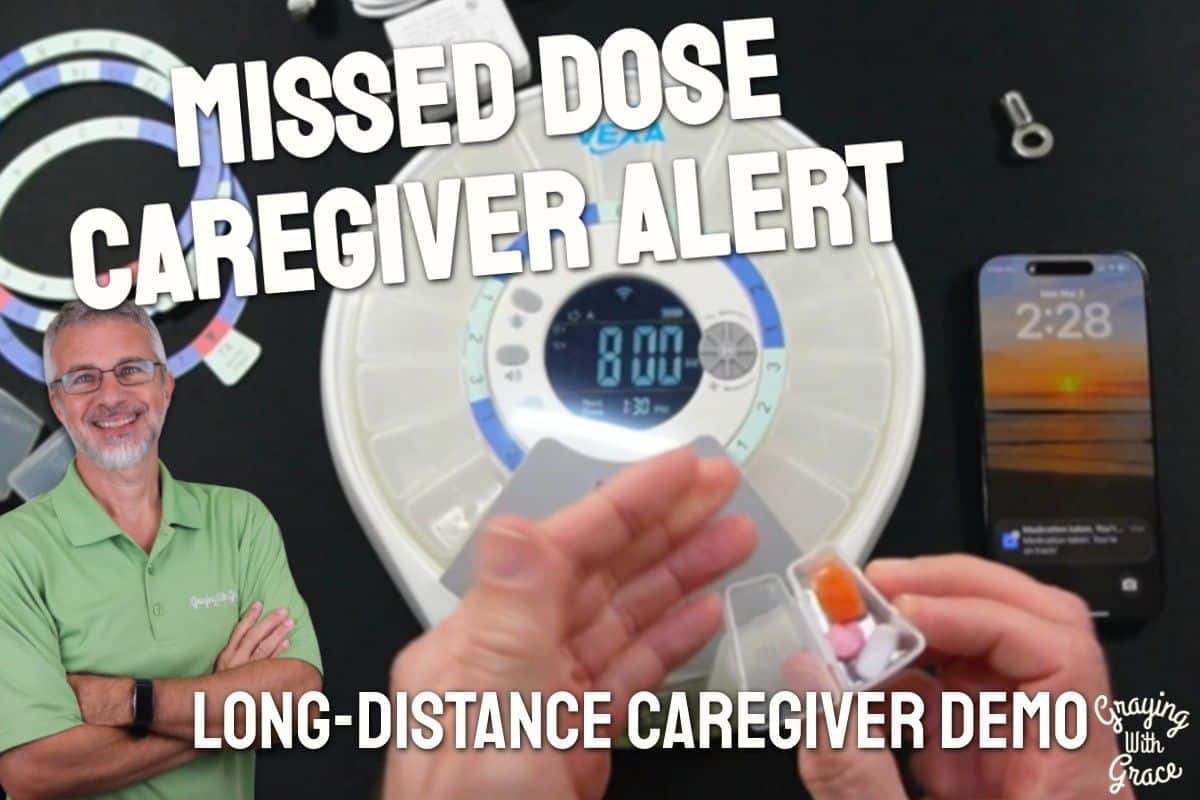
Missed doses do not just disappear. You can set the alert window between 5 and 30 minutes in the app. If the compartment has not been cleared by the end of that window, a missed-dose notification goes out to every family member connected to the device. That built-in accountability is something a basic pill organizer simply cannot offer.
The early pickup feature is a thoughtful touch. As I showed in the video, if you have an appointment at 8:00 PM but your next dose is not scheduled until 8:00 PM, you can authorize an early dispensing right from the app. The device then advances to that dose and dispenses it early, then resets for the next scheduled time.
The app also tracks refill status, lets you change the volume and ringtone remotely, adjust the early pickup window, and log individual medications by name for more detailed compliance tracking. You can even run the device completely without the app by setting the time and alarms manually on the unit itself, using the buttons and dial on the front panel.
Real Life Experience
Using this device day-to-day is remarkably low-friction once the initial setup is complete. The morning routine I described earlier becomes genuinely automatic within a few days. The device handles the remembering so the person using it does not have to.
As I demonstrated in the video, I set up a simulated three-times-per-day schedule and watched the full cycle play out. At exactly 8:00 AM, the carousel rotated, the verbal announcement played, the LED flashed, and a notification landed on my phone within seconds. The experience felt polished, not clunky.
When I evaluated this product, I noticed that the clear compartment lids make it easy for a caregiver or family member to visually confirm whether a dose was actually dispensed. When I deliberately skipped the 1:30 PM dose in my demonstration, I could later open the lid and see that compartment still had its pills sitting inside. That kind of visual confirmation matters when you are caring for someone who might not accurately report whether they took their medication.
Charging is simple. A standard USB cable plugs into the back of the unit, and the battery level is always visible on the LCD screen. The device also has a battery backup system, so alarms will continue to fire even during a brief power interruption.
Cleaning is straightforward. The individual compartments can be removed for cleaning, and because the lids are clear plastic, you can spot any residue without having to open each one.
In the video, you can see that the compartment lids are not difficult to open. I used my thumb without a gripping or pinching motion, which is meaningful for anyone with joint stiffness or reduced hand strength.
Will You Be Able to Use It?
If you can press a single button, you can use this device independently. The core interaction on dose day is literally one button press to raise the pod, retrieve your pills, and one button press to reset.
The app requires a smartphone or tablet and a basic comfort level with downloading an app and entering a Wi-Fi password. If that sounds intimidating, it is worth knowing that the device functions perfectly as a standalone unit without the app. You can set alarms manually on the device itself.
For someone with mild cognitive impairment, this device shines. The automatic rotation means there is no guessing about which compartment is next. The loud verbal announcement and flashing light are hard to miss. And the caregiver alert system creates a safety net for moments when memory fails.
For someone with moderate to advanced dementia, the device may still be useful but will require caregiver-assisted operation. A person in that stage may not respond appropriately to the alerts without prompting.
Important Considerations
This device is not a substitute for professional medication management for people with advanced cognitive decline. If someone is at the stage where they could take medications incorrectly or unsafely even with reminders, a locked dispenser managed entirely by a caregiver or nurse is the more appropriate solution.
The lock on the device does provide physical medication security. As long as the key is stored separately, someone would have to physically break the unit to access the medications. The app also sends tamper alerts if the device is accessed unexpectedly.
The device requires Wi-Fi for caregiver monitoring and app control. If the person using it does not have home Wi-Fi, the alerts and remote features will not work. The dispensing and alarm functions still operate, but the family connectivity piece is lost.
It is also worth knowing that the 21-compartment capacity sounds generous, but if you are taking medications six or seven times daily, that reduces the refill interval to just three days. The more frequently medications are taken, the more often the device needs to be reloaded.
Always consult with your doctor or pharmacist before changing how you manage your medications, and discuss whether an automatic pill dispenser is appropriate for your specific health situation.
Help When You Need It
The VitaMate Pro 21 comes with a one-year warranty that covers mechanical failures, including the rising pod mechanism. If something goes wrong, VEXA offers U.S.-based customer support by both phone and email.
The package includes both a quick-start guide and a full professional manual, so whether you want to get up and running in five minutes or reference detailed technical instructions, both options are there.
The Tuya-powered cloud infrastructure backing the app is enterprise-grade, which means connectivity issues are less likely than with smaller or generic platforms. CCPA compliance also means your health data is protected and not shared with third parties.
Understanding the Cost
The VEXA VitaMate Pro 21 Smart Pill Dispenser is significantly more expensive than a basic seven-day pill organizer from a pharmacy. That comparison, though, is a bit like comparing a deadbolt lock to a rubber doorstop. They are not really in the same category.
The relevant comparison is to other smart pill dispensers, where the VitaMate Pro 21 holds its own through its 21-compartment capacity, dedicated app, rising pods, and independent triple-alert system. Many competing devices offer fewer compartments, rely on generic app platforms loaded with ads, or lack the caregiver alert infrastructure this device provides.
Think of the cost against the alternative. One medication-related emergency room visit or hospitalization routinely costs thousands of dollars and far more in stress, recovery time, and disrupted independence. If this device prevents even one of those events, the math is straightforward.
Some HSA and FSA accounts may cover automatic pill dispensers. It is worth checking with your plan administrator before purchasing.
Making It Work for You
Place the device somewhere highly visible and easily accessible, like a kitchen counter near where you make morning coffee or on a nightstand. Out of sight often means out of mind, even with alerts firing.
Have a caregiver or family member help with the initial loading, especially the first time. Once you understand the color-coded ring system, reloading becomes quick and intuitive. Many families have a caregiver come in once a week specifically to reload and verify the device.
Make sure to keep the lock key in a consistent, secure location that the primary caregiver knows about but is not easily accessible to the person being monitored. A small hook inside a cabinet works well.
Turn on all notifications in the Smart Life app right from the start. You want missed-dose alerts arriving instantly, not sitting in a silenced notification queue. Test the alert system during setup so you know exactly how it sounds and looks before it matters.
If the device will be used by someone who tends to become confused by technology, consider keeping the front door panel closed at all times except during dose retrieval. This reduces the chance of accidental button presses that could disrupt the schedule.
Our Recommendation
The VEXA VitaMate Pro 21 earns a strong recommendation from me, with one important caveat: it is genuinely excellent for the right person, and it is not the right tool for everyone.
If you or someone you care for manages three or more daily medications, has dealt with missed doses, struggles with arthritis or limited grip strength, or if you are a long-distance caregiver who needs reliable remote monitoring, this device delivers real, meaningful value.
It is also a strong fit for older adults living alone who want to maintain their independence without relying on daily phone check-ins from family. The automatic dispensing and triple-alert system create a safety net that allows for genuine autonomy.
If your medication routine is simple, just one pill once a day with a good memory and steady hands, a smart dispenser at this level may be more than you need. A simpler reminder app or a basic organizer might serve you just as well.
For families where medication compliance is a genuine daily concern, though, I have not seen a more complete home-use solution at this price point. The rising pods, the independent alarms, the family alert system, and the 21-compartment capacity together make a compelling case.
Where to Get It
You can check current pricing and availability for the VEXA VitaMate Pro 21 Smart Pill Dispenser on Amazon. Prices can change, so clicking through will always show you the most current offer, including any available discounts or bundles.
Let’s Wrap This Up
Managing multiple medications every day is genuinely hard work, and the consequences of getting it wrong are serious. The VEXA VitaMate Pro 21 takes most of that burden off your shoulders with smart automation, accessible design, and a caregiver alert system that actually works.
If you watched the video and found yourself thinking “that would really help,” trust that instinct. It probably would.
Have questions about whether this device is right for your specific situation? Drop them in the comments below. I read every one and am happy to help you think it through.