![Older woman walker hallway basket[1]](https://www.grayingwithgrace.com/wp-content/uploads/2026/02/older_woman_walker_hallway_basket1-e1770641082148.png)
You’ve checked your coat pockets three times. You’ve scanned the coffee table. You’ve retraced your steps to the front door.
Still no sign of your keys.
Here’s what’s interesting: research on lost items shows that the places we think things disappear—entryways, coat racks, obvious spots—aren’t where most items actually vanish. The real loss zones are completely different, and once you understand the pattern, prevention becomes straightforward.
This isn’t about memory. It’s about how our brains work in specific spaces, and the patterns are remarkably consistent across all age groups.
Stop Losing Your Glasses, Keys, and Phone: 5 Simple Fixes That Actually Work
Losing everyday essentials isn’t a memory problem—it’s about how our brains work in specific spaces. This video walks you through the five “loss zones” in your home where items disappear most often, and shows you straightforward fixes you can implement right away to keep track of what matters.
You’ll learn why hallways, bathroom counters, and nightstands are the biggest culprits, and discover practical strategies using simple containers and designated spots that take just minutes to set up.

The 5-Zone Lost Item Prevention Checklist
Stop wasting time searching for lost glasses, keys, and wallets—download this 5-zone checklist to identify exactly where items disappear in your home and implement simple fixes that work within days.
Loss Zone #1: Transitional Spaces (The Hallway Effect)
Hallways, staircases, and connecting spaces between rooms are where items disappear most frequently. These aren’t memory failures—they’re predictable outcomes of how your brain handles multitasking.
When you’re moving between activities, your brain prioritizes forward movement over item tracking. Neuroscientists call this “destination amnesia”—you remember that you moved something, but not where you set it down.
The risk multiplies when you’re carrying multiple items. Mail in one hand, reading glasses in the other, phone tucked under your chin—your brain can’t track all of them while also navigating stairs and thinking about what’s for lunch.
“Temporary” placements become permanent disappearances. You set your glasses on the hall table “just for a second” while you grab something from the closet. Three hours later, you’ve completely forgotten that moment existed.
The Landing Zone Solution
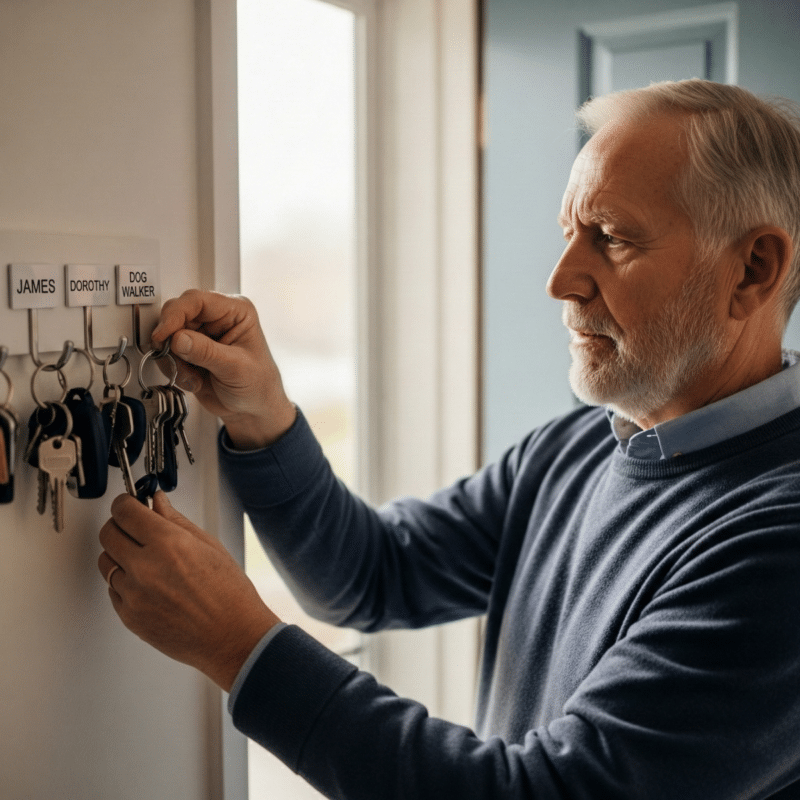
Create designated spots at transition points—small decorative baskets on hall tables, wall-mounted key hooks near doorways, or entryway organizers with visible compartments.


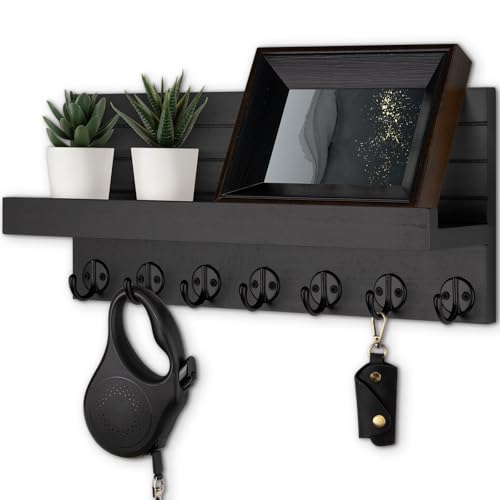

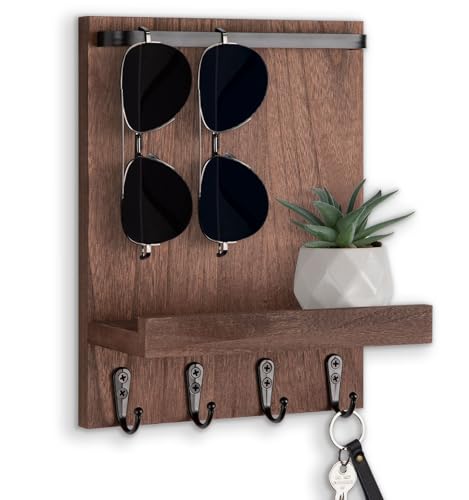
The key word is visible. Clear containers or open trays work better than closed drawers because you can see what’s inside without opening anything.
Place these landing zones before you enter the multitasking danger zone. If your hallway connects the kitchen to the bedroom, put the container at the kitchen end, not halfway down the hall.
Loss Zone #2: The Bathroom Counter Phenomenon
Bathroom counters are the number one location for lost glasses, jewelry, and small items. The reason surprises most people.
When you look in the bathroom mirror, you see your reflection—not the counter. Your visual attention focuses on your face, creating a blind spot for items you’ve just set down.
Steam and condensation during showers obscure items left on counters. By the time the mirror clears, you’ve forgotten you left something there.
Personal care routines involve significant distraction. You’re focused on brushing teeth, washing your face, or taking medication—not on tracking where you placed your glasses when you removed them to splash water on your face.
Items get wiped away during cleaning or covered by towels. That hand towel you tossed on the counter? It just buried your wedding ring.
The Bright Container Strategy
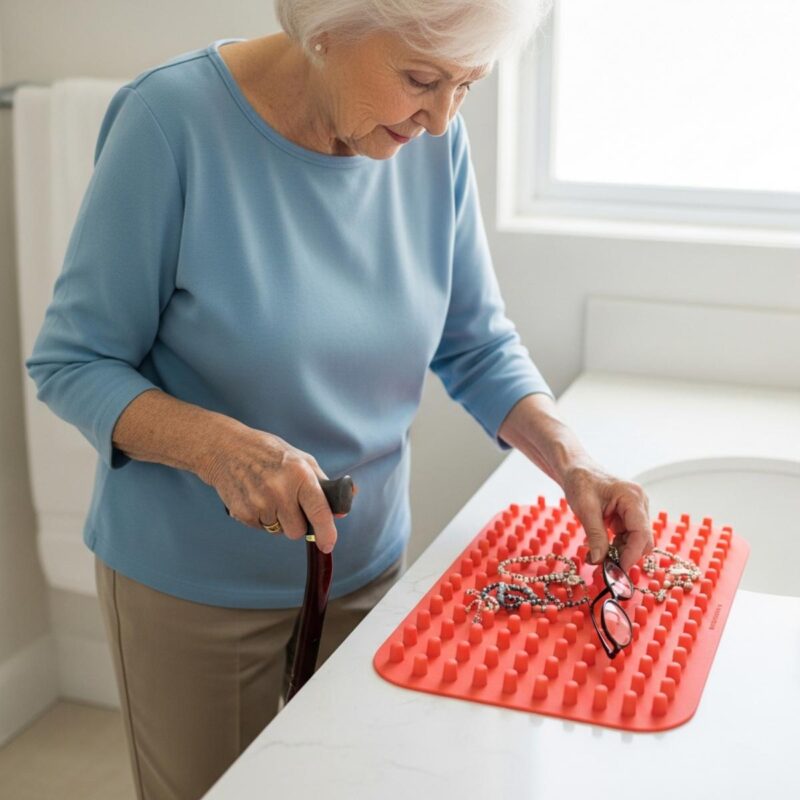
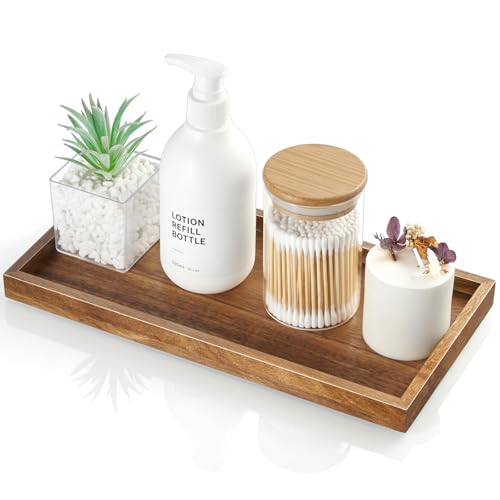
Designate one brightly colored container specifically for items you remove during bathroom routines. Make it impossible to miss.
Brightly colored trays, non-slip rubber mats with raised edges, or magnetic strips for metal items create unmissable spots. Items can’t roll off or get accidentally wiped away.

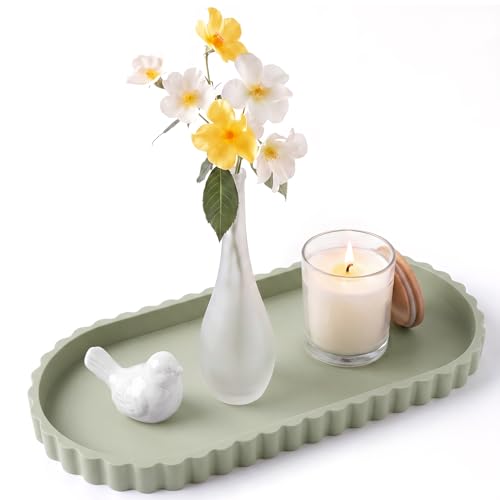
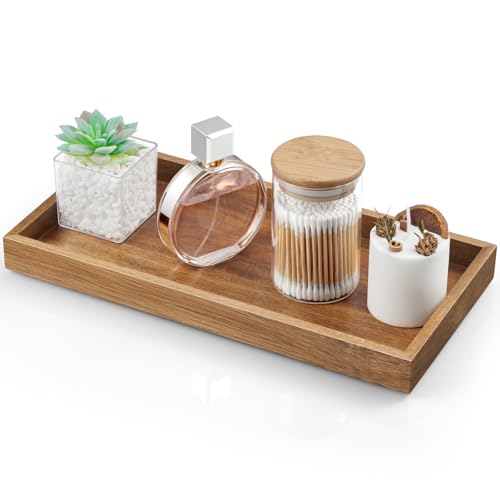


Place the container away from the sink edge, toward the back of the counter where it won’t get splashed or knocked during face-washing.
Consistency matters more than the specific container. Use the same spot every single time, and your brain will start tracking it automatically.

Loss Zone #3: The Car As a Black Hole
Vehicles combine movement, darkness, and hidden crevices—a perfect storm for vanishing items.
Phones slide under seats during turns. Sunglasses slip into door pockets and get buried under papers. Small items drop between seat cushions and disappear into upholstery gaps.
Multiple entry and exit points create confusion. You remember bringing your phone to the car, but did you take it out when you stopped for gas? Or was that yesterday?
Your car isn’t an extension of your home—it’s a high-movement zone that needs different organization strategies.
The Consistent Spot Method
Establish one location for essential items every single time you drive. Not “the passenger seat area”—one specific spot.
Phone mounts, seat-gap fillers, center-console organizers, or brightly colored item pouches prevent objects from disappearing into vehicle crevices or becoming invisible against dark interiors.


Do a quick car sweep before exiting. Pause with your hand on the door handle and mentally inventory: phone, wallet, keys, glasses.
For items you frequently forget (like shopping bags in the trunk), put something you never forget—like your phone—in the back seat. You can’t miss it when you’re looking for your phone.
Ready to discover more practical solutions for daily living challenges? Subscribe to our newsletter for expert-tested strategies designed specifically for older adults.

Loss Zone #4: Kitchen Counters Near the Sink
Kitchen counters seem logical for setting things down. They’re not.
Active work zones are terrible for storing items. You’re unpacking groceries, preparing meals, and cleaning dishes—all activities that require counter space and generate visual clutter.
Items get covered quickly. You set your reading glasses down while sorting mail. Five minutes later, they’re buried under grocery bags, cooking ingredients, or the newspaper.
Cleaning creates disposal risk. That quick wipe-down of the counter? You just swept your medication bottle into the trash along with the crumbs.
Kitchen multitasking creates absent-minded placement. You’re thinking about recipe steps or timing, not about where you put the small object in your hand.
The No-Work Zone
Create one designated spot on your kitchen counter that never gets used for food prep or cleaning—a “no-work zone” specifically for items that don’t belong in the kitchen but need visibility.
Position it away from the sink and stove. The counter section nearest the entrance to your kitchen works well—you naturally pause there when entering the room.
Use a distinctive container that doesn’t look like kitchen items. A small basket in a bright color signals “different purpose” to your brain.
Keep this zone clear of kitchen clutter. No mail, no dishes, no cooking tools. When the space maintains its distinct purpose, you’re more likely to remember it.

Loss Zone #5: The Bedroom Nightstand Shuffle
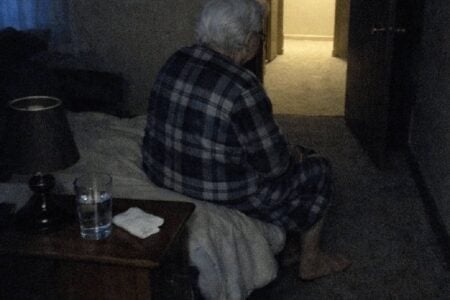
Nightstands serve you during your least alert moments. Items frequently get knocked behind furniture during sleep or fumbling in darkness.
You reach for your phone at 3 AM, miss the edge of the table, and send your glasses flying. You’re too groggy to search for them, so you go back to sleep. By morning, you’ve forgotten the incident entirely.
Items slide behind headboards or into narrow gaps between the nightstand and wall. That reading light cord creates a perfect channel for small objects to slip down.
Charging cables create visual clutter that camouflages other items. Your phone charger, watch charger, and reading light cords tangle together, hiding whatever’s underneath.
Morning grogginess increases placement mistakes. You’re not fully awake when you remove your glasses or set down your medication bottle. Your spatial awareness is compromised.
The Nighttime-Proof Setup
Your nightstand needs to work for half-awake you, not fully alert you.
Use containers with raised edges set back from the table edge. Bedside caddies that hang over the table edge, charging stations with individual item slots, or small bins with raised sides prevent items from rolling off during nighttime reaching.


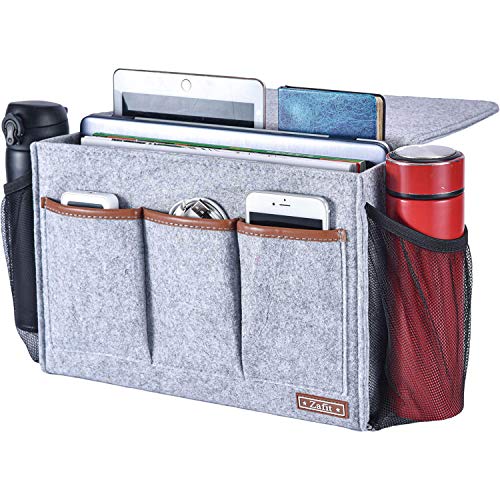
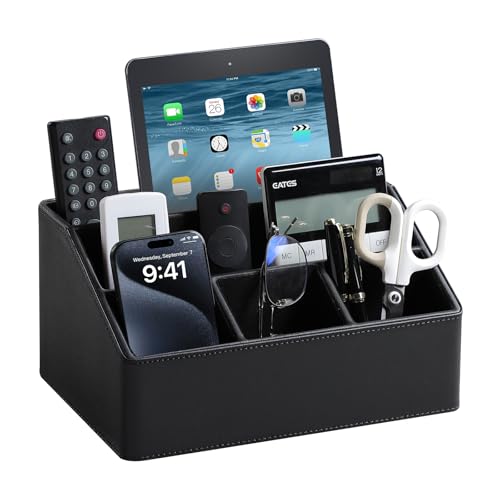
Position essentials toward the back of the nightstand surface, not at the edge. Items at the back are less likely to get knocked off but remain easily reachable.
Keep the surface clear. One container for glasses, one charging station for devices, one small tray for medication. No stacks of books, no piles of papers, no decorative items competing for space.
Consider motion-activated lighting that illuminates the nightstand area automatically when you reach for something. You can’t knock over what you can clearly see.
Better bedroom organization reduces middle-of-the-night incidents and morning frustration. Small environmental changes prevent most nightstand losses before they happen.
The 5-Zone Lost Item Prevention Checklist
Stop wasting time searching for lost glasses, keys, and wallets—download this 5-zone checklist to identify exactly where items disappear in your home and implement simple fixes that work within days.
The Pattern Behind the Losses
These loss zones share common characteristics that explain why items disappear:
Movement and multitasking. When your brain is processing multiple activities simultaneously, item tracking becomes a lower priority. Your cognitive resources focus on navigation, decision-making, and forward planning—not on where you set down that small object.
Visual competition. Spaces with high visual clutter or changing conditions (like steam-covered bathroom mirrors or crowded kitchen counters) make items effectively invisible even when they’re in plain sight.
Inconsistent routines. You don’t have the same ritual every time you use these spaces, so your brain can’t develop automatic tracking patterns. Each instance feels unique rather than part of a predictable sequence.
Darkness and limited visibility. Nighttime fumbling, car interiors, and shadowy hallways all reduce your ability to visually confirm where you’ve placed something.
“Just for a second” placements. Temporary intentions create permanent problems. When you set something down “just while I do this other thing,” your brain doesn’t encode it as a placement worth remembering.
Prevention Beats Searching
Creating effective systems in these high-risk zones prevents losses before they happen. You’re not fixing your memory—you’re designing your environment to work with how human brains actually function.
Start with your personal highest-risk zone. Where do you most frequently lose items? That’s where to focus first.
Implement one prevention strategy this week. Don’t try to reorganize every loss zone simultaneously. Choose one change, make it consistent, and give your brain time to adapt to the new pattern.
The goal isn’t perfection—it’s reduction. If you can prevent 80% of lost item incidents by addressing your top two loss zones, that’s a meaningful improvement in daily frustration and wasted time.
These patterns are universal human behaviors, not signs of cognitive decline. Understanding how environmental design and brain function interact gives you control over a problem that often feels random and inevitable.
Once you see the patterns, you can’t unsee them. And once you’ve adjusted the environment, the problem largely solves itself.
What’s your most frustrating loss zone? Share in the comments—your experience might help someone else identify their own pattern.