
![Group of seniors sharing simple grocery saving tips[1]](https://www.grayingwithgrace.com/wp-content/uploads/2026/01/group_of_seniors_sharing_simple_grocery_saving_tips1-e1769521429158.jpg)
You buy the same groceries each week. The same cereal. The same milk. The same bread. Yet somehow, your grocery bill keeps climbing.
If you’re on a fixed income, you feel every price increase. You watch your budget shrink while store prices expand. You’re making difficult choices—skipping items you used to buy without thinking, stretching meals further, wondering if you’ll need to compromise on nutrition just to make ends meet.
Here’s what most people don’t realize:
The solution isn’t extreme couponing or buying inferior products. It’s simply knowing what to look for during the same five minutes you’re already standing in the checkout line.
Your receipts and shelf tags contain money-saving information that most shoppers completely ignore.
I’m going to show you exactly where to look and what to do with what you find. These aren’t desperate bargain-hunting tactics—they’re intelligent consumer strategies that take advantage of how stores actually operate.

Grocery Savings Cheat Sheet: 5-Minute Store Strategy
Download this one-page grocery savings guide and discover the five specific strategies that save older adults $800-1,800 annually on groceries they’re already buying—with just five minutes of effort per week.
The Unit Price Secret: Your Built-In Savings Calculator
Every shelf tag in your grocery store displays a unit price—the cost per ounce, per pound, or per item. It’s required by law. And it’s the single most valuable piece of information for smart shopping.
Most people grab the ‘bigger’ size assuming it’s the better value. That’s exactly what stores count on.
Here’s what actually happens: A 24-ounce jar of pasta sauce costs $4.32, which breaks down to $0.18 per ounce. The 32-ounce jar—the one that looks like the obvious better deal—costs $6.72, or $0.21 per ounce. You’d pay more per serving by buying the bigger jar.
This isn’t an accident. Package sizing is designed to confuse, not inform. The biggest package isn’t always the best value. Sometimes the smallest size costs less per ounce than the medium or large.
On a fixed income, these differences matter. Every dollar you stretch goes further. Understanding how to make smart financial decisions in retirement means refusing to pay more for less.
The unit price appears in small print on the shelf tag, usually in the bottom corner. It shows you the true cost comparison between different sizes and brands of the same product.
Your action step: On your next shopping trip, compare unit prices on three items you regularly buy. I’m willing to bet you’ll find immediate savings on at least one of them.

The Store Brand Intelligence Test
Many store brands are manufactured in the exact same facilities as name brands. Same ingredients. Same quality standards. Same product. Different label—and 30-50% lower price.
The reason stores can charge less has nothing to do with quality. It’s because they don’t spend millions on advertising and fancy packaging. You’re not paying for celebrity endorsements or Super Bowl commercials.
For staples—pasta, rice, flour, sugar, canned goods, dairy products—there’s zero quality difference between store brand and name brand. The nutritional content is identical. The taste is identical. The only difference is the label and the price.
Over-the-counter medications are even more straightforward. Generic acetaminophen at $4.99 contains the exact same active ingredient, in the exact same dosage, as name-brand Tylenol at $12.99. The FDA requires generic medications to meet the same standards as brand names. You’re getting identical medication for 60% less.


Here’s how to verify you’re getting true equivalent quality: Compare the ingredient lists. They’re required by law to be listed in order by weight. If the first five ingredients match, you’re looking at essentially the same product.
Some products are worth paying for the name brand—specialty items where formulation genuinely differs, or products where you’ve tried both and strongly prefer the branded version. But for everyday staples, choosing store brands isn’t settling. It’s refusing to pay for marketing.
Your action step: Pick one category this week—pain relievers, pasta, or canned tomatoes. Compare labels ingredient by ingredient. Most of you will be surprised by how identical they are.

The Tuesday Morning Markdown Strategy
Stores follow predictable patterns for marking down items. Knowing when to shop can save you hundreds annually without changing what you buy.
Tuesday and Wednesday mornings typically offer the most markdowns. Here’s why: Stores clear weekend inventory on Monday, then apply markdown stickers Tuesday morning. You’re shopping the fresh markdowns before other customers pick through them.
You’ll find 30-50% off stickers on meat approaching its sell-by date, bakery items from the previous day, and produce that’s perfectly fresh but needs to move quickly. These foods are completely safe and often at their peak ripeness.
Understand the difference between ‘sell by’ and ‘use by’ dates. ‘Sell by’ is the date by which stores should sell the item—but the food remains fresh for days beyond that date. ‘Use by’ is the manufacturer’s estimate of peak quality, not a safety deadline. Most food is perfectly safe well beyond these dates.
Managing your grocery budget strategically means understanding these timing patterns and adjusting your shopping schedule accordingly.
Bakery sections often markdown items at the end of the day. Bread, rolls, and pastries from that morning go to 50% off in late afternoon. If your schedule allows shopping between 5-7 PM, check the bakery markdown rack.
Your action step: Try one Tuesday or Wednesday morning trip. Note what’s marked down. If you find consistent savings, adjust your weekly shopping routine to match.
Ready to discover more money-saving strategies for grocery shopping and retirement living? Subscribe to our newsletter for weekly tips that help your fixed income go further.


![[4 in 1] 7 Day Medicine Pill Organizer+5 Reminder Alarms+Timer+Clock,Large](https://m.media-amazon.com/images/I/31tkYlpE-OL._SL500_.jpg)


The Loss Leader Advantage
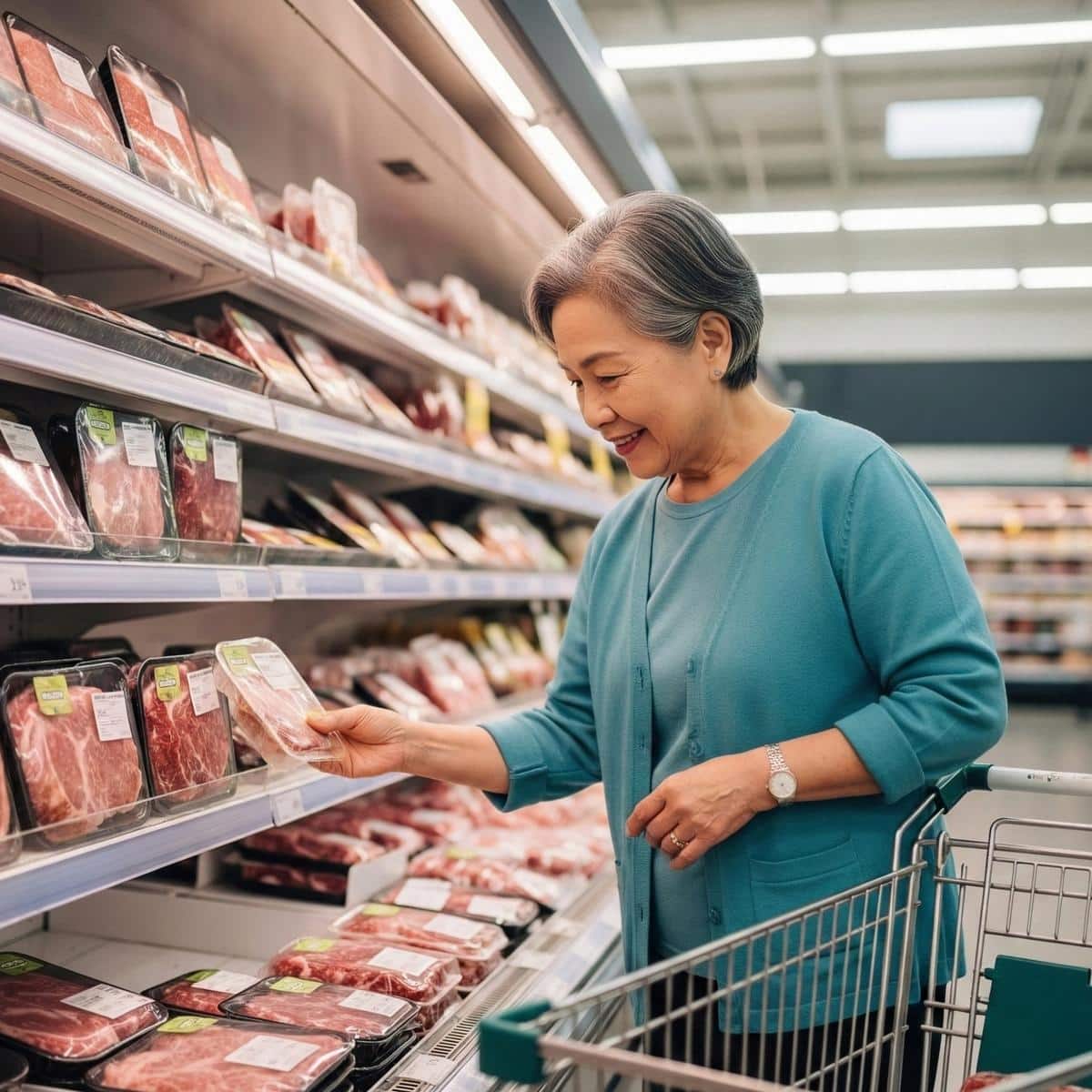
Stores intentionally price certain items below their cost to get you in the door. These ‘loss leaders’ are advertised heavily—milk at $2.99, eggs at $1.99, bread at $1.50—prices that seem too good to be true.
They’re real. And they’re strategic. Stores lose money on these items, banking on you buying higher-margin products during the same trip.
Your strategy: Buy the loss leaders without falling for the impulse purchases placed strategically around them. You’re not being disloyal to your regular store—you’re being a smart consumer who takes advantage of competitive pricing.
Check two or three stores’ weekly ads online. Most stores post their ads on their websites Wednesday or Thursday for the following week. Identify the loss leaders—they’re usually front-page featured items or dramatic price drops.
Plan your shopping around these patterns. Smart spending in retirement often means visiting different stores for different items rather than doing all your shopping in one location.
If Store A has eggs at $1.99 and your regular store sells them for $3.99, you save $2 per dozen. Buy several dozen (eggs keep for weeks), and you’ve saved $10-12 in five minutes. Multiply that across multiple loss leaders each week, and the savings become substantial.
Your action step: This week, check three stores’ ads online. Identify loss leaders for items you buy regularly. Plan one strategic shopping trip to stock up.

The Pharmacy Counter Secret
The cheapest over-the-counter medications aren’t always on the shelf. Sometimes they’re behind the pharmacy counter at a fraction of retail price.
Pharmacies stock basic OTC medications behind the counter in bulk packaging—larger quantities at dramatically lower per-unit costs. These aren’t prescription items. They’re the same products on the shelf, just in larger containers at better prices.
Shelf ibuprofen might cost $14.99 for 100 tablets. Behind the pharmacy counter, the generic bulk option costs $5.99 for 200 tablets. You get twice as many tablets for less than half the price.
This works for pain relievers, allergy medications, vitamins, and other items you use regularly. The pharmacist can tell you what’s available and whether the bulk option makes sense for your needs.
Managing medications effectively includes knowing where to find the best prices on items you take daily.
Asking for cost-saving options isn’t embarrassing. It’s smart healthcare consumer behavior. Pharmacists expect these questions and respect customers who ask.
Your action step: On your next pharmacy visit, ask: ‘Do you have behind-the-counter options for [specific OTC medication] that might cost less than shelf pricing?’ You’ll often get immediate savings.

The Five-Minute Receipt Audit
Here’s where everything comes together: Spend five minutes reviewing your receipt each week. This simple habit reveals patterns you’re missing in the moment.
Look for:
- Items where the unit price you paid was higher than expected
- Name brands where you could have chosen store brands
- Regular-price items that might have been on sale at a different store
- Impulse purchases you didn’t plan to buy
Keep your last three receipts. Compare prices on items you buy weekly. You’ll spot patterns—certain items consistently cost more at certain stores, or specific days offer better pricing.
This isn’t about perfect memory or complicated tracking. It’s about awareness. Being intentional with your spending means knowing where your money goes and making adjustments based on what you learn.
Many people discover they’re spending $15-20 weekly on impulse items placed strategically near the checkout. That’s $800-1,000 annually on purchases they didn’t plan to make.
Others find they’re consistently paying more for the same items because they default to one store out of habit. Spreading purchases across two or three stores based on weekly sales can save $30-50 per week—$1,500-2,600 annually.
Your action step: This week, keep your receipt. Spend five minutes reviewing it when you get home. Circle three items where you could have saved money using strategies from this article.
Grocery Savings Cheat Sheet: 5-Minute Store Strategy
Download this one-page grocery savings guide and discover the five specific strategies that save older adults $800-1,800 annually on groceries they’re already buying—with just five minutes of effort per week.




Making These Strategies Work for You
You don’t need to implement all of these strategies at once. Start with one or two that feel most relevant to how you already shop.
If you have a predictable schedule, the Tuesday morning markdown strategy might fit naturally. If you’re already shopping weekly ads, adding loss leader awareness is an easy next step. If you take daily medications, the pharmacy counter question could save you hundreds annually with one conversation.
These aren’t desperate measures. They’re intelligent consumer behavior that takes advantage of how stores operate. You’re already a smart shopper—now you’re adding strategic awareness to habits you already have.
The retiree who saved $1,847 this year didn’t do anything extreme. She started checking unit prices, switching to store brands for staples, shopping Tuesday mornings for markdowns, and buying loss leaders from weekly ads. Five minutes of attention per week. No coupons. No apps. No complicated systems.
Living well on a fixed income means making smart choices that stretch your budget without sacrificing quality or nutrition. These strategies do exactly that.
What’s one strategy you’ll try on your next shopping trip? Share your experience—or your own grocery-saving discoveries—in the comments below.
![Elderly man with cane looking up recurring charge[1]](https://www.grayingwithgrace.com/wp-content/uploads/2026/01/elderly_man_with_cane_looking_up_recurring_charge1-e1769520115610-450x300.jpg)
![Daughter discussing suspicious bank activity with elderly mother[1]](https://www.grayingwithgrace.com/wp-content/uploads/2026/01/daughter_discussing_suspicious_bank_activity_with_elderly_mother1-e1768862439415-450x300.jpg)
![Older couple walker grocery shopping produce[1]](https://www.grayingwithgrace.com/wp-content/uploads/2025/12/older_couple_walker_grocery_shopping_produce1-e1767122004698-450x300.jpg)
![Older asian man setting up budget billing[1]](https://www.grayingwithgrace.com/wp-content/uploads/2025/12/older_asian_man_setting_up_budget_billing1-e1767120559858-450x300.jpg)
![Older hispanic woman monthly plan bills calculator[1]](https://www.grayingwithgrace.com/wp-content/uploads/2025/12/older_hispanic_woman_monthly_plan_bills_calculator1-e1767120424679-450x300.jpg)
![Older woman washing jars kitchen sink[1]](https://www.grayingwithgrace.com/wp-content/uploads/2025/12/older_woman_washing_jars_kitchen_sink1-e1765809604552-450x300.jpg)
![Older man setting boundary at doorway[1]](https://www.grayingwithgrace.com/wp-content/uploads/2025/12/older_man_setting_boundary_at_doorway1-e1765808920364-450x300.jpg)
![Senior woman with walker holiday grocery[1]](https://www.grayingwithgrace.com/wp-content/uploads/2025/12/senior_woman_with_walker_holiday_grocery1-e1765212886497-450x300.jpg)


