
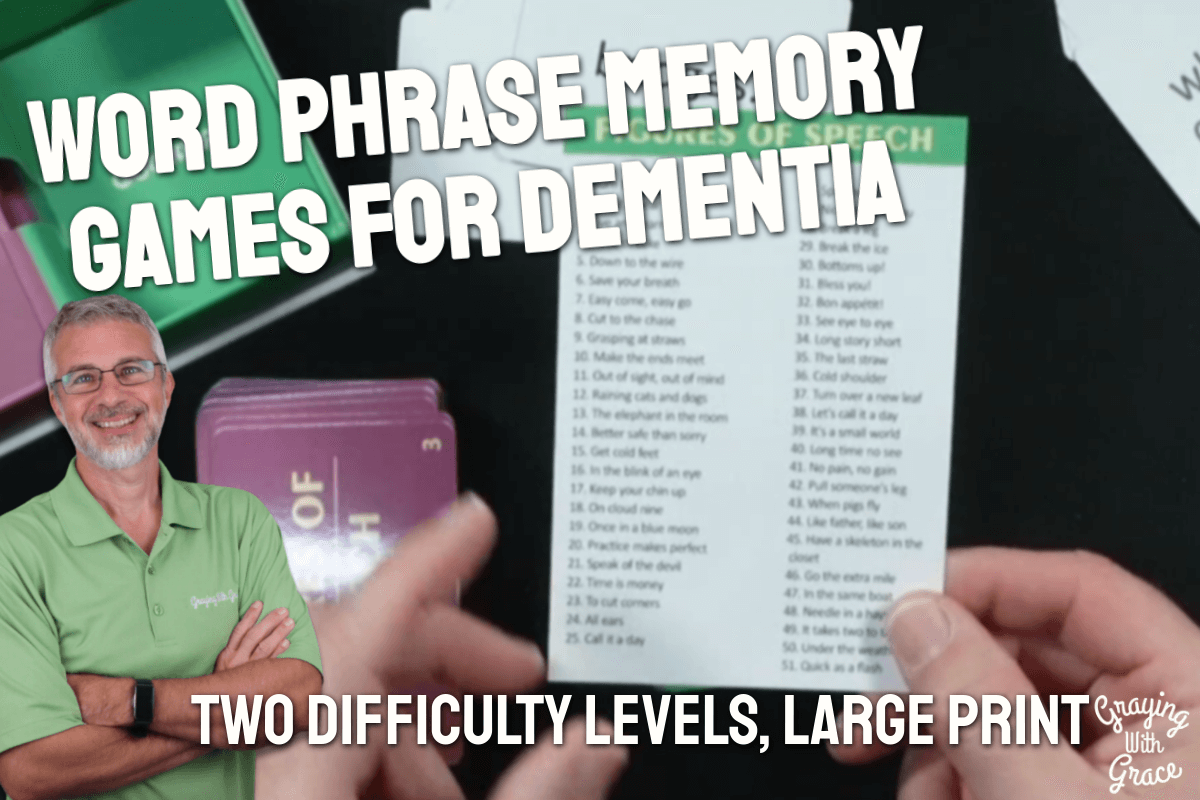
Finding meaningful activities for an older adult living with memory loss is one of the hardest challenges a caregiver faces. Most games feel too childish, too complicated, or too frustrating when memory starts to fade. So when a product comes along that is specifically engineered for older adults with cognitive concerns — not just adapted from a kids’ toy — it deserves a serious look.
The QUOKKA Elderly Memory Games for Seniors promises 202 cards, two difficulty levels, two game modes, and an accessible design built around familiar phrases that tap into long-term memory. It sounds thoughtful on paper. But does it actually deliver in practice?
I’m Scott Grant, a Certified Senior Advisor (CSA) and Senior Home Safety Specialist (SHSS) at Graying With Grace. I personally evaluated this product hands-on and walked through every feature on video so you can see exactly how it works before you decide. This review covers everything from the card design to the gameplay mechanics to the honest limitations you should know about before purchasing.


Quick Takeaways
- Problems it solves: Boredom and isolation for memory-impaired seniors, caregiver frustration with inaccessible games, and the challenge of finding activities that feel dignified rather than childish
- Who benefits most: Older adults with early to moderate Alzheimer’s or dementia, their family caregivers, and memory care facility activity staff
- Worth the investment? Yes — the combination of 202 cards, two difficulty levels, and two game modes gives this product real staying power compared to simpler alternatives
- Best feature for seniors: Phrase-based matching that draws on long-term memory rather than requiring new learning, paired with visual symbol clues that support recall
- Biggest limitation: Seniors with severe language loss or very advanced cognitive decline may struggle even with the simpler green-level cards and will need significant caregiver facilitation
How This Could Help You
Think about the last time you tried to engage a parent or spouse with memory loss in an activity they genuinely enjoyed. Did they stare blankly at a puzzle with too many tiny pieces? Did a board game’s instructions cause confusion or embarrassment? These moments are painful for everyone involved.
The QUOKKA game takes a different approach. Instead of asking someone to remember something new, it asks them to complete something familiar. Phrases like “quick as a flash” or “bite the bullet” are expressions most older adults have heard thousands of times over decades. Matching the beginning of a phrase to its ending taps into deep, well-worn memory pathways — the kind that often survive longer into cognitive decline than short-term recall does.
For a senior living at home who feels cut off from family activities, this game creates a natural entry point for connection. For a caregiver who dreads the awkward silence of a visit, it provides a structured, low-pressure activity that can spark real conversation. And for a professional working in a memory care setting, it offers a scalable group activity with built-in difficulty adjustment.
Could this be the activity that finally sticks for your loved one? That depends on their current cognitive level and what they respond to — but the design gives it a genuinely strong chance.
Important Details You Should Know
When I evaluated this product, I noticed that the cards are roughly the same size as a standard playing card. That is a detail worth paying attention to. They are not oversized like some senior-specific games, which means they are easy to shuffle, hold, and store — but may require a flat table surface for easier handling by someone with limited dexterity.
The fonts are genuinely large and bold, printed in high-contrast black on a light background. As I demonstrated in the video, you can read the text clearly without squinting, even at a comfortable arm’s length. That matters more than people realize — small print is one of the fastest ways to frustrate an older adult and get a game put back on the shelf for good.
The entire set — all 202 cards, the answer sheet, and the included instructions — stores in a premium magnetic-closure gift box. It is compact enough to sit on a shelf or nightstand without taking up much space, and the magnetic closure keeps everything contained between sessions.
Card quality appears solid and appropriate for repeated handling. The color coding — green for simpler phrases, crimson for more complex ones — is clear and easy to distinguish at a glance.
Getting Started
Everything you need is in the box: 202 color-coded cards divided into green (51 match sets) and crimson (50 match sets) levels, an answer sheet listing every correct pair, and instructions for multiple game modes.
Setup is genuinely simple. In the video, you can see that I had the game up and running within a couple of minutes of opening the box. There is no app to download, no batteries to install, and no complicated assembly. You pick a difficulty level, pull out a set of matched pairs by checking the numbers on the card backs, shuffle them, and start playing.
The manufacturer recommends starting with at least five match sets (ten cards total) for a solo player. For group play with two people, they suggest ten pairs; with three players, fifteen pairs. These are sensible starting points that keep the game manageable without feeling too easy.
A caregiver or family member can help set up the initial game, but once the cards are laid out, many seniors can take it from there independently.
Ready to discover more innovative strategies for healthy, comfortable aging? Subscribe to our newsletter for expert-tested tips and product recommendations designed specifically for older adults.
Features That Matter to You
Two Difficulty Levels That Respect Every Player
The green and crimson color-coding system is one of the most thoughtful design decisions in this product. Green cards use simple two- or three-word phrases. Crimson cards use longer, more complex expressions. As I demonstrated in the video, green might give you “quick as” and ask you to match it with “a flash,” while the crimson level might present something like “let someone off” paired with “the hook.”
This matters enormously for dignity. When someone with moderate cognitive decline plays alongside a family member with milder impairment, each person can use the level that fits their ability. Nobody is forced to struggle through cards that are too hard, and nobody is patronized with material that feels too simple.
Numbers on the Back for Independent Verification
Every card has a number printed on the back that identifies its match set. In the video, you can see that the beginning card of each pair has an illustration on the back and the ending card carries a corresponding graphic — so players can tell which type of card they are holding just by flipping it over. This means a senior playing alone can verify every match without needing a caregiver to confirm the answer. That kind of built-in independence is genuinely valuable.
Visual Symbols as Memory Clues
Each card also carries a small visual symbol related to the phrase. When I evaluated this product, I noticed that these symbols act as a secondary cue for recall — if the words alone are not triggering recognition, the image often will. For someone whose verbal memory is fading but whose visual processing remains relatively intact, this is a meaningful accessibility feature.
The Answer Sheet
The included cheat sheet lists every matched pair by number, organized by deck. Caregivers can use it to verify answers instantly, which eliminates the frustrating disputes that sometimes arise during games. There is no guessing, no arguments, and no uncertainty. It also means a caregiver who is unfamiliar with the phrases themselves can facilitate the game confidently.
Real Life Experience
In the video, you can see me walk through two different game formats. The first is a solo memory-matching style, where you lay matched pairs face-down and flip them over to find correct combinations — similar to a traditional concentration game. The second is a group format where players divide beginning cards and ending cards between them and take turns trying to make correct matches.
The solo format is well-suited to an older adult who wants quiet, independent cognitive exercise. The group format creates that natural family dynamic where conversation flows naturally from the phrases themselves. As I mentioned during the video, some of these sayings will spark memories — “That’s what Dad always used to say” is exactly the kind of moment this game can generate.
When I demonstrated the group game, I noticed that the rule for incorrect matches — where the player who guessed wrong has to keep both cards — adds just enough gentle competitive tension to keep the game engaging without becoming stressful. Getting a match wrong does not feel like failure; it just means you hold onto the cards a little longer.
Day-to-day maintenance is minimal. The cards do not require any special care beyond keeping them dry and stored in the included box. The magnetic closure makes it easy to put away between sessions without losing any pieces. There are no batteries to replace, no screens to clean, and no software to update. Pick it up, play, put it away. That simplicity is genuinely underrated.
As I showed in the video, the manufacturer estimates four to six months of regular engagement before the phrases start to feel overly familiar. With two difficulty levels and two game modes, there is real variety built in — and in a group setting, the dynamic of different players always keeps things fresh.
Will You Be Able to Use It?
If you or your loved one can read standard-size print and has some ability to follow a simple matching concept, this game is accessible. The large fonts and high-contrast design remove most vision-related barriers. The simple mechanics — match a beginning to an ending — can be demonstrated in a single round.
Solo play is entirely possible for many seniors without any caregiver help. The numbered card backs and answer sheet provide all the support needed to play and self-verify independently. For someone who values autonomy and does not want to depend on others for entertainment, that independence matters.
Seniors with some hand dexterity challenges should still be able to manage the cards with reasonable ease, since they are standard playing card size and not unusually heavy or awkward. However, someone with significant tremors or very limited grip strength may find handling and sorting the cards tiring. In those cases, a caregiver can do the physical handling while the senior focuses on the matching itself.
For someone with more advanced cognitive decline who has difficulty with language, the visual symbol clues on each card can partially substitute for word-based recognition. A caregiver reading the phrases aloud while the senior responds to the visual cues is a practical adaptation.
Important Considerations
I want to be straightforward here, because honest reviews are more useful than cheerful ones.
This game is not a medical treatment. It will not reverse dementia, halt cognitive decline, or replace professional memory care. It is a therapeutic engagement activity — meaningful and beneficial, but firmly in the category of supportive tools, not clinical interventions. Always consult with your doctor or occupational therapist before making health-related product decisions, including choosing cognitive engagement activities.
For someone in the later stages of Alzheimer’s with significant language loss, this game will likely not be suitable — even the simpler green cards depend on some residual language comprehension. The visual cues help, but they are supplementary, not a complete substitute for verbal engagement. If your loved one is at a stage where following a simple two-step direction is consistently difficult, this may not be the right fit right now.
The group format requires willing participants. If a senior lives alone and does not have regular family or caregiver visits, the social benefits of group play are harder to access. Solo play is genuinely viable, but the full experience of the game is richer with others involved.
Finally, younger caregivers or grandchildren may not recognize some of the classic idioms and expressions. That is actually an opportunity for intergenerational learning rather than a problem — but it is worth knowing going in.
Help When You Need It
QUOKKA is an Amazon-sold product, which means standard Amazon return and customer service policies apply. If the product arrives damaged or is not as described, Amazon’s buyer protection process covers the purchase.
The game itself does not require replacement parts — there are no batteries, no consumable components, and no digital elements that can malfunction. If individual cards are lost or damaged over time, reaching out to the QUOKKA brand directly through their Amazon storefront would be the first step for replacement options.
The product qualifies for Amazon Prime shipping, which is worth noting if you need it for an upcoming visit or gifting occasion and do not want to wait.
Understanding the Cost
Without naming a specific price, I can tell you that this product sits in a range that is reasonable for a purpose-built therapeutic activity with 202 cards and an included answer system. Compare it to other dementia-specific activity products, and it holds up well on a per-use basis.
The longevity factor is important here. This is not a one-time consumable. The cards are reusable indefinitely, and with multiple game formats and difficulty levels, the same set of cards provides varied engagement over many months. That kind of sustained value is harder to find than you might expect in this category.
If budget is a genuine concern, simpler phrase-completion activities can sometimes be found at libraries or through occupational therapy programs. But for families looking for something polished, gift-ready, and specifically designed for cognitive accessibility, the QUOKKA game offers genuine value for what it delivers.
Making It Work for You
Start small. The temptation when you first open the box is to use a large number of cards right away. Resist that. Begin with five or six match sets — ten to twelve cards — and let the senior get comfortable with the format before increasing the quantity. Success early on builds confidence and willingness to keep playing.
Use the green deck first, regardless of your loved one’s current cognitive level. It is much easier to move up to the crimson cards once someone is comfortable than to backtrack after a frustrating experience with phrases that were too complex.
If verbal recall is particularly difficult on a given day, shift your focus to the visual symbol clues on the cards. You or the senior can match by image association rather than language recognition — a useful adaptation for harder days.
For memory care facilities or caregivers using this in a group setting, consider assigning one person to manage the answer sheet so disputes are resolved quickly and gently, without drawing attention to who got something wrong.
And do not underestimate the conversation value. When a phrase like “not the sharpest tool in the shed” comes up, it is an invitation to share a memory, tell a story, or laugh together. Those moments are often the real gift of this game.
Our Recommendation
The QUOKKA Elderly Memory Games for Seniors earns a solid recommendation from me. It is one of the more thoughtfully designed cognitive engagement products I have reviewed for older adults with memory concerns — not because it does everything perfectly, but because it genuinely understands its audience.
The phrase-based matching format respects the long-term memory that often remains intact even as short-term recall fades. The dual difficulty system means one product can serve a wide range of ability levels without requiring additional purchases. The numbered card backs and answer sheet remove caregiver friction. And the large, high-contrast design means accessibility is built in rather than bolted on as an afterthought.
This product is the right choice for adult children looking for a meaningful, usable gift for a parent with early to moderate cognitive decline, for family caregivers seeking a structured activity that supports connection and cognitive engagement, and for memory care professionals who want a versatile group activity tool.
It is not the right choice if your loved one has advanced dementia with significant language loss, if physical card handling is genuinely impossible due to dexterity impairment, or if you are hoping for a medical intervention rather than a supportive activity.
If none of those limitations apply, this is a product worth adding to your caregiving toolkit.
Where to Get It
The QUOKKA Elderly Memory Games for Seniors is available on Amazon. You can check the current price and availability, read verified buyer reviews, and order directly through the product link included with this article. Prime shipping is available for faster delivery if you need it for an upcoming occasion.
The Bottom Line
Memory loss does not have to mean the end of meaningful activity or genuine family connection. The QUOKKA memory card game gives older adults something real to engage with — familiar phrases, achievable success, and the quiet dignity of playing a real game rather than a simplified imitation of one.
Whether you are a caregiver looking for a sustainable activity, a grandchild searching for a gift that actually gets used, or a senior who wants something to keep your mind active at home, this game is worth your attention.
If you have tried this product or have questions about whether it might work for your situation, I would love to hear from you in the comments below. Your experience helps other families make better decisions — and that is what Graying With Grace is all about.
![Bubble word search dementia activity 1200 x 800 px[1]](https://www.grayingwithgrace.com/wp-content/uploads/2025/01/bubble-word-search-dementia-activity-1200-x-800-px1-450x300.jpg)


