![Older couple cane portioning meals kitchen[1]](https://www.grayingwithgrace.com/wp-content/uploads/2025/12/older_couple_cane_portioning_meals_kitchen1-e1767120111377.jpg)
It’s 5 PM on a Tuesday, and you get that familiar text from your mom: “Not really hungry tonight. I’ll just have some crackers.”
Your stomach drops. Again? That’s the third time this week. You know she needs proper nutrition, but between your job, your kids’ homework, and the fact that she’s two towns away, what can you actually do?
Here’s what most caregivers don’t realize: The “I don’t feel like cooking” nights aren’t about being lazy or depressed.
They’re about decision fatigue meeting physical exhaustion in a cold kitchen during the most expensive heating month of the year. And there’s a surprisingly simple system that solves it.
Why Every “Just Batch Cook” Article Misses the Mark for Seniors
You’ve probably read those enthusiastic meal prep articles promising that one Sunday afternoon will solve all your problems.
They show beautiful photos of identical containers stacked in matching rows. They suggest making five lasagnas or three enormous casseroles. They assume you’re feeding a family of four who will cheerfully eat chicken teriyaki for lunch every day this week.
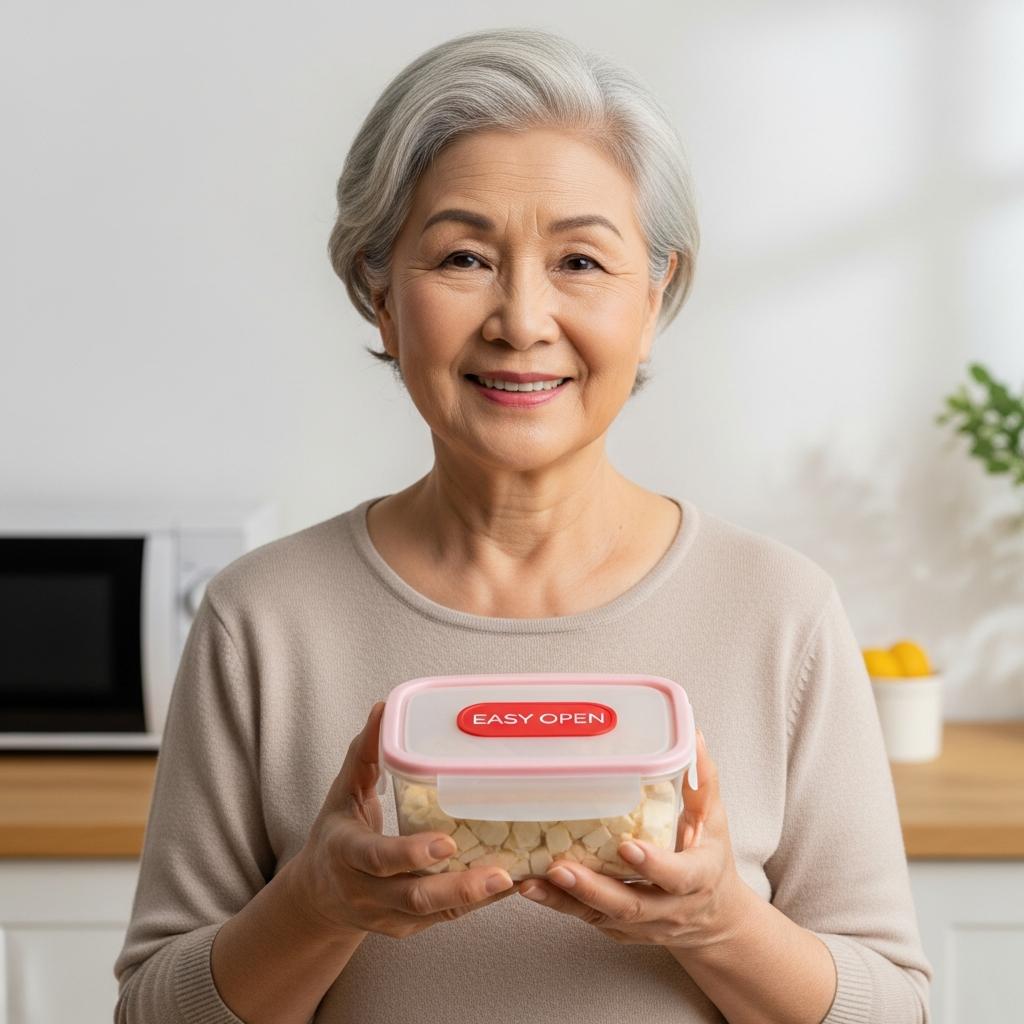
But your 78-year-old mother isn’t a family of four. She’s one person with arthritis who can’t open most container lids, who doesn’t want to eat the same casserole for four days straight, and whose appetite is about half what it used to be.
Standard freezer meals create their own problems. That “family-sized” lasagna means she’s either eating Italian food for a week or throwing away half of it. Those heavy glass containers? Her hands can’t grip them safely. The fancy vacuum-sealed bags? She doesn’t have the strength to open them.
And here’s the part that really matters: When cooking feels like “too much work,” batch cooking fifteen identical meals on a Sunday feels absolutely impossible.
The “Rule of Three” System That Actually Works
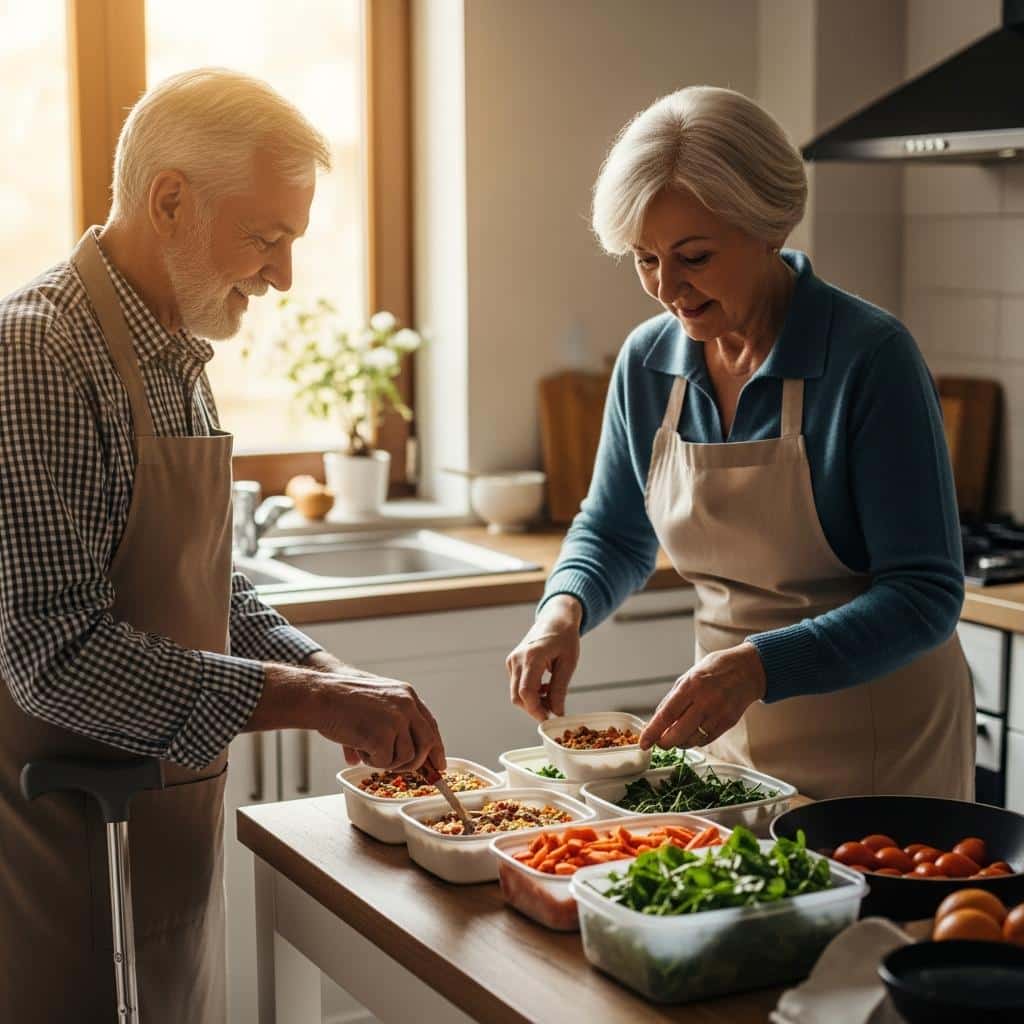
What if instead of making complete frozen dinners, you created a mix-and-match system that gives your mom 27 different meal options from just nine components?
That’s the Rule of Three: three proteins, three bases, and three vegetables that can be combined in any way she wants on any given night.
Here’s how it works. You prepare three proteins like portioned rotisserie chicken, turkey meatballs, and baked salmon pieces. You cook three bases like brown rice, quinoa, and roasted sweet potato cubes. You roast three vegetables like broccoli, green beans, and carrots.
Each component gets frozen separately in single-serving containers. When your mom doesn’t feel like cooking, she doesn’t pull out a predetermined “frozen dinner” that someone else chose for her. She opens the freezer and picks what sounds good: Maybe chicken with rice and broccoli today. Tomorrow, maybe salmon with sweet potatoes and green beans. The next day, meatballs with quinoa and carrots.
That’s 27 different combinations from nine simple cooking sessions. And because each component reheats in about the same amount of time, she just pops three containers in the microwave for four minutes and has a real meal.
The beauty of this system? It preserves her independence and dignity. She’s not eating “meals someone made for me because I can’t take care of myself.” She’s choosing what she wants from options that happen to be conveniently prepared. This approach builds on time-tested kitchen strategies that reduce waste while maximizing efficiency.

The Container Setup That Elderly Hands Can Actually Manage
Let’s talk about what actually works when arthritis makes everything harder.
Standard food storage containers fail seniors in predictable ways. Snap-on lids require grip strength she doesn’t have. Stacked containers get stuck together. Small writing makes it impossible to see what’s inside. Containers that aren’t microwave-safe create confusion about reheating.
Here’s the system that solves these problems. Use 2-cup rectangular glass containers with easy-lift lids for the individual components. The rectangular shape stacks efficiently, and the larger size makes them easier to handle. Look for lids with built-in tabs that require just a gentle squeeze rather than prying around the edges.
For complete meals, round plastic containers in the 8-12 ounce range work best. They’re lighter weight than glass, and the round shape means no corners for food to hide in and get forgotten.
Add color-coded lids to create a visual system that doesn’t require reading labels. Red lids for proteins. Green lids for vegetables. Yellow lids for grains and bases. Your mom can tell at a glance what category she’s looking at.
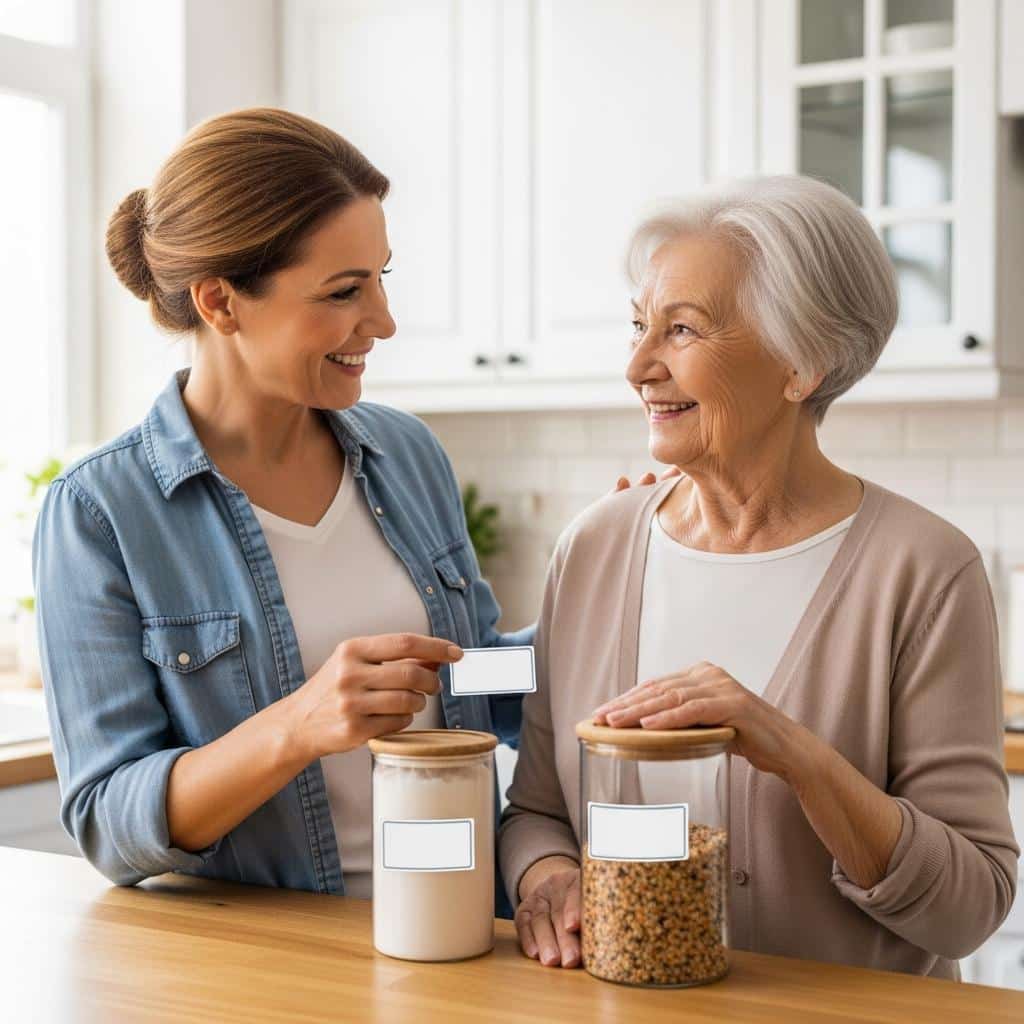
Then add large-print labels with both contents and simple reheating instructions. “Chicken – Microwave 2 minutes” is all she needs to see. Include the date if you want, but focus on the information that matters for safe reheating.
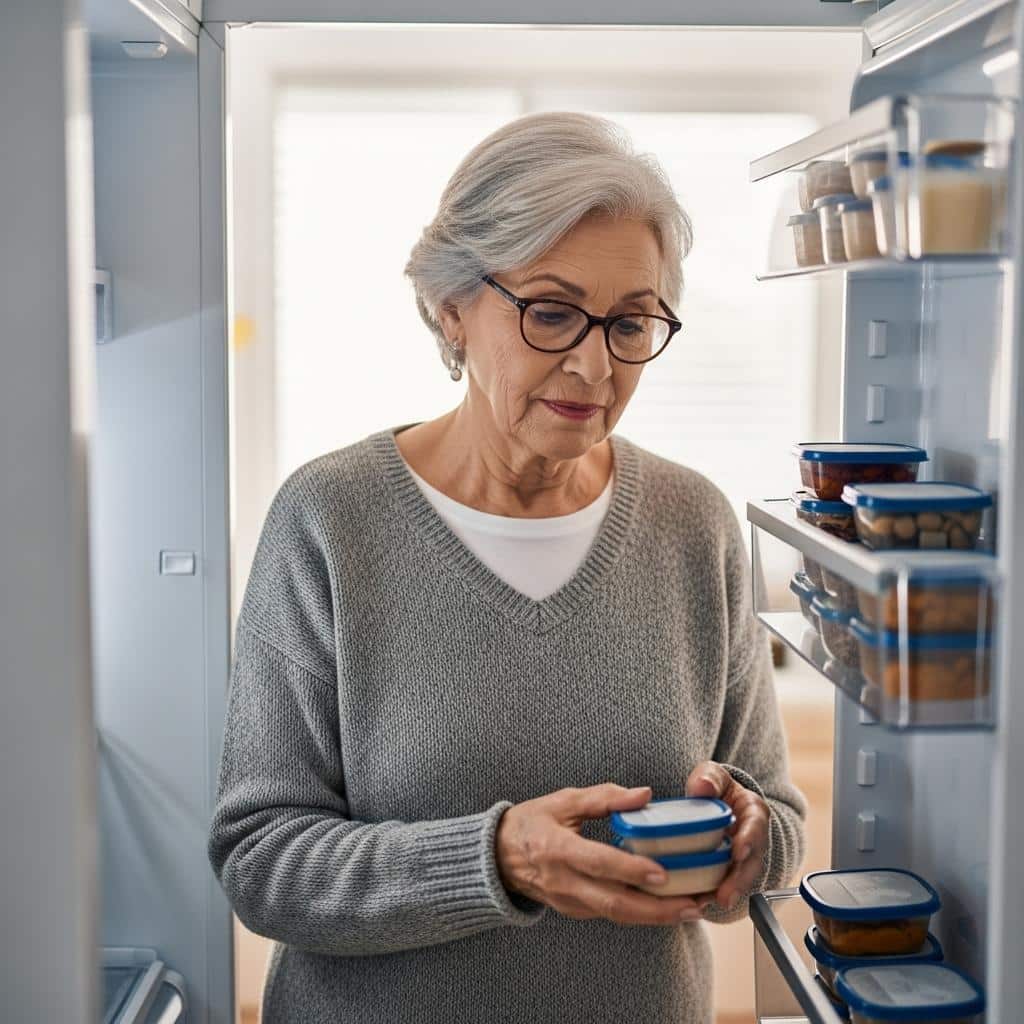
Organize the freezer by category. All proteins together on one shelf. All vegetables on another. Bases on a third. This prevents the “dig through everything to find what I want” frustration that makes people give up and order pizza instead. Simple kitchen safety solutions like these help maintain independence while reducing risk.
Want more practical caregiving strategies and time-saving solutions? Subscribe to our newsletter for expert-tested tips designed specifically for family caregivers supporting older adults.
Ten Meals That Reheat Perfectly and Taste Like Real Food
The secret to freezer meals seniors will actually eat? They need to taste good, be easy to chew, and reheat without turning into mush.
Start with turkey meatballs and marinara sauce. Make them slightly smaller than restaurant size for easier eating. Freeze the meatballs individually on a parchment-lined tray, then transfer to bags once frozen. Keep sauce in separate 1-cup containers. To reheat, she combines four meatballs with sauce and microwaves for 2-3 minutes until steaming throughout.
Chicken and vegetable soup works beautifully for those nights when nothing else sounds appealing. Use wide-mouth mason jars and leave a full inch of headspace at the top so the soup can expand as it freezes. She thaws it overnight in the refrigerator, then microwaves for 3-4 minutes, stirring halfway through. The result tastes fresh, not reheated.
Individual shepherd’s pie portions give her a complete meal in one container. Use small ramekins or oven-safe containers. She can reheat in the oven at 350°F for 30 minutes if she’s planned ahead, or microwave for 4-5 minutes if she hasn’t. Either way, it’s comfort food that actually comforts.
Pulled pork portions freeze exceptionally well and pair with multiple sides. Portion into 4-ounce servings with a little extra sauce to prevent drying. She can reheat and serve over rice, on a bun, or alongside roasted vegetables depending on what sounds good.
Baked salmon with lemon butter maintains its texture better than most fish when frozen properly. Portion into individual 3-4 ounce pieces. Freeze with a small pat of lemon butter on top. Microwave for 2 minutes, let stand for 1 minute, and it tastes fresh.
Beef and barley stew is hearty without being heavy. The barley holds up to freezing better than pasta would. Freeze in 2-cup portions. Reheat gently in the microwave, adding a splash of water if needed, for about 4 minutes.
Chicken pot pie filling without the crust is easier on sensitive stomachs than the full pastry version. Freeze the filling in single portions. She can reheat and serve over a biscuit or toast, or eat it as a thick soup.
Turkey chili in mild or medium heat levels works for most seniors. Freeze in 1.5-cup portions. Reheat in the microwave for 3 minutes, stirring halfway through. She can top with cheese, sour cream, or eat it plain.
Stuffed bell pepper filling freezes better than whole stuffed peppers. She can reheat the filling and serve it over rice or eat it as a bowl. Two minutes in the microwave and it’s ready.
Asian-style meatballs with ginger sauce give her variety from Italian flavors. Make them the same size as the turkey meatballs for consistent reheating. Freeze separately from sauce. Combine and reheat for 2-3 minutes.
The key with all of these? They’re genuinely appealing meals, not just “healthy options” she’ll reluctantly eat. They reheat in under five minutes. And they’re easy to chew, which matters more than most caregivers realize.
Your Sunday Setup System and What It Actually Costs
Here’s what two hours on Sunday afternoon can do for your peace of mind over the next two weeks.
Hour one is for proteins. Put a whole chicken in the oven to roast. While that’s cooking, form meatballs and get them baking on a second rack. Use your stovetop to brown ground turkey for another recipe. By the end of the hour, you have three proteins in various stages of cooking.
Hour two is for bases and vegetables. Cook your grains according to package directions. Cut vegetables and toss them with olive oil for roasting. Use any remaining oven space while proteins finish. By the time everything cools enough to portion and freeze, you’ve used about three hours total including cooling time.
Time-saving strategies make this more manageable. Buy pre-cut vegetables without guilt. Use that rotisserie chicken from the grocery store instead of roasting your own. Cook double batches every other week instead of smaller batches weekly. The goal is having backup meals available, not winning culinary awards.
Let’s talk about what this actually costs compared to alternatives. A two-week supply of backup meals—about 20 single-serving portions—costs approximately $40-50 in groceries. That’s assuming you’re buying standard grocery store ingredients, not organic or specialty items.
Compare that to frozen dinners at $5-7 each. Fourteen frozen meals would cost $70-100. Or consider takeout at $12-15 per meal. Fourteen takeout meals would run $168-210.
Over two weeks, you’re saving anywhere from $20 to $160 depending on what you’re comparing against. More importantly, you have control over sodium levels, portion sizes, and ingredients. You’re reducing food waste because you’re cooking appropriate portions. And you’re giving your mom the independence to choose what she wants to eat.
This isn’t about pinching pennies. It’s about investing in health and dignity while reducing everyone’s stress level. For caregivers managing post-holiday exhaustion, establishing systems like this now can prevent the January health crisis many seniors face.
Ready to discover more innovative strategies for healthy, comfortable aging? Subscribe to our newsletter for expert-tested tips and product recommendations designed specifically for older adults.
Start Small, See Results Fast
You don’t need to implement this entire system this Sunday to see benefits.
Start with three proteins this week. Roast a chicken, make a batch of meatballs, cook some ground turkey. Portion them into single servings and freeze. That alone gives your mom backup options for those “I don’t feel like cooking” nights.
Next Sunday, add three vegetables. The Sunday after that, add bases. By the end of the month, you have the full Rule of Three system running.
Block out two hours this weekend for the first setup. Shop for appropriate containers if you need them—the right containers make this system work. Choose easy-open options that respect your mom’s hand strength.
Even five or six frozen portions make a difference. You’re not trying to eliminate all cooking. You’re creating a backup system for the nights when everything feels like too much.
This one system removes the 5 PM decision-making stress for both of you. Your mom maintains her independence by choosing what she wants to eat. You get peace of mind knowing she has real nutrition available even on her lowest-energy days. And if you’re coordinating care with other family members, having this system in place makes it easier for everyone to support her consistently.
You’re not just meal prepping. You’re creating freedom, preserving dignity, and ensuring the person you care about is actually nourished—not just fed.
What’s your biggest concern about starting a freezer meal system? Share in the comments—your question might help another caregiver who’s wondering the same thing.
![Keep older woman plating tempeh grain bowl kitchen counter[1]](https://www.grayingwithgrace.com/wp-content/uploads/2026/05/KEEP-older_woman_plating_tempeh_grain_bowl_kitchen_counter1-e1779362353354-450x300.jpg)
![Keep older woman hands wrapped around coffee mug armchair[1]](https://www.grayingwithgrace.com/wp-content/uploads/2026/05/KEEP-older_woman_hands_wrapped_around_coffee_mug_armchair1-e1779362196840-450x300.jpg)

![Keep older woman enjoying butternut soup elegant[1]](https://www.grayingwithgrace.com/wp-content/uploads/2026/05/KEEP-older_woman_enjoying_butternut_soup_elegant1-e1778616351599-450x300.jpg)