![Older woman evening reset coffee table[1]](https://www.grayingwithgrace.com/wp-content/uploads/2026/02/older_woman_evening_reset_coffee_table1-e1771333481812.jpg)
You’re about to leave for an important appointment, and suddenly your keys are nowhere to be found. You check the kitchen counter, the table by the door, your coat pocket. Ten minutes later—and five minutes late—you find them on top of the refrigerator.
This isn’t a memory problem. It’s a habit problem.
Most people assume they need a better memory to stop losing everyday items. The truth is simpler: when you put things in different places each time, your brain has no pattern to follow. You’re asking it to remember chaos.
The solution isn’t memory improvement—it’s creating consistent patterns your brain can rely on. A simple 8-minute evening routine can eliminate 90% of the frustration you feel when you can’t find your glasses, wallet, or phone.
This article shows you exactly how to build that routine, choose the right spots for your essentials, and make it so automatic you never think about it again.
The Never-Search-Again Cheat Sheet: Your 8-Minute Evening Reset System
Download your free Never-Search-Again Cheat Sheet and stop wasting time hunting for everyday essentials—a simple 8-minute evening routine that creates automatic habits, not reliance on memory.
Why You Can’t Remember Where You Put Things (And Why That’s Actually Good News)
Your memory works through pattern recognition. When you repeat an action in the same way multiple times, your brain creates a shortcut. You don’t have to think about where your toothbrush goes—it’s always in the same spot.
But when you place your glasses on the coffee table one day, the bathroom counter the next, and the kitchen table the day after that, there’s no pattern. Your brain can’t create a reliable shortcut because you keep changing the route.
This isn’t memory failure. It’s habit failure.
Here’s the empowering part: habits are easier to change than memory. You don’t need cognitive exercises or supplements. You need to give your brain consistent patterns to follow.
Consider two different approaches. One person takes off their glasses wherever they happen to be and leaves them there. Six rooms, twelve possible locations. Another person has exactly two spots—nightstand and kitchen counter—and uses only those spots.
The second person doesn’t have a better memory. They have a better system.
Building consistent daily routines becomes easier when you understand that small, repeated actions create lasting habits.
The goal isn’t remembering where you put things. The goal is never having to remember because they’re always in the same place.

The Evening 8 Reset Ritual That Changes Everything
An 8-minute routine before bed prevents morning panic. It resets your home to a predictable state every single night.
Why evening instead of morning? Because mornings are rushed. You’re trying to get somewhere, and searching for essentials creates stress. Evening gives you calm, unhurried time to put everything in its place.
This routine uses habit stacking: you attach new actions to something you already do consistently. After dinner, during evening TV, or as part of your bedtime routine—pick whatever anchor works for you.
Waking up to a reset home creates psychological calm. You start each day knowing exactly where everything is.
The Evening 8 Routine
1. Kitchen counter sweep
Clear all surfaces. Create a ‘tomorrow station’ near your keys—a small area where you place anything you need the next day. Appointment card, shopping list, library book. Everything goes in one visible spot.
2. Glasses checkpoint
Place your glasses in their designated nightstand spot. If you use reading glasses in multiple rooms, each pair needs its own permanent home.
3. Keys and wallet station
Both items go in the same bowl or tray by your most-used door. Not the drawer. Not your pocket. The bowl.
4. Phone charging spot
Same location every night. Nightstand or kitchen counter—pick one and stick with it. Maintaining organized spaces throughout your home supports independence and reduces daily stress.
5. Bathroom counter clear
Items get buried on bathroom counters. Put everything back in its permanent spot so nothing disappears under a towel or behind bottles.
6. Mail sorting
Sort mail during evening TV time. Three piles: action needed, file, recycle. Process it, don’t pile it. Managing paperwork efficiently prevents overwhelm and helps you stay on top of important documents.
7. Tomorrow preparation
Gather anything needed for the next day’s plans. Medications for a morning appointment, the book you’re returning, the gift for your lunch date. Everything goes in your tomorrow station.
8. Final visual sweep
Quick glance through your main living spaces. If something’s out of place, put it back now.
This isn’t extra work. It’s 8 minutes that saves you 30+ minutes of searching and frustration tomorrow.
Compare the chaos of searching for keys while you’re already late versus the calm of knowing they’re in the bowl by the door. Every single time.
Start with just three items—glasses, keys, phone—and their designated spots. Practice for one week. Then add the rest.
Ready to discover more practical strategies for maintaining your independence? Subscribe to our newsletter for expert-tested tips and solutions designed specifically for older adults.
Creating Your Forever Homes for Essential Items
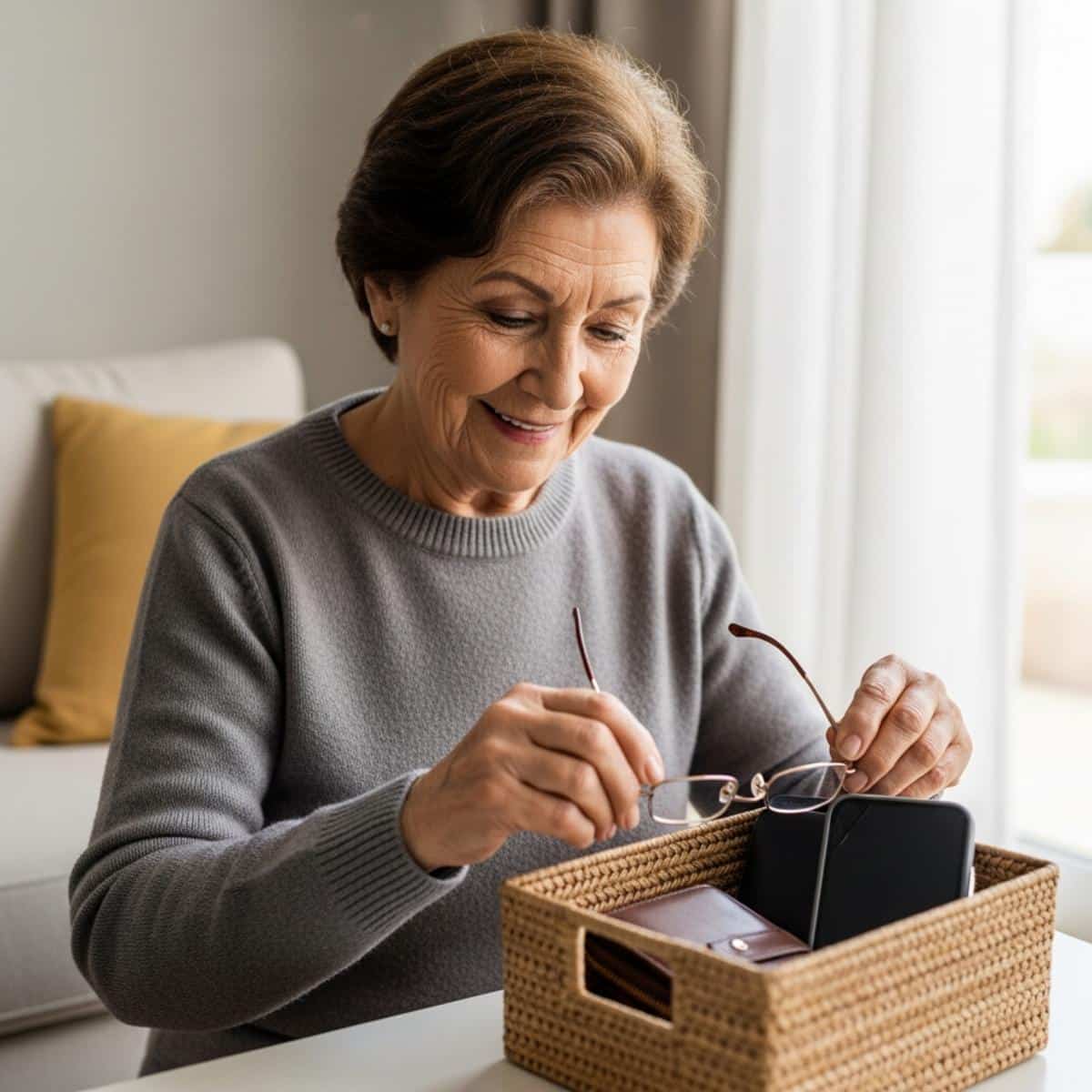
Every essential item needs exactly two designated spots. Not three, not six. Two.
One primary location and one backup. Glasses: nightstand plus kitchen counter. Keys: bowl by front door plus hook by garage door (if you use both exits regularly).
Why only two? Because three creates confusion. Four creates chaos. Six means you’re back to searching.
Choose spots based on where you naturally use or remove items, not where you think they ‘should’ go. If you always take your glasses off in the living room, don’t force yourself to walk them to the bedroom. Put a designated spot in the living room.
Make spots visible and accessible. Not in drawers. Not in cabinets. Out in the open where you can see them and reach them easily.
The spots must be convenient enough that using them requires less effort than setting items down randomly. Otherwise, you won’t use them consistently.
Essential Items That Need Forever Homes
• Glasses: Nightstand plus one daytime spot (kitchen counter, living room end table)
• Keys and wallet: Entry table, kitchen counter, or bowl by most-used door
• Phone and charger: Nightstand or kitchen—same spot every time
• Medications: Bathroom counter or kitchen, never moved from that spot
• Important papers: Single designated mail spot with action/file/recycle system
Someone with glasses in six different rooms faces an overwhelming search every morning. Someone with two designated spots they actually use never searches at all. Organizing essential items strategically helps you avoid the frustration of misplaced belongings.
These aren’t restrictions. They’re liberating. Once you commit to two spots, you never waste time searching again.
Choose your two spots for each essential item right now. Base the decision on your actual patterns, not ideal behavior. Where do you naturally set things down? Start there.

The Habit Stacking Secret That Makes This Automatic
Attaching your evening reset to an existing habit you already do every day makes it effortless. This technique is called habit stacking.
Your brain already runs automatic routines. After dinner, you clear dishes. Before bed, you brush your teeth. During evening news, you sit in your favorite chair.
These anchor habits require no thought or willpower. You just do them.
When you stack your new routine onto an anchor habit, it inherits that automatic quality. You’re not trying to remember a new task—you’re piggybacking on behavior that’s already hardwired.
Habit Stacking Examples
• ‘After I finish dinner dishes, I do my kitchen counter sweep’
• ‘During the first commercial of evening news, I sort today’s mail’
• ‘When I brush my teeth before bed, I place my glasses on my nightstand’
• ‘Before I sit down to watch TV, I put my keys in their bowl’
Compare these two approaches. First approach: decide ‘sometime in the evening’ you’ll do the reset. Maybe you remember, maybe you don’t. Second approach: do it ‘right after dinner dishes’ every single night. Same time, same trigger, automatic action.
The pattern forms in about 21 days. For the first three weeks, you’ll need to think about it. After that, not doing it will feel strange. Creating sustainable daily habits helps you maintain routines that support your wellbeing.
You’re not adding more to remember. You’re linking new actions to automatic behaviors you already do.
Set a simple phone alarm for 8 PM as a reminder. After 2-3 weeks of consistent practice, you won’t need the alarm anymore.
The Never-Search-Again Cheat Sheet: Your 8-Minute Evening Reset System
Download your free Never-Search-Again Cheat Sheet and stop wasting time hunting for everyday essentials—a simple 8-minute evening routine that creates automatic habits, not reliance on memory.

What to Do When You Break the System (And You Will)
Everyone breaks the routine occasionally. Travel disrupts it. Illness disrupts it. Houseguests disrupt it.
This doesn’t mean the system failed or you failed. It means life happened.
The key is getting back on track immediately, not perfectly. When you notice something out of place, return it to its forever home right away. Don’t wait for evening. Don’t leave it for later. See it, fix it, done.
After a disrupted period—a week of travel, recovering from illness—just do the Evening 8 the next available evening. Don’t try to make up for missed days. Don’t feel guilty. Simply start again.
Consistency over time matters more than perfect execution. One person does the routine 6 days a week for a year. Another does it perfectly for three weeks, misses two days, and gives up entirely.
The first person has organized spaces and never searches for essentials. The second person is back to daily frustration. Maintaining organized systems long-term requires patience and self-compassion when life interrupts your routines.
When you break the routine once, you haven’t failed. You’ve simply encountered the reality of being human. The Evening 8 is still there tomorrow.
The goal isn’t perfection. It’s building a pattern strong enough that returning to it feels natural.

Building Your Personal System
Start small. Choose three essential items: glasses, keys, phone. Pick their two forever homes based on your actual daily patterns.
For the next seven days, commit to using only those spots. Every single time you set down these three items, they go in their designated places. No exceptions.
Notice what happens. Track how many times you search for these items during the week. By day four or five, searching stops. The items are always where they belong.
After one successful week with three items, add your wallet and medications. Give them their forever homes. Practice for another week.
Then implement the full Evening 8 routine. Pick your anchor habit—after dinner, during TV, before bed. Set your 8 PM reminder alarm.
Follow the eight-step routine every evening for 21 days. Some nights it takes 8 minutes. Some nights it takes 6. Some nights it takes 10. Time varies based on how much got out of place during the day.
After 21 days, the routine feels automatic. After 60 days, not doing it feels wrong.
Your home resets to the same state every evening. You wake up every morning knowing exactly where everything is. The mental energy you used to spend searching gets redirected to things you actually care about.
This system doesn’t require a better memory. It requires better habits. Your brain is working exactly as designed—you’re just giving it consistent patterns to follow.
Moving Forward
Remembering where things are isn’t about memory. It’s about creating simple, consistent habits your brain can rely on.
The Evening 8 routine takes 8 minutes and gives you back hours of time you’d otherwise spend searching. It reduces frustration, creates calm, and reminds you that you’re completely capable of managing your daily life.
You’re not forgetful. You’re not declining. You were using an unreliable system. Now you’re building a better one.
Choose your three essential items and their forever homes this week. Start the Evening 8 routine tonight. Notice the difference in just a few days.
Share your experience in the comments. What items give you the most trouble? What forever homes have you chosen? Your insights might help another reader solve their own organizational challenges.