
Finding the right activity for someone living with dementia or Alzheimer’s can feel like searching for a needle in a haystack. Too simple, and it feels condescending. Too complex, and it leads to frustration that makes the whole effort counterproductive. And somewhere in between, there’s a sweet spot that actually helps.
That’s exactly the challenge I set out to evaluate when I got my hands on the QUOKKA 63 Piece Dementia Puzzle Set. As a Certified Senior Advisor (CSA) and Senior Home Safety Specialist (SHSS) at Graying With Grace, I look at products like this through a practical lens: does it actually work for real people in real situations, or does it just sound good on paper?
I personally handled and tested all three puzzles in this set, and I want to walk you through everything I found — the good, the honest limitations, and who this product genuinely serves best. Whether you’re a caregiver searching for meaningful activities or an older adult looking for something stimulating you can do on your own terms, this review is for you.


Quick Takeaways
- Problems solved: Provides accessible, therapeutic cognitive engagement for older adults with dementia, arthritis, or reduced dexterity
- Who benefits most: Older adults in early to moderate dementia stages, their caregivers, and memory care facilities
- Worth the investment: Yes — three puzzles in one set offers meaningful variety at a reasonable value
- Best feature for seniors: Large, easy-to-grip pieces that snap together smoothly without frustration
- Biggest limitation: May be too challenging for those in advanced dementia; the same company offers lower piece-count options for that stage
How This Could Help You
Picture this: Margaret, 78, was diagnosed with early-stage Alzheimer’s two years ago. Her daughter visits on weekends and struggles to find activities they can do together that don’t feel forced or childish. Card games have become too confusing. Television feels passive. And Margaret gets restless.
Or consider David, a 71-year-old retired engineer whose wife notices he’s been more withdrawn since his mild cognitive impairment diagnosis. He used to love building model trains, but his hands shake more now and the fine motor work frustrates him. He wants something that uses his brain without making him feel defeated.
Both Margaret and David are exactly who this puzzle set was designed for.
Do you ever wonder what it would mean for your loved one to experience a small, real sense of accomplishment every single day? Puzzle completion — even a modest 21-piece puzzle — delivers exactly that. It gives the brain a structured challenge, rewards completion with a visual payoff, and provides a natural talking point for caregivers and family members to share in.
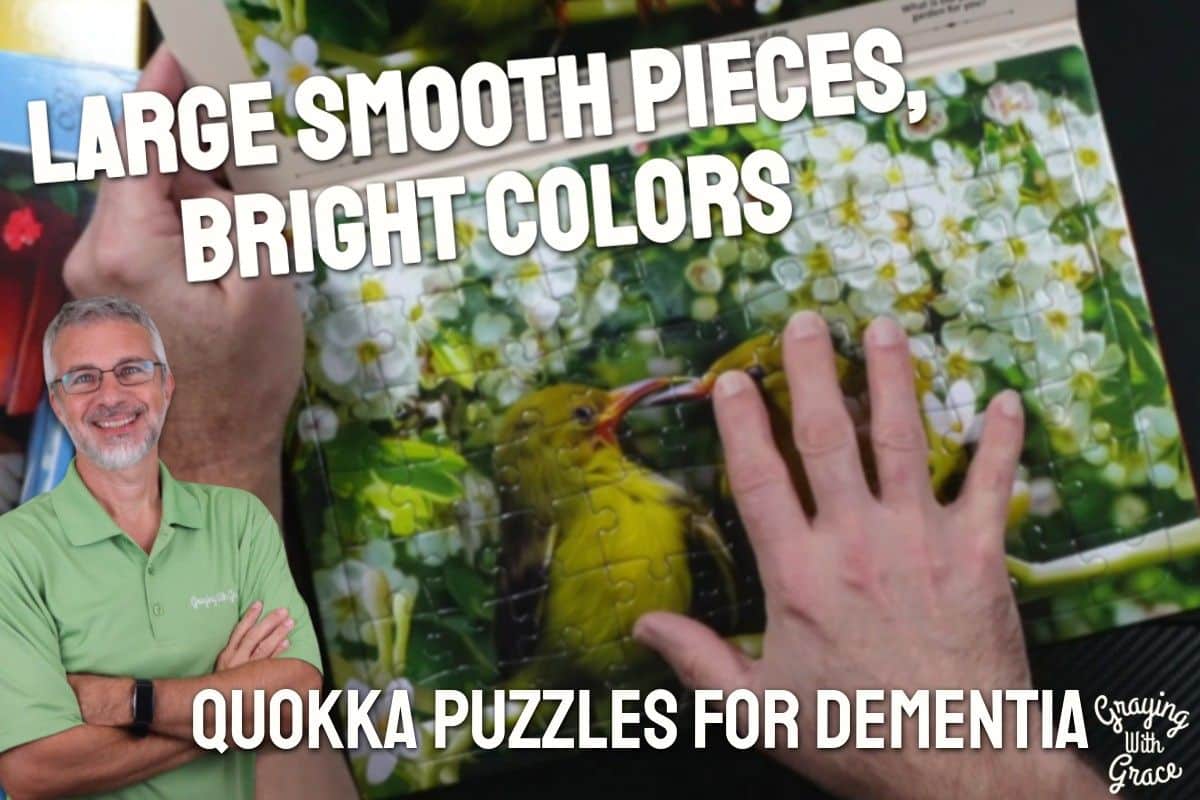
The three puzzles in this set — a watermill scene, a kitten surrounded by bright reds and warm colors, and birds in a spring garden — are all designed around familiar, comforting imagery. That familiarity matters more than many people realize. For someone living with dementia, recognizable subjects can spark genuine emotional connection and even memory recall.
Beyond the cognitive benefits, there’s something deeply dignified about engaging in an adult activity that feels age-appropriate. These are not children’s puzzles. The imagery is elegant, the construction is quality, and the experience respects the person doing it.
Important Details You Should Know
Each of the three puzzles measures approximately 9.1 by 13.3 inches when completed. That’s a very workable size — large enough to see clearly, small enough to fit comfortably on a lap tray, a dining table, or even a car seat.
As I demonstrated in the video, the puzzle can quite literally be worked right inside its own case while sitting on someone’s lap, almost like a small laptop. That’s a practical detail that makes a real difference for someone who spends much of their day in a chair or wheelchair.
Each puzzle comes in its own individual hard-backed cardboard case with a magnetic closure. When I evaluated this product, I noticed how well-designed that closure is — it holds firmly enough to prevent spills during transport but opens easily without requiring significant hand strength.
The pieces themselves are notably larger than standard jigsaw puzzle pieces. In the video, you can see that I compared one QUOKKA piece directly to a piece from a 500-piece puzzle, and the size difference is substantial. That size advantage means less fumbling, less frustration, and more success.
The total piece count across the set is 63 pieces — roughly 21 per puzzle. The watermill and kitten puzzles are more straightforward, while the birds-in-the-spring-garden puzzle is slightly more challenging due to color similarities among pieces. So even within one set, there’s a natural progression of difficulty you can use based on the day and the person’s current capacity.
Getting Started
The set arrives with all three puzzles pre-packaged in their individual magnetic cases. There is no complicated setup involved. Open a case, see the completed image printed inside the lid as a reference guide, and pour the pieces out or gently tip them onto the workspace.
As I demonstrated in the video, you can either bend the case slightly to guide pieces out one by one, or simply turn it over and let them tumble onto the table. Both approaches work well.
No tools, no batteries, no instruction manual. The only prep a caregiver might do in advance is flip through the memory-evoking questions included with each puzzle. These are printed cards that suggest conversation prompts tied to the puzzle’s imagery — a genuinely thoughtful addition that transforms a solo activity into an opportunity for connection and reminiscing.
For someone new to puzzles or in an earlier stage of cognitive difficulty, I’d suggest starting with the kitten puzzle. The bright, high-contrast reds and warm colors make piece placement a bit more intuitive. Save the birds puzzle for days when your loved one is feeling particularly sharp and engaged.
Ready to discover more innovative strategies for healthy, comfortable aging? Subscribe to our newsletter for expert-tested tips and product recommendations designed specifically for older adults.
Features That Matter to You
Let’s talk about what actually makes a difference when you’re living with or caring for someone with cognitive changes.
Large, smooth-edged pieces. When I evaluated this product, I noticed the edges are genuinely smooth — no rough cardboard burrs that snag arthritic fingers. The pieces interlock cleanly and satisfyingly. That smooth snap of a correctly placed piece is a small but meaningful reward for the person doing the puzzle.
Standard jigsaw shapes. This is more important than it sounds. Some puzzle manufacturers use unusual shapes and odd angles that add unnecessary confusion. As I pointed out in the video, these use traditional jigsaw puzzle shapes — the classic knob-and-socket design most people have worked with their whole lives. Familiarity reduces cognitive load.
Bright, high-contrast imagery. Research in dementia care consistently shows that bright colors — particularly reds, oranges, and yellows — improve engagement and attention in people with cognitive decline. The kitten puzzle especially delivers on this, and as I noted during my hands-on evaluation, the print quality is sharp and vivid.
Memory-evoking conversation prompts. This feature quietly elevates the product from a simple activity to a therapeutic tool. A caregiver can read a question aloud while the puzzle is being worked, creating a natural, low-pressure opportunity for reminiscing. That kind of structured conversation has real value in memory care.
Magnetic closure cases. Portability without mess. The magnetic lids hold securely enough to carry from room to room or pack in a bag without pieces scattering — a detail any caregiver who has ever chased puzzle pieces under a hospital bed will deeply appreciate.
Real Life Experience
Day to day, this set is as low-maintenance as it gets. There are no batteries to charge, no apps to update, no passwords to remember. You open a case, work the puzzle, close it back up. That simplicity is genuinely valuable.
In the video, you can see that once the puzzle is completed, everything tucks back neatly into the case and the magnetic lid closes it securely. That means a caregiver can hand it to a loved one, step away for a few minutes, and return to help close it up — no complicated cleanup, no lost pieces scattered across the floor.
As I demonstrated in the video, the puzzle works comfortably inside its own case while resting on a lap. This is a detail I want to highlight because it genuinely expands where and when this activity can happen. A doctor’s waiting room, a car ride, a recliner in the living room — the portability is real and practical, not just a marketing claim.
For longevity, the pieces are sturdy cardboard construction designed to withstand repeated handling. I did not observe any warping, delamination, or edge fraying during my evaluation. That said, as with any cardboard puzzle, keeping them away from moisture and storing them in their cases will extend their life considerably.
Cleaning is simple — a dry cloth if needed. These are not designed to be washed, so keeping drinks away during puzzle time is a reasonable precaution.
One real-world scenario worth mentioning: caregivers in memory care facilities can realistically rotate these three puzzles across multiple residents over the course of a week. The variety of difficulty levels means the same set can serve different individuals at different cognitive stages, which makes this a surprisingly versatile tool for professional care settings as well.
Will You Be Able to Use It?
This is the question that matters most, and the honest answer is: it depends on where someone is in their cognitive journey.
For older adults in early to moderate stages of dementia or mild cognitive impairment, these puzzles are well within reach for independent use. The piece count is manageable, the imagery is familiar, and the case provides a built-in reference image. Many people in this stage will find these satisfying and achievable on their own.
For those in moderate to advanced dementia, I would recommend treating these as assisted or guided activities rather than independent ones. A caregiver sitting alongside, handing over pieces one at a time, asking questions from the prompt cards — that transforms this from a potentially frustrating solo attempt into a genuinely connecting shared experience.
Physical requirements are minimal. The ability to pick up and place pieces is the primary motor skill involved. The large piece size accommodates mild to moderate hand tremors and arthritic grip. Someone with severe fine motor limitations may need more direct assistance, but the pieces are forgiving enough that a light grasp is usually sufficient.
Sitting comfortably is the main positional requirement. Because the puzzle can be worked inside its own case on a lap, even someone confined to a chair or bed can participate with minimal adjustment.
Important Considerations
I want to be straightforward with you here, because honest information helps you make the right choice.
Advanced dementia: If your loved one is in a late stage of dementia where they no longer recognize common objects or cannot follow simple sequential tasks, 21 pieces may still be overwhelming. The QUOKKA brand does make lower piece-count sets that would be a better fit. I’d encourage you to look at those options if this stage applies to your situation.
Significant vision impairment: The puzzle images are bright and well-printed, but they do require enough vision to distinguish colors and shapes at a moderate distance. For someone with significant vision loss, this activity would require close caregiver involvement and may not be fully accessible independently.
Theme preference: Birds and cats are widely appealing, but they are not universally so. If your loved one had strong interests in other subjects — sports, vehicles, landscapes — they may engage more enthusiastically with a differently themed puzzle set. This is not a flaw in the product, just a practical consideration.
Piece loss over time: With frequent use, pieces can go missing. The magnetic case reduces this risk considerably compared to a loose box, and the larger size makes pieces easier to spot if they do fall. But it is worth establishing a consistent storage habit from the start.
Always consult with your doctor or occupational therapist before making health-related product decisions, including choices about therapeutic activities for cognitive health.
Help When You Need It
QUOKKA is a brand that specializes in senior wellness products and has built a reputation for durability and purposeful design. For warranty details, customer support, and return policy specifics, I recommend checking the current product listing on Amazon, as these details can change and the most up-to-date information will always be there.
Because this product has no electronic components, there are no parts that require replacement or technical support. If a puzzle piece is lost, reaching out to the seller directly is your best avenue — many brands will accommodate replacement requests for missing pieces, particularly on newer purchases.
Amazon’s standard return window typically applies, making this a relatively low-risk purchase to try with a loved one before committing to multiple sets.
Understanding the Cost
Without getting into specific numbers, I can tell you that three therapeutic puzzles in a single, well-designed set represents strong value in this product category. Comparable dementia-specific activity products — sensory kits, reminiscence therapy tools, professionally facilitated memory care sessions — often cost significantly more for fewer or shorter-duration benefits.
The fact that this set includes three different puzzles at varying difficulty levels means you’re not buying a one-and-done item. A person can rotate through the puzzles, return to favorites, or use different ones on different days depending on energy and cognitive clarity. That extends the useful life of a single purchase considerably.
For caregivers managing a tight budget while trying to provide quality engagement for a loved one, this set hits a practical price point that makes regular use realistic — not a one-time special occasion item.
If your loved one progresses and needs easier puzzles, the same brand offers lower piece-count versions. That means you’re not locked out of a familiar, trusted product line as needs evolve.
Making It Work for You
A few practical tips that will make a real difference in how well this set serves your situation:
- Start with the kitten puzzle. The bold colors and high contrast make it the most visually intuitive of the three. Build confidence there before moving to the more nuanced birds puzzle.
- Use the conversation prompt cards actively. Don’t skip over them. These questions are a genuine bridge between the puzzle activity and meaningful conversation. Read one aloud while your loved one is working — the distraction-free focus of puzzle-solving often loosens up memory and storytelling in a way that direct questioning does not.
- Work the puzzle inside the case. Rather than dumping pieces on a table, try keeping the case open as the working surface. The completed image in the lid serves as a constant visual guide, and pieces stay contained and organized.
- Match the puzzle to the day. On high-energy, clear-headed days, try the birds puzzle. On slower or more fatigued days, stick with the kitten or watermill. Having three options means you’re never forcing a mismatch.
- Invite participation, don’t assign it. Place the open case nearby and let curiosity do the work. People with dementia often respond better to gentle invitation than to being told it’s activity time.
- Designate a storage spot. A small basket or dedicated shelf where the three cases always live reduces the chance of pieces being lost and creates a reliable routine anchor.
Our Recommendation
The QUOKKA 63 Piece Dementia Puzzle Set earns a genuine recommendation from me. It does what it promises, it’s built with real thought for the people who will use it, and it solves a problem that caregivers face every single day.
This is a strong choice if you are caring for someone in early to moderate dementia who can still engage with structured activities. It’s equally well-suited for older adults in the early stages of cognitive decline who want something stimulating they can do independently or with a grandchild nearby. Memory care facilities and professional caregivers managing group activities will also find real utility here.
Look elsewhere — or look at QUOKKA’s lower piece-count options — if your loved one is in a more advanced stage where 21 pieces feels overwhelming, or if they have significant vision impairment that would limit their ability to distinguish the puzzle imagery.
If you’re uncertain which product stage is right, an occupational therapist who works in memory care can be an excellent guide. They assess exactly these kinds of functional activity needs and can point you toward the right difficulty level with confidence.
Where to Get It
The QUOKKA 63 Piece Dementia Puzzle Set is available on Amazon. Use the button in the review box above to check current pricing and availability. Prices and stock can change, so checking directly gives you the most accurate, up-to-date information before you buy.
Conclusion
Finding an activity that respects dignity, supports cognitive health, and actually gets used — rather than sitting in a closet after one attempt — is no small thing. The QUOKKA dementia puzzle set gets that balance right in a way that many products in this category simply don’t.
Three well-designed puzzles, large accessible pieces, thoughtful conversation prompts, and a portable magnetic case that makes engagement possible anywhere. That’s a lot of genuine value packed into one straightforward purchase.
If you’ve been searching for a meaningful activity to share with a parent or partner living with dementia, or if you’re an older adult looking for something stimulating you can work through on your own schedule, I think you’ll find this set earns its place on the shelf.
Have you tried this puzzle set, or do you have questions about whether it’s the right fit for your situation? Leave a comment below — I read every one, and I’m happy to help you think it through.
![Older woman receiving meal dignity[1]](https://www.grayingwithgrace.com/wp-content/uploads/2026/02/older_woman_receiving_meal_dignity1-e1771334664816-450x300.jpg)
![Older couple pottery wheel studio[1]](https://www.grayingwithgrace.com/wp-content/uploads/2026/02/older_couple_pottery_wheel_studio1-e1771334326831-450x300.jpg)
![Older couple sofa adult child support[1]](https://www.grayingwithgrace.com/wp-content/uploads/2026/02/older_couple_sofa_adult_child_support1-e1771334039968-450x300.jpg)
![Older woman side sleeping position peaceful[1]](https://www.grayingwithgrace.com/wp-content/uploads/2026/02/older_woman_side_sleeping_position_peaceful1-e1771333748525-450x300.jpg)
![Older woman evening reset coffee table[1]](https://www.grayingwithgrace.com/wp-content/uploads/2026/02/older_woman_evening_reset_coffee_table1-e1771333481812-450x300.jpg)
![Elderly woman high contrast controls microwave[1]](https://www.grayingwithgrace.com/wp-content/uploads/2025/12/elderly_woman_high_contrast_controls_microwave1-e1765217272116-450x300.jpg)
![Older black couple transcribing home office[1]](https://www.grayingwithgrace.com/wp-content/uploads/2025/11/older_black_couple_transcribing_home_office1-e1763400682707-450x300.jpg)
![Senior woman setting boundaries holiday table[1]](https://www.grayingwithgrace.com/wp-content/uploads/2025/11/senior_woman_setting_boundaries_holiday_table1-e1762888071788-450x300.jpg)


