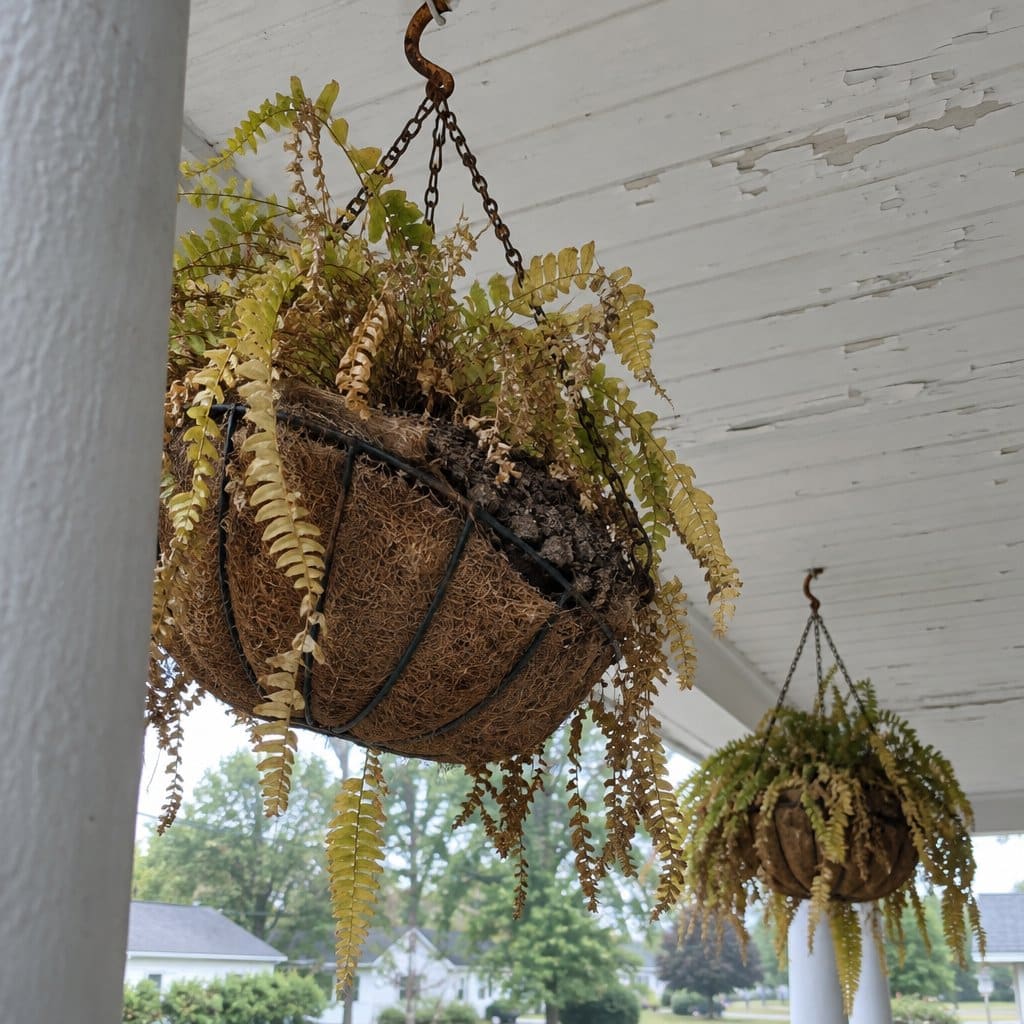
You pull into your parent’s driveway and notice the hanging baskets on the porch. The ferns are yellowing at the edges. The soil looks bone dry. You mention it gently, and Mom waves her hand — “I’ll get to it.” But you’ve heard that before, and you know she won’t.
The tension isn’t really about the plants. It’s the quiet worry underneath: she used to love that porch. She used to have fresh flowers by Memorial Day and full, swaying ferns all summer. That porch was something she was proud of.
Here’s the good news: there’s an easy fix that preserves everything she loves about her porch — the color, the fullness, the welcoming feel — without a single watering can or pruning session. Low-maintenance porch décor has genuinely come a long way, and artificial hanging ferns in particular are worth a much closer look than you might expect.
Low-Maintenance Porch Makeover Checklist
Download this complete checklist to transform your parent’s porch into a beautiful, welcoming space that requires zero maintenance—no more guilt about neglected plants, no more physical strain, and no more discussions about upkeep.
Why Keeping Up With Porch Plants Gets Harder (And Why That’s Completely Normal)
The Physical Demands Add Up Quietly
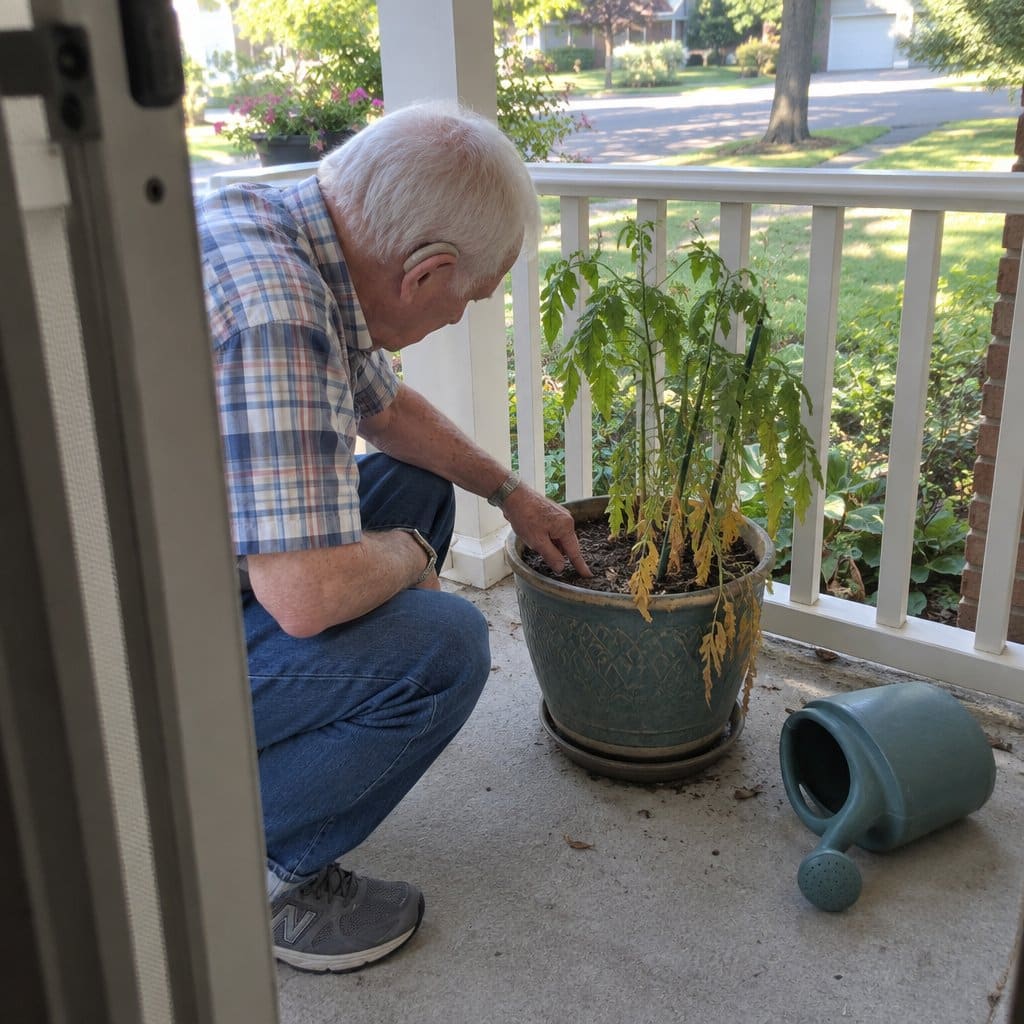
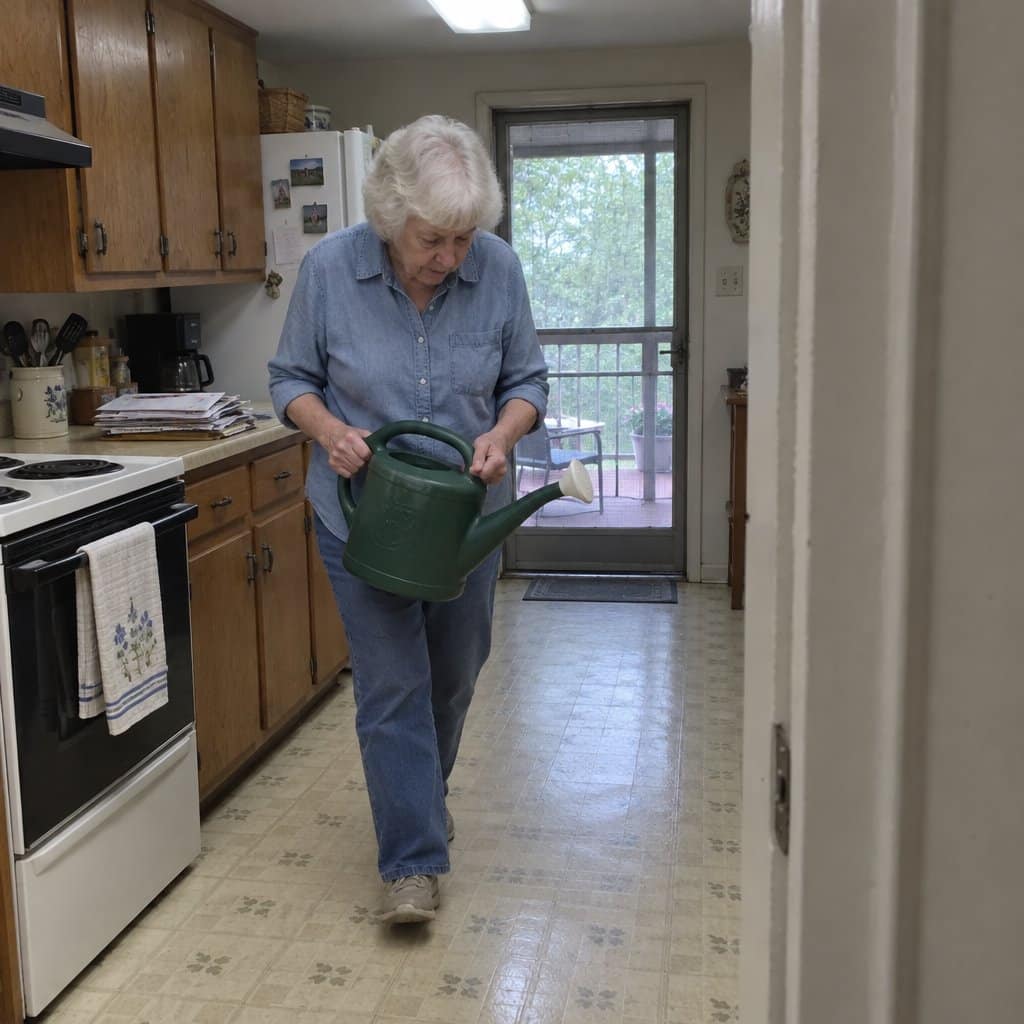
Tending outdoor plants sounds simple — but the tasks compound fast. Carrying a full watering can from the kitchen to the porch. Reaching up to unhook a heavy basket. Bending to check whether a lower planter is dry. Remembering to water every day or two during a hot week.
Each of those tasks is manageable on its own. Together, for someone dealing with knee pain, reduced stamina, or early balance concerns, they can quietly become too much — especially in midsummer heat, when watering frequency peaks and energy reserves are at their lowest.
Most Older Adults Won’t Ask for Help With “Simple” Things
Here’s what I’ve seen in my work with families navigating this kind of transition: many older adults are perfectly aware that something has become harder. They just don’t want to admit it about something that “shouldn’t” be difficult.
Watering the porch plants doesn’t feel like a big enough problem to bring up. So the plants go unwatered, the baskets start to look ragged, and the porch quietly stops being the welcoming space it used to be. For someone who took real pride in that space, that’s a small loss that accumulates.
Noticing Early Is Good Caregiving
If you’ve noticed the plants looking neglected and felt that small, familiar worry — you’re paying attention in the right way. Addressing this early, before it becomes a source of embarrassment or a safety issue (wobbly step stools, heavy cans near a door), is exactly the kind of proactive support that makes a genuine difference in daily quality of life.
This is also a good moment to think about other ways the home environment can be adjusted to support independence. Our guide to fall prevention at home is a practical companion read if you’re already in that headspace.
Not All Faux Plants Hold Up Outdoors — Here’s What Actually Matters
UV Resistance Is Non-Negotiable
This is the single most important feature to look for, and it’s worth repeating: if the artificial ferns aren’t UV-resistant, they will fade. Within one season. Colors that started as rich, deep green will turn a washed-out yellowish-grey by August.
Quality outdoor artificial ferns are made with UV-stabilized materials specifically designed to resist sun degradation. Look for this listed explicitly in the product description — not just “suitable for outdoor use,” but UV-resistant or UV-protected.
Construction Quality Makes the Difference Between Real-Looking and Obviously Fake
What separates a convincing artificial hanging fern from a cheap one is the detail work: leaf texture, color variation within individual fronds, and foliage density. Real ferns have subtle color gradations — lighter at the center, deeper toward the outer edges. Better artificial versions replicate this.
Density matters too. A sparse basket looks sparse whether the plant is real or artificial. Look for full, layered baskets with fronds that move naturally in a breeze.
Be Clear About What They Do and Don’t Do Well
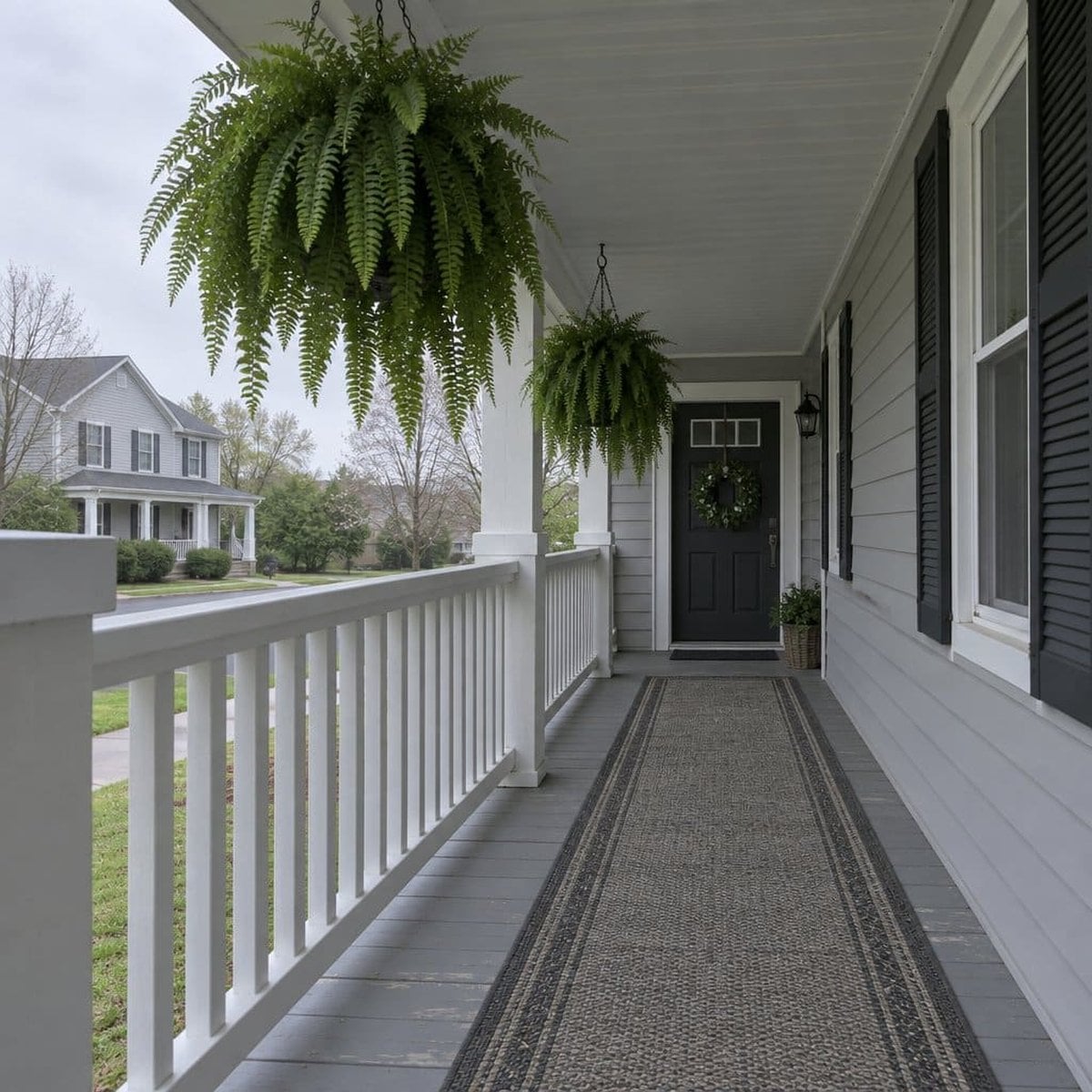
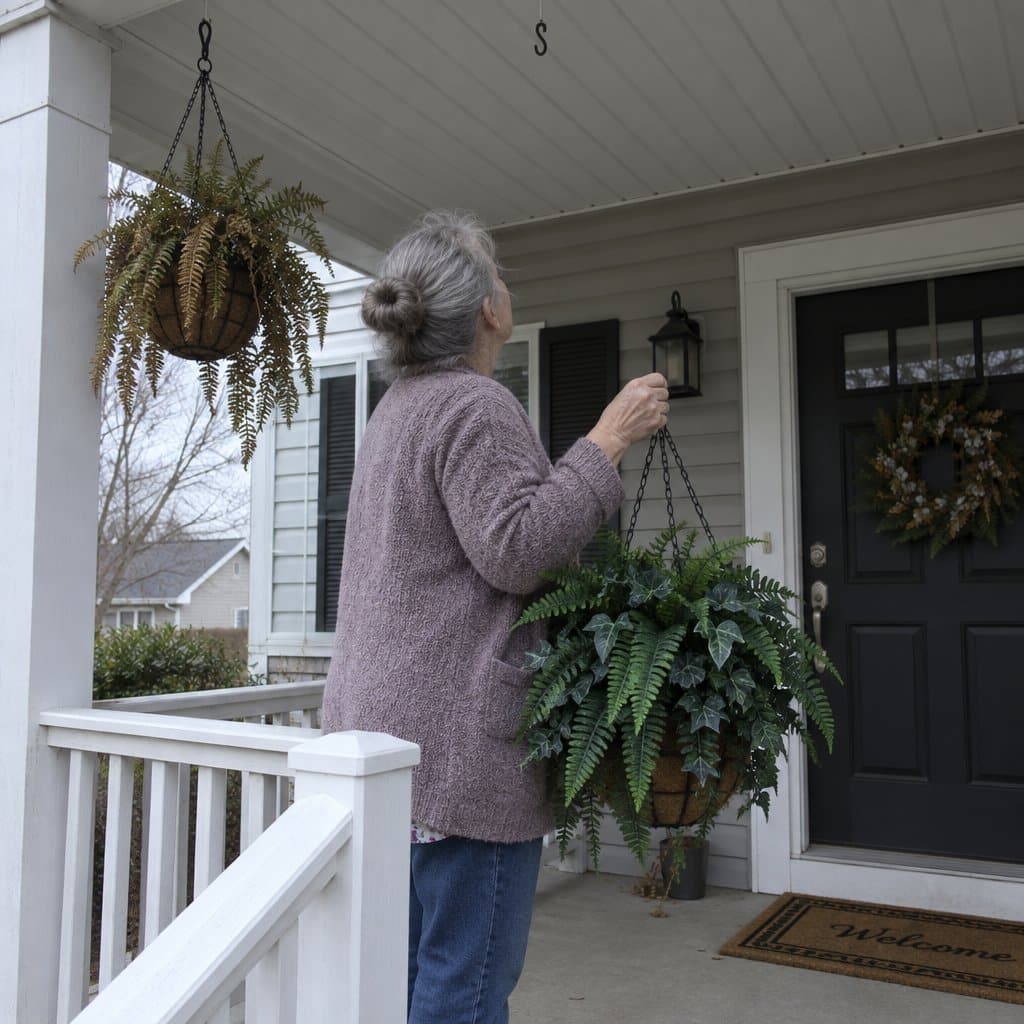
At porch distances — viewed from the street or from a few feet away — high-quality artificial hanging ferns are genuinely convincing. A neighbor walking by won’t know. Your parent’s porch will look full and cared for.
Up close, very high-quality ones still pass. Budget versions don’t.
If someone walks up to the porch and touches the fronds, they’ll know. That’s a real limitation, and it’s worth naming.
The right framing: these look exactly as good as real ferns at the distance most people see a porch — and they look that good every single day of the season, regardless of whether anyone remembered to water.
Weight and Hanger Quality Matter More Than You’d Think
Lightweight baskets are easier on porch hooks and railings, and they’re much easier to hang without a ladder or a second set of hands. Heavier baskets can strain older hooks or pull loose over time. When evaluating options, look for baskets with sturdy, rust-resistant hangers that won’t corrode after a season of rain exposure.
Here’s where artificial hanging ferns earn their place as the anchor of a low-maintenance porch setup — UV-resistant, realistically constructed, and genuinely zero-upkeep once they’re hung.


How to Arrange Faux Greenery So Your Porch Looks Intentional, Not Temporary
Odd Numbers and Varied Heights Create Visual Flow
A single artificial fern hung in the middle of a porch can look like a placeholder. Three baskets, hung at slightly staggered heights, look like a deliberate design choice.
If your parent’s porch structure allows for it, varying the hanging height by six to twelve inches between baskets adds dimension and makes the overall display look more like a real planted arrangement and less like a row of identical objects.
Pair Greenery With Low-Maintenance Accents
Artificial ferns do their best work when they’re part of a complete porch picture. A few additions that complement faux greenery without adding any maintenance burden:
- An all-weather outdoor rug — defines the space and adds color without needing care
- A front door wreath (also artificial) — extends the greenery look to eye level at the door
- A small bench or bistro chair — adds warmth and a sense of a lived-in, welcoming porch
- Solar porch lights — soft evening ambiance with no wiring or bulb replacement required
Shaded Spots Make Artificial Ferns Look Their Best
Here’s a useful styling note: artificial ferns look most convincingly real in partial shade. In full, blazing sun, even real ferns look stressed by midsummer. In a partially shaded spot, faux ferns look lush and full — exactly right.
If your parent’s porch has a mix of shaded and sunny exposure, prioritize the shadier spots for the hanging baskets and use the sunnier areas for a different accent — an outdoor rug, a decorative pot with a low-water succulent, or a faux topiary ball.
Railing vs. Overhead Hook Placement
Most artificial hanging baskets are light enough to hang from standard porch ceiling hooks without any reinforcement. For railing placement, look for baskets with adjustable hangers that can drape over or clip to a standard railing without hardware. This matters especially if your parent’s porch doesn’t have ceiling hooks already installed — railing placement requires no tools at all.
Faux topiaries, trailing artificial ivy, and mixed-foliage outdoor artificial plants round out a porch display beautifully alongside hanging ferns — and like the ferns, they hold their look season after season.


Subscribe to our newsletter for more tips: Join here
How to Swap Real Plants for Artificial Ones Without Making It Feel Like a Defeat
The Way You Introduce the Change Matters
For many older adults, accepting this kind of swap quietly feels like admitting they can’t manage something they once did easily. The plants aren’t just plants — they’re a symbol of capability and pride in the home. That feeling is worth respecting, not overriding.
I’ve seen caregivers make this transition go smoothly, and I’ve seen it go sideways. The difference is almost always in how it’s framed.
Frame It Around the Outcome, Not the Limitation
“These look incredible and you never have to think about them again” lands completely differently than “since you’ve been having trouble keeping up with the watering.”
The first framing is about the result — a porch she loves, with zero effort. The second is about what she can no longer do. Lead with the former, every time.
Let Her Choose
This is her porch. She should have a say in how it looks. Bring her into the decision — show her options for basket styles, foliage types, whether she wants pure fern fronds or a mixed-foliage look. Involving her in the choice means the result still feels like an expression of her taste, not something done to her space.
This approach mirrors something I try to reinforce whenever I talk about supporting older adults: facilitating a decision is very different from making one for someone. The same principle applies whether you’re helping a parent adapt their home or choose a mobility aid — the process matters as much as the outcome.
Start With One Basket
You don’t have to replace everything at once. Swap the most visible hanging basket first — the one she and her neighbors see every day. Let her see how it looks for a week. Most people are converted quickly when they realize the porch looks exactly as they want it to look, with no effort at all.
A Few Real Plants Can Stay
If she still wants some living plants on the porch, there’s a natural middle ground: a few low-water succulents in contained planters can coexist with artificial hanging baskets. The succulents require very little water, don’t need deadheading, and give her something living to tend if that matters to her. The hanging ferns handle the visual fullness. It’s a practical, dignified mix.
Installation is simple. Most artificial hanging baskets weigh very little and hang from standard porch hooks or a railing with no tools.
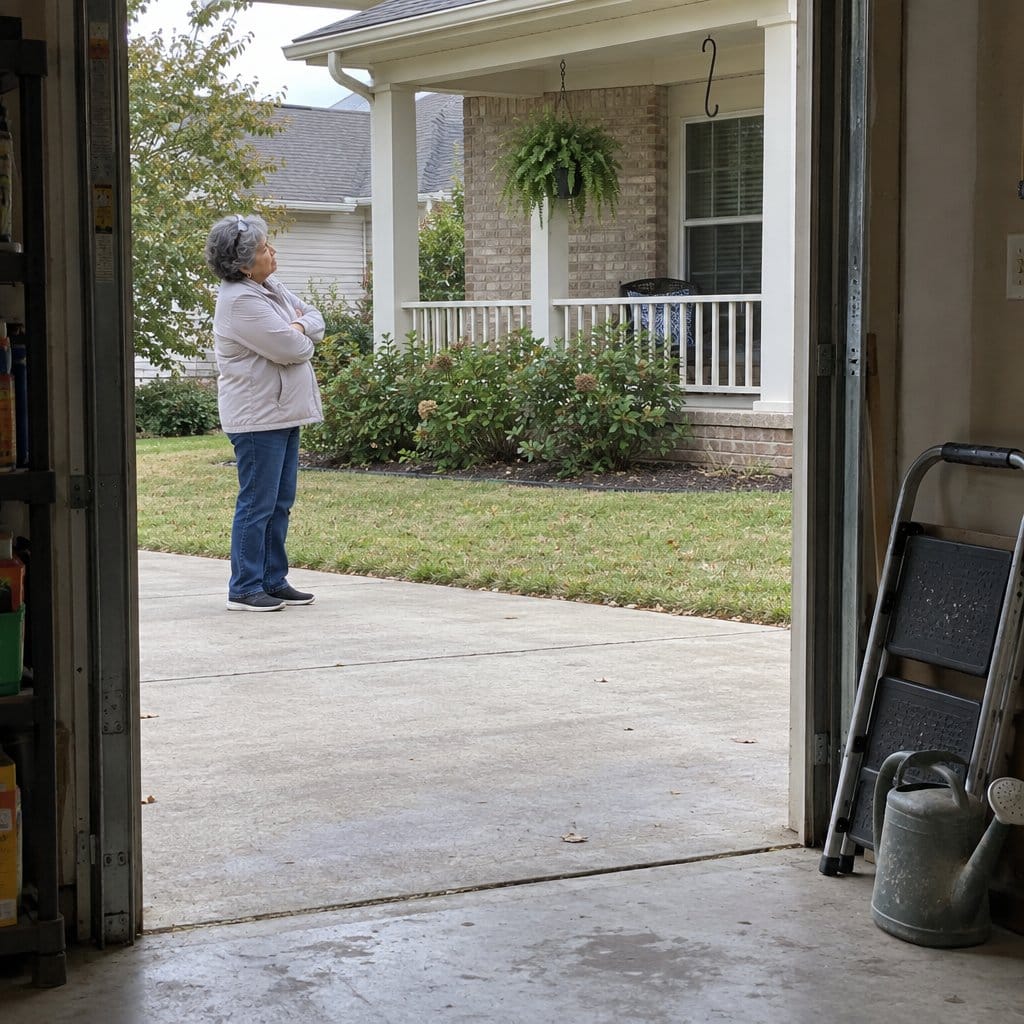
If a basket goes on a ceiling hook, have a family member hang it so your parent isn’t reaching up from a step stool.
Beyond Ferns: More Low-Upkeep Ways to Keep a Porch Looking Cared For


All-Weather Outdoor Rugs
A durable outdoor rug is one of the highest-impact, lowest-effort porch upgrades available. It defines the space, adds color and pattern, and holds up through rain and sun.
Choose one that lies flat with a non-slip backing, and keep it away from the top of the steps, since a sliding rug or curled edge is easy to trip on.
Most can be hosed off when dirty, with no special cleaning required.
Solar-Powered String Lights or Porch Lights
Solar lights charge themselves during the day and come on automatically at dusk. No wiring, no bulb changes, no remembering to flip a switch. For a porch that feels welcoming at all hours, this is a simple win.
Durable Outdoor Cushions With Removable Covers
A cushioned chair or small bench makes the porch feel like a place to actually sit and enjoy — not just a surface for plants. Look for cushions with covers that zip off and can go in the washing machine. They look put-together without being fragile.
A Lightweight, Easy-to-Shake Doormat
A good doormat is practical and finishing. The key word is lightweight: heavy coir mats are hard to lift for shaking and difficult to move for sweeping underneath.
A lighter mat does the same job and is much easier to manage, as long as it has a non-slip backing and low, flat edges so it doesn’t slide or catch a foot.
Faux Hanging Baskets in Different Styles
Artificial hanging ferns are the most popular choice for a reason — they’re lush, full, and convincingly real. But faux hanging baskets come in a range of styles: trailing ivy, mixed foliage, flower-accented versions with faux blooms woven through the greenery. Mixing styles across a porch creates visual interest and makes the overall display look more layered and intentional.
The goal of all of this isn’t to strip away personality from the porch. It’s to choose elements that hold their look without requiring a maintenance routine that’s quietly become difficult.

Low-Maintenance Porch Makeover Checklist
Download this complete checklist to transform your parent’s porch into a beautiful, welcoming space that requires zero maintenance—no more guilt about neglected plants, no more physical strain, and no more discussions about upkeep.
A Porch That Still Looks Like Hers
Choosing low-maintenance porch décor isn’t about lowering standards. It’s about keeping the home looking exactly the way she loves it — without the physical cost that comes with the real thing.
A porch with full, swaying hanging ferns and a welcoming front door still tells the same story it always did: someone lives here who takes pride in their home. The fact that those ferns don’t need watering is nobody’s business but hers.
If you’re thinking about other ways to help a parent maintain their home and independence with less effort, our guide to helpful products for older adults living alone is a good next read. It covers a lot of the same ground from a practical, dignity-first angle.
Is there one thing on your parent’s porch that’s become harder to keep up? Share it in the comments below — someone else is probably wondering about the exact same thing, and your experience might point them in the right direction.