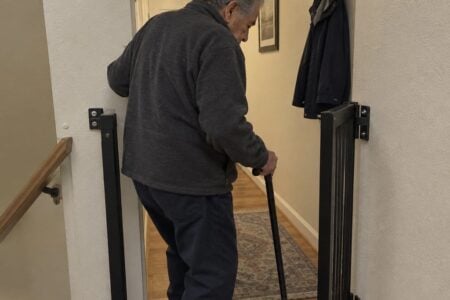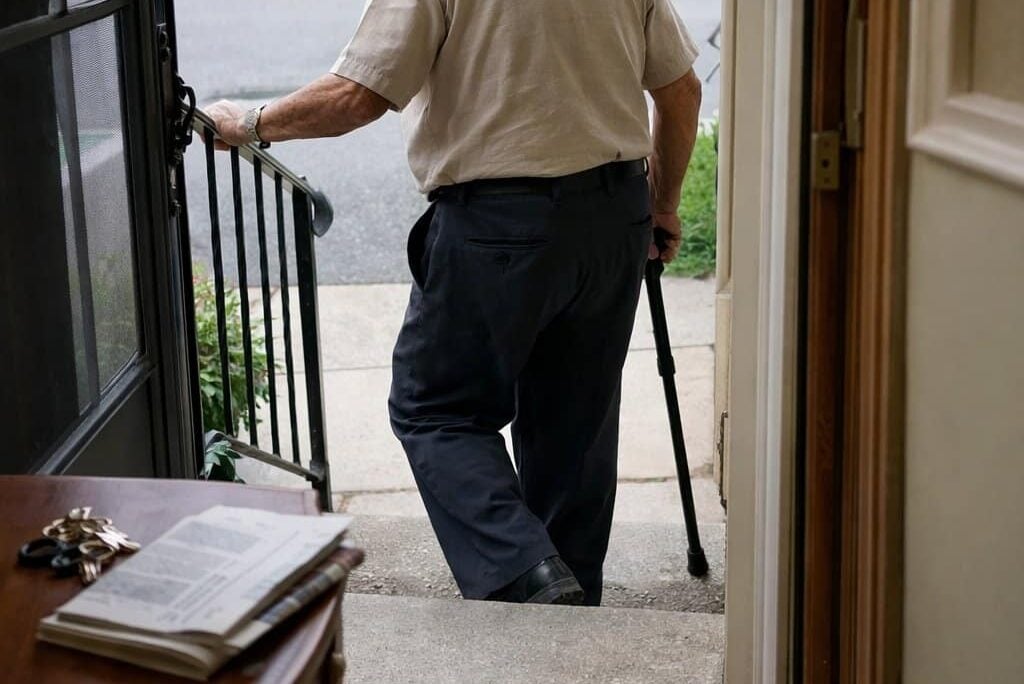
You noticed the rail wobbling on your parent's front steps. Or maybe you grabbed it yourself coming down and felt it shift — just slightly, but enough to know. So you pulled up a product page, picked something that looked sturdy and came in the right length, and ordered it.
Here's where most families land: what arrives looks fine. It goes on the wall. And the first time someone grabs it hard mid-fall, it gives.
Falls on stairs are among the most serious fall events for older adults, and a handrail that pulls away from the wall during a grab doesn't catch the fall — it contributes to it. The problem isn't that families don't buy handrails. It's that they buy the wrong type for the situation, or the right type anchored into the wrong substrate.
Before style, before finish, before height — the question this article answers is: which category of handrail fits this specific location, and what does the installation actually require to hold? That sequence is what makes the difference between hardware that looks right and hardware that works.
Handrail Shopping Guide: Grip, Height & Anchoring
Download this practical shopping guide to confidently evaluate any handrail before you buy—so you know exactly which products will actually hold under load and which ones to walk away from.
What to Look For
This is where most buyers skip ahead, and where most mistakes begin. The criteria below aren't bureaucratic checkboxes — they're the physical reasons a handrail either catches someone or doesn't.
Graspable profile and diameter
A handrail you can only touch is not a handrail you can use. IBC and ADA guidelines specify a circular rail between 1¼ and 2 inches in diameter as the graspable standard. Oval profiles in that size range are also compliant. Flat 2×4 or 2×6 cap rails — regardless of how solid the posts are — fall outside this range. You cannot get a functional grip on them under load. Bring a tape measure, not just your eyes.
Returns to the wall
Both ends of a compliant handrail should return to the wall or to the post. A rail that terminates in open air creates a snag point for sleeves and wrists, and it removes the natural stopping cue a returned end provides. If an existing rail doesn't return, it's not just non-compliant — it's actively less safe than one that does.
Wall clearance
Between 1½ and 2 inches of clearance between the rail and the wall is required for a graspable grip. Less than that, and knuckles contact the wall before the hand can close around the rail. This detail gets skipped in decorative installations and noticed the first time someone tries to use the rail in an emergency.
Height
ADA handrail height runs 34 to 38 inches above the stair nosing or walking surface. For older adults with balance impairment or limited range of motion, the lower end of that range — 34 to 36 inches — is typically more useful. It reduces the reach required and keeps the arm in a stronger position. Outdoor handrails may fall under different local code requirements; verify before installation.
Anchoring substrate
This is the single most important structural variable, and the one most buyers ignore. A wall-mounted handrail anchored into drywall with toggle bolts will hold light contact. It will not hold a 150-pound person grabbing hard mid-fall.
Lag screws into studs at 16-inch centers — or into solid blocking — are the minimum for a rail that functions as fall protection. Specifically: 3-inch lag screws minimum into wood framing, anchored into at least two studs for any continuous run. For exterior concrete installations, wedge anchors or sleeve anchors in the appropriate diameter for the base plate.
This is the point where Michael — standing in his parent's living room — may realize he needs a stud finder and a drill, or a handyperson. Not just a mounting kit.
Load rating
The rail and its mounting hardware should be rated for at least 200 pounds of force applied in any direction. That's the OSHA residential handrail load floor and a reasonable minimum for anything sold as fall-prevention hardware. If a product listing doesn't publish this figure, that absence is itself useful information.
Material and weather rating
For any exterior application, powder-coated steel, galvanized steel, or marine-grade aluminum are appropriate. Standard zinc or chrome finishes corrode. Interior applications have more flexibility, but humid areas — basements, mudrooms — still require moisture resistance. Graspable sleeves over existing wood rails need to account for seasonal wood movement; a sleeve that fits tightly in summer may bind or loosen in winter.
If you're also assessing the bathroom while you audit the stairs, the same graspability principles apply to grab bars — the diameter and anchoring requirements are nearly identical.
Outdoor Step Handrail Kits
Multi-step exterior entries are among the highest-risk fall locations for older adults, and a continuous handrail kit provides support across the full run from bottom to top. These kits are designed for one to five steps and mount into concrete, wood decking, or treated framing — giving the user something to hold throughout the entire ascent or descent, not just at one end.


Outdoor step handrail kits are designed for one to five exterior steps. They provide continuous support across the full run — from the bottom step to the top — and consist of a rail, angled posts, and base plates sized for installation into concrete, pavers, wood decking, or treated lumber framing.
This is the right product type when the entry has multiple steps and when a single fixed grab point would leave the user unsupported for part of the ascent or descent. Continuous support matters most for older adults who rely on the rail throughout the full movement, not just at the top or bottom.
Where it's the wrong choice: if the surface it mounts into is compromised — spalling concrete, heaving pavers, soft or rotted decking — installing a high-quality kit doesn't solve the problem. It attaches good hardware to a bad foundation. The substrate issue has to come first. This type is also more hardware than necessary for a single-step threshold, where a single-post option is cleaner and equally effective.
Metty Metal Hand Rails for Outdoor Steps, 4 Step Stair Railing Kit
This kit is rated for four-step runs and uses a powder-coated steel construction with angle-adjustable base plates. The adjustable base configuration matters for outdoor use — concrete stoops and decking surfaces are rarely perfectly level, and a base plate that can angle to match the surface distributes load more evenly than one forced into a gap.
The kit is suited to a multi-step front entry where the existing structure is sound and the user needs continuous support from grade to door. It is not the answer if the concrete pad shows settling, cracking, or uneven heave. Hardware is only as safe as what it's anchored into.
Check the product documentation carefully for whether concrete anchors are included or sold separately. Many kits in this category include hardware only for wood installation.
CHR CR Fence & Rail 2–3 Step Stair Handrail
This option covers two- to three-step entries and is built around a simpler rail-and-post configuration suited to shorter runs. The rail profile is graspable within the target diameter range, which is the baseline requirement any kit must clear before other features matter.
For a two-step front entry where the stoop is solid and level, this kit fits without the added structural complexity of a longer-span installation. Shorter runs mean fewer anchor points, which makes the quality of each anchor point more critical — there's less distributed load.
Verify the stated weight capacity in the product listing before purchase. A kit without a published load rating for the bracket-to-wall or bracket-to-surface connection should prompt additional research.
VIVOHOME 3-Step Hand Rails for Outdoor Steps with Curved Ends and Balusters
The inclusion of balusters in this kit gives it a more finished visual profile than a simple rail-and-post design. For a front entry where aesthetics matter alongside function, that's a practical consideration — a rail that looks integrated into the home is more likely to stay in place and be maintained.
The curved ends address one of the compliance details most outdoor kits overlook: a rail that terminates in open air creates a snag hazard. Curved or returned ends reduce that risk without requiring a separate modification.
This kit suits a three-step entry where the user wants continuous support and a cleaner installation profile. The baluster configuration does add installation complexity compared to a minimal two-post design; factor that in if the installer is working alone.
Metty Metal Hand Rails for Outdoor Steps, 3 Step Stair Railing Kit
This is the three-step variant of Metty Metal's powder-coated steel kit. The construction and base plate logic are consistent with the four-step version — the difference is span, not structural approach.
For a three-step entry, this kit provides continuous support across the run without the added material of a longer configuration. If the entry has exactly three risers and the surface is sound concrete or treated lumber, this is a direct-fit option.
As with any steel outdoor kit, inspect the powder coat integrity at installation and seasonally thereafter. Chips or scratches at the base plate interface — where moisture contacts steel — are where corrosion begins.
CHR CR Fence & Rail Handrails for Outdoor Steps, 1–2 Step Stair Railing Kit
This kit is designed for one- to two-step entries, which are among the most commonly underprotected transition points in a senior's home. The single step from a garage into the house, or from a porch to a walkway, gets treated as trivial — until it isn't.
A continuous rail on a one- or two-step run provides a reference point for the user's balance throughout the transition, not just at the moment of peak risk. For older adults who are beginning to experience balance uncertainty, that reference matters.
Confirm the base plate configuration is appropriate for your surface type. A one-step entry often has a narrower stoop than a full multi-step approach, which constrains where the base plates can land.
Bobolish Upgrade 2-in-1 3 Step Stair and Horizontal Handrail
The 2-in-1 designation on this kit refers to its configurable geometry — it can be set up for a standard stair angle or repositioned for a more horizontal application. That flexibility is worth noting for entries where the step geometry doesn't conform to a standard rake angle.
The adjustable span — listed at 40 by 38 inches — gives the installer some room to fit the kit to the actual step configuration rather than forcing the steps to conform to the product. For entries where the rise-to-run ratio is shallower or steeper than standard, this adjustability reduces the chance of a forced or poorly-angled installation.
This kit suits a three-step entry where the geometry is slightly nonstandard and the installer needs flexibility in the base plate positioning. It is not a substitute for correct anchoring into a sound substrate.
Metty Metal 3-Step Hand Rails for Outdoor Steps with Black Balusters
This Metty Metal variant adds black balusters to the three-step kit, giving it a more enclosed profile than the basic rail-and-post configuration. The balusters don't change the graspability of the top rail, but they add visual definition to the stair boundary — a detail that helps older adults with depth perception changes read the edges of each step.
The black powder coat finish provides reasonable weather resistance for a painted steel product, but — as with all painted steel outdoor installations — the base plate areas need seasonal inspection. Water pooling at the interface between a steel plate and a concrete or wood surface accelerates corrosion faster than the rail surface itself.
This option is suited to a three-step front entry where the user wants a more substantial visual boundary in addition to a graspable rail.
Single-Post Grab Rails
A single-post grab rail provides one solid, fixed grab point for a one- or two-step threshold transition — the kind of brief step that gets treated as trivial until it causes a fall. These freestanding posts anchor into a concrete stoop or wood deck and give the user a reliable reference point for those two or three seconds when balance is most at risk.


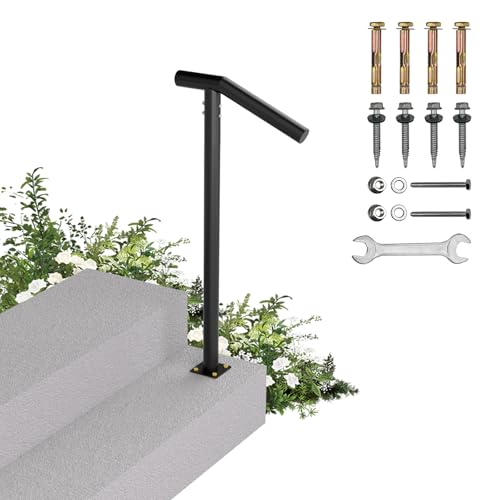

A single-post grab rail is a freestanding post — typically 30 to 36 inches tall — with a grip on top, anchored via a base plate into a concrete stoop, wood deck, or porch floor. It provides one fixed point of contact for a transition that lasts two or three seconds.
This is the right product for a one- or two-step threshold where a full handrail run is more hardware than the situation requires: the single step from a porch to the yard, the one-step entry from a garage into the house, any transition where the user needs one solid thing to grab and then they're done.
Where it is the wrong choice: a single post does not provide continuous support. For anyone with significant balance impairment, Parkinson's, or a history of mid-stair falls, a single post does not replace a continuous rail on a multi-step run. If the user grabs the post at the wrong point in their stride, it doesn't catch them. This product is not equivalent to a full stair rail — it is a different product for a different situation. Installing one and considering the stair problem fully solved is a mistake.
For a deeper look at how grab points interact with daily movement patterns, the same principles that apply here also apply to fall prevention throughout the home.
Aatrixkit Single Step Handrail, 1 or 2 Steps Single Post Handrail
This wrought iron single-post option uses an in-ground or surface-mount base plate configuration for one- to two-step applications. The rust-proof finish designation matters for outdoor installations — bare or poorly finished iron at a concrete interface is a maintenance problem within the first winter in wet climates.
The post is suited to a front stoop with one or two steps where the concrete pad is sound and level. Four-point base plate anchoring distributes lateral load better than two-point configurations, so confirm the fastener pattern before comparing products in this category.
This is a fixed-point support, not continuous railing. Make that distinction explicit when selecting it for a family member — it tells someone where to grab, not how to get safely from top to bottom.
VEVOR Single Post Handrail Wrought Iron Post Mount Step Grab
VEVOR's single-post option uses a longer post configuration, which affects the anchoring geometry. A taller post with a wider base plate distributes lateral force across a larger surface area — relevant when the primary loading direction is someone pulling outward or sideways as they catch their balance.
The wrought iron construction provides mass that resists deflection under load better than hollow-core alternatives. For a user who leans into the post rather than just touching it, that rigidity matters.
Verify the base plate dimensions and anchor point count in the product listing. For this product category, more anchor points and a wider plate are structural advantages, not just aesthetic ones.
VEVOR Happybuy Single Post 1–2, Black Steel Railing, 330 lb Capacity
The published 330-pound capacity on this post is notable — it's one of the higher stated ratings in this product category, and the baking varnish finish is more durable than standard painted steel for outdoor conditions.
For older adults who are heavier or who apply significant force when catching their balance, a higher rated post matters. The load rating should appear in the product's technical specifications, not just the title; verify it before purchase.
This post suits a one- to two-step entry with a sound concrete surface and a user who needs a robust, high-rated grab point. The black finish is less likely to show weathering than chrome alternatives in wet climates.
smusei Single Post Handrail Stair Railings for Outdoor Steps, Fit 1–2 Steps
This single-post option is designed specifically for one- to two-step outdoor entries. The configuration is straightforward — post, base plate, grip — without adjustable-height features, which simplifies installation but requires confirming the fixed height works for the user.
For an older adult between 5'2" and 5'8", a standard 36-inch post height lands in the ADA-compliant range for a one-step entry. Outside that height range, verify the post height in the product specifications before ordering.
Grip surface texture on the handle is a detail worth examining for users with reduced hand strength or arthritis. A smooth cap requires more grip force than a rubberized or knurled surface.
Vlaeng 1–2 Step Single Post Handrail, Wrought Iron with D-Ring Handle
The D-ring handle profile on this post is a design distinction worth noting. A D-ring allows the user to hook their hand through the grip rather than relying solely on finger closure — meaningful for users with weakened grip or hand pain who cannot reliably close their fingers around a standard round post cap.
For an older adult with rheumatoid arthritis or post-stroke hand weakness on the grab-side, that grip geometry can make the post usable where a round cap would not be. Evaluate the specific user's hand function before defaulting to a standard round grip.
The wrought iron construction and powder-coat finish are appropriate for outdoor installation. Confirm the base plate fastener count and anchor diameter before installation into concrete.
Ironlux Upgraded Single Post Handrail, White, Metal Freestanding
The white powder-coat finish on this post makes it a fit for entries where the existing hardware or trim is light-colored — a detail that matters when the goal is a rail that gets used, not avoided because it looks out of place. A rail that blends with the home's appearance is more likely to be accepted by an older adult who has been resistant to visible assistive hardware.
The freestanding designation typically refers to a surface-mount base plate configuration rather than an in-ground anchor. For concrete or paver surfaces, confirm that the included hardware is appropriate for the surface type — surface-mount into pavers requires a different anchor than surface-mount into poured concrete.
This post suits a one- to two-step entry where aesthetics are a factor in product acceptance and the surface is sound and level.
Graspable Rail Sleeves and Covers
When an existing handrail is structurally sound but has a flat 2×4 or 2×6 cap profile that cannot be gripped under load, a graspable sleeve converts it to a code-compliant graspable profile without removing or replacing the underlying structure. These covers are the most cost-effective intervention available when the only problem is the grip surface, not the anchoring.


A graspable rail sleeve is a round or oval profile — typically PVC, neoprene, foam, or aluminum — that slides or clamps over an existing flat 2×4 or 2×6 cap rail. It converts a non-graspable profile to a code-compatible one without removing or replacing the underlying structure.
This is the right product when the existing rail and its posts are structurally sound — no wobble, posts anchored into solid material, no movement under firm force — but the profile fails the graspability test. It is the most cost-effective intervention available when the structure is already correct in every way except the grip surface.
Where it is wrong: a sleeve fixes the grip problem. It does not fix the anchoring problem. If the rail it slides onto wobbles, the finished assembly wobbles. A sleeve installed over a structurally compromised rail masks a hazard rather than resolving one. Do not skip the pull test.
Before selecting a sleeve, grab the existing rail firmly with both hands and apply lateral, downward, and outward force. If it moves in any direction, the sleeve is not the next step — the anchoring is. If it holds firm and the only problem is the flat profile, a sleeve is a 20-minute project that genuinely works.
The same audit logic that applies here extends to the full exterior of the home. Checking every transition point before wet or icy weather catches problems when they're fixable, not after a fall.
U.S. Pool Supply 6-Foot Pool Handrail Cover with Zipper
This sleeve is marketed as a pool handrail cover, but the underlying function — adding a graspable, non-slip profile over an existing round metal rail — applies directly to residential step rails with a compatible diameter. The zipper closure allows installation without removing end caps or hardware.
At six feet, this sleeve suits longer rail runs — a multi-step stair rail or a longer deck rail — where a shorter sleeve would leave sections of the original profile exposed. The zipper closure line runs along the underside of the rail when installed, keeping it out of the primary grip area.
Confirm the interior diameter against your existing rail dimensions before ordering. A sleeve that's slightly too large will shift under use; one that's too tight won't close over the rail.
Ginchain Pool Handrail Cover, Zippered Grip Sleeve, 6 ft, Royal Blue
The bright blue color of this sleeve is functionally useful in one specific context: for older adults with reduced contrast sensitivity or early-stage vision changes, a high-contrast rail cover makes the rail's location immediately visible. A rail you can see easily is a rail you reach for — and finding it without fumbling matters at the top of a step descent.
The zipper installation and six-foot length match the U.S. Pool Supply option in configuration. The material and grip texture are the differentiation points to evaluate between similarly-sized options in this category.
This sleeve suits an outdoor rail where the existing structure is sound and increased visual contrast is a priority alongside grip improvement.
Frantie Pool Handrail Cover, 4 Feet Zipper Slip Resistant Rail Grip Cover
The four-foot length makes this sleeve appropriate for shorter rail runs — a three- or four-step stair where the total rail span doesn't reach six feet. Buying a longer sleeve than the run requires means trimming or leaving excess, which creates a loose end that can shift.
The slip-resistant surface texture is the feature most relevant to its function as a grip aid. For older adults with reduced hand strength, a sleeve that adds friction to the grasp reduces the effort required to maintain contact during a transition.
Confirm the sleeve's inner diameter matches your rail's outer diameter before purchase. Pool rail sleeves are typically designed for 1.5- to 1.9-inch diameter round pipe, which falls within the ADA-compliant graspable range.
Helba Pool Handrail Cover, 4ft Neoprene Sleeve with Zipper, Gray
Neoprene is a material distinction worth understanding in this category. It is softer and more compressible than PVC or rigid aluminum, which means it conforms slightly to the user's hand shape during grip. For users with arthritis or reduced grip strength, a material that yields slightly is easier to hold than one that doesn't.
Neoprene is also weather-resistant — relevant for outdoor installations where the rail sees temperature cycling, UV exposure, and moisture. It holds up better than foam alternatives in those conditions.
The gray color is neutral and less likely to read as pool or recreational equipment when installed on a residential stair rail. For older adults who are resistant to visible assistive modifications, lower-profile aesthetics reduce friction.
Mydrissu RV Handrail Cover with Zipper, Camper Grab Rail Grip Sleeve, Black
This sleeve is marketed for RV handrails — an application where the rail diameter and installation requirements are similar to residential step rails. The RV application implies outdoor durability: exposure to sun, rain, and temperature variation is the design assumption, not indoor-only use.
The black color and generic profile make it visually compatible with powder-coated black steel handrail kits — a consideration if the sleeve is being installed over a section of rail that connects to existing black hardware.
Check the specified interior diameter against your rail. RV handrail dimensions vary by manufacturer, so don't assume compatibility — measure first.
Kakolvan Pool Handrail Covers Non-Slip for Pool Railing Ladder, 6 Ft
This six-foot, non-slip sleeve is designed for pool ladder rails, which are subject to wet-hand gripping — arguably a higher grip-demand environment than a dry residential stair. A product that performs under that condition transfers well to a residential stair application where rain, dew, or wet hands from a garden hose may be factors.
The non-slip surface specification is the primary functional feature here. For an outdoor stair rail that gets wet, grip texture matters more than color or material stiffness.
One sleeve covers a six-foot run. For a longer run — or for a rail that continues past the stair section — two units may be needed. Measure the full rail length before ordering.
Stromberg Carlson Lend-A-Hand Zip Grip RV Handrail Neoprene Cover
Stromberg Carlson is a recognized name in RV accessories, and this sleeve reflects a more purpose-built design for the grip-aid function than a generic pool cover repurposed for the application. The Lend-A-Hand branding is specific to the assist function, not just the protective function.
The neoprene construction and zipper closure are consistent with other options in this category. The differentiation is in the brand's track record for this specific application — RV users are a population that uses this product in the same physical context as a residential step rail.
For an older adult who wants a product designed with grip assistance as the primary goal rather than a secondary use case, this option's design intent is closer to the residential application than pool ladder covers.
Frequently Asked Questions
What height should a handrail be for an older adult?
The ADA standard runs 34 to 38 inches above the stair nosing or walking surface. For older adults with balance concerns or limited range of motion, staying at the lower end of that range — 34 to 36 inches — makes the rail easier to reach and use without overextending. Local building codes may vary from the ADA standard, so check your jurisdiction's requirement before installation.
How do I know if my existing handrail is actually safe?
Grab it with both hands and apply firm force — lateral, downward, and pulling outward from the wall. If anything shifts, squeaks, or feels uncertain under that force, it is not safe for fall protection. Also check the profile: if you can't wrap your hand around it with your thumb and fingers meeting or nearly meeting, it's not graspable in any meaningful way.
Can I install a handrail in drywall if there's no stud where I need it?
Not safely, for a rail intended to catch a fall. The options are: locate the nearest stud and adjust rail placement, install blocking between studs (which requires opening the wall), or use a surface-mounted blocking plate that spans two studs. Toggle bolts and standard drywall anchors are not appropriate for this application.
My parent's outdoor rail is fine but the profile is flat — is a sleeve enough?
If the posts are solid, the anchoring is sound, and the rail doesn't move under firm two-handed force, yes — a graspable sleeve is an efficient fix. It converts the grip profile without requiring any structural work. But do the pull test first, without exception. A sleeve over an unsound structure is not a solution; it's a hazard with better grip texture.
Is one handrail on a staircase enough, or do you need both sides?
For a private residence, code typically requires one rail on stairs narrower than 44 inches. But for older adults — especially those with one stronger side due to stroke, surgery, or asymmetric weakness — rails on both sides make the stair usable in both directions of travel and provide a second catch point if the primary hand slips. When in doubt, rail both sides.
What's the difference between a grab bar and a handrail?
Grab bars are fixed support points designed for static loading — holding position, lowering into a seat, rising from one. Handrails provide continuous support across a span of travel. Both must be graspable and properly anchored, but they serve different movements and different locations. If you're also assessing bathroom safety, the same anchoring and diameter principles apply to grab bars — and both audits are worth doing in the same visit.
Want trusted guidance on aging in place, home safety, and the products that actually work? Subscribe to the Graying With Grace newsletter for expert-tested recommendations delivered directly to your inbox.
Hacks and Advice
Do the pull test before you buy anything.
Walk every rail in the home and grab each one firmly with both hands. Apply force in multiple directions — lateral, downward, outward. This takes five minutes and tells you more than any product description. A rail that doesn't move is a rail that works; you may not need to buy anything there. A rail that shifts under moderate pressure needs more than a sleeve, and buying a sleeve first wastes time and leaves the hazard in place.
Stud location decides rail placement, not the other way around.
A common mistake is deciding where the rail should go, ordering the hardware, and then discovering the studs don't align with the bracket spacing. Start with a stud finder. Mark the studs. Then select hardware whose mounting pattern fits what you found. A rail shifted two inches to hit solid framing is infinitely safer than a rail in the preferred location that pulls out under load.
Outdoor installations need a seasonal check.
Freeze-thaw cycles, moisture intrusion, and wood movement affect outdoor anchoring more than most homeowners expect. Every fall — before wet or icy weather arrives — test every exterior handrail with the same two-handed pull test. Tighten any fasteners that show play. Inspect base plates for rust at the surface interface, where water pools between steel and concrete or wood. Catching a loosening anchor early costs nothing. Catching it after a fall costs everything.
Finish last, function first.
Many families choose a rail finish to match existing door hardware or trim and then discover their preferred product doesn't meet the structural rating or graspable diameter requirement. Choose the correct structural product first. Match finish second, or don't match at all. A rail that holds is always the right color.
For arthritic or weakened grip, texture matters more than material.
Rubber-coated, neoprene, or foam-wrapped rail profiles require significantly less grip force than bare aluminum or smooth PVC. If the user has rheumatoid arthritis, limited hand strength, or reduced sensation in the fingers, prioritize grip texture in product selection. A rail that requires less force to hold is one that actually gets used — and kitchen tools designed for arthritic hands follow the same logic. Grip design is a safety feature, not a comfort upgrade.
A sleeve is a 20-minute project. A missed anchoring problem is a six-month recovery.
If the existing rail passes the pull test but fails the grip test, a sleeve is genuinely fast, low-cost, and effective. But the pull test comes first, every time. Skipping it is how a sleeve becomes the thing someone grabbed when the rail gave way.
Single-post rails solve a specific problem — don't expand the scope.
I've seen families install a single-post grab rail at a three-step entry and consider the stair problem handled. It isn't. A single post gives one fixed point of contact for a two-second transition. It does not substitute for continuous support on a multi-step run. Know what you're solving before you buy.
Handrail Shopping Guide: Grip, Height & Anchoring
Download this practical shopping guide to confidently evaluate any handrail before you buy—so you know exactly which products will actually hold under load and which ones to walk away from.
Conclusion
A handrail that fails isn't a product problem. It's a sequencing problem.
Most buying errors happen because families move directly from "we need a rail" to "which one looks good" without passing through the questions that actually determine whether the rail will hold: What is the substrate? Which product type fits this location? What does a sound installation require here?
The correct sequence is: pull test first, substrate assessment second, product type selection third, product selection fourth, finish last. In that order, the risk of buying something that looks right and fails under load drops to near zero.
Walk every handrail in the home today — including the ones that seem fine — and give each a firm two-handed pull. If anything moves, shifts, or feels uncertain, write it down before doing anything else. That list is where the next conversation starts.
If you've arrived at this article after a fall or a close call, the next read is what to do in the immediate aftermath — and what most families get wrong in those first hours. A handrail audit is one piece of the picture. The full picture includes every location where anchoring, surface transitions, and daily movement patterns intersect.
If you'd like help assessing the complete picture — not just stairs, but every fall risk location in the home — I'd encourage you to reach out about a Home Safety and Independent Living Assessment. It covers the full environment: graspability, anchoring, lighting, surface transitions, and the specific movement patterns of the person living there. A handrail is where the audit often starts. It rarely ends there.