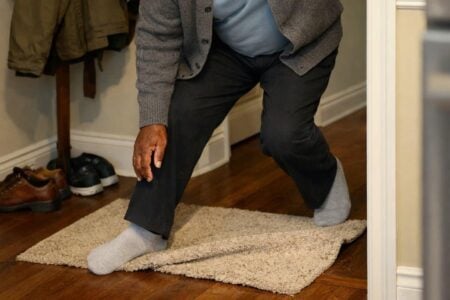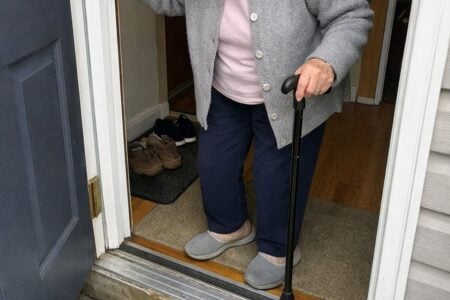
Every year, wheelchair users and their caregivers are hurt on ramps that were installed with good intentions. The chair tips forward on the descent. A caregiver loses control of a manual chair coming down. A power scooter stalls halfway up and begins to slide back.
The ramp was there. It was installed. It looked like an accessibility solution.
The slope made it a fall risk.
The most common ramp mistake is not choosing the wrong style — it is installing any ramp at the wrong angle and assuming that presence equals safety. A folding ramp propped against a six-inch step at a steep angle is not an accessible entry. A modular ramp installed without handrails on a ten-inch rise is not a safe one.
This article gives you the specific numbers — slope ratios, width minimums, load ratings, rise thresholds — you need to evaluate any ramp before you commit to it.
Wheelchair Ramp Shopping Guide: Slope, Width & Safety
Download this printable shopping guide to confidently select the right wheelchair ramp for your home—with exact measurements, safety checklists, and the specific details that prevent costly mistakes.
What to Look For
Before you look at a single product, you need four measurements and four numbers. Everything else follows from these.
Slope: The Most Important Specification
The ADA standard for public ramps is 1:12 — one inch of rise for every twelve inches of run. For residential ramps, 1:12 is the upper limit of safe, not the target.
Power wheelchairs and heavy scooters do better on a slope of 1:16 or 1:20. The gentler the slope, the more control the user retains on the descent.
Here is the formula: divide the rise in inches by the slope ratio to find the minimum run in inches.
- A 24-inch rise at 1:12 = 24 feet of ramp minimum
- A 24-inch rise at 1:16 = 32 feet of ramp minimum
- A 24-inch rise at 1:20 = 40 feet of ramp minimum
Readers who are not expecting those lengths are exactly the ones who end up with a ramp that is too steep. A ramp that looks reasonable in a product photo can be genuinely dangerous once it is placed against a real entry.
If you are looking at a ramp for front door steps and wondering why the slope feels wrong, this is why. The math does not lie, and the entry does not move.
Width: Surface Width, Not Frame Width
The ADA minimum clear width is 36 inches. Most manual wheelchairs are 24–27 inches wide. Power wheelchairs and scooters can reach 30 inches or wider.
A 36-inch ramp surface clears most chairs — but with limited margin. Forty-four inches is the practical standard for comfortable single-user navigation. Forty-eight inches accommodates a caregiver walking alongside.
Note: the width of the ramp surface matters, not the width of the frame. Some manufacturers list the frame dimension. Ask specifically for the usable surface width before purchasing.
Load Rating: Check the Combined Weight
Residential ramps should be rated for at least 600–800 lbs to safely cover the combined weight of a power wheelchair and a user. Power wheelchairs can exceed 250 lbs empty. Bariatric power chairs can exceed 400 lbs without a user aboard.
Always check the ramp's stated load capacity against the actual combined weight of the chair and user before purchasing. Never assume.
Handrails and Edge Barriers: Not Optional After Six Inches
The six-inch rule: once the rise exceeds six inches, handrails on both sides move from helpful to required — not just by code, but by the physics of what happens when a wheelchair user reaches for something that is not there on a descent.
Edge barriers — the raised lip or curb that prevents a caster from rolling off the side of the ramp — are equally important and just as often skipped. Ramps sold without these features need aftermarket additions before they are safe for daily use.
Landings: The Step Most Buyers Forget
A ramp that starts at the top step and ends at grade is not complete without a level landing at the top. The minimum is 60 × 60 inches — enough space to allow a wheelchair to clear the door before it begins to move onto the ramp surface.
If your entry does not have this space, a modular system with a switchback design may be necessary. That adds cost and planning time, but there is no safe shortcut around it.
Surface Material and Traction
Aluminum with a non-slip grit coating or diamond-plate texture is the current standard. The surface must remain non-slip when wet. Avoid painted surfaces that may degrade seasonally — a ramp that is slip-resistant in July can be a hazard in November.
Modular Aluminum Ramp Systems
Modular aluminum ramp systems are the right solution for daily wheelchair or scooter users accessing a home entry with a rise greater than six inches. These are not a convenience purchase. They are permanent access infrastructure, and they should be treated that way.
This type suits front or back door entries used daily, rises of six inches or more, and users who need handrails for stability or have a caregiver managing the descent. Modular systems can also be reconfigured if the entry layout changes — you are not locked in to a single footprint.
Where a modular system is the wrong choice: if you are renting without landlord approval, if no 60 × 60-inch landing exists at the top of the entry, or if no one has confirmed the slope calculation in advance. A modular ramp installed at the wrong angle is not safer than no ramp at all.
The trade-off against other types in this article is straightforward: modular systems cost more, require planning, and have a larger footprint. In exchange, they are the only type appropriate for daily unsupervised use by a wheelchair or power scooter user.
Silver Spring 10' Wheelchair Ramp for Home Steps, 850 lb Capacity, 36" W

This is a ten-foot aluminum modular ramp rated at 850 lbs — a load capacity that covers most power wheelchair and user combinations, including heavier chairs. The 36-inch surface width meets the ADA minimum for clear width, which is workable for most manual chairs and many power chairs with careful alignment.
At ten feet, this ramp clears a rise of up to ten inches at 1:12. If your entry rise is less than that, the slope will be gentler — which is exactly what you want. If the rise is greater than ten inches, this ramp cannot achieve a safe 1:12 grade and a longer system is necessary.
The honest limitation here is width. At 36 inches, there is limited margin for a caregiver walking alongside or for a wider power chair drifting slightly off-center. If your chair is 28 inches or wider, or if a caregiver regularly assists on the ramp, a wider system is worth the additional cost.
MAASTERS Wheelchair Ramp 12 Feet – Loading Capacity 600 lbs – ADA Compliant

At twelve feet, this ramp can safely clear a rise of up to twelve inches at 1:12 — or provide a gentler slope on shorter rises, which is the better outcome for daily use. The 600-lb load capacity is adequate for most manual wheelchair users and lighter power chair users, but should be verified against the combined weight of the chair and user before purchase.
ADA-compliant construction means the surface and dimensions meet the standards developed for public accessibility — a meaningful baseline for a residential installation. Confirm the usable surface width (not the frame width) before ordering to ensure it fits your entry and your chair.
This ramp suits entries where a longer run is available and the rise falls within the twelve-inch range. At twelve feet, it may require planning for landings on both ends, particularly at the top where a 60 × 60-inch level surface is needed before the door threshold.
Nuvium 6 in Threshold Ramp for Doorways – Modular Aluminum Wheelchair Ramp

This threshold ramp addresses a specific and common problem: the low vertical transition at a doorway, typically between two and six inches, that a wheelchair or scooter cannot clear without a bump or a sudden drop. It is modular aluminum, designed to sit at the base of a door threshold and create a gradual transition rather than a sharp edge.
The intended application is narrow. This is not a ramp for steps or for entries with meaningful rise. It is for threshold clearance — the lip at the bottom of a sliding door, the transition between indoor and outdoor flooring, or the small bump at a garage entry. Within that use case, it serves a real purpose.
The honest limitation is that a six-inch threshold ramp is not a substitute for a full ramp system on a stepped entry. If your entry has steps, this product does not apply. If your entry has a threshold lip, this product addresses that specific gap.
NULTRUMA Aluminum Wheelchair Ramp with Handrails – Adjustable Height 3.4" to 7.2" & 880 lbs

This modular ramp arrives with handrails included and is rated at 880 lbs — one of the higher load capacities in this section. The adjustable height range of 3.4 to 7.2 inches gives it flexibility across different threshold heights without requiring a custom-order configuration.
The inclusion of handrails at the point of purchase is significant. Many modular ramp systems are sold without handrails, and compatible aftermarket options can be difficult to source once the ramp is installed. Getting both together eliminates that problem and ensures the rail attachment points are designed to work with the ramp frame.
Confirm the usable surface width before ordering to make sure it accommodates your chair with adequate clearance. At 880-lb capacity, this system is appropriate for heavier power wheelchairs and larger users — verify the combined weight against the rating as a standard pre-purchase step.
VEVOR Wheelchair Ramp with Handrails – 71.1 x 32.7 in – Heavy Duty Wide Aluminum Wheelchair

At 71.1 inches in length — just under six feet — and 32.7 inches in surface width, this ramp is designed for lower-rise entries where a shorter run is available. The surface width is narrower than the ADA minimum of 36 inches of clear width, so measure your chair's width against the usable surface dimension before purchasing.
This ramp includes handrails, which is the right configuration for any modular system used in a daily-access application. The heavy-duty aluminum construction and included rails make this a more complete package than bare ramp sections sold without safety features.
The primary limitation is length. At six feet, this ramp achieves 1:12 on a six-inch rise — at the upper boundary of safe slope. For any rise greater than six inches, a longer modular system is the appropriate choice. For entries with a rise of five inches or fewer, this ramp provides a gentler, safer slope.
Portable Folding Ramps
Portable folding ramps solve a specific, narrow problem: low threshold transitions of three inches or fewer, occasional step clearance under supervision, and vehicle transfers where the ramp is deployed and then stowed. Their light weight and compact storage make them practical for travel and secondary entries, within the rise limits their length can actually handle safely.

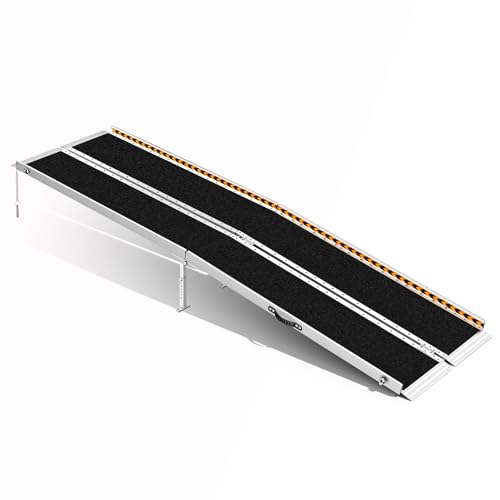



Portable folding ramps are the category most quietly misused in this space. They are marketed broadly — for home use, for travel, for steps — but the conditions under which they are genuinely safe are narrower than most product listings suggest.
This type suits single steps of three inches or fewer where a modular system would be disproportionate. It also works for vehicle transfers under caregiver supervision, occasional access at a secondary entry not used daily, and travel situations where a lightweight ramp bridges a single threshold at an airport, hotel, or friend's home.
Here is what must be stated plainly: folding ramps are routinely deployed at angles that make them genuinely dangerous. A six-inch step requires a ramp at least six feet long to achieve 1:12. Most consumer folding ramps are two to five feet. A three-foot folding ramp on a six-inch rise creates a slope of approximately 1:6 — twice the maximum safe grade. This is not a fringe misuse. It is the default outcome when a buyer selects a ramp based on step height alone without calculating the required run.
If you are considering a folding ramp for your front door because it costs less than a modular system, I am asking you to work through the slope calculation above before purchasing. The price difference is real. So is the risk.
VNN Portable Wheelchair Ramp 6FT – Seamless Non-Slip Aluminum
At six feet, this ramp can safely clear a rise of up to six inches at 1:12. That is a meaningful threshold — it places this ramp at the outer limit of what a portable folding ramp can handle for single-step entries, and only just. For any rise greater than six inches, a longer ramp or a modular system is required.
The seamless non-slip aluminum surface is an important feature. Seamed or hinged surfaces can create a ridge that catches a wheelchair caster on the way up. A seamless surface reduces that risk and improves traction.
This ramp suits occasional use at entries with a rise of six inches or fewer, or vehicle transfer applications where it is deployed and then stowed. It is not appropriate as a permanent daily-use front door ramp for any user who navigates it without caregiver assistance.
TaiH Leo 8FT Wheelchair Ramp with Support Legs – Portable Ramps for Home Steps
Eight feet of ramp length allows this model to safely clear a rise of up to eight inches at 1:12, or to provide a gentler slope on shorter rises. The support legs are a meaningful addition — they stabilize the ramp surface midspan, which reduces flex on longer folding ramps when a heavy power chair is in motion.
The folding design makes it portable, but at eight feet, the folded dimensions are larger than shorter models. Measure your storage space and vehicle trunk before ordering if portability is a primary reason for choosing this type.
This ramp suits entries where the rise falls within eight inches and occasional deployment — not a permanently installed solution. The support legs make it more appropriate for heavier chair-and-user combinations than unsupported folding ramps of similar length.
Rocspire 2FT Portable Wheelchair Ramp – 800lb Folding Aluminum
A two-foot ramp achieves 1:12 on a rise of two inches. That is the honest parameter for this product. It is not a ramp for steps — it is a ramp for very low threshold transitions: a doorway lip, a small bump at a sliding door, or a transition between two floor surfaces of slightly different heights.
The 800-lb capacity is a genuine strength for a compact ramp. It means the product can handle heavier chair-and-user combinations at the threshold clearance applications where it actually belongs.
Do not use this ramp on a step. A two-foot ramp on a four-inch step creates a slope of 1:6, which is dangerous for any wheelchair user. Within its correct application — threshold clearance of two inches or fewer — it does exactly what it is designed to do.
FACHNUO 4FT Portable Wheelchair Ramp for Home Steps – Non-Skid Aluminum
At four feet, this ramp safely clears a rise of up to four inches at 1:12. For entries with a three- to four-inch rise and no practical space for a longer or modular solution, this is a workable option — but only under those specific conditions.
The non-skid surface is important for any outdoor application. Check that the traction coating is integrated into the aluminum rather than a painted or adhesive-applied finish that may degrade over time and in wet conditions.
The honest limitation is the same one that applies to all short folding ramps: four inches of clearance is the maximum rise this ramp can handle safely. If the step you are addressing is taller than that, a longer ramp or a modular system is necessary. A ramp that looks like it reaches the step is not the same as a ramp that creates a safe slope.
HOMCOM Wheelchair Ramp 5FT – Foldable Aluminum Handle, 600lbs Capacity
Five feet of ramp length means this model safely clears a rise of up to five inches at 1:12. The foldable handle design affects how the ramp stores and whether it can be managed by one person — relevant for caregivers who deploy and retrieve the ramp regularly.
At 600 lbs, the load capacity covers most manual wheelchair and lighter power chair applications. Verify the combined chair-and-user weight against this figure before purchasing, particularly for power chair users whose chair alone may approach or exceed 250 lbs.
This ramp suits entries with a rise of five inches or fewer, used occasionally and with a caregiver present. It is not the right product for daily unsupervised use, for power chair users with heavier equipment, or for any rise greater than five inches.
KOLOTOOL 7FT Telescoping Aluminum Portable Wheelchair Ramp with Bag – 600LBS
At seven feet extended, this telescoping ramp safely clears a rise of up to seven inches at 1:12. The telescoping mechanism means the ramp stores shorter than its extended length — a practical advantage for transport and vehicle storage. Confirm the locked length before use; telescoping sections must engage fully before bearing weight.
The included carrying bag makes this a reasonable travel option. At 600 lbs, the load capacity is adequate for most manual chairs and lighter power chairs, but should be verified against the specific chair and user weight combination.
Note that telescoping ramps that extend to a single surface — as opposed to two-rail track designs — provide the full-width ramp surface that offers better lateral stability. Confirm whether this model is a single-surface or two-rail design, as that distinction affects who can use it safely and how.
Rocspire 3FT Wheelchair Ramp – 800lb Folding Anti-Slip Ramp
Three feet of ramp length handles a rise of up to three inches at 1:12. The 800-lb capacity is one of the higher ratings in this section at this length — useful for heavier chair-and-user combinations at threshold-level clearance applications.
The anti-slip surface is a necessary feature for any ramp used outdoors or in wet conditions. Verify that the slip resistance is a structural feature of the aluminum surface rather than an applied coating.
This ramp belongs at threshold transitions of three inches or fewer. On a four-inch step it creates a slope of 1:9; on a six-inch step, 1:6. Neither is safe for daily wheelchair use. Within the correct application, the 800-lb capacity and anti-slip surface make it a solid option for heavier users at low thresholds.
Track and Telescoping Ramps
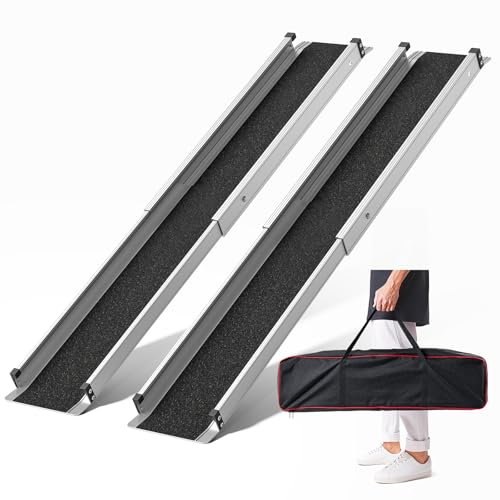
Track and telescoping ramps are designed for vehicle loading and single low-step clearance where a full-width ramp is not practical — and they are intended for use by a caregiver who controls the chair throughout the transfer, not for independent daily home entry.


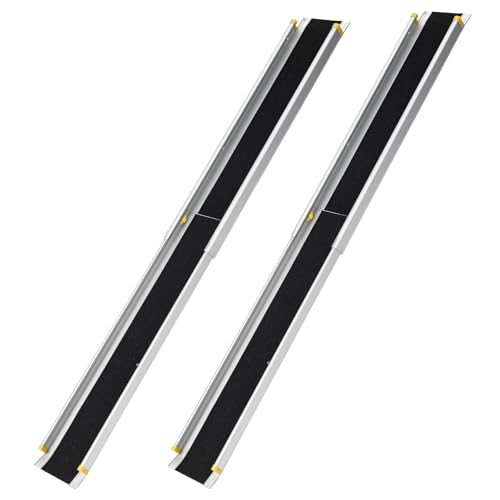


Track ramps — two parallel rails, one under each wheel — and telescoping ramps serve a specific and limited role. They are primarily designed for vehicle loading and single-step clearance where the full footprint of a folding or modular ramp is not practical.
This type suits loading a manual wheelchair into a vehicle trunk or van, single low steps of three inches or fewer with limited width available, lightweight manual wheelchairs and transport chairs, and situations where a trained caregiver controls the chair throughout the transfer.
Track ramps should not be used for daily home entry. The gap between rails is an active tip risk for any chair that drifts off-center on the descent. Most consumer track ramps are rated for 400–600 lbs per pair — lower than modular or full-surface folding systems. They are not appropriate for power wheelchairs, which are heavier and have less manual control on a slope.
One more thing worth saying directly: track ramps are a caregiver tool, not an independence tool. A wheelchair user cannot typically use a track ramp without assistance. If independence on the ramp is the goal, a full-surface ramp system is the right product category.
KOLOTOOL 7FT Telescoping Aluminum Portable Wheelchair Ramp with Bag – 600LBS
This telescoping single-surface ramp extends to seven feet and stores compactly in the included bag. At seven feet, it can safely clear a rise of up to seven inches at 1:12 — and it provides a full-width surface rather than two separate rails, which is a meaningful stability advantage over track designs.
The 600-lb capacity covers most manual chairs and lighter power chairs when the combined weight is confirmed. The telescoping mechanism must lock fully at the extended length before bearing weight — a step to verify on every deployment.
The included bag makes this a practical vehicle-transfer option and a reasonable travel ramp for single-step clearance. It is not a daily-use home entry solution for unsupervised wheelchair users.
Discount Ramps 5.5' / 10' Portable Wheelchair Ramps – Telescoping, 600 lb, Silver Spring
This telescoping model extends from 5.5 feet to 10 feet — a meaningful range that covers rises from under six inches at 1:12 on the short end to up to ten inches at 1:12 on the long end. The adjustable length makes it more versatile than fixed-length folding ramps across different vehicle heights and step configurations.
At 600 lbs, the load capacity applies to the pair. Verify whether the manufacturer states this as a per-rail or total-pair rating — manufacturers are inconsistent on this point, and it affects the actual load the system can safely carry.
This ramp suits vehicle transfer applications and occasional step clearance by a caregiver. The telescoping range gives it flexibility that fixed-length ramps lack, which is its primary advantage in this category.
Discount Ramps 4' / 7' Portable Wheelchair Ramps – Telescoping, 600 lb Cap, Silver Spring
This shorter telescoping model extends from four to seven feet — a range suited to lower vehicle heights and shorter step transitions. At seven feet extended, it safely clears a rise of up to seven inches at 1:12; at four feet, the maximum safe rise drops to four inches.
The compact storage size at four feet is a practical advantage for caregivers who carry the ramps in a vehicle regularly. Weight matters here — confirm the total weight of the pair to ensure the caregiver can manage them safely.
As with all track designs, the rails must be placed parallel and at the correct wheel spacing for the specific chair being transferred. Measure the chair's wheel spacing and compare it to the rail placement before deployment.
ActiveTrail 1 Pair 8 FT Telescoping Portable Wheelchair Ramps for Steps – Adjustable
At eight feet, this pair of telescoping rails can safely clear a rise of up to eight inches at 1:12 — on the longer end of consumer track ramp options. The adjustable design provides some flexibility for different step heights within that range.
Rail width matters for caster safety. Wider rails — four inches or more — give the caster more surface contact and reduce the risk of drifting off the edge. Confirm the rail width for this model and compare it to the caster diameter of the specific chair being used.
This product suits vehicle loading and occasional step clearance under caregiver supervision. At eight feet, the rails are longer to carry and store than shorter models — a trade-off against the additional clearance range.
KOLOTOOL 6FT Telescoping Aluminum Portable Wheelchair Ramp with Bag – 600LBS
At six feet extended, this telescoping ramp safely clears a rise of up to six inches at 1:12. The included carrying bag and telescoping storage make it a portable option for caregivers who need a ramp at multiple locations or for travel.
The 600-lb load capacity should be verified against the combined chair-and-user weight. For any power chair user, the chair weight alone — often 200–300 lbs — should be added to the user's weight before comparing to the rated capacity.
This model occupies the middle of the KOLOTOOL telescoping range between the 6FT and 7FT options. The shorter stored length compared to the 7FT model may be the deciding factor for caregivers with limited vehicle storage space.
gardhom 7FT Telescoping Portable Wheelchair Ramp with Carrying Case
At seven feet, this telescoping ramp covers the same rise range as other seven-foot models in this section — up to seven inches at 1:12. The carrying case is a practical feature for transport and storage, and its presence suggests the product is designed with travel and vehicle-transfer use in mind.
Confirm whether this is a single-surface or two-rail track design before purchasing, as that distinction affects lateral stability and who can use it safely. A single-surface telescoping ramp at seven feet provides better stability than two separate rails at the same length.
This suits vehicle transfer and occasional step clearance under supervision. It is not a replacement for a full-surface modular ramp at a daily home entry.
Ramp Handrails and Edge Barriers
Once a ramp rise exceeds six inches, handrails on both sides and edge barriers along the ramp surface move from optional to required — not just by code, but by the physics of descending a slope without something stable to hold. These products complete a modular ramp installation and serve every person who uses the slope, ambulatory or not.


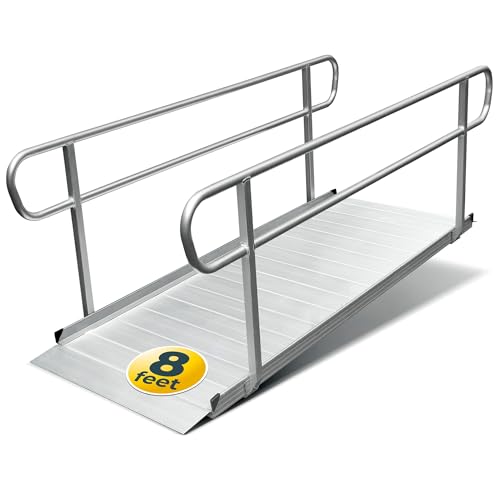


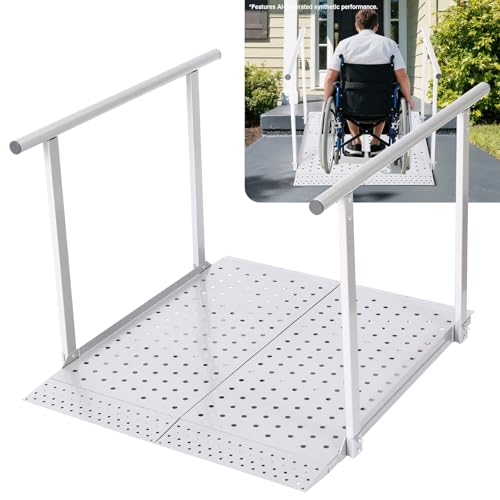

Handrails and edge barriers are not accessories. Once a ramp rise exceeds six inches, they move from helpful to required — not just by code, but by the physics of what happens when a user reaches for something that is not there on the descent, or when a caster reaches the ramp edge without anything to stop it.
Many buyers skip handrails to save money at the initial ramp purchase. They then find that compatible aftermarket options are limited or require professional installation anyway. I want to make that trade-off visible before you purchase a modular ramp, not after.
If you are looking at aftermarket handrails for a folding or track ramp, those products are not designed for fixed-surface attachment. Readers in that situation are, in most cases, looking at the wrong product category — the underlying ramp needs to be a modular or fixed system before handrails can be added safely.
Handrails also serve ambulatory family members who use the ramp while walking — to carry groceries, to assist the wheelchair user, or simply to navigate the slope. At ADA height (34 to 38 inches above the ramp surface), they reduce fall risk for everyone who uses the ramp.
RDCMKL Wheelchair Ramp with Handrails – 10-30" Rise, Non-Slip, Carbon Steel
This system is designed for entries with a rise between 10 and 30 inches — a range that covers most residential front door and garage entry applications where multiple steps are present. Carbon steel construction adds durability and structural stability compared to lighter aluminum handrail systems.
At rises in this range, handrails are not optional. A 10-inch rise at 1:12 produces an 8.3-foot ramp; a 30-inch rise at 1:12 produces a 30-foot ramp. Both slopes require bilateral handrails for safe unsupervised use.
Confirm the grip diameter falls within the ADA recommended range of 1.25 to 2 inches, and verify the mounted rail height is between 34 and 38 inches above the ramp surface. Carbon steel rails in direct sun can become hot — a consideration for installations with significant sun exposure.
RDCMKL Wheelchair Ramp with Handrails – 3-10" Rise, Non-Slip, Carbon Steel
This model covers the lower end of the rise range — 3 to 10 inches — where many single-step home entries fall. At a 6-inch rise, handrails become required by the practical six-inch threshold; this system addresses exactly that transition point.
Carbon steel construction provides rigidity. Verify the mounting compatibility with the specific ramp frame in place, since handrail attachment points vary across ramp systems and not all aftermarket rails fit all modular frames.
For entries at the lower end of this range — 3 to 6 inches — the system provides handrails at rises where they are transitioning from helpful to required. For entries at the upper end — 8 to 10 inches — they are fully required and this system delivers both bilateral rails and the non-slip ramp surface.
MAASTERS Ramp with Handrails 8 FT – Loading Capacity 850 lbs, ADA Compliant
An eight-foot ramp with integrated handrails rated at 850 lbs covers a rise of up to eight inches at 1:12. The high load capacity means it accommodates heavier power wheelchairs and larger users without requiring a separate bariatric-rated system.
ADA-compliant construction is a meaningful standard here — it sets baseline expectations for surface width, handrail height, and edge treatment that a non-compliant product may not meet. Verify the usable surface width (not the frame dimension) before ordering.
Handrails included at the point of purchase eliminate the compatibility problem that arises when aftermarket rails are sought for an installed ramp. For entries in the eight-inch rise range, this is a more complete starting configuration than a bare ramp system.
MAASTERS Ramp with Handrails 10 FT – Loading Capacity 850 lbs, ADA Compliant
At ten feet, this ramp clears a rise of up to ten inches at 1:12, with handrails included and an 850-lb load capacity. The additional two feet compared to the 8FT model in this section extends the safe rise range to ten inches — relevant for entries where a single large step or two smaller steps produce a combined rise in that range.
The 850-lb capacity provides margin for heavier power chair users without requiring a separately rated bariatric system. Confirm the usable surface width for your specific chair before purchasing.
For entries between eight and ten inches of rise, this model provides the additional ramp length needed to maintain a safe slope without upgrading to a longer custom-configured modular system.
RDCMKL Wheelchair Ramp with Handrails – 6-18" Rise, Non-Slip, Carbon Steel
This system covers a 6 to 18-inch rise range — the range where most multi-step residential entries fall. At 6 inches, handrails become required. At 18 inches, the ramp length at 1:12 is 18 feet, and bilateral handrails are not negotiable for safety.
Carbon steel construction at this rise range provides the structural stability that longer ramp runs require. Confirm mounting compatibility with the existing ramp frame, grip diameter, and mounted rail height before purchasing.
Edge barriers should also be confirmed for any ramp in this rise range. At 18 feet of run, a wheelchair caster that drifts off the edge mid-ramp has more distance to travel before the user can correct — edge barriers reduce that risk at every point along the run.
Sancunhui Folding Wheelchair Ramp with Handrails for Steps – Heavy Duty Threshold Ramp 500lbs
This product combines a folding ramp design with integrated handrails — a configuration that addresses the most common safety gap in the portable folding ramp category. Most folding ramps are sold without rails; this one includes them.
At 500 lbs, the load capacity is lower than most other products in this section. Verify the combined chair-and-user weight carefully before purchasing. For lighter manual chair users, this capacity may be adequate; for power chair users, it likely is not.
The folding design means this is not a permanent fixed installation. Confirm that the handrails remain stable and do not shift when the ramp is deployed and loaded. Handrails on a folding surface must be as secure as handrails on a fixed surface to provide reliable support.
Support Way 3FT Portable Wheelchair Ramp with Handrails – Black Seamless Aluminum, Threshold
At three feet with integrated handrails, this ramp targets the threshold transition application — rises of three inches or fewer where a portable ramp with side rails provides both clearance and a grab point for ambulatory users navigating the same threshold.
The seamless aluminum surface reduces the risk of caster-catching seams that hinged ramp designs can create. Black powder-coat finish has aesthetic advantages but should be checked for sun-temperature behavior in outdoor installations.
At three feet, this product belongs at threshold transitions, not at steps. The presence of handrails makes it more useful for ambulatory users crossing a low threshold than a bare folding ramp, but the rise limitation remains: three feet of ramp safely clears three inches of rise at 1:12, and nothing more.
Frequently Asked Questions
What slope is safe for a wheelchair ramp at home?
The ADA maximum for public ramps is 1:12 — one inch of rise for every twelve inches of run. For residential use, 1:12 is the upper limit of safe, not the target. Power wheelchairs and heavy scooters do better on 1:16 or 1:20. Steeper slopes — 1:8 or 1:6 — appear in some product listings as "maximum rise" specifications, but they are not safe for unsupervised daily use. Use this formula: divide the rise in inches by the slope ratio to find the minimum run in inches.
How wide does a residential wheelchair ramp need to be?
The ADA minimum clear width is 36 inches — and that refers to the usable surface, not the frame. Most manual wheelchairs are 24–27 inches wide; power wheelchairs and scooters can reach 30 inches or wider. A 36-inch surface works for most chairs with limited margin. Forty-four inches is the practical recommendation for comfortable single-user navigation. Forty-eight inches accommodates a caregiver walking alongside.
Do I need a permit to install a wheelchair ramp at home?
This varies by municipality. Permanent modular ramps often require a building permit. Some jurisdictions exempt ramps installed for documented medical necessity. Check with your local building department before installation — not after. Skipping this step can create problems when the home is sold or the ramp needs to be modified.
Can I use a portable folding ramp as my main home ramp?
Only if the rise is three inches or fewer, the ramp is long enough to achieve 1:12 at that rise, and the ramp is secured at the top edge so it does not shift under load. For any daily-use entry with a rise greater than three inches, a modular system is the appropriate choice. A folding ramp that looks like it reaches the step is not the same as one that creates a safe slope.
When are handrails legally required on a ramp?
ADA standards require handrails on both sides of any ramp with a rise exceeding six inches. Residential building codes vary by jurisdiction, but the six-inch threshold is the practical standard to apply regardless of what local code requires. If anyone in the household is ambulatory and uses the ramp — to carry items, to assist the wheelchair user, or simply to navigate the slope — handrails reduce their fall risk as well.
What weight limit should I look for in a residential ramp?
For a power wheelchair user: 800 lbs minimum, based on the combined weight of chair and user. For a bariatric user or heavy power chair: identify the specific combined weight and look for ramps rated at or above that number. Never assume the stated weight limit includes both user and chair — check the manufacturer's language explicitly. Some ratings apply to the user only; others apply to the combined load.
Hacks and Practical Advice
Take this measurement before you look at any product. Walk to the exterior entry you use most. Measure the vertical rise — the distance from the lower surface to the upper surface. Then divide that number by 0.083 (which is 1/12 as a decimal) to find the minimum ramp length in inches at 1:12. Convert to feet. That single number immediately eliminates most folding ramps from consideration and clarifies whether a modular system's standard section lengths will work for your entry.
The slope test most buyers skip. After a ramp is installed, place a cup of water on the surface. If it slides, the slope is too steep for safe use. This is a rough check, not a precise measurement — but it catches the worst cases before the first real trip down the ramp.
Check edge barriers every fall. Debris, ice, and warped sections collect at the ramp edge in outdoor installations. Inspect the barrier height and the non-slip coating condition before wet weather arrives each year. A coating that worked in summer may not hold in frost.
Measure the landing before you order the ramp. The 60 × 60-inch landing requirement at the top of a ramp is one of the most frequently overlooked dimensions in a residential ramp installation. Measure that space at your entry before you order anything. If it does not exist, the ramp design needs to account for it — and that affects the total footprint and cost.
Handrails serve everyone who uses the ramp. If a family member walks the ramp to carry groceries or assist the wheelchair user, graspable rails at ADA height — 34 to 38 inches above the surface — reduce their fall risk as well. Handrails are not just for wheelchair users; they are for everyone who touches that slope.
If you are concerned about other fall risks in and around the home, the fall prevention checklist for the elderly covers the full picture from interior to exterior — room by room.
Wheelchair Ramp Shopping Guide: Slope, Width & Safety
Download this printable shopping guide to confidently select the right wheelchair ramp for your home—with exact measurements, safety checklists, and the specific details that prevent costly mistakes.
Conclusion
The ramp decision starts not with style or budget. It starts with frequency of use and one measurement.
Daily wheelchair users need a modular system with handrails and a landing. Portable folding ramps have a real but narrow role — threshold transitions and supervised vehicle transfers, within a rise that the ramp's length can actually handle safely. Track and telescoping ramps are caregiver tools for vehicle loading, not independence tools for home entry. Handrails are not optional once the rise exceeds six inches.
Knowing which category you actually need before you look at prices protects you from buying something that feels like a solution but functions like a hazard.
Here is the one thing to do before you look at another product: walk to the entry you use most, measure the rise, and write that number down. That single observation is the starting point for every ramp conversation — and it is the first question any home safety assessment will ask you.
The right ramp does not just solve a problem. It gives you — or someone you love — back the entry to their own home.