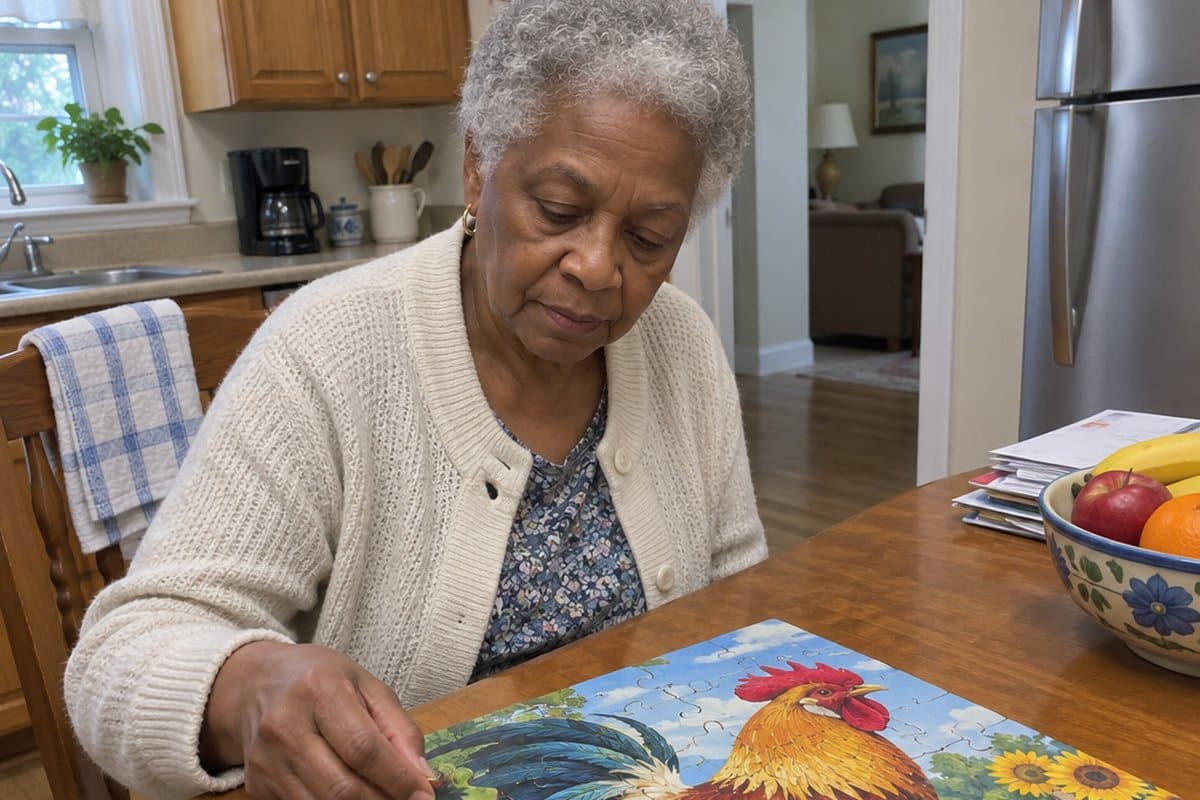
You’re standing in the game aisle — or scrolling through yet another page of search results — trying to find a puzzle for your mom or dad.
There are hundreds of options, the packaging all looks the same, and nothing tells you which one will actually work for someone with stiff fingers, low vision, or early memory changes.
That moment of uncertainty is exactly why I put this guide together.
A puzzle sounds like a simple gift. But the right one can become a daily source of calm, focus, and genuine accomplishment. The wrong one sits on a shelf after one frustrating attempt — and that’s a harder outcome to watch than most people expect.
Before jumping to product recommendations, it helps to understand what actually makes a puzzle accessible for older adults. Here’s what to look for.
The Senior Puzzle Buyer’s Cheat Sheet: 4 Factors That Determine Whether a Puzzle Gets Used or Sits on a Shelf
Download our Senior Puzzle Buyer’s Cheat Sheet and learn the 4 critical factors that determine whether a puzzle gets completed or abandoned—so you can make a confident choice in minutes and finally find puzzles your loved one will actually use.
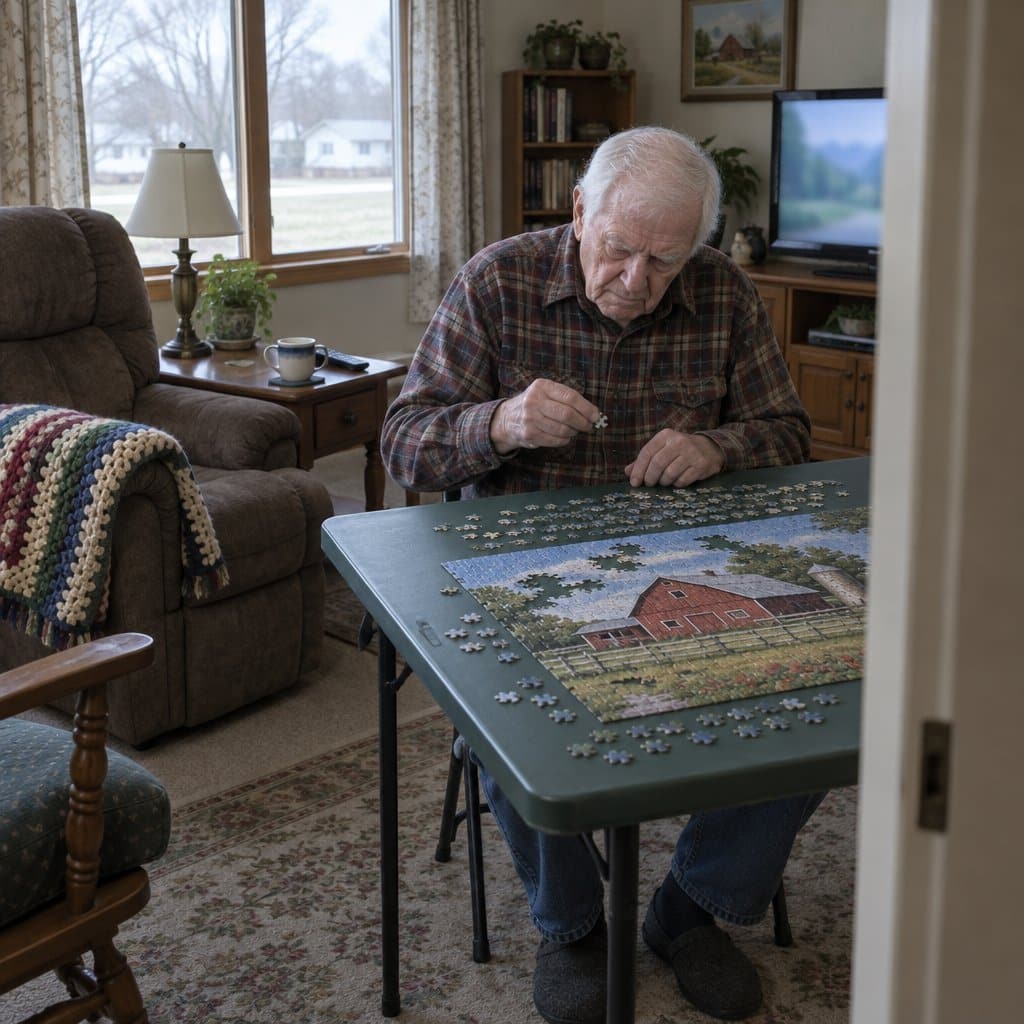
Why Puzzle Choice Matters More Than You’d Think
A puzzle that’s too difficult — or just physically awkward — isn’t just frustrating. It can discourage an older adult from trying again, and that’s the last thing you want.
When the right fit is chosen, puzzles support cognitive engagement, give fine motor skills a gentle workout, and create real emotional satisfaction. The problem is that most puzzles are designed for younger adults: tiny pieces, busy images, piece counts that would challenge anyone.
The Decision Is a Care Decision
Choosing the right large piece jigsaw puzzles for seniors isn’t really a shopping decision — it’s a care decision. Getting the specs right means your loved one actually uses it, returns to it, and benefits from it.
Start with the most physically obvious factor: piece size.
What Puzzles Can Do for Memory and Mood
Beyond being a pleasant way to pass an afternoon, a jigsaw puzzle gives the mind some real work to do. Here is what it offers your mom or dad.
Puzzles help people relax. Your mind settles on the task in front of you, which can take the edge off when you are feeling stressed or overwhelmed.
They also build spatial reasoning. Working out how the pieces fit, and what the finished picture should look like, is the kind of thinking that carries over into many everyday tasks.
A study in Frontiers in Aging Neuroscience found that jigsaw puzzles improved memory, spatial ability, and problem-solving. Keeping the mind active and engaged may also help guard against age-related cognitive decline. I would call that encouraging, not a promise.
Puzzles can also be a comfort. They are often tied to feelings of happiness and satisfaction, which can help an older adult who feels lonely or isolated feel more connected.
You may wonder whether a large piece puzzle is too easy to bother with. It still asks for problem-solving, even with bigger pieces and a simpler design. Keep in mind that big pieces do not automatically mean an easy puzzle, because the picture itself changes how hard it is.
The trade-off is that a puzzle can be slow, tedious work for some people. If your loved one gets restless, that is worth watching for.
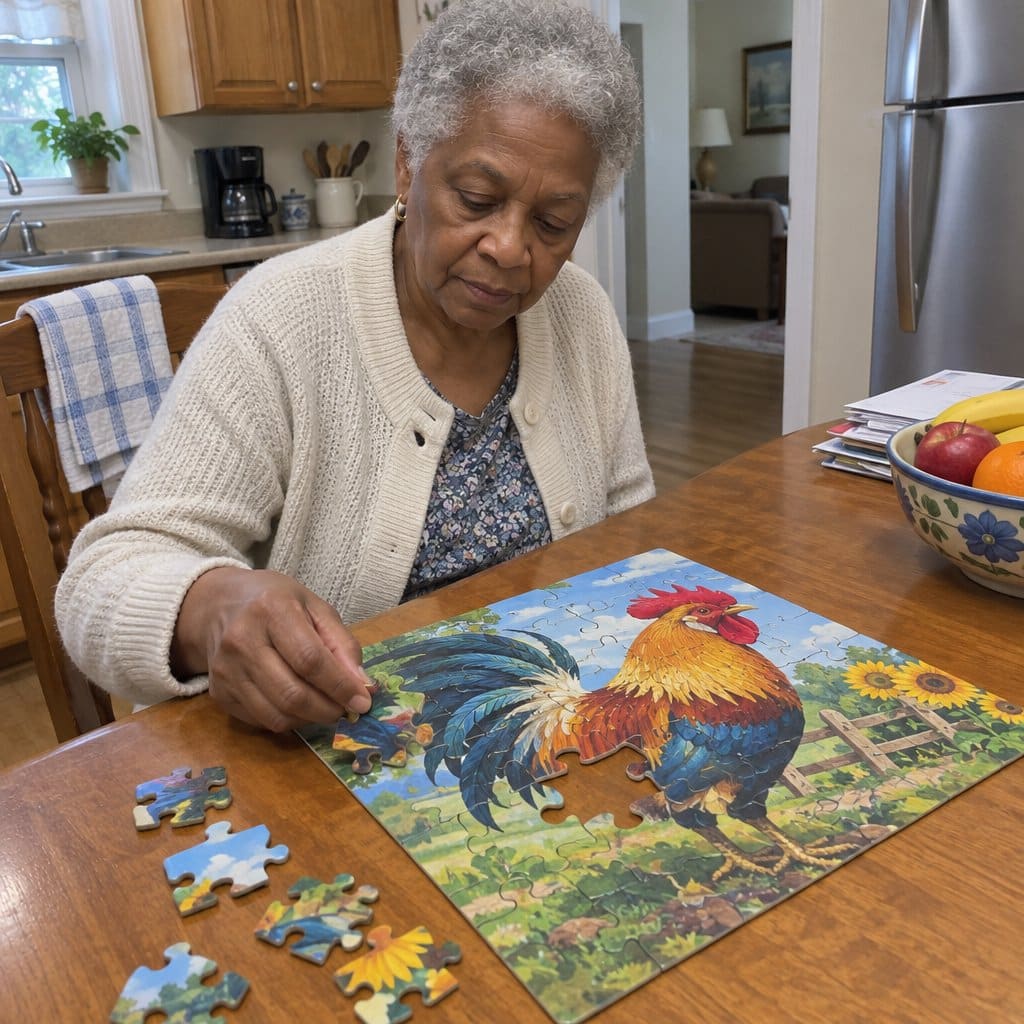
Section 1 — Piece Size: The Foundation of Accessibility
Piece size is the single most important factor when selecting jigsaw puzzles that are easy to handle for elderly adults. And most standard puzzles don’t come anywhere close to what seniors actually need.
What “Large Piece” Actually Means
In practical terms, a genuinely large piece puzzle offers pieces that are easy to pinch, pick up, and orient without straining arthritic or stiff fingers. If a manufacturer lists actual piece dimensions on the packaging, that’s a good sign — it means they’re building for accessibility, not just marketing.
Oversized pieces reduce frustration in three concrete ways:
- Improved grip — larger surface area means less precise pinching required
- Visible fit points — edges and connectors are easier to see and align
- Satisfying click-fit connections — well-defined edges give clear tactile feedback when a piece is placed correctly
Thickness Matters Too
Piece thickness is an under-discussed detail. Thicker cardboard pieces hold their shape, resist bending, and feel more substantial in the hand — all of which matter for older adults with limited dexterity.
Puzzles for seniors with limited dexterity also benefit from companion tools like easy-grip puzzle lifters or puzzle sorting trays alongside large-piece sets to make the experience even more comfortable.


The Reframe Worth Remembering
Larger pieces aren’t a “dumbed down” version of the activity. They’re an accessibility feature — one that keeps the experience enjoyable rather than exhausting.
Action point: When evaluating any puzzle, check the stated piece dimensions, not just the piece count. Piece count alone tells you almost nothing about accessibility.
Section 2 — Piece Count: Matching Difficulty to the Individual
Knowing how many puzzle pieces are appropriate for seniors is just as important as piece size — and the right answer varies more than most people expect.
A Practical Piece Count Guide
Here’s a starting framework based on ability level:
- Independent older adults with good cognition: 300–500 oversized pieces can provide real engagement without feeling childlike
- Adults with mild cognitive changes: 100–300 pieces, with clear imagery and distinct color zones
- Adults with moderate dementia: 48–100 pieces, ideally with large, bold, familiar images — accessible puzzles for adults with dementia work best when the image is nearly as recognizable as a photograph
Start Lower Than You Think
The most common mistake I see caregivers make is overestimating piece count. It’s always better to watch someone successfully complete a puzzle than to watch them walk away from one.
A 100-piece oversized puzzle occupies meaningful table space, provides real tactile engagement, and delivers genuine satisfaction when completed. That’s not too easy — that’s the goal.
Jigsaw puzzle difficulty levels for older adults aren’t fixed, either. Needs change, and it’s worth reassessing the right fit every few months.
Action point: If you’re unsure where to start, begin with a 48–100 piece oversized set and observe engagement. You can always move up from there.
Want more practical ideas for keeping your loved one engaged and comfortable at home? Subscribe to our newsletter for expert-tested tips and product recommendations designed specifically for older adults and the people who care for them.
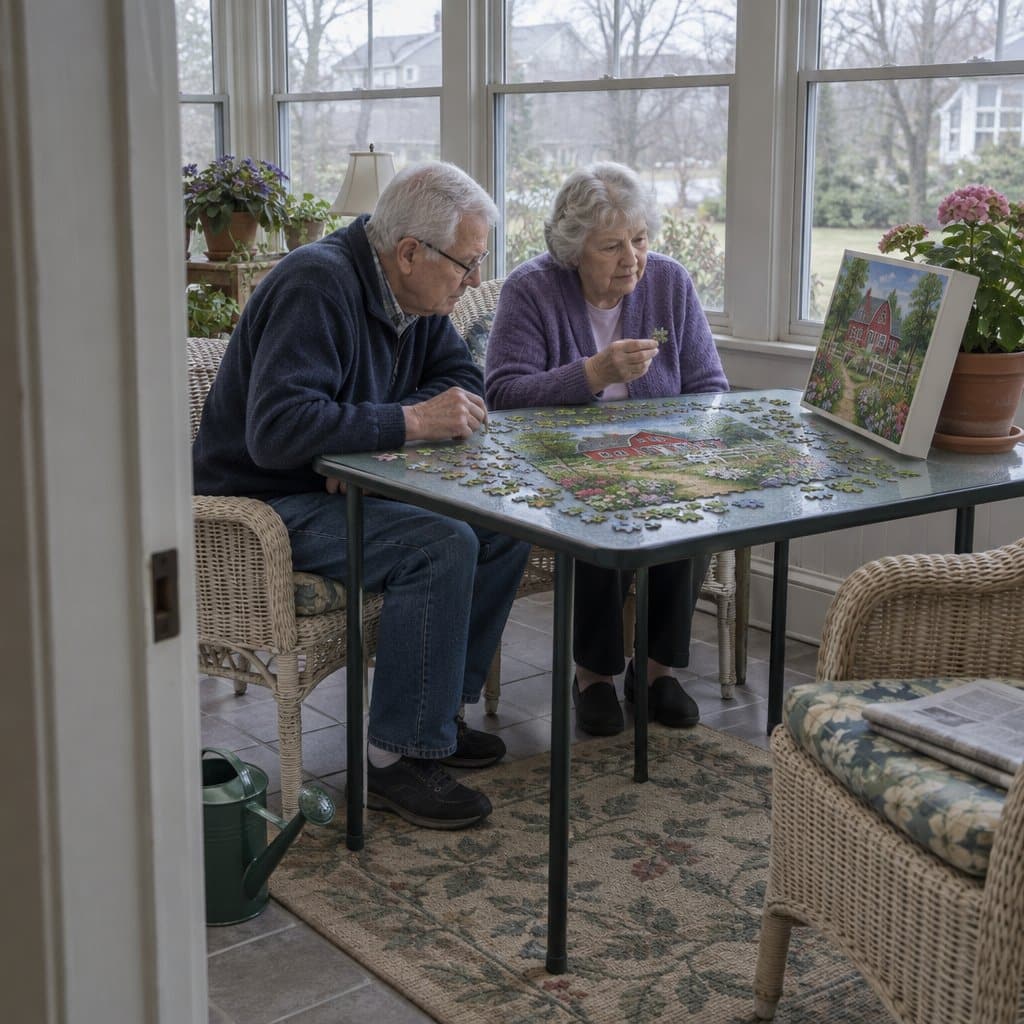
Section 3 — Image Clarity and Subject Matter: What the Eye Needs to Stay Engaged
Puzzle picture clarity for low vision seniors is a critical factor — and one of the most frequently overlooked. The image on the box should do as much work as the pieces themselves.
What Makes an Image Accessible
High-contrast, clearly defined images consistently outperform abstract or busy designs for older adults. Here’s what to look for specifically:
- Bold, distinct subject matter — a farmhouse, an animal, a recognizable landmark
- Clear color zones — areas of the image that are visually distinct from one another, giving a natural sorting strategy
- Minimal repetitive patterning — heavily patterned backgrounds or gradient skies become nearly impossible to parse, even for adults with good vision
What to Avoid
Abstract designs, photographic collages, and images with large sections of a single color (think: an all-blue sky taking up half the puzzle) create unnecessary difficulty that has nothing to do with cognitive ability. Puzzles for seniors with low vision need images where every section of the puzzle has something visually meaningful to guide placement.
Subject Matter Matters
Familiar themes sustain engagement more effectively than novelty ones. Nature scenes, animals, gardens, nostalgic Americana, and warm domestic images tend to hold attention longer — and for accessible puzzles for adults with dementia specifically, emotionally resonant imagery can add a layer of comfort that goes beyond the activity itself.
If your loved one also enjoys other activities that keep their mind engaged — card games and board games are worth exploring alongside puzzle time.
Action point: Before purchasing, look closely at the actual puzzle image — not just the thumbnail. Ask yourself: can I identify distinct areas of color and content that would help someone sort and place pieces? If the answer is uncertain, keep looking.
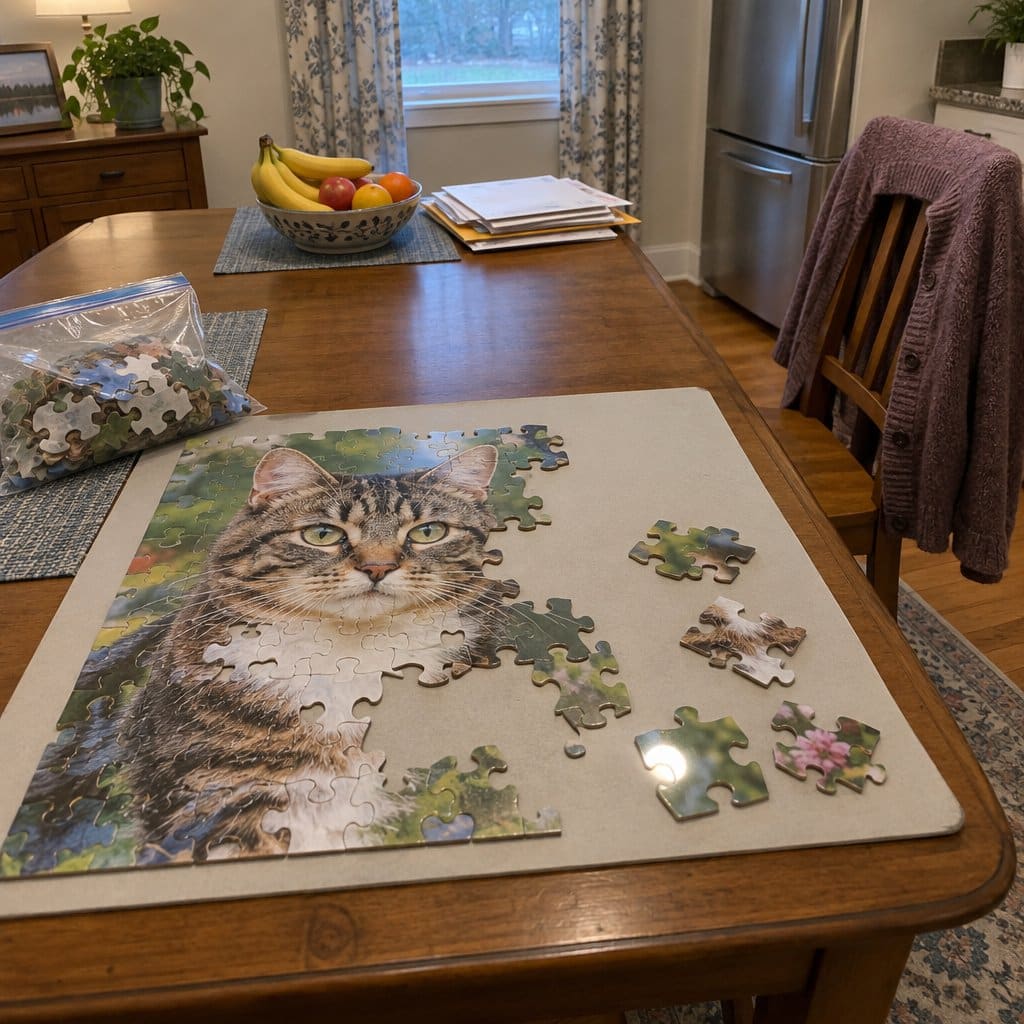
Section 4 — Surface, Build Quality, and Portability: The Details That Make It Work
Beyond piece size and image, the physical construction of a puzzle determines whether it becomes a regular activity or a one-time attempt.
Surface Finish
Matte or linen-finish puzzle surfaces reduce glare significantly — an important detail for seniors with low vision or light sensitivity. Glossy surfaces reflect overhead lighting in ways that make it genuinely harder to see piece details clearly.
Piece Durability
Thick, sturdy cardboard pieces resist bending and hold their shape through repeated use. If your loved one is going to assemble the same puzzle multiple times — which is common and completely fine — piece quality determines how long the puzzle stays usable.
Storage and Portability
Puzzles that come with resealable bags or storage trays make it easier for older adults to work across multiple sessions without losing pieces or feeling pressured to finish in one sitting. For caregivers who want a puzzle their parent can use at home, during family visits, or in a care facility, compactness and easy transport matter.
A well-curated large piece jigsaw puzzles for seniors set that includes multiple images adds long-term value over a single standalone puzzle — and makes a more thoughtful gift.


For more ideas on meaningful gifts that support independence and daily engagement, the gift guide for nursing home residents and the guide to hobbies for seniors both offer complementary options worth bookmarking.
Action point: Check reviewer feedback specifically for comments on piece thickness and fit. Pieces that are too thin or that don’t connect securely create frustration that has nothing to do with difficulty level.
Where to Find Large Piece Puzzles
You can sometimes find large piece puzzles at big stores like Walmart and Target, but the selection on the shelf is usually limited. Walmart has a bigger choice of large piece puzzles on its website than in the store.
Amazon also carries a large selection. Some of those puzzles are made with seniors in mind, and others are general puzzles that happen to have bigger pieces, so read the listing carefully.
Online stores that focus on dementia and Alzheimer’s care are another good place to look. They tend to stock puzzles built for this purpose, with a wide range of piece counts. One such store carries individual puzzles from 35 to 275 pieces, plus multi-puzzle packs. Another ships to the US, Canada, the UK, and Australia, and carries puzzles from 13 to 100 pieces.
If you want something more personal, a photo service can turn your own pictures into a puzzle. One service makes a 50 large piece puzzle from a single photo, or from several photos arranged as a collage. Say your dad has a favorite picture of the family home or the grandkids. That could become a puzzle he recognizes right away.
The trade-off is that the big retailers give you more to choose from but less guidance, so you will be sorting through general puzzles to find the right ones. A specialty store narrows that down for you, though the selection is smaller.
Section 5 — Why the Yigney Large Piece Puzzle Set Checks the Right Boxes
Yigney Large Piece Jigsaw Puzzles


After walking through what makes a puzzle accessible, the Yigney large piece puzzle set stands out as a well-specified option that thoughtfully addresses each of the criteria above.
Piece Size and Handling
The Yigney set is built with genuinely oversized pieces — not oversized by marketing standards, but oversized in a way that makes a real difference for older adults managing arthritis, reduced grip strength, or tremors. The pieces are thick, hold their shape, and connect with satisfying, clear feedback.
Image Selection
The set includes multiple puzzle images, each designed with clear color zones, distinct subject matter, and the kind of visual warmth that tends to sustain engagement. The images hold up well against the accessibility standards in Section 3 — bold, familiar, and easy to navigate visually even when broken into individual pieces.
Multi-Puzzle Value
One of the practical advantages of the Yigney set is that it’s a curated collection, not a single puzzle. For families looking for a reliable, repeatable activity option, this adds meaningful long-term value. Once a puzzle becomes familiar, repeating it can actually be a feature — particularly for older adults with memory changes, who may experience each completion as fresh and satisfying.
Honest Framing
This set works best for older adults in the mild-to-moderate range of puzzle engagement. If your loved one has significant cognitive changes and needs a very low piece count with simple, minimal images, it’s worth evaluating whether the included image complexity is the right fit. For most caregivers reading this, the Yigney set will land in exactly the right zone.
You’ve done the research now. When a product is built to the right specs, the decision gets straightforward — and that’s exactly what this set offers.


Puzzle Boards and Easels That Make Puzzling Easier on the Body
Once you have a puzzle with pieces big enough to handle, the next thing to look at is where you do it. Most of us puzzle at the kitchen or dining table, hunched over, reaching across, and then we have to pack it all up when it’s time to eat. A puzzle board or easel is a sturdy flat surface for the puzzle to sit on, and some of them tilt toward you so you aren’t bending your neck for an hour. If your back or neck complains after a long afternoon, or you’d like to leave a puzzle half done without losing the table, this is worth a look.
Here is what to check before you buy one. First, does the surface tilt, and does it turn? A swivel base lets you rotate the puzzle instead of stretching to reach the far corner. Second, does it have a cover? That keeps pieces in place, and keeps the cat or the grandkids from helping. Third, think about storage. Boards are bulkier than a roll-up mat, so measure the closet shelf before you order. Last, check whether a puzzle comes with it. Most don’t, so you’ll be supplying your own.
Bits and Pieces Jigsaw Puzzle Board
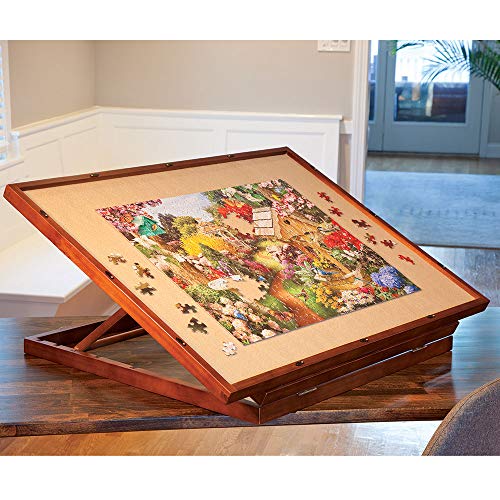
The Bits and Pieces Deluxe Jigsaw Puzzle Board is a puzzle easel. It’s a tilting, swiveling board you work on instead of the tabletop. I’ve used it, and the tilt is the part that matters most.
Leaning over a flat table for an hour is hard on the neck and back. Tilting the board toward you means you sit more upright and look at the puzzle instead of down at it. The swivel base lets you turn the puzzle to you, so you aren’t reaching across it for a piece on the far side.
It also comes with a cover. When it’s time to set the table for dinner, you put the cover on and move the board, and your work stays together. A fold-down handle and the cover make it easier to put away.
Two things to know. The puzzle isn’t included, so you’ll need your own. And it’s bulkier and heavier to store than a roll-up mat, so it suits someone with a spot to keep it. If you only work puzzles now and then, or you’re short on space, a roll-up mat may fit better.
Small Puzzle Sets with Big Pieces
If you’ve read this far, you’re probably shopping for someone who likes a puzzle but can’t manage the regular kind anymore. Maybe the pieces are too small to pick up, or the 500-piece box ends in frustration instead of fun. A smaller, simpler puzzle with big pieces is the natural next step. It gives them something to do with their hands and a finished picture to be proud of, without the struggle.
Here’s what to check before you buy. First, count the pieces. Fewer pieces means a faster finish, which is good for some people and a bit boring for others, so think about what they can really handle. Second, look at the piece size and thickness, because chunky pieces are easier to grip with stiff or shaky fingers. Third, check the finished size. It should fit on a lap tray or bedside table, not take over the dining room. Last, look at the pictures. Clear, familiar images work best, and it helps to know whether the set sticks to one theme that they may or may not care for.
QUOKKA Large Piece Dementia Puzzles


The QUOKKA set is built for people living with dementia. You get three puzzles, each with 21 oversized pieces (63 in all), with bird and cat designs.
The big pieces are easy to grip with arthritic or unsteady hands. Each finished puzzle measures 9.1 x 13.3 inches, so it fits on a lap, a tray table, or a bedside surface. That helps if your person spends most of the day in a chair or bed.
Having three different pictures means you can rotate them instead of putting the same one in front of them every day.
Two things to know. The pictures are only birds and cats, so if they have no interest in either, nothing else in the set will win them over. And 21 pieces may feel too simple for someone in early cognitive decline. For that person, a puzzle with more pieces is the better fit.
25-Piece Puzzles for a Quick Finish
If you’ve read this far, you probably know someone who likes to keep their hands and mind busy, but who has outgrown the thousand-piece box. Maybe their fingers don’t pinch the way they used to, or their attention tires before the sky is finished. A puzzle with big pieces and a small piece count fixes that. You can finish it in one sitting, and finishing is a good feeling at any age.
Here’s what to check before you buy. Look at the piece count first. Somewhere around 25 pieces is a gentle start, and you can move up later. Then look at how big the pieces actually are, because “large” means different things to different makers. Also look for pictures that are clear and adult-looking, not ones that seem meant for a toddler. Nobody wants to be handed a toy. Some sets leave out the piece size or the finished puzzle size, so measure or ask the seller before you order. Otherwise you may be guessing, and that’s an easy way to waste money.
Large Piece Senior Jigsaw Puzzles

The 25-Piece Large Piece Puzzles for Seniors 6 Pack is a set of six adult-appropriate puzzles, each with 25 pieces. It fills the gap between a thousand-piece project and anything that looks like it belongs in a toy box.
Twenty-five pieces means one puzzle is a complete activity, start to finish, in a single sitting. The large pieces are designed for hands with reduced pinch strength or arthritis. Six different images also give a caregiver or activity director some variety without reordering.
The trade-off is the same thing that makes it easy to finish. If your loved one enjoys a long puzzle that stays on the table for a week, 25 pieces will be done quickly and may feel too simple. This set suits someone who wants a quick win, or someone for whom a bigger puzzle has become more frustrating than fun.
Easy Puzzle Sets for Seniors with Memory Loss
If the person you’re buying for has dementia or Alzheimer’s, even a large-piece puzzle can be too much. A puzzle with a hundred pieces, or even fifty, can turn a pleasant afternoon into a frustrating one. A set of much simpler puzzles, around 20 pieces each, lets them finish what they start. Finishing is the point. It also means you aren’t hunting for a new puzzle every week.
Here’s what to look for. Check the piece count first, and keep it low. Next, look for a full-size picture of the finished puzzle to match pieces against. A small image on a box lid is hard to see for anyone, and harder with poor eyesight. Separate storage for each puzzle matters too, because one lost piece in a mixed-up pile ends the fun fast. Choose pictures an adult will recognize and not enjoy less for being childish. The downside is that a puzzle this simple won’t hold the interest of someone who wants a real challenge, so think about who it’s for before you buy.
Large Piece Jigsaw Puzzles For Seniors

This set has six animal puzzles, each with 20 large pieces. Each puzzle comes with its own full-size reference poster and its own storage bag. It’s made with older adults in mind, including those living with dementia or Alzheimer’s.
The poster is the part I’d point to. It’s the same size as the finished puzzle, so nobody has to squint at a small picture on a box lid to see where a piece goes.
The separate bags help too. Each animal stays in its own bag, so pieces don’t get mixed together, and a caregiver can hand over one puzzle at a time. Six themes in the set also means fewer trips to find something new.
The trade-off is that 20 pieces is meant to be easy. If the person you’re buying for likes a real challenge, they’ll finish these quickly and want something harder.
The Senior Puzzle Buyer’s Cheat Sheet: 4 Factors That Determine Whether a Puzzle Gets Used or Sits on a Shelf
Download our Senior Puzzle Buyer’s Cheat Sheet and learn the 4 critical factors that determine whether a puzzle gets completed or abandoned—so you can make a confident choice in minutes and finally find puzzles your loved one will actually use.
Making a Thoughtful Choice
Choosing the right large piece jigsaw puzzles for seniors comes down to four practical factors: piece size, piece count, image clarity, and build quality. Once you know what to look for, the decision becomes much simpler — and the difference it makes in day-to-day life is real.
The fact that you’re researching this rather than grabbing the first option off the shelf matters. The right puzzle can become a daily ritual — a quiet 20 minutes of focus and calm that your loved one returns to on their own terms. That’s worth getting right.
If you’re looking for a place to start, the Yigney large piece puzzle set delivers on the specs that matter. Pick it up, set it on the table, and see what happens.
And if you’ve found a puzzle approach that’s worked well for your loved one — a piece count that surprised you, an image theme that held their attention longer than expected — share it in the comments. Caregivers helping caregivers is how the best advice actually travels.
For more on creating comfortable, engaging daily routines, take a look at the must-have products for elderly people living alone, the large print games guide, and the best hobbies for seniors — all worth a read if you’re building out a fuller activity toolkit for someone you love.