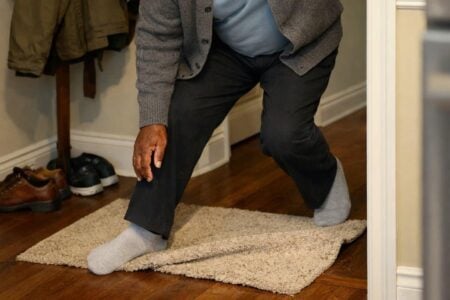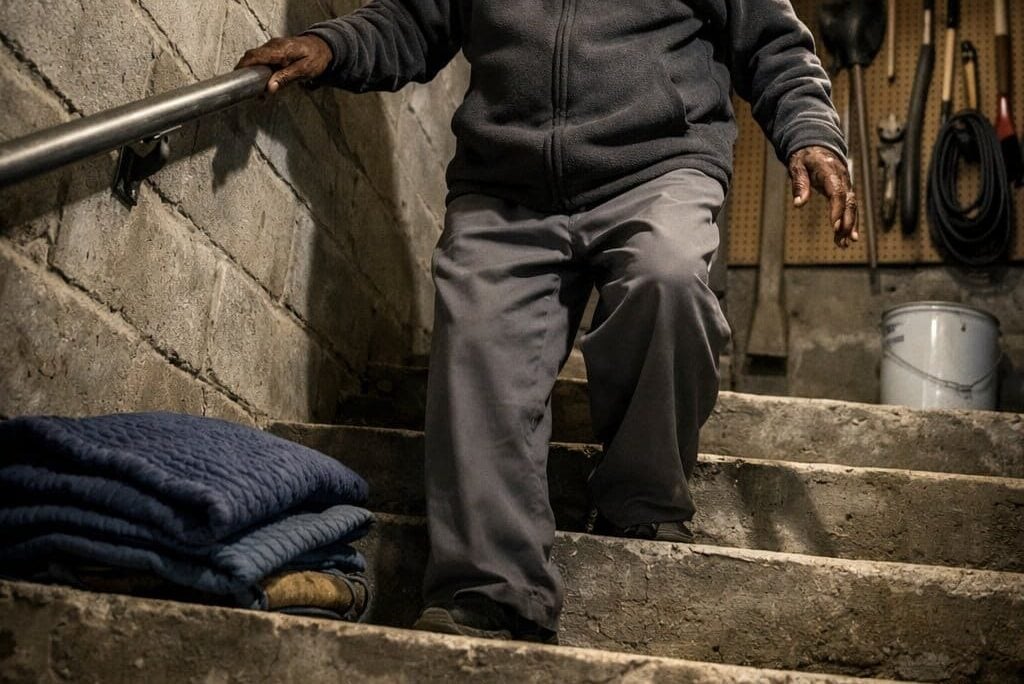
Most stair missteps begin at the tread edge — the nosing — not in the middle of the step. A worn, rounded, or visually indistinct tread edge gives your foot no reliable landing signal. Your body compensates automatically. Sometimes that compensation fails.
The good news: there is a specific, inexpensive fix for each of the four ways a stair edge fails. Those four failure modes are:
- The tread edge is slippery or smooth
- The tread edge is hard to see
- The tread edge is physically deteriorated — chipped, soft, or crumbling
- The stairwell is too dark to see any edge at all
Each of these has a different product solution. Buying the wrong type wastes money at best and creates a new hazard at worst. This article is organized around that diagnostic logic, so you can match your problem to its fix before you spend a dollar.
Here is the one thing I want you to do before reading any further: walk your staircase in low light tonight and count how many tread edges you cannot clearly see. That number tells you which section to read first.
Stair Nosing Strip Buyer’s Checklist
Download this stair nosing shopping checklist to choose the right anti-slip solution for your home on the first try—with measurements, product checklists, and disqualification rules that prevent costly mistakes and dangerous misfits.
What to Look For
Before you buy anything in this category, there are a handful of specifications that actually matter. Here is what I check before recommending a product to anyone.
Tread depth and overhang compatibility Standard residential stair treads are 10–11 inches deep with a 3/4-inch to 1-inch nose overhang. Aluminum nosing pieces are typically designed for a 1- to 1.5-inch overhang. Measure your actual overhang before ordering — a nosing that does not fit the profile sits unevenly and creates a new trip hazard.
Adhesive performance by surface type Pressure-sensitive adhesive (PSA) performs reliably on clean, dry, sealed wood, laminate, and painted concrete. It performs poorly on unsealed concrete, textured carpet tile, and any surface with residual wax or silicone. If the tread has been cleaned with a silicone-based product in the last six months, adhesion will be compromised regardless of what the label claims.
Grit rating for anti-slip tape Anti-slip tape is rated by grit, similar to sandpaper. For residential stair use — especially for older adults in socks or soft-soled slippers — 46-grit to 80-grit is the practical range. Coarse enough to grip, not so aggressive it damages skin on contact. Tape marketed for industrial use often runs 24-grit or lower. That is excessive for a home staircase.
Strip width Most stair nosing strips run 1 inch to 2 inches wide. For high-contrast visibility, a strip narrower than 1.5 inches provides a weaker visual signal. For aluminum replacement nosings, width should match the tread nose profile precisely.
Temperature range for installation PSA adhesive sets poorly below 50°F. For garage stairs or unheated basement staircases, wait until the surface has warmed, or use a construction-grade adhesive alongside mechanical fasteners.
Light-charging requirement for photoluminescent strips Glow strips charge from ambient light. They need at least 30–60 minutes of adequate light exposure — typically above 100 lux — to produce a useful glow duration. A stairwell that receives no daylight and is lit only briefly will undercharge these strips significantly.
Installation permanence Tape and adhesive strips are semi-permanent — removable with heat and solvent, but not without surface prep. Mechanical aluminum nosings require drilling and screws. LED plug-in systems are the most reversible option. Match permanence to how long the installation needs to last.
High-Contrast Nosing Tape
When a stair tread is both hard to see and feels slippery underfoot, high-contrast nosing tape solves both problems in one step — combining a visible two-tone edge marker with an anti-slip grit surface sized to sit right across the tread nose.


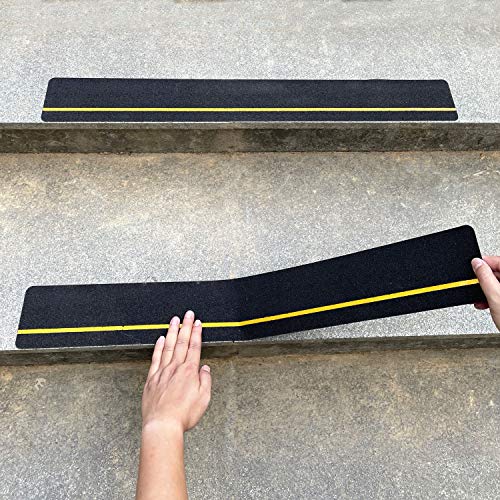

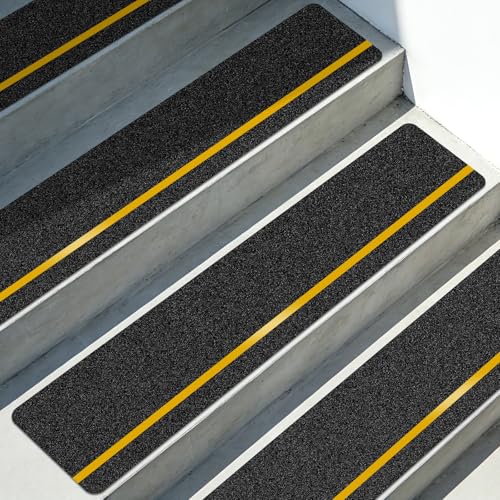
High-contrast nosing tape combines anti-slip grit with a visual edge marker in one product. It is typically a two-tone strip — most commonly black and yellow, or black and white — sized to sit across the nose of the tread so it creates both friction and a clear visual boundary.
This is the right first choice when the treads are intact but the edge blends visually into the riser below, or the surface feels insecure underfoot. It suits wood stairs, painted concrete, laminate, and vinyl plank — any surface that is clean, flat, and firmly bonded.
Contrast tape is the wrong choice when the tread surface is soft, textured, or deteriorating. Carpet and cork will not hold PSA reliably. A tread that is crumbling, chipped, or has a raised or rounded nose needs a structural solution first. It is also the wrong answer in a stairwell that is dark at night — no amount of contrast is visible in near-zero ambient light.
Compared to photoluminescent strips, contrast tape provides grip — glow strips do not. Compared to aluminum nosing, tape is faster to install and fully reversible. The trade-off: inspect every three to six months for peeling edges, which can create a new trip hazard if they lift and curl.
Trazon Grip Tape Heavy Duty Anti Slip Tape
This is a roll-format tape at 4 inches wide and 35 feet long — enough to cover a full staircase with material to spare for trimming. The 4-inch width places a meaningful visual band across the tread nose, which matters as much as the grip surface for edge visibility.
The grit rating sits in the heavy-duty residential range, appropriate for bare feet, socks, and soft-soled footwear. It is waterproof, which makes it a reasonable choice for exterior stairs or basement staircases with humidity exposure.
One honest limitation: at 4 inches wide, you are cutting every strip to length yourself. Pre-cut options simplify installation for someone working alone. If cutting and measuring feels like a barrier, the pre-cut pack options below are worth the slight cost premium.
LifeGrip Anti Slip Tape 4 Inch x 60 Foot Roll
The 60-foot roll length is the practical advantage here. A standard 12-step staircase requires roughly 40–45 feet of 4-inch tape when cut to tread width with overlap at the nose. The extra footage provides margin for mistakes and damaged strips during installation without requiring a second order.
LifeGrip markets this product for stairs specifically, which means the adhesive formulation and grit level are calibrated for that use case rather than industrial flooring. It is waterproof and rated for outdoor use, expanding its usefulness to garage and exterior stairs.
As with all roll-format tape, surface preparation determines longevity more than any other variable. A clean, dry surface prepped with isopropyl alcohol will hold significantly longer than one that was simply wiped down.
COSIMIXO Anti Slip Stair Treads with Reflective Strips — 10 Pack
Pre-cut at 4 inches wide and 30 inches long, these strips are sized for standard residential stair treads without requiring any cutting. The inclusion of reflective strips adds a dimension that plain contrast tape does not offer: visibility under a flashlight or hallway light when overhead fixtures are off.
The 10-pack covers a full staircase with two strips left over — useful for prioritizing the top and bottom steps, which are statistically the most hazardous. Pre-cut format also means consistent placement across steps without measuring each one individually.
The limitation is fixed width and length. If your treads are wider than 30 inches, you will need to supplement with additional strips or choose a roll format instead.
LifeGrip Reflective Anti Slip Stair Treads 6 x 24 Inch — 10-Pack
At 6 inches wide, these pre-cut treads provide a noticeably larger anti-slip and visual contrast surface than 4-inch options. The wider footprint means more of the tread nose is covered, which matters if the primary concern is misjudging the edge during descent.
The reflective strip runs the full length of each tread, so even a small amount of ambient or secondary light — a nightlight in the hallway, light from under a door — will create a visible edge marker. This is a meaningful feature for staircases that are not entirely dark but are dim enough to make the tread edge ambiguous.
These are rated for outdoor grip, which means the adhesive and grit are formulated for temperature variation and moisture. A reasonable choice for garage stairs or an enclosed porch staircase.
Ealyder 10-Pack 6 x 30 Inch Reflective Anti Slip Tape Black Yellow
Black and yellow is the highest-contrast color combination available in this category — the same pairing used on industrial safety markings for good reason. On light-colored treads (natural oak, pine, painted white), this combination creates an unmistakable edge signal. On dark treads, the yellow provides the contrast that a black-only strip would not.
At 6 inches wide and 30 inches long, these pre-cut strips cover more tread depth than narrower options. The reflective stripe runs parallel to the tread edge, reinforcing the visual boundary under any directional light source.
The trade-off for the black-yellow combination is aesthetic. On a finished interior staircase, the industrial look is pronounced. If the staircase is a garage, basement, or utility space, this is a non-issue. If it is a main interior staircase, some readers will prefer a less visually dominant option.
Photoluminescent (Glow) Edge Strips
For anyone who navigates stairs in the dark without wanting to turn on overhead lights, photoluminescent strips charge passively from ambient daylight and glow for hours at night — no batteries, no wiring, and no switch to find in the dark.

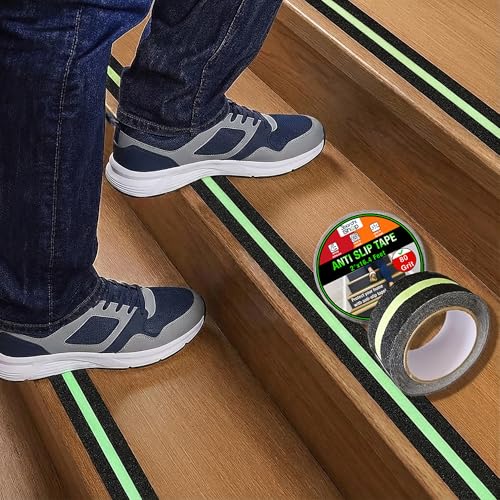


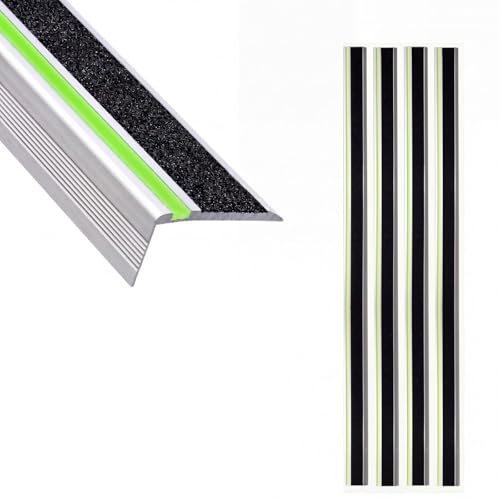
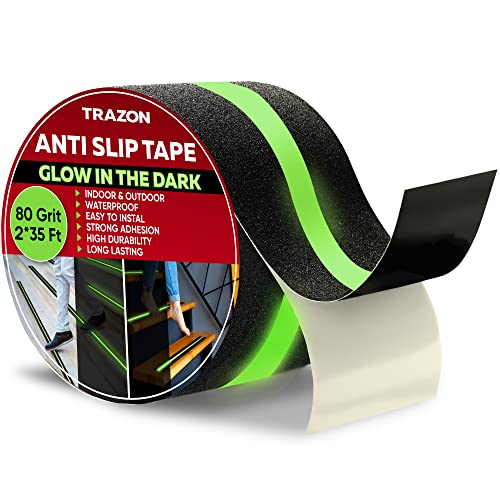
Photoluminescent strips absorb ambient light during the day and emit a low-level visible glow in darkness — typically green or blue-green. They contain no batteries or wiring. This is the correct solution when the primary hazard is a stairwell used at night, where overhead lighting requires crossing a room or fumbling for a switch.
For older adults who wake between 2 a.m. and 5 a.m. and need to navigate stairs without disturbing a partner, these strips provide a passive, always-on solution. They suit any intact tread surface and are particularly well-suited to basement stairs and interior stairwells with adequate daytime light exposure.
Photoluminescent strips provide zero friction improvement. If the tread surface is slippery, a glow strip does nothing to address that hazard. They are also ineffective in stairwells that stay dark during the day — the charging cycle will be insufficient. In that scenario, LED stair lighting is the correct solution.
Compared to LED systems, glow strips are dramatically cheaper — typically $15–$40 for a full staircase versus $60–$200 or more for LED systems — and require no installation beyond adhesive. Their limitation is that glow intensity fades over the course of the night. Most photoluminescent materials provide 4–8 hours of diminishing glow after a full charge.
Qsdboc Glow in the Dark Tape 30 FT x 1 Inch
At 1 inch wide, this tape is the narrowest option in the glow category. It is best used along the very edge of the tread nose as a precise boundary marker rather than a broad visibility band. The 30-foot roll covers a full staircase with room to spare, and the roll format allows you to cut strips to any length.
This product is positioned primarily as a safety and decor tape, so the grit level is minimal — it provides visibility, not grip. If your stairs are also slippery, pair this with a grip-focused solution rather than relying on it alone.
The roll format also makes it useful for marking non-stair hazards: door thresholds, raised floor transitions, or the base of a step stool. One roll has more applications than a dedicated stair-tread pack.
3BARCHI Anti Slip Glow in the Dark Tape — 2 Pack, 2 Inch x 16 Inch
This is a combined solution: anti-slip grit and photoluminescent glow in a single strip. That combination directly addresses the most common oversight — buying glow strips for a staircase that is also slippery. You get both functions without layering two separate products.
At 2 inches wide and 16 inches long, these pre-cut strips are sized for a standard residential tread nose. Two packs provide strips for a typical 12-step staircase. The pre-cut format reduces installation complexity significantly.
The honest limitation is that pre-cut strips at 16 inches will not span the full width of a wider tread. For treads over 36 inches, you will need to align two strips per step or choose a roll-format product.
ZALNVEY L-Shaped Aluminum Stair Nosing with Green Glow Strip — 2 Pack, 36 Inch
This product crosses two categories: it is an aluminum structural nosing with an integrated glow strip. The L-shape means it caps the tread edge and extends onto the riser, providing both structural edge definition and passive nighttime visibility in one piece.
For stairs where the tread nose is beginning to show wear but is not yet deteriorated enough to require full replacement, this is a useful middle ground. The aluminum profile restores edge geometry while the embedded glow strip handles the nighttime visibility problem simultaneously.
Installation requires screws or construction adhesive — this is not a tape-and-go product. Each piece is 36 inches long; measure your tread width and account for trimming.
Gaffer Power Glow in the Dark Anti Slip Tape 2 Inch x 30 Foot

Gaffer Power's version of combined glow-and-grip tape comes in a 30-foot roll at 2 inches wide. The clear base with glow-active compound means the tape takes on the color of the tread below it while still glowing at night — a meaningful advantage on finished wood staircases where a yellow or black strip would be visually disruptive.
The 2-inch width provides a more visible band than 1-inch tape while remaining narrower than contrast tape options. For a staircase where aesthetics matter and the primary need is nighttime edge visibility, the clear format is worth considering.
As with all PSA-based products, adhesion on textured or waxed surfaces is unreliable. Surface prep with isopropyl alcohol before application is not optional here — it is the variable that determines whether this strip lasts one year or three.
Vintruep 10-Pack 6 x 30 Inch Anti Slip Stair Treads with Glow Strips
At 6 inches wide, these pre-cut treads offer the widest glow-strip footprint in this section. The larger surface area means more of the tread is both gripped and marked with passive light — useful on stairs where users tend to place their full foot rather than just the toe.
The 10-pack covers a full 12-step staircase with strips remaining. Each strip includes both anti-slip texture and photoluminescent strips embedded in the surface, addressing grip and visibility simultaneously without product layering.
Wide pre-cut treads have one trade-off: they are more visible during daylight hours than narrower strips. On a finished interior staircase, this may be acceptable or may be visually dominant depending on the tread color. On utility, basement, or garage stairs, it is a non-issue.
Zonon 4-Pack 36-Inch Aluminum L-Shaped Stair Nosing with Green Glow Strip
Similar in concept to the ZALNVEY option above, this 4-pack provides coverage for a short flight of stairs — approximately 4 steps — with each piece running 36 inches. The aluminum L-profile caps the tread edge and the embedded green glow strip provides nighttime edge marking without batteries.
Four pieces per pack makes the per-step cost explicit: this is a structural nosing purchase with glow functionality built in, not a tape purchase. Plan for drilling and mechanical fastening unless you are using construction adhesive, which requires a completely clean, dry surface.
The aluminum finish is bright silver, which is highly visible during the day. On a dark-stained or painted staircase, the contrast is pronounced — which may be exactly what is needed, or may be aesthetically jarring depending on the home.
Trazon Heavy Duty Anti Slip Tape — Glow in the Dark Version
Trazon's glow variant pairs their heavy-duty grip tape with photoluminescent strips, offering the most aggressive anti-slip surface in this section. The grit level is higher than most glow-strip products — intended for outdoor use or high-traffic conditions — which makes this a strong choice for exterior stairs or basement utility stairs where grip is a primary concern and aesthetics are secondary.
The trade-off for the aggressive grit is that it is rougher underfoot in bare feet or thin socks. For an interior staircase used primarily with slippers, the softer grit options may be more appropriate.
Check the roll length when ordering, as Trazon offers multiple configurations under the same product line. Confirm you are purchasing the glow variant and the correct roll length for your staircase before checkout.
Rubber and Aluminum Stair Nosings
Rubber and aluminum stair nosings are structural edge replacements. Rather than sitting on top of the tread, they cap the tread edge — covering the nose and extending slightly onto the riser — and are secured with screws, construction adhesive, or both.
This is the correct solution when the tread edge itself is the problem: visibly worn, chipped, rounded through years of use, or soft wood that has compressed and no longer offers a firm landing surface. Aluminum nosings are the most durable option; rubber nosings offer similar edge protection with additional flex and slightly more grip. Both restore the stair's original safety geometry.
This product type also makes sense when tape-based solutions have previously failed on a specific stair due to surface conditions. The mechanical fasteners remove the adhesion dependency entirely.
Rubber and aluminum nosings are not a same-day no-tools fix. For a caregiver adult child who arrives without tools and has two hours, this is the wrong product unless the tread condition genuinely demands it. They are also inappropriate for carpet-covered stairs without first exposing the tread substrate.
Compared to adhesive tape, structural nosings last 10–20 years with normal residential use. The trade-off is installation complexity and cost: nosing pieces typically run $5–$20 per step versus $0.50–$2.00 per step for adhesive tape.
Pangda 50 ft Rubber Edge Trim for Steps

At 50 feet, this is a bulk roll of rubber edge trim intended for projects where consistent coverage across many steps — or a long run of threshold edging — is the goal. The flexible rubber construction allows it to be cut to length and applied to curved or irregular stair profiles that rigid aluminum cannot accommodate.
Rubber edge trim in this format is typically secured with adhesive rather than screws, which simplifies installation but shifts longevity onto surface preparation quality. A well-prepped surface will hold reliably; a surface with any wax, silicone, or contamination will not.
This is a practical choice for commercial-style installation on concrete or painted basement stairs, or for a landlord or property manager addressing multiple staircases at once. For a single residential staircase, the 50-foot quantity is significantly more than needed.
Elvone Rubber Stair Nosing — 10 Ft

Ten feet is approximately the right quantity for a 5- to 6-step half-flight, or for replacing nosings on the most-used steps of a longer staircase. The rubber construction provides a defined edge with some natural grip — rubber against a shoe sole or slipper creates more friction than smooth wood or laminate.
This product is positioned for straightforward tread-edge coverage without the installation complexity of screw-mounted aluminum. Confirm the adhesive compatibility with your tread surface before application — rubber edge trim relies entirely on adhesive bond, and the bond must hold against repeated foot-strike loading.
The honest limitation of rubber compared to aluminum: rubber compresses under load over time. On a high-traffic staircase, the edge profile may gradually soften. Inspect annually and replace if the edge has flattened significantly.
TONGMO Rubber Stair Nosing 7Ft — Standard Profile

TONGMO's 7-foot rubber nosing uses a self-adhesive strip for installation, making this one of the more accessible structural nosing options for a reader who wants more than tape but is not ready to drill. Seven feet covers three to four steps depending on tread width.
The wear-resistant rubber construction is designed to maintain its profile under foot traffic better than softer rubber alternatives. Check the stated nose overhang depth against your actual tread measurement — TONGMO specifies the overhang their profile is designed for, and a mismatch will result in an uneven installation.
This product is available in multiple colorways. For maximum edge visibility, choose a color that contrasts clearly with your existing tread surface rather than matching it.
TONGMO Rubber Stair Nosing 7Ft — Alternate Profile
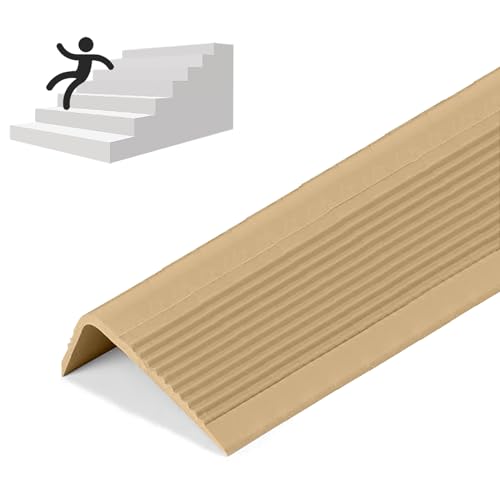
This is a second TONGMO profile variant at the same 7-foot length. The difference between TONGMO's product variants is the nose profile shape and the anti-slip ribbing pattern on the exposed surface. Confirm which profile matches your stair geometry before ordering — both are described on the product listing.
The self-adhesive installation method applies equally here: surface prep determines outcome. A tread that has been swept but not cleaned with isopropyl alcohol will produce a weaker bond than one that has been properly degreased.
For readers comparing the two TONGMO options: the ribbing pattern on the walking surface is the functional differentiator. A more aggressive rib pattern provides more grip; a finer rib pattern is smoother underfoot in socks or slippers.
TONGMO Thickened Stair Edge Trim — 10 Ft

The thickened construction here means a taller and more substantial edge profile — appropriate for stairs where the tread nose has worn down enough that a thinner strip would not restore adequate edge definition. This is a structural repair choice as much as a safety product.
At 10 feet, this version provides slightly more coverage than the 7-foot variants, making it a better fit for a standard 12-step staircase when you want to prioritize the most-used steps without buying two separate orders. Cut to length with a utility knife or tin snips, depending on the material hardness.
Inspect the nose overhang depth on your stair before ordering this product. Thicker nosing profiles require adequate clearance under the overhang to seat correctly — a tread with a minimal nose may not provide the needed depth.
FAKILO 12Ft Pre-Angled L-Shaped Rubber Stair Nosing

The pre-angled L-shape is the key differentiator here. Rather than a flat strip applied to the top of the tread nose, this profile wraps the edge — covering the top of the nosing and the front face of the riser below it. That geometry provides protection and edge definition on both the horizontal and vertical surfaces simultaneously.
At 12 feet with self-adhesive backing, this is enough material for a 5- to 6-step staircase with room for trimming. The pre-angled format reduces the fitting work compared to flat strips applied at the tread edge — the angle does the geometric work for you.
The limitation of any L-shaped profile: installation requires clean, flat surfaces on both the tread top and the riser face. A tread with chipping, raised grain, or surface irregularity will create gaps in the adhesive bond at the bend.
Trimold Vinyl Anti-Slip Stair Nosing — Self Adhesive, Flexible

Vinyl construction makes this the most flexible option in the structural nosing section — it conforms to slight surface irregularities that rigid aluminum and stiffer rubber profiles cannot. For older wooden stairs where the tread surface has developed minor bowing or cupping, that flexibility is practically useful.
The self-adhesive backing means no tools required for installation, which places this product between the tape-based options and the mechanical aluminum nosings in terms of installation commitment. Surface prep remains the critical step.
The trade-off for vinyl flexibility is long-term durability. Vinyl compresses and may crack under prolonged UV exposure in exterior applications. For interior stairs, this is generally not a concern. For exterior use, aluminum with mechanical fasteners is a more durable choice.
LED Stair Nosing Lighting
For stairwells where overhead fixtures cast shadows across the treads or where consistent nighttime visibility is needed regardless of daylight charging, motion-activated LED stair strips illuminate each step edge on demand — without requiring anyone to find a light switch first.


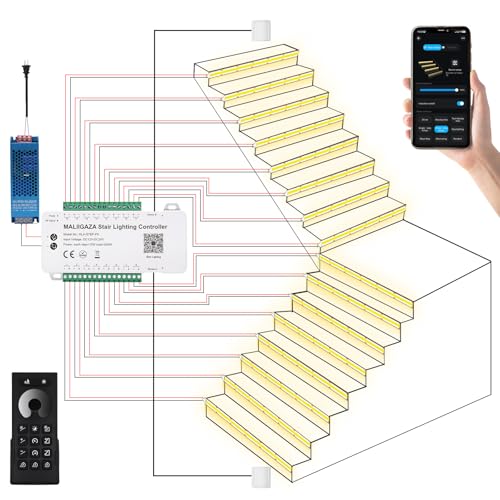

LED stair nosing lighting integrates low-level light directly into the tread edge, illuminating the step boundary from below or within the nosing itself rather than relying on overhead fixtures. This is the correct solution when the stairwell's geometry is the problem: overhead lighting that creates shadow across the treads, a stairwell that turns a corner with a naturally dim zone, or a household member with low vision who cannot reliably distinguish tread boundaries even with the overhead light on.
Motion-activated versions — which illuminate only when someone is on the staircase — are particularly well-suited to overnight use without disturbing sleep in adjacent rooms. Plug-in LED strip systems without hardwiring reduce installation complexity significantly and are appropriate for readers who are not comfortable with electrical work.
LED stair lighting is the most expensive option in this category. Plug-in systems typically cost $60–$150 for a full staircase; hardwired systems run $150–$300 or more. For a stairwell with adequate lighting and intact tread surfaces, this is significant overspend when contrast tape at $20 solves the actual problem.
Compared to photoluminescent strips, LED systems provide consistent light output all night, independent of daytime charging, and are effective in stairwells that receive no natural light. The trade-off is cost, power dependency, and installation effort.
GOOMEEYA Dual Motion Sensor Plug-In LED Step Stair Light Strip
The dual motion sensor design means the system detects motion at both the top and bottom of the staircase — so the lights activate whether you are descending or ascending, without requiring you to be midway up before the strip illuminates. That distinction matters at 3 a.m. when you need the light before you take the first step.
The plug-in power supply eliminates hardwiring, which keeps this product within DIY territory. Confirm there is an accessible outlet near the staircase before ordering — routing a cable to a distant outlet can create its own trip hazard if not managed with cable clips.
The light strip is adjustable, which allows you to position illumination at the tread nose rather than along the wall. That placement creates the shadow and contrast that makes the edge visible, rather than simply lighting the wall beside the stair.
KOMIGAN Intelligent Motion Triggered LED Stair Lighting Kit KMG-3233 — 40 Inch
This kit uses motion-triggered activation with individually illuminated strips per step, meaning each tread lights up as you approach rather than the entire staircase flooding with light simultaneously. That progressive illumination is gentler on eyes adapted to darkness — a real advantage for overnight use.
The 40-inch cuttable LED strip accommodates a range of tread widths without requiring a separate extension kit for standard residential stairs. Confirm the number of steps included in the kit against your staircase before ordering.
KOMIGAN positions this product for both aesthetics and safety, so the installation is designed to be discreet — the strip sits in or under the tread nose rather than on top of it. That placement protects the LED from foot traffic while directing light downward onto the riser and floor below.
SuperlightingLED 20-Step Motion Activated Stair Lights Kit — 47.2 Inch Warm White
Twenty-step coverage in a single kit is the practical advantage here. Most stair lighting kits cover 10–16 steps; this system accommodates a longer flight without requiring a second kit. The 47.2-inch cuttable strip handles wide tread formats as well.
Warm white light is the key specification for overnight use. Cool white and blue-white lighting triggers the same alertness response as daylight — counterproductive at 3 a.m. Warm white provides adequate visibility without suppressing the return to sleep after a bathroom trip.
The motion-activated design requires a sensor with adequate detection range to trigger before you reach the first step. Confirm the stated detection distance against the geometry of your stairwell — a sensor with a 10-foot trigger radius works differently in a narrow corridor than in an open landing.
MALIIGAZA Smart Motion Sensor Stair Lights — 16 Step COB Strip with App Remote
App control and remote adjustment are the differentiating features here. For a household where multiple people have different nighttime needs — one person who wants maximum brightness, another who prefers minimum disruption — adjustable brightness via app is a meaningful convenience rather than a gimmick.
COB (chip-on-board) LED technology produces more even, shadow-free illumination than standard LED strips, which can create visible hot spots. On a tread that needs consistent edge-to-edge visibility, that evenness matters.
The 16-step coverage is standard for residential use. Confirm app compatibility with your phone's operating system before purchasing, and check whether the hub or controller requires a specific WiFi band — some smart home devices do not support 5GHz networks.
NIVOTA Dual Sensor LED Strip Light for Stairs
Dual sensor placement — top and bottom of the staircase — addresses the same activation gap as the GOOMEEYA option. The staircase is lit from whichever end you approach, before you take the first step. For a staircase that is used in both directions throughout the night, that redundancy matters.
NIVOTA positions this as a self-contained system, which simplifies ordering. Check the stated coverage (number of steps) against your staircase, and confirm the power supply cord length is sufficient to reach your nearest outlet without visible cable runs that could create hazards.
The installation method uses adhesive mounting for the LED strips, which keeps this fully reversible — no drilling required. Adhesive strip mounts require the same surface prep discipline as any PSA product: clean, dry, and free of silicone residue.
KOMIGAN KMG-3233 Motion-Activated LED Stair Lighting Kit with Wall Switch — 42 Inch
This variant of the KOMIGAN system adds a wall switch, which provides manual override — useful when you want the lights on without triggering the motion sensor, or when you want to confirm the system is functioning without walking the staircase repeatedly. That manual control option is practical for caregivers checking the installation.
The 42-inch cuttable strip accommodates standard residential tread widths. The motion-triggered design with wall-switch override gives the user more control over when and how the system operates compared to motion-only systems.
Confirm the installation instructions for the wall switch component before purchasing if your staircase does not have an accessible wall location for the switch near the top or bottom landing. The switch must be within reach to provide the intended convenience.
Frequently Asked Questions
Can I put stair nosing strips on carpet?
The direct answer is: not reliably with PSA adhesive. Carpet pile does not provide a flat, stable bonding surface, and PSA will separate from carpet under the repeated load of foot traffic. If the carpet is very low-pile and tightly bonded to a hard substrate, some products claim compatibility — but performance is inconsistent, and inspection should be frequent. For carpeted stairs, the correct approach is either applying strips to the hard tread substrate exposed at the very edge of the nose, or choosing a mechanical nosing that can be screwed into the substrate beneath the carpet.
How long do adhesive stair strips last?
On a properly prepared surface — clean, dry, free of wax and silicone, treated with isopropyl alcohol before application — PSA adhesive typically holds 1–3 years in residential indoor use before peeling risk increases meaningfully. High-traffic stairs wear faster. Environmental factors like basement humidity or garage temperature swings accelerate degradation. Inspect semi-annually. A peeled or lifting edge is not just a sign the product has aged — it is a new trip hazard in its own right.
Do glow strips work in a stairwell with no windows?
Only if the stairwell light is left on during the day for at least 30–60 minutes at adequate intensity. If the stairwell is kept dark during the day and only lit briefly when in use, photoluminescent strips will charge inadequately and produce minimal glow at night. In that scenario, battery-operated LED strips or a plug-in LED system is the correct alternative. The glow-strip option is genuinely effective only when the stairwell receives sufficient ambient light during waking hours.
Are these products safe to install myself, or do I need a contractor?
Adhesive tape and glow strips are fully DIY. Surface prep — specifically the isopropyl alcohol step — is the critical variable, not installation skill. Aluminum and rubber nosings with screw installation require a drill and basic comfort with fasteners. That is a genuine step up from tape, but within most adults' capability. Plug-in LED systems are DIY; hardwired LED systems should be installed by a licensed electrician. No product in this article requires a contractor for the installation method it is designed around.
Will these strips damage my stairs when I remove them?
Adhesive residue is the main concern. On sealed and finished wood, PSA tape typically removes cleanly with a heat gun or hair dryer and a plastic scraper. On painted surfaces, paint may lift with aggressive adhesive. On unsealed or soft wood, some fiber transfer can occur. Goo Gone or a similar adhesive remover handles residue in most cases. Aluminum nosings with screws leave screw holes that require filling if removed. LED adhesive mounts behave the same as other PSA products on the same surface types.
Which product type should I buy if I'm not sure what the problem is?
Do the diagnostic walk I mentioned in the introduction: low light, full staircase, count the edges you cannot see, and check whether the surface feels firm and non-slip underfoot. If visibility is the only issue and the stairwell gets daylight, start with photoluminescent strips — lowest cost, no tools, fully reversible. If grip and visibility are both needed, high-contrast tape. If the tread edge is physically damaged or worn down, aluminum or rubber nosing. If the stairwell is dark regardless of time of day — no daylight, minimal artificial light — LED lighting is the correct solution. Buying the wrong type does not fix the actual problem, and sometimes makes it worse.
Hacks and Practical Advice
The isopropyl prep step is not optional. The number-one cause of premature tape failure is a surface cleaned with a household cleaner that left a surfactant film. I've seen families go through three rounds of strip replacement because they skipped this step. Isopropyl alcohol at 70% or higher, applied with a lint-free cloth and allowed to dry for five full minutes, removes that film. Skip it and a strip that should last two years may start peeling in two months.
Buy a test strip before committing to a full staircase. Apply one strip on the most-used step and wait 72 hours before doing the rest. This costs nothing but time and reveals adhesion problems on that specific surface before they become a $40 mistake.
Inspect in low light, not full light. Peeling edges and chipped nosings are easy to miss under overhead illumination. Get down to tread level in the same low-light conditions the staircase will actually be used in. That's when the hazards reveal themselves — and that's exactly when your fall prevention checklist becomes useful beyond just the staircase.
The most dangerous step is usually the bottom one. Landing missteps — where someone thinks there's one more step when there isn't, or vice versa — are most common at the top and bottom of a staircase. If budget or time is limited, prioritize those two steps first and work outward from there.
Mark your installation date. Write the date on a piece of tape on the back of the bottom step riser. One year from that date, run the full inspection again. Adhesive stair safety products are not install-and-forget.
Match the permanence to the situation. If you are installing these products in a rental, a parent's home you may sell in two years, or a temporary living situation, PSA tape or plug-in LED are the right choices — reversible without damage. If this is a forever home with a staircase that will be used daily for the next twenty years, mechanical aluminum nosings are worth the extra installation effort.
Stair Nosing Strip Buyer’s Checklist
Download this stair nosing shopping checklist to choose the right anti-slip solution for your home on the first try—with measurements, product checklists, and disqualification rules that prevent costly mistakes and dangerous misfits.
The Right Fix for the Right Problem
The central insight of this article is simple: four distinct failure modes exist on home staircases, and four product types address them. Buying a glow strip for a slippery stair does nothing. Buying contrast tape for a pitch-dark stairwell does nothing. Matching the product to the actual problem is the entire point — and the diagnostic walk I described in the opening is how you do that.
I've seen families spend $300 on stair runners when a $12 roll of contrast tape would have solved the actual problem. I've also seen glow strips installed on a stairwell that receives no daylight, sitting inert and dark every night. Neither outcome is helpful.
The staircase in most homes can be meaningfully safer for $15 to $50 and a Saturday morning. If you have already addressed the stairs and want to know which room to turn to next, the bathroom is typically the next priority — and many of the same diagnostic principles apply there. For the floor at the base of the staircase and throughout the rest of the home, night lights placed strategically can extend the same passive-safety logic from the staircase into every room.
The staircase is a good place to start. It rarely has to be where you stop.