
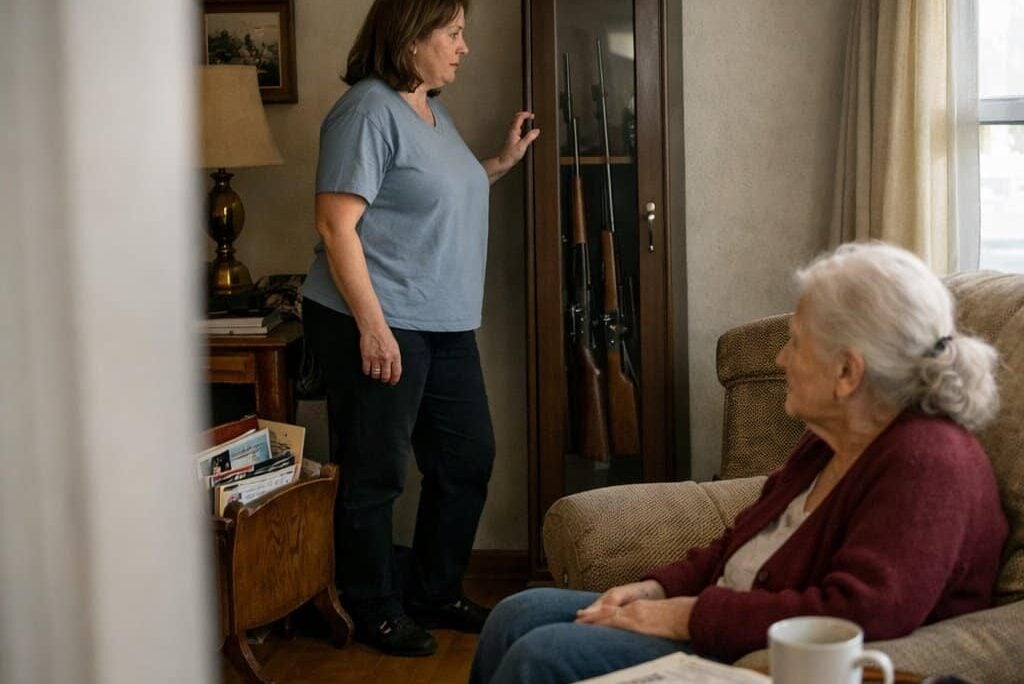
A firearm that has lived in the same nightstand drawer for thirty years is still findable. The person with dementia who has always known exactly where it is has not lost that knowledge — not yet, and sometimes not for a long time. What they have lost, or are losing, is the judgment that used to govern what they did with that knowledge.
That is the problem this article is about. Not dementia broadly. Not gun safety broadly. The specific collision of the two: a household where someone’s cognition is changing, and where the firearms in that household are still exactly where they have always been.
Most families treat this as a binary decision — remove the guns or don’t. In many case, removing the guns is the best and only option.
The real question is more immediate: what is the status of every firearm in this household right now, and could a confused person access it without help? That answer determines which products on this list matter most to you.
This article covers four types of solutions, in the order most households need them. Biometric and quick-access pistol safes address owner access and unauthorized access at the same time. Full-size locking gun cabinets address households with multiple firearms or long guns. Trigger and cable locks are interim measures only — useful today, while something better is on order. And locking ammunition storage is the step almost everyone skips, which closes the final gap that every other measure leaves open.
Before you read further: go locate every firearm in the household and ask honestly whether every person living there could reach it without help. That answer tells you where to start.
Firearm Storage for Dementia Households: Shopping Guide
Download this printable shopping guide and know exactly which firearm storage products meet safety standards for dementia households—no guessing, no second-guessing, just a checklist you take to the store.
What to Look For
Choosing the wrong product here is not an inconvenience. It is a gap that stays open. These are the criteria that separate adequate storage from inadequate storage in a household where someone’s judgment is changing.
Access method reliability under stress. Biometric readers vary significantly in false-rejection rates. A reader that fails one in five attempts — under cold hands, damp hands, or a slightly different finger placement — creates pressure to leave the safe unlocked between uses. Look for a rated false-rejection rate under 1% and a backup access method that is genuinely redundant. A mechanical key override is not optional. It is what you use when the battery dies at 2 a.m. A second fingerprint slot is not a backup — it is a second version of the same potential failure.
Battery life and backup. Most quick-access safes run on four AA batteries, with rated life between 6 and 12 months under normal use. Temperature extremes shorten that significantly. The safe should provide a low-battery warning — audible or LED — before failure, not after. External battery terminals on the outside of the door allow you to power the safe with a 9-volt battery when the internal batteries are dead, without needing the door open first. That feature is worth paying for.
Steel gauge. Safe steel is measured in gauge; lower numbers mean thicker steel. Consumer quick-access pistol safes typically run 14- to 18-gauge. Full-size gun cabinets in the consumer range run 12- to 16-gauge. In a dementia household, the concern is not a determined thief with tools — it is a confused person who may pull, tug, or pry at something that doesn’t open the way they expect. 14-gauge or heavier is a meaningful baseline for any permanent installation.
Anchor points and hardware. Any safe that can be carried out of the room defeats its purpose. Look for pre-drilled anchor holes and verify the product ships with mounting hardware. For cabinets, confirm the anchor bolt spacing and whether the hardware shipped is rated for your wall type. A cabinet anchored to drywall alone — without hitting studs — is not meaningfully anchored.
Interior dimensions. A pistol safe that cannot fit the owner’s specific handgun with a mounted light or red-dot sight is useless from the day it arrives. Before purchasing, measure the firearm’s overall length, width with any additions, and height. Compare against stated interior dimensions — not exterior.
Pry resistance. Where manufacturers publish pry resistance in pounds of force, look for 1,750 lbs or higher for a pistol safe that will see daily access. For gun cabinets, check whether the door hinges are exposed — exposed hinges can be defeated with a pry bar regardless of the lock quality behind them.
Ammunition separation. A locked firearm next to accessible ammunition does not complete the safety picture. These two storage decisions must be made together. This article returns to that in the ammunition section.
Biometric and Quick-Access Pistol Safes
Quick-access pistol safes let the authorized owner reach a handgun immediately while making that same firearm inaccessible to every other person in the household, including a family member whose judgment is no longer reliable. In a dementia household, this type of safe addresses the single most common scenario: one handgun in a bedroom or nightstand that needs to stay secured around the clock.


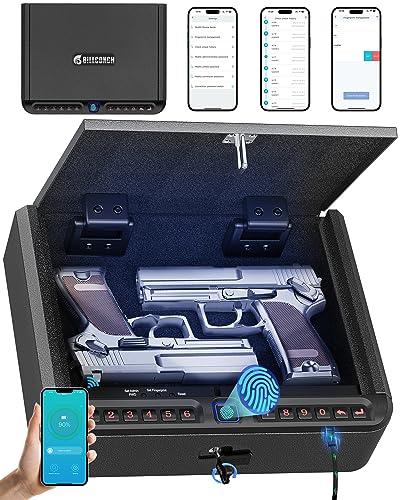


A quick-access pistol safe solves a specific problem: the owner needs to reach a handgun faster than a traditional combination lock allows, while making that same firearm inaccessible to every other person in the household. In a dementia household, “every other person” includes someone who may be physically capable, determined in the moment, and entirely unaware they are doing something dangerous.
This type suits households where the primary concern is a single handgun — typically kept in a bedroom, home office, or near a vehicle. It is the right first purchase when the owner is cognitively intact and wants to retain lawful access. It is not a substitute for a full cabinet in a home with multiple firearms or long guns, and it is not the right solution if the gun owner’s own access needs are in question.
No quick-access pistol safe is impenetrable. These products are designed to resist a confused or unauthorized person, not a determined person with tools and uninterrupted time. That honest limitation is worth naming before you buy.
XDeer Biometric Gun Safe for Handgun, Slider Bedside Handgun Safe
The XDeer uses a sliding drawer design that opens horizontally rather than swinging a door. That distinction matters in a nightstand context — a swinging door requires clearance that a nightstand may not have. The biometric reader is positioned at the front of the drawer, with keypad and key override as redundant access methods.
For a dementia household where the concern is a family member accessing a bedside handgun, the slider format is worth considering specifically because the drawer does not create a visible, swinging-door cue that a person operating on habit might recognize and manipulate. The access methods are layered, which is the right design for this use case.
The honest limitation here is interior capacity. This safe is sized for a single compact to mid-size handgun. If the owner’s firearm is a full-size pistol with an optic or light attached, measure the interior dimensions against the firearm before ordering.
AIRMuch Biometric Gun Safe for Handguns, Pistol Safe Fits 2-3 Handguns
The AIRMuch is designed to fit two to three handguns, which puts it in a different category than single-pistol safes for households where multiple handguns need to be consolidated into one secured location. Consolidation is relevant in a dementia household — every additional unsecured firearm location is an additional risk point.
Access is biometric with backup keypad. The interior is larger than most pistol safes in this category, and the added capacity means less pressure to store a second firearm elsewhere, unsecured. The trade-off for larger interior is typically a heavier, less flexible mounting profile.
Before purchasing, verify anchor options against your intended installation location. A bedside safe that cannot be anchored to a nightstand or the floor beside it is a safe that can be moved.
BILLCONCH Gun Safe for Handgun with Fingerprint, App, 0–9 Numeric Keypad
The BILLCONCH in this configuration adds app-based access management to the standard biometric-plus-keypad combination. For a caregiver who wants to monitor access events or manage the safe remotely — without being present in the room — that connectivity is a genuine feature rather than a gimmick.
In a household where the adult child caregiver lives separately from the parent with dementia, app access logging can provide an additional layer of awareness. The owner can open the safe normally; the caregiver can see when that happens. That is information that matters when judgment is changing.
The limitation of any app-connected safe is dependency on a functioning wireless connection and app infrastructure. Confirm that the mechanical override is present and accessible before relying on this product in a primary safety role.
RPNB Bedside Gun Safe for Handgun, Biometric Pistol Safe, Small Handgun Safes
The RPNB is a well-documented quick-access safe that has been on the market long enough to have meaningful real-world feedback across different installation environments. The biometric reader uses a capacitive sensor with a stated high acceptance rate and includes keypad and mechanical key override.
The design is compact, which suits a nightstand top, drawer interior, or under-desk mount. Compact also means the interior fits most single handguns without optics. If your firearm has a mounted light or extended grip, check interior dimensions before ordering.
For a household making its first purchase in this category, the RPNB is a straightforward starting point with redundant access methods and a mounting hardware kit included.
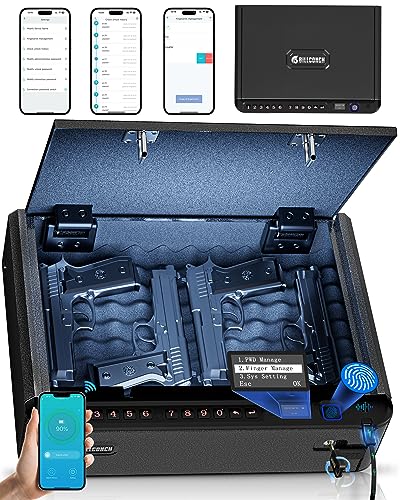
BILLCONCH Smart Gun Safe with Fingerprint, App, Keypad, LCD & Security Cable
This BILLCONCH model adds an LCD display and a security cable to the biometric-app-keypad combination. The LCD provides status feedback — battery level, access confirmation — that removes ambiguity about whether the safe is functioning correctly. The security cable is designed for situations where mounting is not possible, allowing the safe to be tethered to a fixed object.
The cable tether is worth understanding clearly: it is a deterrent to opportunistic removal, not a structural anchor. A cable that loops around a bed frame leg resists someone picking up the safe and walking away, but it does not resist determined effort with a tool. Use it in situations where anchor bolting is not possible, and treat it as a step above no anchoring, not an equivalent to bolting.
The LCD status display is genuinely useful for households where the caregiver — not the owner — is responsible for confirming the safe is locked and functional during periodic checks.
ZCF mate Biometric Gun Safe, Auto Sliding Drawer Pistol Safe with Fingerprint Access
The ZCF mate uses an auto-sliding drawer mechanism, meaning the drawer opens on a motorized track after a successful fingerprint read rather than requiring the user to pull it manually. For a gun owner with arthritis or reduced hand strength — a common co-occurring condition with cognitive decline — a motorized open eliminates a friction point that might otherwise cause a person to leave the safe unlocked for ease of access.
The automatic open also removes a habitual motion that someone observing access might memorize and attempt to replicate. The drawer slides open without the user pulling at it.
Interior capacity is sized for a single handgun. The electrical mechanism adds a layer of dependency on battery function, which makes the external battery terminal feature — if present — worth confirming before purchase. Check the product listing for mechanical override availability.
Full-Size Locking Gun Cabinets
Full-size locking gun cabinets consolidate multiple firearms and long guns into a single locked location, eliminating the multiple unsecured storage points that create multiple risk points in a home where someone’s cognition is changing. Properly anchored to wall studs, a full-size cabinet prevents casual or confused access to an entire collection without requiring the owner to give up their firearms.

![[No Assembly Required] Gun Safe for Rifles and Pistols, with](https://m.media-amazon.com/images/I/5184OAl8VIL._SL500_.jpg)

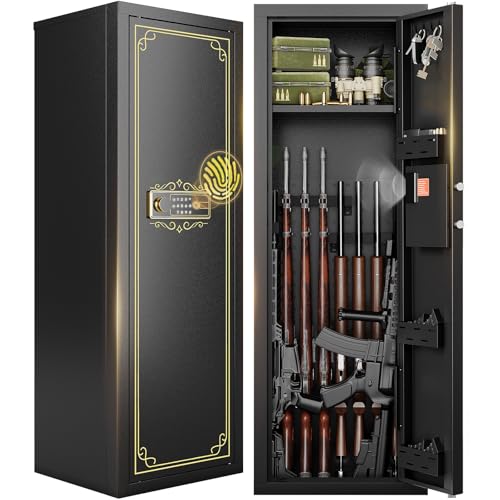
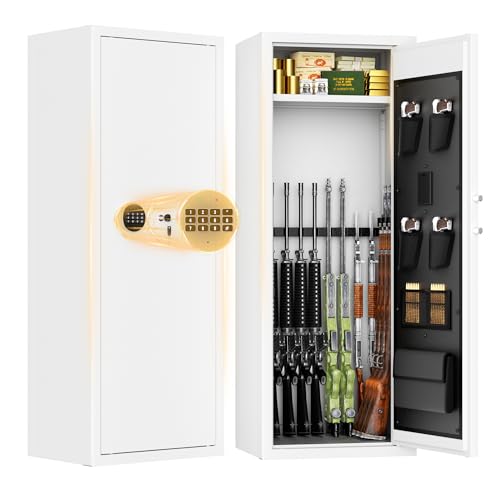

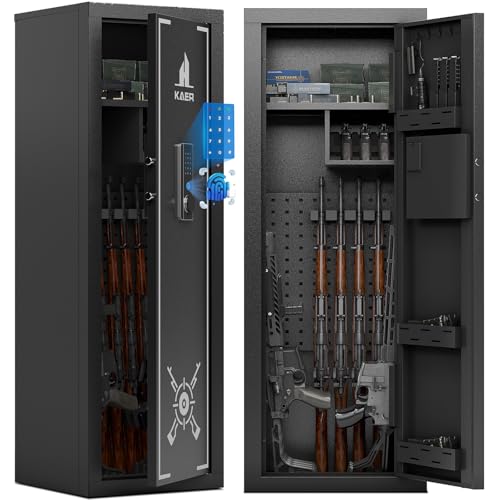
A full-size locking gun cabinet is the right solution for households with multiple firearms, long guns, or both. It stores rifles and shotguns vertically alongside handguns in a dedicated pistol rack, secured behind a locked door. In a dementia household, the cabinet’s security is entirely dependent on how and where it is anchored.
A cabinet that weighs 150 lbs empty and 250 lbs loaded can still be accessed by someone who pulls it away from the wall if it is not properly anchored into studs. A person operating on habit or impulse — not judgment — can be physically capable and persistent. Anchoring is not optional.
This type suits households with a collection that cannot practically be divided among multiple pistol safes, and where a permanent installation is possible. Gun cabinets are significantly less resistant to prying than gun safes. For a dementia household, the purpose is preventing casual or confused access — not defeating a determined intruder with tools. Properly anchored, these products accomplish that purpose well.
KAER Biometric Gun Safe Rifle, Gun Safes for Rifles and Pistols Holds 14-15 Firearms
The KAER 14-15 firearm cabinet uses biometric access on a full-size long gun cabinet, which removes the combination or key management problem from a household where the owner’s memory is unreliable. A fingerprint reader that the owner has used consistently creates less cognitive load than a combination that must be recalled under pressure.
Capacity of 14-15 firearms covers most household collections that would otherwise require multiple storage points. Consolidation into a single locked location simplifies the security picture.
Confirm the steel gauge and anchor hardware specifications before purchasing. A biometric lock on a thin-gauge, unanchored cabinet provides less real-world security than a key lock on a thick-gauge, bolted one. These two factors — steel and anchoring — matter more than the access method.
INTERGREAT 12-15 Gun Safe, Large Gun Safe for Rifles and Pistols, Quick Access Rifle Safe
The INTERGREAT is a full-size cabinet with capacity for 12-15 firearms and quick-access functionality for the primary long gun. The quick-access feature means the first firearm in the cabinet can be retrieved faster than unlocking and reaching into the full cabinet — useful for a home defense scenario, but worth evaluating carefully in a dementia household.
If the primary concern is unauthorized access, a quick-access feature that bypasses the main lock for one firearm is a design trade-off to understand. Confirm how the quick-access zone is secured relative to the main cabinet lock before purchasing.
The full cabinet capacity is appropriate for mixed long gun and handgun storage. Interior shelving and pistol rack configurations vary by model — confirm the interior layout against your specific firearms before ordering.
Leariso Gun Safe for Rifles and Pistols, No Assembly Required, Biometric Quick Access Gun Lock
The Leariso ships fully assembled, which eliminates the installation variable of assembly errors in a product category where structural integrity matters. For a caregiver ordering this for a parent’s home — possibly installing it without the manufacturer’s documentation immediately at hand — no-assembly delivery reduces the margin for installation error.
Biometric access on a full-size rifle cabinet means the owner does not need to remember a combination. The honest limitation of factory-assembled cabinets is that shipping damage to the door alignment or locking mechanism is harder to detect and correct than with field-assembled units. Inspect the cabinet immediately on delivery before installation.
Anchor the cabinet into wall studs. Confirm stud location before drilling. A cabinet this size, improperly anchored, is a tipping hazard as well as a security gap.
KAER 4-5 Biometric Gun Safe for Rifles and Pistols, Long Rifle Safe for Home
The KAER 4-5 is a smaller-footprint long gun cabinet for households with a limited number of rifles or shotguns alongside handguns. Smaller cabinet size means easier placement in rooms where a full-size cabinet does not fit — a bedroom, a closet, or a home office — without sacrificing the locked long gun storage that a pistol safe cannot provide.
Biometric access functions the same as in the larger KAER models. The reduced footprint also means reduced steel volume, and lighter cabinets are easier to move if not properly anchored. For a smaller cabinet, anchoring is proportionally more important, not less.
This is the right choice when the household has two to four long guns and the collection does not justify a 14-gun cabinet.
KAER 8-12 Fingerprint Long Gun Safe for Rifles & Pistols, Password Lock, Adjustable Shelving
The KAER 8-12 sits between the compact 4-5 and the full 14-15 in capacity and footprint. Adjustable interior shelving is a relevant feature for households with mixed firearms of different lengths and configurations — a fixed interior that cannot accommodate a particular long gun’s length forces that firearm to be stored elsewhere.
Password lock with fingerprint access provides two independent access methods. The password option is useful when the biometric reader needs maintenance or when a second authorized user needs access without enrolling their fingerprint.
Verify the adjustable shelf configurations against your specific long gun lengths before purchasing. Stated capacity in “8-12 firearms” is typically based on standard-length rifles without optics or slings. Your actual usable capacity may be lower.
Bonusall 12-15 White Gun Safe for Rifles, Fireproof Gun Safe for Rifles and Pistols
The Bonusall adds a fireproof rating to the full-size cabinet category. In a home where fire safety is a concurrent concern — particularly relevant given that many homes with a family member with dementia also have related fire safety considerations — a fireproof-rated cabinet addresses two risks simultaneously.
Fireproof ratings on consumer cabinets specify a temperature and a duration. Confirm that the rating reflects conditions realistic to a residential fire scenario, not a laboratory minimum. The white exterior finish is a cosmetic distinction that matters in households where a cabinet placed in a living area needs to be less visually clinical.
The fire safety concerns that come with dementia caregiving extend beyond firearms, and a product that addresses fire protection as part of the storage solution is worth noting for households managing multiple safety priorities simultaneously.
KAER Long Gun Safe for Rifles and Pistols with Electronic Lock, Assembled
The KAER assembled model with electronic lock ships ready to anchor without field assembly of the cabinet structure. Electronic lock means keypad access, which is straightforward and does not require fingerprint enrollment — useful in households where the owner’s fingerprints are inconsistent due to dry skin, medication effects, or reduced ridge definition with age.
Keypad access creates one risk to name plainly: a person observing the code being entered can memorize it. In a dementia household, that means the keypad code should be changed if there is any reason to believe it has been observed. Confirm that code change is possible without manufacturer involvement.
Assembled delivery combined with electronic access and full long gun capacity makes this a straightforward installation for a household that needs all three features without the variable of field assembly.
Trigger and Cable Locks
Trigger and cable locks are the one storage solution that can be in place the same day a family decides something needs to change, requiring no installation, no planning, and no waiting for delivery. They are interim measures only, designed to close the gap between the moment of decision and the arrival of a proper safe or cabinet.

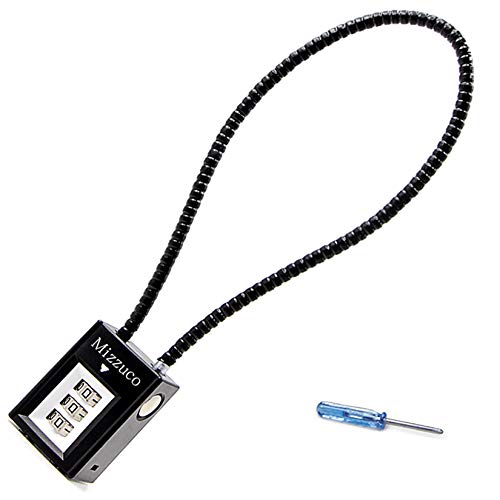


A trigger lock prevents the trigger from being pulled. A cable lock threads through the action or barrel and prevents the firearm from being loaded or handled normally. Neither product stores the firearm. Neither removes it from its current location. Both are interim measures — appropriate the same day a family decides something needs to change, while a proper safe is still on order.
In a dementia household, trigger and cable locks are not a long-term solution. A confused person may still handle the firearm, may attempt to defeat the lock, or may not recognize the lock as a deterrent. These products belong in this article because they can be in place today, which matters when the alternative is doing nothing while waiting for a safe to arrive.
Lockdown 15 Inch Cable Gun Lock with Non-Marring Design, California DOJ Approved
The Lockdown cable lock uses a 15-inch cable with a keyed mechanism and a non-marring coating that protects the firearm’s finish. California DOJ approval means the product has passed a state-level safety standard — a meaningful baseline for a product in this category.
The keyed mechanism is preferable to a combination in a dementia household: fewer steps for the authorized user, and no observable code for an unauthorized person to watch and repeat. Two keys are standard; store them separately from each other.
This lock is appropriate for rifles, shotguns, and most semi-automatic handguns. The 15-inch cable length provides flexibility for threading through different action types. Confirm compatibility with your specific firearm before purchase.
Mizzuco Trigger Lock 3 Digit Combination Gun Lock & Gun Cable Lock Compatible with Many Handguns
The Mizzuco combination trigger lock includes a cable component, giving both trigger-guard blocking and the option to run a cable through the action. The combination mechanism means no key to lose — which is the argument for combination locks — but also means a code that can be observed.
For a dementia household, a combination lock on a trigger lock is an appropriate interim measure, but the code should not be one that is in regular visible use (a birthday, an address). If the lock is used in a room that the person with dementia accesses, a non-obvious combination matters.
Compatibility is stated for many handguns but not all. Revolvers and semi-automatics have different trigger guard geometries. Confirm fit for your specific firearm.
Mizzuco Keyed Cable Gun Lock with 3 Spare Keys for Dry Home Firearm Storage
The Mizzuco keyed cable lock in this configuration includes three spare keys, which is a practical advantage in a household where key management is part of the safety plan. One key in use, one stored separately, one in the hands of a trusted second person — that distribution is possible with three keys included.
The cable design threads through the action, making the firearm non-functional for loading without removing the cable. The keyed mechanism requires the authorized user to have the key on their person or in a known location. Store keys away from the firearm and away from the person with dementia’s regular areas.
This product is specified for dry home storage, not vehicles or humid environments. If the firearm will be stored in a garage or vehicle at any point, confirm the lock’s moisture resistance rating.
RioRand Keyed Alike Trigger Lock, Adjustable Gun Safety Lock with 2 Brass Spare Keys
The RioRand trigger lock is keyed alike, meaning if a household purchases multiple locks, all of them open with the same key. In a household with multiple firearms that all need interim securing, keyed-alike locks simplify key management — one key opens everything.
Adjustable jaw size covers a range of trigger guard dimensions, which addresses the compatibility problem that a fixed-size trigger lock creates. The adjustment mechanism should be confirmed functional and correctly set before the lock is relied upon.
Two brass keys are included. As with all keyed locks in this setting: store the keys where the person with dementia cannot access them.
RioRand 15 Inch Combination Gun Cable Lock, 5-Pack
The five-pack format of the RioRand cable lock is appropriate for a household that needs to secure multiple firearms simultaneously on the same day. A family taking action across an entire collection — not just a single firearm — can use five cable locks to address five firearms in one order.
Combination mechanism with a 15-inch cable. The same observation about visible combinations applies here as in the Mizzuco trigger lock. Do not use a combination that is in everyday visible use in the household.
The five-pack price per unit is lower than single-unit purchase. For an interim measure that will eventually be replaced by a proper safe or cabinet, the five-pack is appropriate for households with multiple firearms that need immediate interim coverage.
lockforall Cable Gun Locks with Keys, Keyed Alike, 15″ Cable Gun Safe Lock
The lockforall keyed-alike cable locks combine the key-over-combination advantage with the keyed-alike advantage for multi-firearm households. One key covers all locks in the set, which is the right design when multiple firearms need to be secured and key proliferation creates its own management problem.
The 15-inch cable provides threading flexibility across different firearm types. The keyed mechanism requires key possession for access — which means keeping the key away from the person with dementia and on the person of the authorized user.
As with all cable locks: this is an interim measure. It prevents a confused person from loading and firing a firearm in the moment. It does not prevent handling, does not prevent removal from the room, and does not secure the firearm the way a locked safe does.
Locking Ammunition Storage
A locked firearm next to accessible ammunition is not a secured firearm, and separate locking ammunition storage is the step that completes every other measure on this list. Storing ammunition in a locked box in a different location from the firearm means that even if one barrier is compromised, the components needed to cause harm are not simultaneously available.


A locked firearm next to accessible ammunition is not a secured firearm — it is a secured firearm next to the components needed to make it functional. A person with dementia who locates a locked handgun in a bedside drawer and locates a box of cartridges in the same drawer has access to everything required, regardless of whether they can operate the lock.
Separate, locked ammunition storage is the step most households skip. It is also the step that completes every other measure on this list. There is no scenario in this article where securing the firearm but leaving the ammunition accessible finishes the job.
Solid Tactical Lockable 50 Cal Metal Ammo Storage Box, Military Steel Ammo Can, Black
The Solid Tactical 50 Cal box is a military-spec steel ammo can with a lockable hasp added to the standard latch. The 50 Cal form factor holds a substantial volume of pistol or rifle ammunition — enough for most household storage needs in a single box.
Military-grade steel construction means meaningful resistance to casual defeat. The hasp requires a padlock, which is sold separately. Choose a padlock with a shrouded shackle — the shrouded design resists cutting — and store its key separately from the firearms key.
The 50 Cal box is heavy when loaded. Determine whether the storage location can support the weight, and confirm whether the location needs to be accessible to the owner or secured and out of regular reach.
Black Sierra Equipment / Reapr Steel Ammo Can, Heavy Duty Locking Metal Ammo Storage Box, Airtight and Watertight
The Reapr steel ammo can adds airtight and watertight sealing to the locking steel box format. In storage environments with humidity variation — basements, garages, some closets — sealed storage protects ammunition from moisture degradation over time.
The locking mechanism is integrated rather than hasp-dependent, which simplifies the security picture. One lock, one key, one access point. The airtight seal also means the box is more resistant to casual prying than a standard ammo can, because the seal adds structural resistance to the lid.
For a household storing ammunition in a garage or basement in a humid climate, the sealed construction is a meaningful feature beyond security alone.
Plano Field Ammo Box .30 Caliber, Black, Lockable Ammunition Storage Box with Heavy-Duty Construction
The Plano .30 Caliber box is a smaller-format lockable ammo box suited for households with a limited ammunition supply or those who want to store different calibers in separate secured boxes. Smaller format means easier placement in a location that is inconvenient for the person with dementia to access — high shelf, locked drawer, or a secondary locked location.
The hasp is designed for a standard padlock. Construction is described as heavy-duty, but the .30 Cal form factor is lighter steel than military-spec cans. This product is appropriate for residential storage where the primary concern is preventing casual access, not defeating determined effort.
Stackable design allows multiple boxes to be stored together — one caliber per box — in a single locked location.
Sheffield 12626 Ammo Box, Made in USA, Stackable Lockable Ammo Storage Box
The Sheffield 12626 is manufactured in the USA, a specification that matters to some purchasers in this category as a proxy for quality control. The stackable design allows multiple boxes to be organized in a single storage area without requiring additional shelving or containers.
Built-in lock with key is the access mechanism — no separate padlock required, which simplifies setup. Key-based access means one key covers one box, and key management applies the same way as with other products in this category.
Sheffield’s ammo boxes have been in production long enough to have consistent real-world feedback on durability. For a household that wants a domestically made, straightforward lockable box without additional features, this is a clear option.
Sheffield 12629 Ammo Box, Made in USA, Stackable Lockable Ammo Storage Box
The Sheffield 12629 is a larger-format version of the 12626, suited for households with greater ammunition volume or those storing larger caliber rounds that take more space per unit. The same stackable design, domestic manufacture, and built-in key lock apply.
Ammunition is dense and heavy at volume. Before purchasing the larger format, confirm the storage shelf or surface can support the loaded weight. A shelf that deflects under a fully loaded ammo box is a shelf that may fail — which creates both a mess and a secondary access event if the box opens on impact.
The two Sheffield models together address households that want uniform, stackable, domestically made storage for mixed calibers in different volumes.
Solid Tactical Lockable 30 Cal Metal Ammo Storage Box, Military Steel Ammo Can, Black
The Solid Tactical 30 Cal is the smaller sibling of the 50 Cal model — same military-spec steel construction, same hasp-and-padlock design, smaller form factor. The 30 Cal size is appropriate for handgun ammunition storage in most households, and the smaller size means it weighs less fully loaded than the 50 Cal.
Military steel construction means the same pry resistance as the larger model. For a household that needs to secure pistol ammunition separately from a pistol safe — storing the safe in the bedroom and the ammunition box in a closet or separate room — the 30 Cal size is the right fit.
Remember that the padlock is sold separately. A hasp with no padlock installed is an unsecured box.
Aolamegs 50 Cal Metal Ammo Can Lock Kit, Lockable Ammunition Boxes with Welded Locking and Padlock
The Aolamegs kit includes the 50 Cal ammo can, a welded locking hasp, and a padlock — everything needed for secured storage in one purchase. The welded hasp is a structural improvement over a surface-mounted hasp, because welding distributes stress across the can wall rather than concentrating it at mounting screws that can be torn out.
For a household that wants a complete solution without sourcing a separate padlock, this kit format removes that variable. The padlock included should be evaluated for shackle protection — if the included padlock has an exposed shackle, consider replacing it with a shrouded model for improved cut resistance.
Welded construction combined with kit completeness makes this a straightforward single-purchase option for households adding ammunition security for the first time.
Frequently Asked Questions
My parent has early-stage dementia and still knows where the guns are. Is a quick-access safe really enough?
In early-stage dementia, the concern is not usually strength or determination — it is that judgment is becoming unreliable in ways that are not always visible from the outside. A quick-access safe requiring the owner’s fingerprint or a code only the owner knows is a meaningful barrier for a person who is physically capable but cognitively confused. The more important question is who is operating the safe. If the person with dementia is the gun owner, the family needs a different conversation — one that should involve the owner’s physician, not just family members. That conversation is about access, not just storage.
My parent won’t agree to a safe. Can I just remove the guns without asking?
This is a legal and ethical question, not a product question, and the answer varies by state. Removing a competent adult’s firearms without consent is legally risky even for family members. If your parent has been adjudicated incompetent or has a legal guardian, the situation is different. What many families find more practical is framing the safe as something the owner controls — a way to keep the guns secure and accessible to them, without giving them up. That framing tends to be more successful than an approach that feels like confiscation.
Is a trigger lock enough for a dementia household?
No. A trigger lock prevents the trigger from being pulled, but it does not prevent the firearm from being handled, does not prevent access to ammunition, and does not stop a determined or confused person from attempting to remove the lock or the firearm. Use a trigger lock the same day you decide to act, while a proper safe is on the way. Do not leave it in place as a long-term solution.
How do I know if a gun cabinet is actually anchored properly?
After installation, try to rock the cabinet forward from the top. An improperly anchored cabinet will move. Lag bolts should be driven into wall studs — not drywall alone — using bolts long enough to reach at least 1.5 inches into the stud after passing through the cabinet back and the drywall. If you are anchoring to masonry, use masonry anchors rated for the loaded weight of the cabinet. Wood lag bolts driven into masonry do not hold.
Do I need to store ammunition separately if I’m already using a gun safe?
Yes. A locked safe with ammunition stored inside is still secure against casual access — but a dementia household is not the same situation as protecting against theft. The concern is a person whose judgment has changed, locating and attempting to use what they find. Separate locked ammunition storage adds a second barrier. It also means that if the safe is ever left open briefly — during access, during a battery change — the firearm and ammunition are not simultaneously accessible to anyone in the room.
What should I do first — buy a safe or have the conversation about the guns?
Both need to happen, but the safe can go in today. The conversation is harder and may require the involvement of the owner’s physician, a social worker, or a family mediator. Every day that passes with unsecured firearms in the household is a day with unnecessary risk. Order the safe, install it, and begin the conversation — but do not make the conversation a prerequisite for taking the physical step.
Hacks and Practical Advice
Do the audit before you buy anything. Pull out every firearm in the household and every box of ammunition. Write down where each one lives. Ask honestly: could the person with dementia locate this without help, based on where it has always been? Habit and spatial memory often outlast judgment in early dementia. That answer determines your priority order.
Buy the safe before you move the guns. A firearm moved to a new location — specifically to keep it away from someone — is now unsecured in an unfamiliar spot. Install the safe first, then move the firearm into it.
Set a quarterly battery check. Put it on the calendar. Quick-access safe batteries typically last 6 to 12 months, but temperature extremes shorten that significantly. A garage safe in a southern summer may need new batteries every 90 days. Test the safe during the battery check — not just the battery indicator.
Keep one override key where you know it is, not where it is convenient. A mechanical key stored on the same ring as the car keys is accessible to anyone who borrows the car. Store it separately. Tell one trusted person where it is.
Check the anchor annually. Wood studs shift. Lag bolts loosen. Once a year, try to rock the cabinet or safe. If it moves, re-torque the bolts.
Do not store the safe instruction manual inside the safe. This sounds obvious. It is a common mistake. Override instructions are not useful inside a locked box.
Firearm Storage for Dementia Households: Shopping Guide
Download this printable shopping guide and know exactly which firearm storage products meet safety standards for dementia households—no guessing, no second-guessing, just a checklist you take to the store.
Conclusion
Return to the question this article opened with: could every person living in this household access the firearms here without help? That answer likely changed when someone’s cognition began to change — and the products on this list are how you make sure that the answer to the next question (“could they cause harm with what they find?”) is no.
None of these products require a confrontation. None of them require removing the guns. All of them can be in place before the larger family conversation happens. And all of them make that conversation less urgent and less charged when it does happen.
The firearms question is one part of a broader set of home safety decisions that come with a dementia diagnosis. Fall risks, kitchen safety, medication management, and door security are all part of the same picture. If you are working through those questions as a family, the door security concerns specific to dementia and remote monitoring options for elderly parents are natural next reads.
For families navigating the full range of home safety in a household where a parent has dementia — not just firearms, but every room and every risk — the 16 must-have products for elderly people living alone is a practical starting checklist for what needs attention beyond the gun cabinet.
The safe goes in today. The conversation follows. Both matter — but the sequence that keeps someone safe is the physical step first.


![Older man installing motion nightlight[1]](https://www.grayingwithgrace.com/wp-content/uploads/2025/06/older_man_installing_motion_nightlight1-e1748523974550-450x300.jpg)


