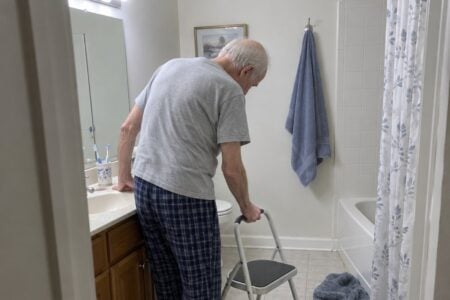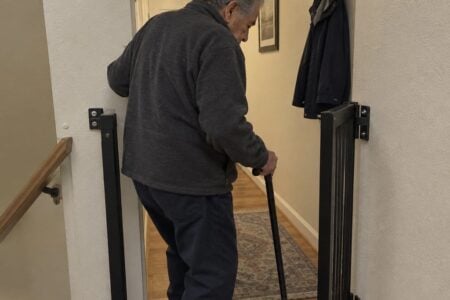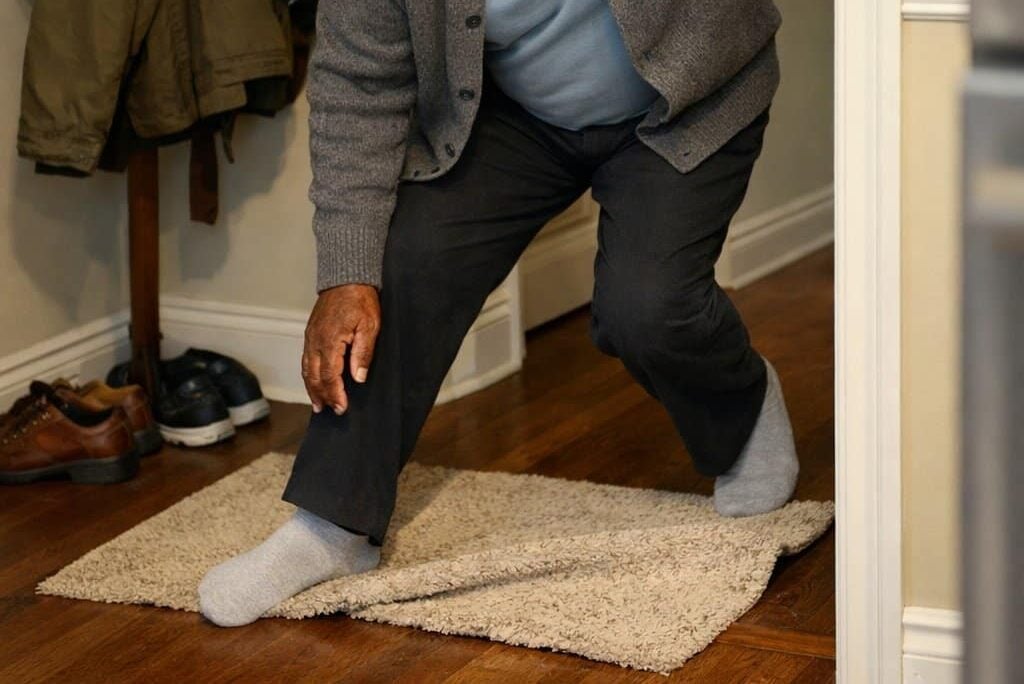
You walk past the same hallway runner every morning. One corner has been folded up against the baseboard for weeks. The living room rug shifts just slightly underfoot every time someone crosses it. Neither one looks dangerous. That’s exactly why they are.
Most falls don’t happen dramatically. They happen on an ordinary afternoon, on a rug that has been sitting in the same spot for years without causing a single problem — until it does. For caregivers, that thought is quietly unsettling. For older adults living independently, it’s a practical motivation to act.
This guide covers the five most common rug-related fall hazards in a senior’s home and gives a specific, practical fix for each one. No guesswork, no expensive contractors, and no removing every rug in the house. Not all rug hazards look the same — so the fixes aren’t one-size-fits-all either.
The Rug Safety Audit Checklist: 5 Hazards to Fix in Every Senior’s Home
Download this room-by-room audit checklist and discover the five hidden rug hazards in your home—then fix each one with the specific product and method that actually works.
Why Rugs Are One of the Most Overlooked Fall Hazards at Home
Rugs feel familiar. They’ve been part of the home for years. That familiarity is exactly what makes them more dangerous — not less.
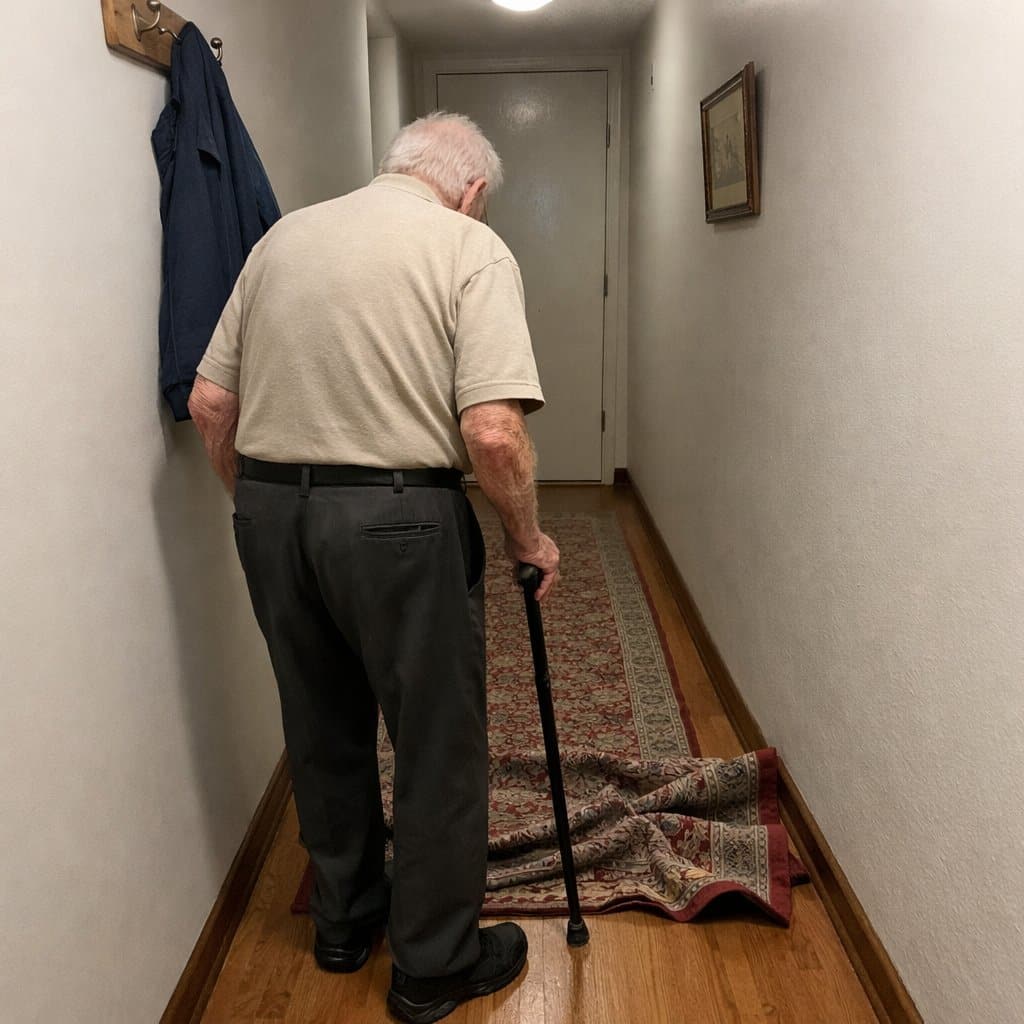
Falls are among the leading causes of injury for older adults, and flooring hazards — including rugs — are a significant contributing factor. The mechanics are straightforward: a rug that slides underfoot shifts your center of gravity before you have time to react. A lifted corner catches a toe mid-stride. A bunching hallway runner gives way in a space where there’s nowhere to step sideways to recover.
Rug hazards are easy to ignore because nothing bad has happened yet. They look fine at a glance. They’ve been there for five years. But as part of a thoughtful approach to fall prevention at home, rugs represent one of the highest-impact, lowest-cost areas to address.
Fixing them isn’t overreacting. It’s the same practical thinking that goes into any home safety improvement — you don’t wait for a problem to act on a clear risk.
Fix #1 — Stop Area Rugs from Sliding on Hardwood Floors


Why Rugs Slide
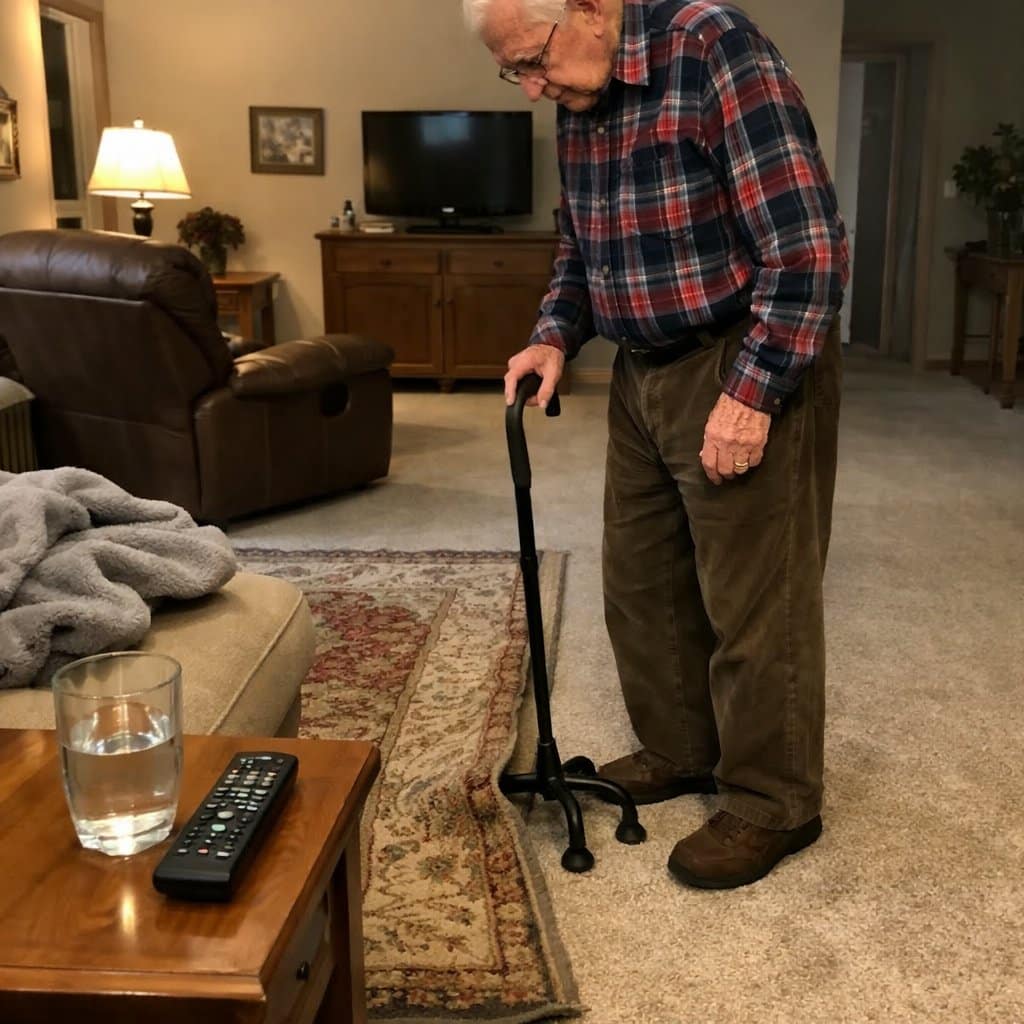
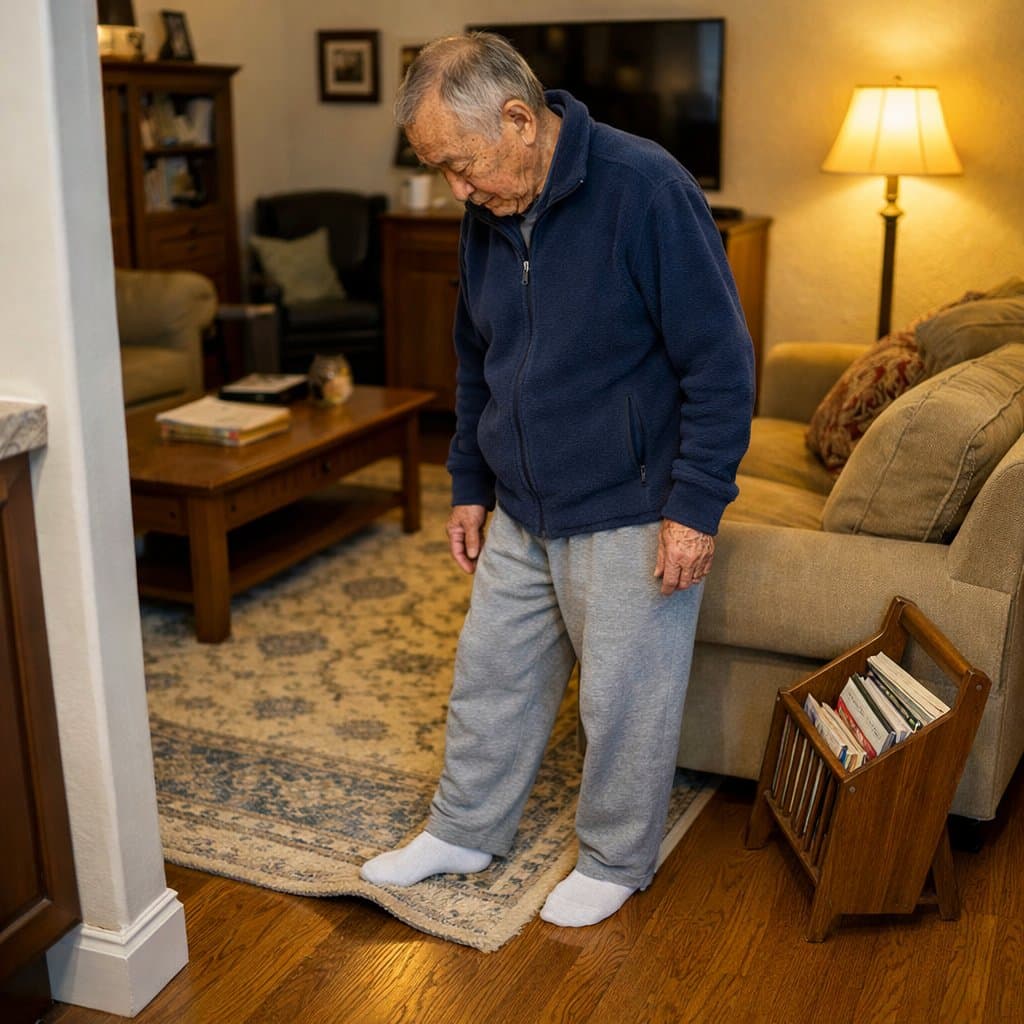
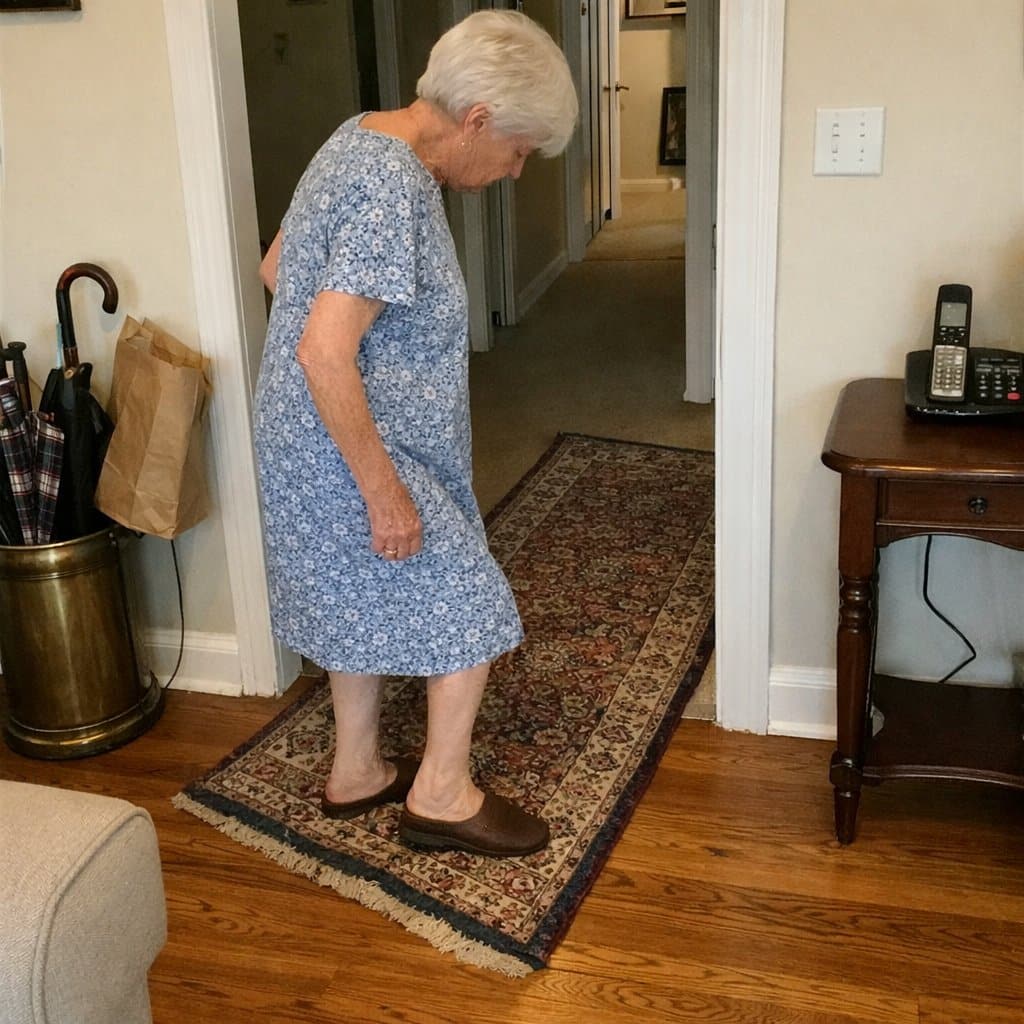
A sliding rug on hardwood or tile is one of the most common — and most fixable — rug fall hazards in any home. Rugs slide because there’s no meaningful friction between the rug backing and the floor surface, especially as older rug pads compress or degrade over time.
Even a small shift underfoot can throw off balance. This is especially true for older adults with mild balance changes or reduced proprioception, where the body’s ability to detect subtle shifts in footing is slightly slower than it used to be.
The Two Main Solutions
There are two tools that work well here, and they serve slightly different roles.
- Non-slip rug pads are the best solution for larger area rugs that need full-surface grip. A quality pad sits between the rug and the floor and prevents movement across the entire rug, not just at the edges.
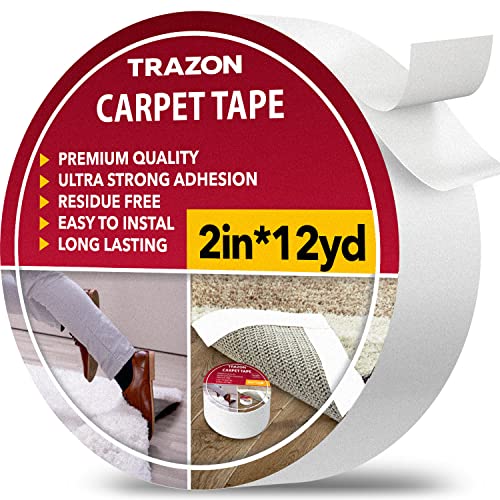
- Anti-slip rug tape is better suited for rugs in tight spaces, lighter rugs, or situations where a visible pad would be impractical. It anchors the perimeter directly to the floor.
Does Anti-Slip Rug Tape Damage Hardwood Floors?
This is one of the most common concerns I hear — and it’s a fair one. Quality anti-slip rug tape designed specifically for floors is removable and won’t damage most finished hardwood when taken up correctly. That said, if your floors have an older finish, are unsealed, or are waxed rather than polyurethane-coated, test a small inconspicuous section first before applying tape to the full perimeter.
How Long Does Rug Grip Tape Last?
Under normal foot traffic, quality rug grip tape holds for several months before it needs to be checked and potentially replaced. High-traffic areas — like a main hallway — may need attention sooner. Make it a habit to test the rug’s stability every few months by nudging the edges with your foot.
The Action Point
For most standard area rugs on hardwood, the most complete solution is a quality non-slip rug pad for full-surface grip, combined with anti-slip rug tape along the edges. These two products work together to address both the center and the perimeter.
A non-slip rug pad gives the rug a stable foundation across its full surface, while anti-slip rug tape locks down the edges where lifting and shifting most often begin.



Fix #2 — Keep Rug Corners from Curling Up

Why Corners Curl
Rug corners curl because of fiber memory, uneven weight distribution, low-quality backing, or simply age. It’s one of the most predictable things a rug does over time — and one of the most predictably dangerous.
Curled corners sit low to the ground, which makes them easy to miss visually. During a normal stride, the toe catches the lifted corner perfectly. The result is a stumble that happens before there’s any time to react.
Rug Tape vs. Rug Pad for Corners
A full rug pad helps with overall stability, but it often doesn’t reach close enough to the corner to prevent curling at the very edge. For corners specifically, targeted solutions win.
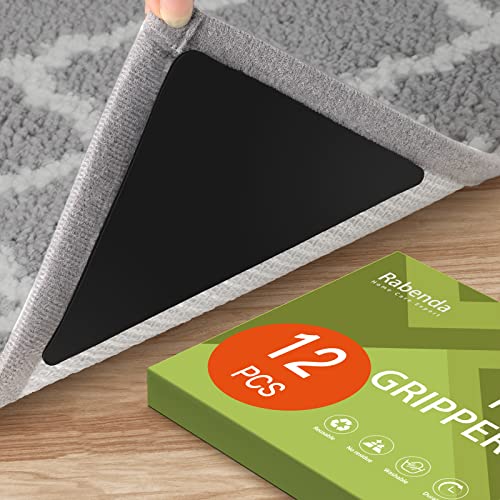
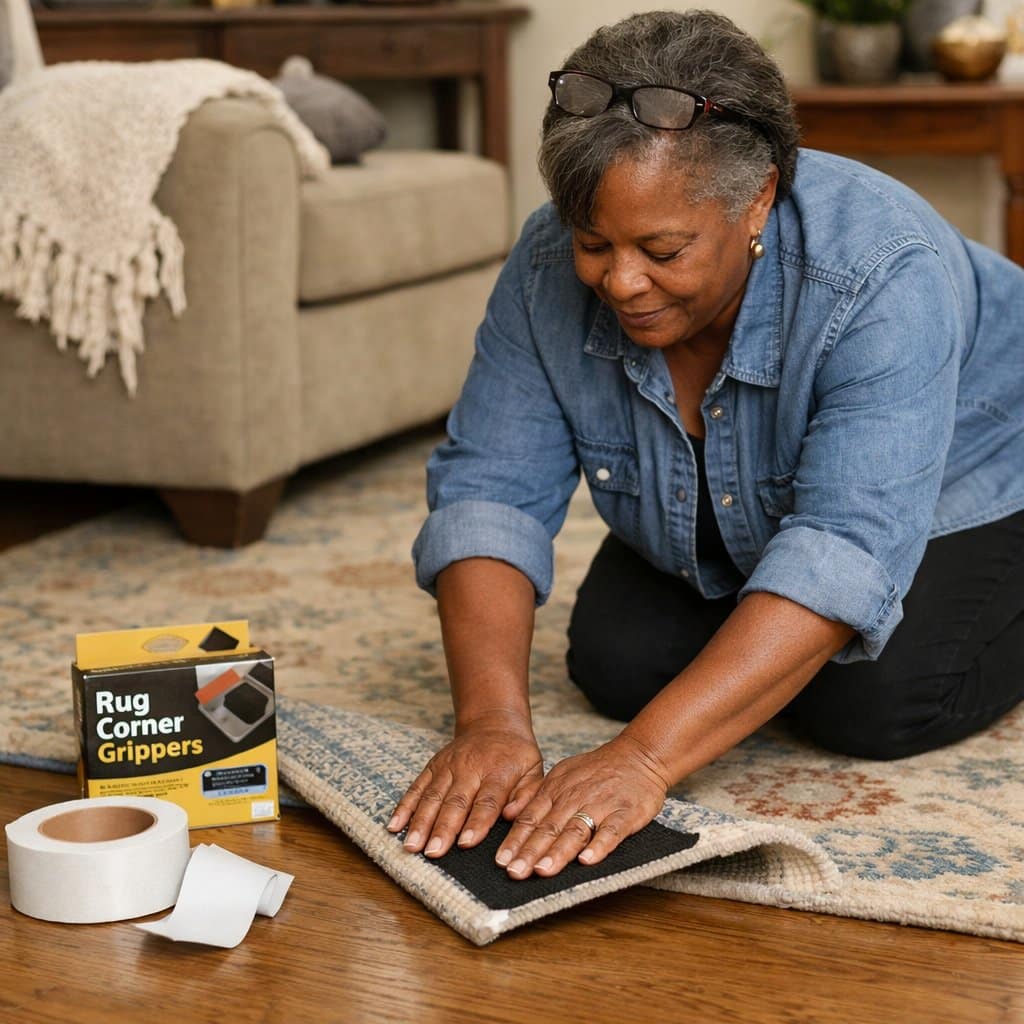
- Rug corner grippers are small adhesive pads designed specifically for this problem — they anchor just the corner to the floor without affecting the rest of the rug.
- Anti-slip rug tape applied directly to the corner underside works equally well and is often easier to find.
Where This Fix Matters Most
This is especially important for rugs placed in high-traffic pathways: entries, living room walkways, and anywhere the rug is crossed repeatedly throughout the day.
The Action Point
Apply corner-specific grip tape or corner gripper pads to all four corners of any area rug in a walking path — not just the ones that appear to be lifting. A corner that looks flat today may start curling next month. Getting ahead of it is a five-minute task that doesn’t need to be repeated often.
Rug corner grippers and anti-slip rug tape are the two most direct solutions for this specific problem. Corner grippers target the exact lift point without requiring you to retape the full rug perimeter.


Fix #3 — Prevent Rug Edges from Lifting in High-Traffic Areas
Corners vs. Edges — Not the Same Problem
A curled corner is isolated to one point of the rug. A lifting edge runs along the full length of one or both sides. Both are hazards, but they require slightly different thinking.
Edges lift when foot traffic repeatedly brushes against them, when a vacuum cleaner catches the edge and folds it back, or when a rug pad doesn’t extend close enough to the rug’s border to hold it flat.
How to Prevent Rug Edges from Lifting
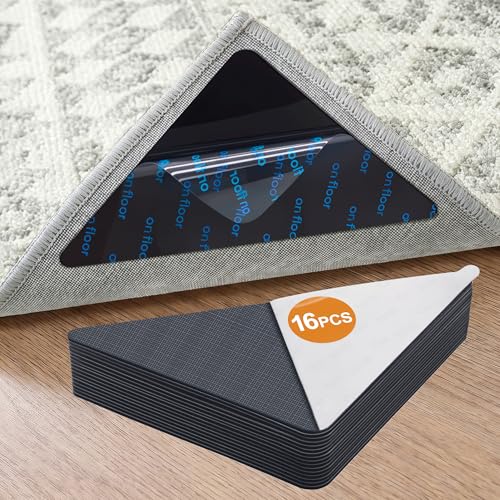
Full-length edge taping along both long sides of the rug is the most reliable solution. The tape should run as a continuous strip — not shorter pieces applied at intervals, which leave gaps where the edge can still lift between them.
Aim to have the tape extend to within about an inch of each corner so there’s no gap between the edge tape and the corner grip.
Is Rug Tape Safe for All Floor Types?
For finished hardwood, laminate, and tile, quality anti-slip rug tape is generally safe. Older floors, waxed surfaces, or delicate finishes deserve a quick test on a small hidden section before committing to a full application. Peel it up slowly and straight — not at an angle — to minimize any stress on the floor surface.
The Action Point
Run a continuous strip of anti-slip rug tape along both long edges of any area rug in a walking path. Check it once a season. This is a one-time task that holds well under normal use — it doesn’t need to be redone frequently.
Ready to discover more practical strategies for a safer, more comfortable home? Subscribe to our newsletter for expert-tested tips and product recommendations designed specifically for older adults and the people who care for them.
Fix #4 — Fix a Bunching Hallway Runner
Why Hallway Runners Are Uniquely Dangerous
A hallway runner that bunches or shifts underfoot is one of the most hazardous rugs in the house — and the location makes it worse. Hallways are narrow. When balance is disrupted there, there’s no room to step sideways to recover.
Runners are long, placed in a high-traffic path, and often laid on smooth flooring. They shift with foot traffic over time, and once they start bunching, they bunch more each day until someone catches a foot on the fold.
How to Fix a Bunching Hallway Runner
The fix here is a combination approach — no single product does the full job on its own.
- A full-length runner pad underneath provides base grip across the entire length of the runner.
- Anti-slip rug tape along the edges adds perimeter control so the runner doesn’t shift sideways or bunch at the sides.
- Make sure the runner is long enough for the hallway. A runner that’s too short gets walked on and off at both ends repeatedly, which accelerates both bunching and shifting.
Runners on Carpet — A Different Problem
If the runner sits on top of carpet, adhesive-based tape won’t grip the way it does on hard floors. For this situation, look for a rug-on-carpet gripper pad with a textured surface on both sides — these grip the carpet pile below and the rug backing above, without relying on adhesive at all.
The Action Point
After each vacuuming session, check whether the runner has shifted. If vacuuming moves it, it needs better anchoring. A well-anchored runner actually improves traction in the hallway — it doesn’t have to be removed for safety, just properly secured.
A non-slip rug pad cut to runner length is the primary fix for hard-floor hallways. For runners on carpet, a rug runner gripper designed specifically for carpet-to-rug contact is the right tool — standard pads designed for hard floors won’t perform the same way on carpet pile.


Fix #5 — Secure Area Rugs Layered Over Carpet
Why Rug-on-Carpet Is Tricky
Layering an area rug over carpet is a common and completely legitimate design choice — it defines a seating area, protects high-traffic sections, or adds color to a room. The problem is that securing a rug on top of carpet is harder than securing one on a hard floor.
Adhesive tape doesn’t grip carpet fibers the way it grips hardwood or tile. Standard rug pads can slide on carpet’s pile rather than anchoring into it. A rug that feels stable when you push it by hand may shift when someone walks across it — and that gap between appearance and reality is where the hazard lives.
The Right Solution for Rug-on-Carpet
Use a rug pad specifically rated for carpet-to-rug use. These pads have a textured surface on both sides — one side grips the carpet pile below, the other grips the rug backing above. They don’t rely on adhesive, which means they work on surfaces where tape doesn’t.
Standard anti-slip rug tape designed for hard floors won’t perform as well here. Using the wrong product on this surface creates a false sense of security — the rug feels anchored when you test it by hand but still shifts underfoot during actual use.
When to Reconsider Layering Altogether
If the carpet beneath is very thick or plush, even the best carpet-rated pad may not provide adequate stability. In that case, it’s worth reconsidering whether the area rug layered on top is the right choice for that specific spot — or whether it would be better placed somewhere else in the home where it can be properly secured.
The Action Point
Test the stability of any rug-over-carpet setup by pressing firmly at all four corners and along both long edges. If it moves under that kind of deliberate pressure, it will move underfoot during normal use. That’s your signal to switch to a carpet-rated pad.
Knowing which solution matches which surface is the difference between a fix that holds and one that gives a false sense of security. The right pad for the right surface isn’t a minor detail — it’s the whole point.
The Rug Safety Audit Checklist: 5 Hazards to Fix in Every Senior’s Home
Download this room-by-room audit checklist and discover the five hidden rug hazards in your home—then fix each one with the specific product and method that actually works.
Your Action Plan: One Fix at a Time
None of these fixes require a contractor, a major renovation, or removing every rug in the house. Each of the five hazards — sliding area rugs, curling corners, lifting edges, bunching runners, and rug-on-carpet instability — has a specific, practical solution that can be implemented in an afternoon.
A safer home doesn’t have to look clinical or feel like a hospital corridor. It just needs to be thoughtfully secured. Whether you’re doing this for yourself or for someone you care about, addressing these rug hazards is one of the most concrete steps you can take toward aging in place safely.
The bathroom is another area worth reviewing alongside your rug audit — bathroom safety products for seniors address many of the same slip-and-fall risks in a room where the consequences of a fall can be especially serious.
And if nighttime movement is a concern, pairing rug fixes with motion-activated night lights makes a meaningful difference — being able to see a rug clearly at 2 a.m. is just as important as having it properly anchored.
For caregivers who want a broader framework, a room-by-room look at safety products for older adults living independently is a good companion to this guide.
Here’s your starting point this week: walk through the main living areas and check each rug underfoot. If a corner lifts, an edge rises, or a runner shifts when you nudge it — that’s where you begin. Fix one thing this week and work through the list from there.
Which of these five hazards surprised you most? Or which fix worked best in your home? Share your experience in the comments — your perspective might be exactly what someone else needs to take that first step.