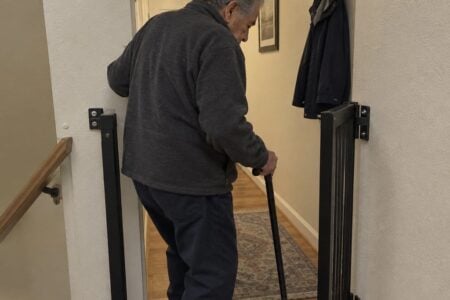
You step off the porch and one foot goes sideways. The concrete looked dry — it wasn’t.
That thin overnight glaze, the kind that doesn’t show until your boot is already on it, is responsible for more winter falls than the obvious heavy snowstorm.
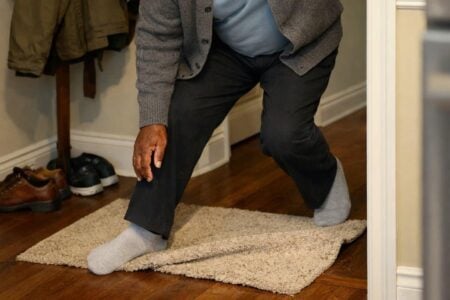
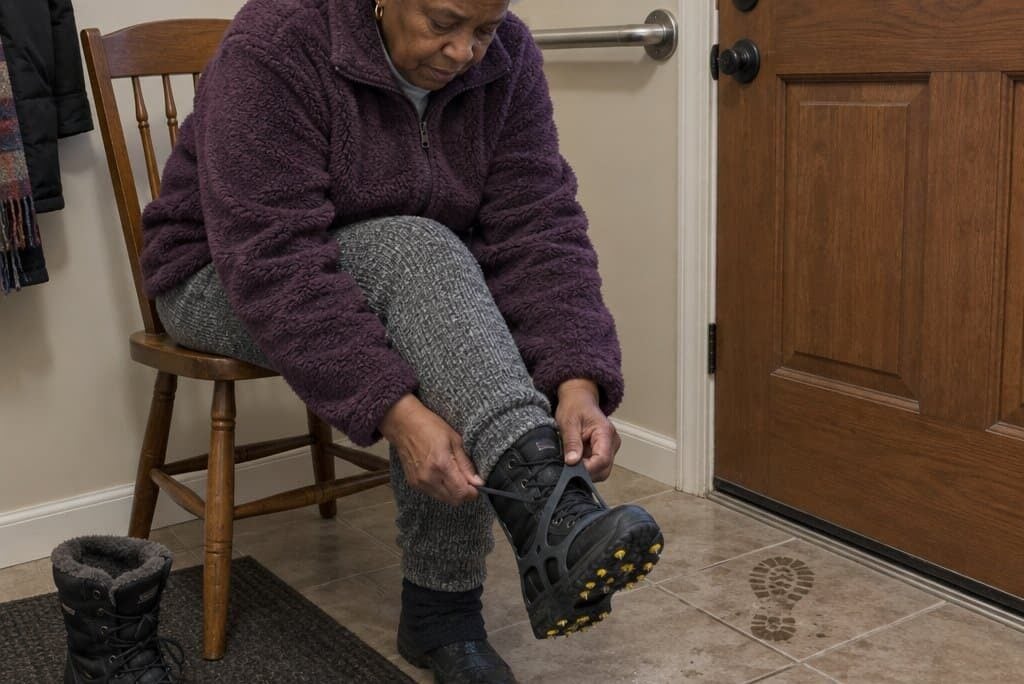
The other moment that catches people off guard is re-entry: standing on one foot at the front door, trying to peel off an ice cleat, no fixed surface within reach.
Winter traction is actually two separate problems. Cleats add grip to the person. De-icers address the surface. A lot of households try to solve both with one tool and end up short on both. This article treats them as the distinct problems they are — and gives you a framework for each.
Two mistakes come up repeatedly in this category. First: buying ice cleats sized to shoe size rather than the measured outsole length, which is how cleats actually fit. Second: defaulting to rock salt on newer concrete without knowing it quietly damages the surface over time.
By the end of this article, you’ll know how to size cleats correctly, how to plan the removal step before you buy, and which ice melt product matches your surface and your temperatures.
Ice Cleats and De-Icer Shopping Checklist
Print this checklist and never buy the wrong ice cleats or de-icer again—match every product to your concrete age, local winter temperatures, and specific walkway conditions with a simple point-of-purchase guide.
What to Look For
Ice Cleats: The Variables That Actually Matter
Sizing is the one thing most people get wrong. Cleats are not sized to your shoe size — they are sized to the physical length of your outsole, measured in inches or centimeters from heel to toe on the rubber bottom of the actual boot you plan to wear. Manufacturers list small, medium, large, and XL as outsole length ranges. A typical range: small covers roughly 5–8 inches, large covers roughly 9–11 inches, XL covers 12 or more. A cleat that runs short on the heel can slip backward mid-stride. One that runs long at the toe can fold and catch on a step edge. Measure the boot, compare to the chart for that specific product, and buy to the longer footwear if you’re between sizes.
Spike material determines which conditions the cleat actually handles.
- Hardened steel spikes provide the most aggressive grip on packed ice and work well on steps and sloped surfaces
- Carbide-tipped spikes hold a sharp edge longer over repeated use — worth the added cost if cleats are used daily
- Rubber or polymer studs (sometimes called micro-spikes or low-profile traction) grip light morning glaze and slush effectively but lose reliability on a thick glaze or refrozen ice
Match the spike to your typical conditions. Mild icy mornings call for rubber studs. Recurring thick ice or regular front steps call for steel or carbide.
Coverage area matters for steps. Some cleats cover only the heel and ball of the foot, which works well on flat pavement. Full-sole coverage is safer on steps, slopes, and uneven ice — the spike contact is distributed across more of the footwear, reducing the chance of one edge catching.
Removal design is the detail most product listings bury. Some cleats have a built-in pull-tab or handle on the rubber frame that makes removal significantly easier. This matters a great deal for anyone with limited hand strength. If a product has no pull-tab, removal means gripping the rubber frame directly and pulling — which requires bending down or sitting. Know which you’re buying before it arrives.
Rubber elasticity degrades. The stretchy cage that holds the cleat to your boot works because of rubber tension. Cold cycling, UV exposure, and storage cause rubber to lose elasticity over time. Check the rubber at the start of each season by pulling it to full stretch — cracks or obvious loss of tension mean it’s time to replace before you rely on it.
Concrete-Safe De-Icers: Matching Chemistry to Surface
Active ingredient determines surface compatibility — this is the decision.
- Sodium chloride (rock salt): Effective to approximately 20°F (−7°C). Low cost, widely available. Causes freeze-thaw damage to concrete poured within the last five years, and degrades reinforcing steel inside poured concrete over years of heavy use. Best suited for older, hardened concrete and lower-volume applications.
- Calcium chloride: Effective to approximately −25°F (−32°C). Activates faster than rock salt and generates heat as it dissolves, which speeds ice penetration. Gentler on concrete surfaces than sodium chloride. Costs more. Can irritate skin and paw pads — rinse surfaces when temperatures allow.
- Magnesium chloride: Effective to approximately 0°F (−18°C). The least damaging of the chloride family to concrete and nearby vegetation. Higher cost than rock salt, lower cost than premium acetates. A reasonable middle choice for households with pets or newer concrete in moderate climates.
- Acetate-based products (potassium acetate, calcium magnesium acetate): The gentlest option for newer concrete and vegetation. Significantly more expensive and less commonly stocked in hardware stores.
Match active ingredient to your situation:
- Concrete poured within the last 3–5 years: avoid sodium chloride entirely — use magnesium chloride or calcium chloride
- Temperatures that regularly drop below 0°F: calcium chloride is the practical choice regardless of concrete age
- Older concrete (10+ years), mild climate, no pets: rock salt remains a functional, low-cost option
Application rate matters. More product does not melt ice faster — the chemistry works at the same rate regardless of how much you apply. Follow the bag’s label rate, typically listed in ounces per square foot. Over-application runs off into soil and groundwater, can damage nearby vegetation, and wastes product.
Concrete age is worth knowing. Concrete reaches full hardness at 28 days but continues to cure for years. The first 3–5 winters represent the highest-risk period for chemical surface damage. If you’re unsure when your driveway or walkway was poured, the safer default is calcium chloride or magnesium chloride — not rock salt.
Ice Cleats for Shoes
Over-boot ice cleats slip over your existing footwear to provide immediate grip on glazed walkways, icy steps, and frozen driveways — no waiting for chemistry to work. They go on at the door before you step out and come off again before you step back in, making them the fastest-deploying traction solution for older adults managing winter conditions independently.


Over-boot ice cleats are removable traction devices — a hardened-spike grid set into a stretchy rubber frame — that slip over the outside of your shoe or boot. They suit flat paved walkways, front steps, driveways, and parking lots in icy conditions.
They are not suited for indoor use on any surface. Steel spikes scratch tile, hardwood, and vinyl on contact. The raised profile catches on rugs and door thresholds, which turns the re-entry point into its own hazard. Cleats come off at the door — before stepping inside, not after.
For anyone managing a front walkway alone, cleats are faster to deploy than de-icers (no waiting for chemistry to activate), portable, and effective the moment they go on. The trade-off is that they do not reduce the hazard at the source. The ice stays; only the person’s grip improves. If you are also concerned about how to prevent falls on icy surfaces, cleats are one part of the answer — the surface itself is the other.
When evaluating any cleat in this section, look for: outsole length range on the size chart, spike material, whether a pull-tab is present, and whether coverage is full-sole or heel-and-ball only.
SILANON Ice Snow Cleats — 9-Point Steel
The SILANON 9-point cleat uses a rubber over-boot frame with a nine-point hardened steel spike configuration. The spike pattern is concentrated at the heel and ball of the foot rather than running the full length of the sole. That makes it well-suited for flat paved surfaces and level walkways — adequate for most front walk and driveway scenarios.
The rubber frame is designed to stretch over a range of boot sizes, and SILANON lists the product by outsole length range rather than shoe size. Measure your boot’s outsole before selecting a size; the manufacturer’s chart is the reliable reference, not your shoe size.
The honest limitation here is the coverage pattern. Heel-and-ball coverage performs well on flat ground but provides less confidence on steps with raised edges, where full-sole contact is the safer design. If front steps are a regular part of your route, weigh whether the 9-point configuration gives you enough surface contact for that specific challenge.
Azarxis Walk Traction Cleats — 19 Spikes
The Azarxis cleat uses a 19-spike hardened steel configuration across a full-coverage rubber frame. The higher spike count and broader distribution across the sole provide more consistent grip contact, which matters particularly on steps and sloped surfaces where the foot angle changes mid-stride.
The rubber frame stretches to fit a range of outsole sizes. Check the Azarxis size chart against your measured outsole length — the product lists sizes with specific length ranges, and sizing to your largest winter footwear is the right approach if you’re between sizes. The heavier spike count adds modest weight compared to simpler 9-point models, which is worth noting for anyone walking longer distances.
The limitation to know: the product does not list a dedicated pull-tab on the rubber frame. Removal requires gripping and peeling the rubber directly. For anyone with limited hand strength or reduced grip, plan to sit or have a fixed grab point at the threshold before buying.
Yaktrax Walk Traction Cleats — Medium
Yaktrax Walk uses a coiled steel wire system rather than individual spikes. The wire coils wrap across the outsole and provide traction through multiple contact points per stride rather than a set of fixed spike tips. This design performs well on compacted snow and light ice — the kind of everyday winter surface that describes most residential walkways through most of a typical winter.
The rubber frame is one of the more established designs in this category. Yaktrax has been in the traction cleat market long enough that the rubber formulation and frame geometry are refined rather than guesswork. The medium size fits a specific outsole length range listed on the Yaktrax website — measure and confirm before ordering.
The trade-off is performance on thick glaze or hard refrozen ice. The coil system, while effective on packed snow and light ice, does not provide the same edge-cutting grip as individual hardened steel or carbide spikes on a solid ice surface. If your conditions regularly produce thick glazed ice rather than compacted snow, a spike-based cleat may serve you better.
Cimkiz Crampons Ice Cleats — 19 Stainless Steel Spikes
The Cimkiz cleat uses 19 stainless steel spikes in a full-coverage rubber frame. Stainless steel holds up to repeated cold-warm cycling better than mild steel for corrosion resistance, which extends useful spike life when cleats are stored in variable-humidity conditions like garages.
The 19-spike count across a full outsole frame gives good surface coverage, including through the instep and toward the toe — relevant for anyone regularly navigating steps where the foot rolls across the full contact area. Cimkiz sizes by outsole length; the size chart on the product page is the reference, not shoe size.
One limitation worth flagging: full-coverage frames with 19 spikes carry slightly more weight than minimal 9-point designs. For short transitions — front walk to door — that difference is negligible. For longer walking distances on errands, it adds up. The other consideration is that, like most cleats in this category, there is no reported dedicated pull-tab for removal. Plan accordingly before the product arrives.
JSHANMEI Ice Cleats — Non-Slip Grip
The JSHANMEI cleat uses a rubber over-boot frame with a steel spike grid. The design targets general winter walking on ice and compacted snow, and the spike layout covers the primary weight-bearing zones of the outsole. It’s sized by outsole measurement — confirm the length range on the product page before ordering, as the JSHANMEI size chart should be treated as the authoritative guide rather than any conversion from dress shoe size.
The rubber material in this design is marketed as cold-resistant. Cold-resistant rubber maintains elasticity at lower temperatures than standard rubber, which reduces the chance of the frame losing tension and shifting during use in deep winter conditions. This is a relevant detail for anyone in climates where temperatures regularly drop well below freezing.
The limitation: the spike coverage is concentrated rather than full-sole. On level walkways and driveways this is adequate. On steps, the contact pattern may feel less secure underfoot than a full-coverage alternative. If steps are a daily part of the route, compare the coverage map of this product against a full-sole option before deciding.
SILANON Ice Snow Cleats — 10-Stud Winter
This SILANON variant uses a 10-stud configuration in a rubber over-boot frame, with the studs positioned across the heel and ball contact zones. It is the lower-profile sibling to the 9-point version — the stud design (rounded rather than spike-tipped) provides grip on light ice and packed snow while causing less surface wear on any pavement it crosses.
The rounded stud profile makes this a reasonable choice for someone whose route includes short icy transitions mixed with dry pavement — the studs track reasonably well on dry concrete without the metallic clicking and surface scoring of hardened steel spikes. It also reduces the risk of scratching an indoor floor during the removal moment, though cleats should still come off at the door regardless.
The trade-off is grip on thick or refrozen glaze. Rounded studs do not cut into hard ice the way spike-tipped or carbide models do. In conditions that produce a solid ice surface rather than packed snow, this design will feel less confident underfoot than a spike-based alternative. Know your typical conditions before choosing stud over spike.
Concrete-Safe De-Icers
Concrete-safe de-icers break the bond between ice and your walkway or driveway surface, addressing the hazard at its source rather than working around it. Choosing the right active ingredient for your concrete age and local temperatures protects both the person crossing the surface and the surface itself from season-after-season chemical damage.




Concrete-safe de-icers are chemical products that lower the freezing point of water, breaking the bond between ice and the paved surface. They work without you being present — apply before you go to bed and the surface is cleaner by morning. That makes them particularly useful for overnight ice events on steps and walkways that are in shadow and stay cold through the day.
The key limitation to understand upfront: no de-icer works instantly. Calcium chloride begins activating within minutes, but a thick glaze can take 15–30 minutes to fully break, depending on temperature. De-icers are not a rescue tool for a surface you need to cross right now. They are a preparation tool.
The other thing worth knowing is that crumbling concrete from prior seasons of heavy rock salt use is itself a tripping hazard — the uneven surface creates catch points for feet and mobility aids. Checking your exterior concrete for existing damage before applying any product is a reasonable first step.
For every product in this section, the relevant questions are: what is the active ingredient, what temperature range does it cover, how does it affect newer concrete, and what is the realistic handling burden of the bag or container size.
Snow Joe Premium Enviro Blend Ice Melt — 50 lb
Snow Joe’s Enviro Blend is a blended ice melt that combines multiple active ingredients — typically a mixture of calcium chloride and other chloride-based compounds — to improve working temperature range beyond what straight rock salt delivers while marketing lower environmental and surface impact than straight sodium chloride. The 50-pound bag format suits households with a driveway and front walk to maintain through a full winter season.
The “enviro blend” designation means the sodium chloride content is reduced or balanced against other active ingredients. For concrete poured within the last five years, a blended product still warrants scrutiny — checking the ingredient label for sodium chloride content and its percentage in the mix is worth the thirty seconds before purchase. The Snow Joe label lists active ingredients, which you can match against the surface guidance earlier in this article.
The practical limitation of the 50-pound bag is handling. A 50-pound bag requires meaningful upper body strength to carry and pour from. For a single older adult managing a front walkway, a smaller format or pre-decanting into a lighter container immediately after delivery is worth planning. The product itself performs well in the range it’s rated for; the handling burden is the honest consideration for this audience.
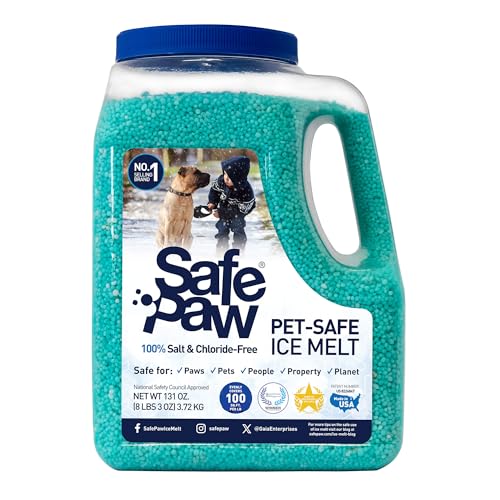
Safe Paw Pet-Safe Ice Melt — 8 lb
Safe Paw is a chloride-free ice melt — it does not contain sodium chloride, calcium chloride, or magnesium chloride. The active system uses a glycol-based mixture and traction-enhancing granules. Chloride-free means it carries essentially no risk of chloride-related concrete surface damage, and it is safe for pets walking across treated surfaces.
The 8-pound jug format is genuinely manageable for a single person. The container is compact, easy to store, and light enough to carry and pour without significant physical exertion. For a front step, a short walkway, or a small covered stoop area, the 8-pound size provides multiple applications through a season.
The limitation is effective temperature range. Chloride-free products generally perform less aggressively at the lower end of the temperature scale compared to calcium chloride. In climates where temperatures regularly drop well below 0°F, Safe Paw’s performance on heavily glazed ice will be less reliable than a calcium chloride product. For mild to moderate winter climates — and for households with pets on newer concrete — it is a well-suited choice.
Safe Paw Pet-Safe Ice Melt — 35 lb
This is the same chloride-free Safe Paw formula in a 35-pound container — the larger-volume option for households with a longer walkway, a larger driveway area, or a preference for fewer mid-season restocking runs. The chemistry is identical to the 8-pound version: glycol-based, no chlorides, rated as safe for concrete surfaces and pet paws.
At 35 pounds, this container sits at the upper end of what a single older adult can reasonably manage without strain. Decanting a portion into a smaller, lighter scoop container kept near the door is a practical approach — it reduces the handling required at application time and keeps the main supply sealed and dry, which matters because even non-chloride products benefit from sealed storage.
The same temperature-range limitation applies here as with the 8-pound version. The 35-pound format makes the most sense for households that have already used Safe Paw and know it suits their climate and conditions — it’s not the entry point for first-time buyers unsure whether the product will perform in their specific winter temperatures.
ECO-ST Ice Melt Safe for Concrete — Fast Acting
ECO-ST positions itself as a concrete-safe, anti-corrosion ice melt with fast-acting performance. Products marketed as “anti-corrosion” typically use a magnesium chloride base or a modified chloride formula designed to reduce the electrochemical damage chlorides cause to concrete’s reinforcing steel. The active ingredient on the ECO-ST label is the first thing to verify before purchase — magnesium chloride is the most common active in this category of “concrete safe” marketing.
If the active ingredient is magnesium chloride, the performance profile fits what that compound delivers: effective to approximately 0°F (−18°C), less aggressive on concrete surfaces than sodium chloride, moderate pet impact (some paw irritation possible, less than calcium chloride). It melts more slowly than calcium chloride at extreme temperatures but is a practical choice for most U.S. winter climates.
The “pet safe” claim on this type of product typically means reduced toxicity relative to rock salt rather than zero irritation risk. If pets are a primary concern, chloride-free products like Safe Paw remain the more conservative choice. If newer concrete and moderate temperatures are the primary concern, a magnesium chloride-based product like ECO-ST is a reasonable fit.
National Blue Ice Melt and Snow Salt — 35 lb Bucket
National Blue is a blended ice melt product in a 35-pound bucket format with a sealed lid. The bucket is a meaningful format advantage over bag products: a sealed bucket prevents the hygroscopic caking that affects open bags of calcium chloride and some blended products between storms. If you buy one large container at the start of the season and want it to remain usable through spring, the sealed bucket does better than a resealed bag over repeated cold-warm cycles in a garage.
The active ingredient blend in National Blue typically includes calcium chloride, sodium chloride, and potassium chloride in a ratio designed to improve low-temperature performance relative to plain rock salt while moderating surface damage risk. Confirm the label’s active ingredient percentages — the sodium chloride content determines whether this is appropriate for your concrete age.
The 35-pound bucket is manageable for decanting and storage but heavy enough that carrying it from a delivery point or store shelf to its storage location warrants a plan. The value proposition here is the storage format over a full season. For households that experienced caked, unusable product from bag storage last year, this format solves that specific problem.
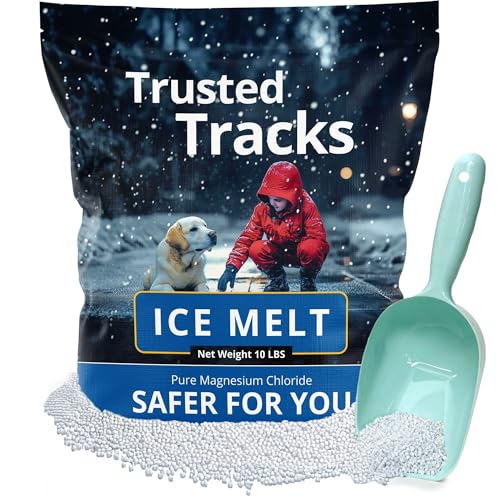
FIREKI Ice Melt — Pure Magnesium Chloride, 10 lb with Scoop
FIREKI markets this product as pure magnesium chloride — not a blend, not rock salt with added compounds. Pure magnesium chloride represents the cleaner option within the chloride family for concrete surface compatibility. It is effective to approximately 0°F (−18°C), carries the lowest damage profile of the chloride compounds, and has better vegetation and pet paw impact than calcium chloride or sodium chloride.
The 10-pound bag with included scoop is a practical format for a single front walkway or set of steps. The scoop reduces the need to handle the product directly, which matters for anyone with skin sensitivity to chloride compounds. The smaller bag format keeps the total weight manageable and encourages proper sealed storage between uses — a 10-pound bag fits easily into a sealed container.
The limitation is temperature range. At 0°F (−18°C) as the lower effective bound, magnesium chloride underperforms calcium chloride in the coldest winter conditions. For climates that stay above 0°F through most of winter — the Mid-Atlantic, the Pacific Northwest, the South — this product covers the realistic temperature range adequately. For climates with regular subzero temperatures, calcium chloride is the more reliable chemistry.
Frequently Asked Questions
How do I know what size ice cleats to buy if I wear different shoes in winter?
Measure the outsole of every boot or shoe you plan to wear outside this winter. Take the longest measurement — heel to toe on the rubber bottom — and buy cleats sized to that footwear. The rubber frame stretches to accommodate a sole that runs slightly short; it cannot expand for one that runs long. Never convert from dress shoe size. The outsole measurement is the only reliable input.
Can I leave ice cleats on when I walk inside?
No. Steel and carbide spikes scratch tile, hardwood, and vinyl flooring on contact, and the raised profile catches on rugs, thresholds, and interior mats. Cleats should come off at the door — before the first indoor step. If balance is a concern during removal, position a sturdy chair or mount a grab bar within reach of the threshold before the first time you use the cleats. Plan the removal step before winter arrives, not at the door in the cold.
Will rock salt damage my concrete driveway?
On concrete poured within the last five years, yes — sodium chloride accelerates the freeze-thaw cycle inside the concrete’s surface pores, causing scaling and spalling over time. On concrete that is ten or more years old and fully hardened, the risk is lower, though heavy repeated applications still carry some cumulative effect. If you don’t know when your driveway was poured, calcium chloride or magnesium chloride is the safer default. When you’re unsure of your home’s exterior condition and what needs attention, that uncertainty is itself worth resolving before winter.
What temperature does calcium chloride stop working?
Most calcium chloride products are rated effective to approximately −25°F (−32°C). For comparison, sodium chloride loses meaningful effectiveness below about 20°F (−7°C). If your region regularly sees temperatures below zero, calcium chloride is the practical choice over rock salt regardless of your concrete’s age or your budget preference.
What’s the safest way to remove ice cleats if I have balance issues?
Sit down whenever possible. A chair positioned just inside the front door works well. If sitting is not practical, place one hand on a fixed grab bar or wall before pulling the cleat off — never remove cleats while standing unsupported on one foot. If the cleat has a pull-tab on the rubber frame, use it to reduce the grip and force required. If it does not have a pull-tab, factor that into your removal plan before you buy.
How much de-icer should I apply — does more work faster?
No. More product does not speed the chemistry. The freeze-point depression happens at the same rate regardless of whether you apply the minimum or twice the label rate. Follow the bag’s application rate (typically listed in ounces per square foot). Excess product runs off into your lawn and soil, can damage nearby plants, and wastes money. Apply at the labeled rate, wait for activation, and reapply only if temperatures drop significantly after the first application.
Hacks and Practical Advice
Pre-stage your cleats at the door, not in the garage. If they’re not at the exit point, most people skip putting them on — they step outside to check conditions and convince themselves it’s fine. A hook or a small bin immediately inside the front door means cleats go on before the door opens, not after you’ve already stepped onto a glazed porch. That habit alone closes more of the risk than any specific product choice.
Apply de-icer before the storm, not after. Pre-treatment prevents ice from bonding to concrete rather than trying to break a bond that’s already set. Calcium chloride and magnesium chloride both work as pre-treatment products — apply before you go to bed when a storm is forecast overnight and the surface will be significantly cleaner by morning. Steps that are in shadow all day and never fully warm are the highest-priority spots for pre-treatment.
Check your cleat rubber at the start of each season. I’ve seen this catch people off guard — a cleat that seated perfectly last February has lost enough rubber tension after a summer in a hot garage to shift underfoot this December. Before the first use each season, pull the rubber cage to its full stretch and check for cracks, brittleness, or obvious loss of tension. A cleat that doesn’t hold position is more dangerous than no cleat at all.
Put a fixed grab point at the threshold and build the removal habit around it. Most households have no plan for cleat removal at the door — it happens ad hoc, on one foot, with a bag of groceries in the other hand. A grab bar mounted at door height on the interior frame costs under $30 and installs in under an hour. With it in place, cleat removal becomes a two-handed, balanced operation instead of a wobble. The same grab bar helps with carrying groceries, managing wet boots, and the awkward weight shift of stepping over a threshold. If you’re looking at mobility aid options broadly, a threshold grab bar is one of the most overlooked and highest-return additions to a home.
Don’t store de-icer in an open bag between storms. Calcium chloride is hygroscopic — it pulls moisture from the surrounding air. An unsealed bag left in a garage will cake into a solid block by the next storm. Decant into a sealed 5-gallon bucket with a lid immediately after purchase. Labeled and sealed, a single 35-pound bucket can last multiple seasons without degrading. The National Blue bucket format solves this problem at the purchase stage.
Match your cleat to your footwear, not your preference for a specific product. The strongest cleat on the market will shift and slip on a smooth-soled leather boot if the rubber frame has nothing to grip against. The cage works best when the boot has a defined heel geometry and a rubber outsole with some texture. If your winter footwear of choice has a smooth or flat synthetic sole, that’s the first thing to address — proper footwear for winter walking affects whether cleats stay put at all. If you’re also thinking about fall risk from ankle instability, the boot itself deserves attention before adding any traction device over it.
Ice Cleats and De-Icer Shopping Checklist
Print this checklist and never buy the wrong ice cleats or de-icer again—match every product to your concrete age, local winter temperatures, and specific walkway conditions with a simple point-of-purchase guide.
Conclusion
Winter exterior traction comes down to two separate problems that need two separate solutions: cleats protect the person during transit, de-icers protect the surface before and during the event. Neither alone is complete. The combination — a surface treated the night before, cleats on at the door before stepping out — closes most of the gap.
What changes outcomes is having both in place before conditions deteriorate. Not ordering something after the first icy morning.
Here’s the actionable step: walk your own front entry today, in daylight, before the first storm. Start at the end of the driveway and move toward the door. Look for where ice tends to form — shaded concrete, north-facing steps, surfaces that drain toward the front walk. Then look at the door threshold itself and ask: is there a fixed surface within arm’s reach where cleats can come off safely before stepping indoors? If the answer is no, that is the first thing to fix. Before buying cleats. Before ordering de-icer.
If you’re ready to look at your full home — inside and out — for the spots that quietly raise fall risk season by season, a structured home safety review is the right next step. And if you’re thinking about preparation, knowing what to do if a fall does happen is part of being genuinely ready — not just hopeful.
Winter exterior safety is one piece of a larger picture. The goal is staying in your home, independently, through every season. This is where that work starts.