This comparison is sponsored by Divoti, who also sent me the bracelets at no cost. Links to Divoti and Amazon are affiliate links, so I may earn a commission at no extra cost to you.
Dementia Band
Self-irremovable chain
For someone with dementia or memory loss who takes jewelry off.
A sister hook clasp the wearer can’t open alone. It takes a second person to put on and take off.
Sport Band
Silicone, trim to fit
For active older adults, hikers, outdoor people and travelers.
Holds the most engraving of the three, on a silicone band you cut to fit.
Slip-On Band
Olive stretch band
For hands that struggle with small clasps, from arthritis or anything else.
A metal stretch band like a watch band. No clasp at all: it slides over the hand.

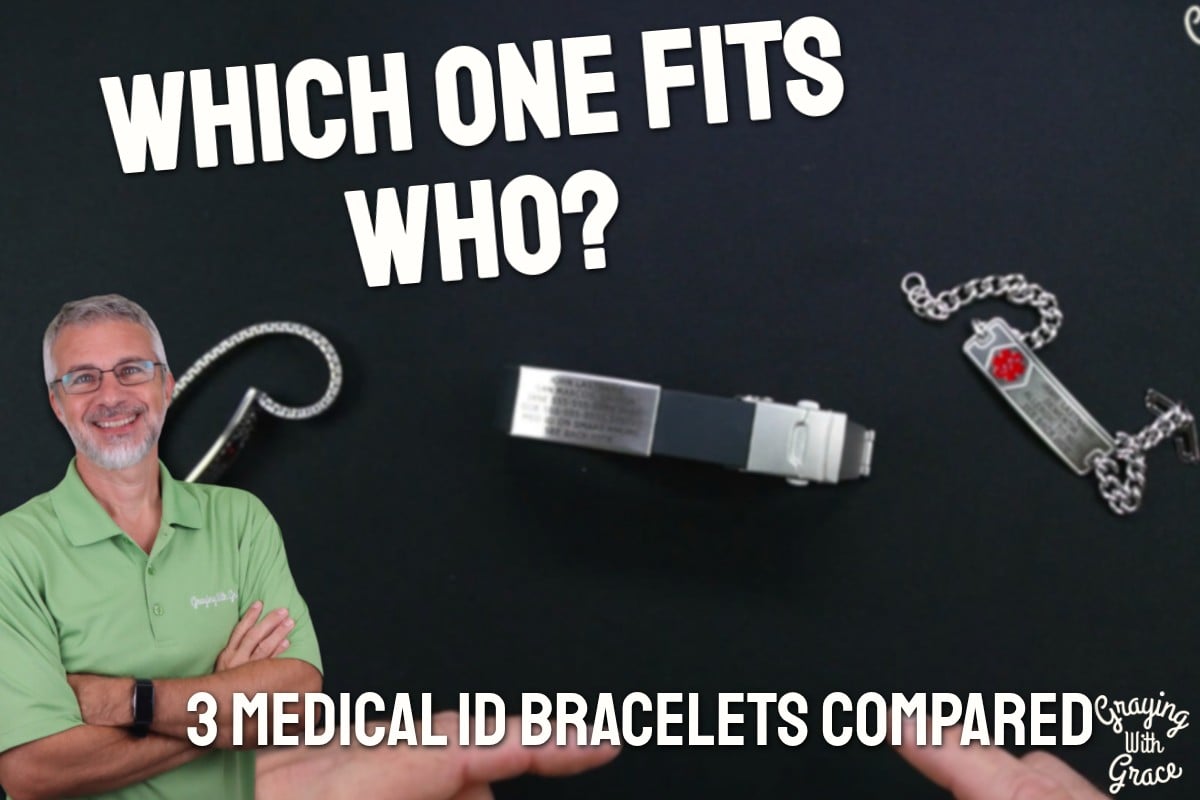
Medical ID Bracelets Compared Side by Side
On a phone, swipe the table sideways.
| Dementia BandSelf-irremovable chainDivotiAmazon | Sport BandSilicone, trim to fitDivotiAmazon | Slip-On BandOlive stretch bandDivotiAmazon | |
|---|---|---|---|
| Who it’s for | |||
| Best for | Someone with dementia or memory loss who removes jewelry, and the caregiver buying for them | Active older adults, hikers, outdoor people and travelers, or anyone with a lot of medical information | Anyone whose fingers struggle with small clasps, and people who want it to look like jewelry |
| What it does best | Stays on: the wearer can’t remove it alone | Holds the most information, for everyday all-weather wear | Goes on and off with no clasp, and keeps everything private on the back |
| Putting it on and taking it off | |||
| Band | Stainless steel chain | Silicone band with a stainless steel plate | Metal stretch band, like a stretch watch band |
| Closure | Sister hook clasp. When worn, the loop sits where the clasp opens, so it stays shut | Locking clasp with two release buttons | None. It slides over the hand and settles back onto the wrist |
| Wearer can take it off alone? | NoTakes a second person: slide the loop to the pivot point, then open it with two fingernails | YesPull up the lock, squeeze both buttons, slide it off | YesSlides off; a paramedic can slip it off to read the back |
| Learning curve | About 5 to 7 tries to get quick at it. Not hard, just unfamiliar | Easy after once or twice | None |
| Sizing | |||
| How you size it | Order by wrist size: measure the wrist, then add about half an inch | Pick a width, 13 mm or 19 mm, then trim the band to the wrist with scissors | One size: stretch fit for wrists 6.5 to 7.5 inches. Sized for women; may sag on a very small wrist |
| Adjusting the fit | Adjustment loops at the end of the chain | Trim more any time, one notch at a time, since you can’t add band back. The plate and symbol slide along the band | Stretches to fit and stays where you put it |
| Engraving and information | |||
| Engraved lines | 8 lines: 4 front, 4 back | The most. 19 mm: 10 lines (6 front, 4 back). Fewer on the 13 mm | 4 lines, back only |
| Characters per line | Up to 18 front, 20 back | Up to 24 on the 19 mm band | 18 |
| Front and back | Alert on the front, private details on the back | Alert on the front (“See back side”), private details on the back | Everything on the back, even the name. The front is the olive branch design |
| Medical symbol | On the front, beside the alert lines | A separate symbol that slides along the band | Red symbol on the front of the plate |
| Engraving | Cut into the steel; you can feel it | Cut in with black fill; easy to read even with glare | Cut into the steel; you can feel it |
| Wallet card included | Yes | Yes | Yes |
| Needs a phone or QR scan? | NoReadable with no phone, signal or Wi-Fi | NoReadable with no phone, signal or Wi-Fi | NoReadable with no phone, signal or Wi-Fi |
| Everyday wear | |||
| Water | Fine for daily showers; don’t leave it underwater for long | All-weather: sweat and rain are fine | Fine for daily showers |
| Weight | About 20 g | About 32 g, a little over an ounce | About 18 g, a little over half an ounce |
| Comfort | Light chain; the loops loosen it without making it removable | Soft silicone; the clasp doesn’t wobble | Feels like a stretch watch band |
| Colors | Polished stainless, gold, rose gold, black | The most choice: band colors like black, blue and wine red; steel, gold, rose gold or black plates; black, white or red engraving | Polished, gold, rose gold, rainbow, with an olive branch pattern |
| Buying | |||
| Free engraving | Yes | Yes | Yes |
| HSA/FSA | May be eligibleCheck with your plan | May be eligibleCheck with your plan | May be eligibleCheck with your plan |
| Reader discount | 10% off all three at DivotiUSA.com with code GWG10 (Divoti’s site only, not Amazon; doesn’t combine with other sales) | ||
| Good to know | Slower for caregivers too, so everyone who might remove it should practice | The wearer can take it off, so it isn’t the pick for someone who removes jewelry | Comes off as easily as it goes on, so it isn’t the pick for someone who removes jewelry |
The Dementia Band: For Someone Who Takes It Off
If someone you love keeps taking their medical ID off, the clasp is the reason to look at the Dementia Band. It’s a stainless steel chain with a sister hook clasp, and once it’s closed, the person wearing it can’t open it with one hand.
That’s the whole point. A bracelet that comes off easily tends to end up in a drawer or a coat pocket, and then it can’t help anyone.
The people around them need to know how it works, too. Everyone who might ever take it off, from family to an aide, should practice before they need to.
Dementia Band: stays on the wrist of someone who takes jewelry off.
The Sport Band: For Active People and Travelers
If you hike, travel or spend your days away from the folks who know your history, the Sport Band holds the most information. It’s a soft silicone band with a steel plate, made for weather and a busy day.
Mine has a name, an address, two emergency contacts and a line pointing to more information on the front. The private details go on the back.
Sport Band: holds the most information and goes wherever you go.
The Slip-On Band: For Hands That Fight Small Clasps
If arthritis, tremors or weak hands make tiny clasps a struggle, the Slip-On Band has no clasp at all. It’s a metal stretch band, like the stretch watch bands a lot of us grew up with.
The front has an olive branch pattern and a red medical symbol, so it looks like jewelry rather than a hospital tag. All the engraving goes on the back, so even your name stays private.
It slides off as easily as it slides on. That makes it a poor pick for someone who removes jewelry, and a good one for nearly everyone else.
Slip-On Band: no clasp to fight: it slides right over the hand.
How Each One Goes On and Comes Off
These three couldn’t be more different here, and that’s on purpose. The Slip-On Band is the easiest, the Sport Band is quick once you’ve done it once or twice, and the Dementia Band needs a second person.
On the Dementia Band, the loop sits right where the clasp needs to open while it’s worn, so it stays shut. To take it off, someone slides the loop down to the pivot point and opens the clasp with two fingernails.
That takes two hands, and the wearer only has one free. It took me five, six, maybe seven tries to get quick at it, so expect a little practice.
You don’t want a dementia bracelet that’s easy to take off. The extra step is the feature, not a flaw.
For the Sport Band, slide your wrist through, lay the panel down and click the lock. To take it off, pull up the lock and squeeze the two buttons.
The Slip-On Band just slides over the hand and back off. A paramedic can slip it off your wrist to read the back.
How to Get the Right Fit
Each band sizes a different way, so check this before you order.
Measuring tip: wrap a fabric tape around the wrist, or a string you mark and lay against a ruler. A watch that already fits well works too.
You order the Dementia Band by wrist size: measure, then add about half an inch. Its adjustment loops let you loosen it a little without making it loose enough to slip off.
The Sport Band comes in one length and two widths, 13 and 19 millimeters. You trim it to fit with scissors, a notch at a time, and the plate and medical symbol slide along it so you can set them where they’re comfortable.
The Slip-On Band comes in one size, for wrists from six and a half to seven and a half inches. It’s sized for women, so it’s a little snug on me, and on a very small wrist it may sag a bit.
What Each One Holds and What to Put On It
On all three, the lettering is cut into stainless steel, and you can feel it with a fingertip. It isn’t printed on top, so it won’t wipe off.
None of them use a QR code. A QR code needs a first responder with a charged phone, a signal or Wi-Fi, and a website that loads, while these put the critical information right on the plate.
The trade-off is room, since a QR code can hold more and you can update it. That’s why the wallet card in each box matters.
The Sport Band holds the most. The 19 mm band takes five lines on the front plus a “See back side” line, and four more on the back, up to 24 characters each.
For someone who wanders, I’d keep the Dementia Band’s front simple: their name, the nickname they answer to, the word “dementia” and a critical allergy. Then “See back side” points to the rest.
On the Slip-On Band, a name, a diagnosis such as type 2 diabetes, an allergy and an emergency phone number fit nicely. Whatever doesn’t fit goes on the wallet card, with a “See wallet card” line so responders know to look.
Your doctor is the best person to tell you which conditions and medications belong on there. Engraving is permanent, so use a phone number that always gets answered.
Weight, Comfort and Water
None of them is heavy. The Dementia Band is about 20 grams and the Slip-On Band about 18, while the Sport Band is the heaviest at about 32 grams, a little over an ounce.
The Slip-On Band feels like a stretch watch band, and the Sport Band’s silicone is soft on the skin. The Dementia Band’s chain is light and breathable.
All three are fine for daily showering and everyday weather. I wouldn’t leave any of them underwater for long stretches.
If looks matter to the person wearing it, the Sport Band gives you the most choices: band colors, plate finishes and even the color of the engraving. The other two come in polished stainless, gold and rose gold, plus black on the Dementia Band and a rainbow finish on the Slip-On.
Free Engraving, HSA/FSA and Your Discount
Engraving is free on all three, and each one comes with a wallet card for the details that don’t fit.
They may be HSA and FSA eligible. Check with your plan before you count on those accounts to help pay.
Divoti is offering my readers 10% off at DivotiUSA.com with code GWG10. The code works on Divoti’s own site, not Amazon, and doesn’t combine with other sales there.
What a Medical ID Bracelet Can’t Do
A medical ID bracelet doesn’t stop anyone from wandering, and it can’t tell you where someone went. It tells whoever finds them who they are and who to call.
For a loved one with dementia, pair it with simple door security for dementia, a recent photo and neighbors who know to call you.
If you’d also like to know where they are, a GPS tracking watch covers what a bracelet can’t. A tracker only helps when it’s charged and on the wrist, so keep those other steps in place as a backup.
If someone goes missing, the Alzheimer’s Association advises calling 911 if you haven’t found them within 15 minutes. Tell them it’s a person with dementia and describe the bracelet and what’s on it.
Some people with dementia get upset wearing something they can’t take off. If that’s your parent, talk it over with them and their doctor first, and weigh the need against the distress.
For more on getting the right details in front of a first responder, see my guide to emergency medical information for seniors.
Which Medical ID Bracelet Fits Who
If someone you love has dementia and keeps taking their bracelet off, look at the Divoti Dementia Band. It takes a second person to open, and that’s exactly the idea.
If you’re active, you travel or you’ve got a lot to say, the Sport Band holds the most and goes where you go. If clasps are the problem, the Slip-On Band is the easiest of the three to wear.
I’ve had these for a few weeks, so this is what I’ve seen up close rather than a long-term verdict.
Dementia Band
Self-irremovable chain
For someone with dementia or memory loss who takes jewelry off.
A sister hook clasp the wearer can’t open alone. It takes a second person to put on and take off.
Sport Band
Silicone, trim to fit
For active older adults, hikers, outdoor people and travelers.
Holds the most engraving of the three, on a silicone band you cut to fit.
Slip-On Band
Olive stretch band
For hands that struggle with small clasps, from arthritis or anything else.
A metal stretch band like a watch band. No clasp at all: it slides over the hand.
Which of these three people are you shopping for? Tell me in the comments.