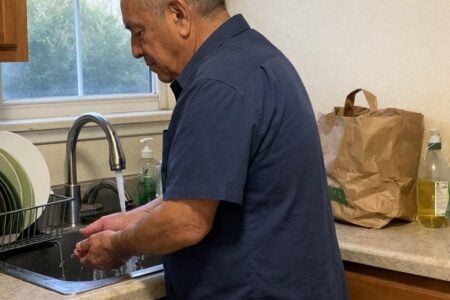
You read that setting your water heater to 120°F prevents scalding. You made the change. Maybe you even felt good about it.
Then your parent stepped into the shower and the water turned searingly hot the moment someone flushed a toilet down the hall. Or you held your hand under the “safe” kitchen tap and it felt dangerously warm after a few seconds. So what went wrong?
Here’s the part most guides skip: aging skin is thinner than younger skin, and it loses sensitivity faster. A burn that takes several seconds to develop in a 40-year-old can occur in under two seconds in a person over 70 — at exactly the same water temperature.
The water heater thermostat sets a ceiling at the source, but it cannot prevent pressure-driven spikes at the showerhead. It cannot compensate for long pipe runs that deliver heat differently room to room. And it cannot protect someone standing in a wet bathtub who cannot step back quickly if the temperature surges.
That’s what this article is actually about: location in the plumbing system determines which type of valve solves the problem. A whole-house thermostatic mixing valve addresses one link in the chain. A pressure-balancing shower cartridge addresses a different one. A point-of-use tempering valve targets a single tap. And a thermometer tells you whether any of it is working.
Pick the right valve for the right location, and you have real protection. Pick the wrong type — or assume one intervention covers everything — and you’ve spent money without closing the gap.
Anti-Scald Valve Shopping Guide: Print & Carry
Download this practical shopping guide to confidently select and install the right anti-scald valve for your situation—no guesswork, no overpaying for features you don’t need, and a simple 30-second test to verify it actually works.
What to Look For
Before you buy anything in this category, these are the specifications that actually matter. They apply to every product, regardless of brand.
Temperature range and adjustment. Any valve worth installing should be adjustable to deliver mixed water at or below 120°F (49°C) at the outlet. Many thermostatic mixing valves are factory-preset at 120°F but can be adjusted; confirm the full adjustment range — typically 85°F–120°F (29°C–49°C) — and whether adjustment requires a tool or can be done by hand. If a resident with dementia lives in the home, look specifically for a tamper-resistant model with a lockable maximum temperature stop.
Flow rate compatibility. Valves are rated in gallons per minute (GPM). A whole-house thermostatic mixing valve must match the home’s peak demand — a typical residential installation needs at least 6–10 GPM. A point-of-use valve at a single sink can function at 1–2 GPM. Mismatching flow rate causes pressure drop and temperature inconsistency, which defeats the entire purpose of the valve.
Inlet pressure balance. Most thermostatic mixing valves require balanced inlet pressures. The difference between hot and cold supply pressure should not exceed a specified ratio — often 25 PSI. Homes with well pumps or aging pressure regulators may need a pressure check before installation.
Certification markings. In the United States, these are the standards to look for:
- ASSE 1016 — shower valves with pressure-balancing and/or thermostatic control
- ASSE 1017 — point-of-use or whole-house thermostatic mixing valves at the water heater
- ASSE 1070 — point-of-use valves delivering 110°F or below, commonly specified for care facilities
These are not marketing claims. They represent third-party performance testing to a defined standard. A valve without one of these markings cannot be independently verified to perform as labeled.
Material and longevity. Brass bodies with stainless steel or ceramic cartridges outlast plastic in high-temperature applications. For whole-house or water-heater-adjacent installations that may sit in a utility space and go uninspected for years, brass construction is the practical minimum.
Plumber-required vs. DIY — stated plainly. This matters, and I won’t bury it. Whole-house thermostatic mixing valves at the water heater almost always require a licensed plumber. Not because the logic is complex, but because the work involves the main hot water supply line, often requires solder or press-fit connections, and may be subject to local permit and code inspection. Getting this wrong can void your water heater warranty. Shower cartridge replacements in an existing valve body are frequently within a confident DIYer’s capability. Point-of-use valves under a sink vary by connection type — many use compression or push-fit fittings that require no special tools.
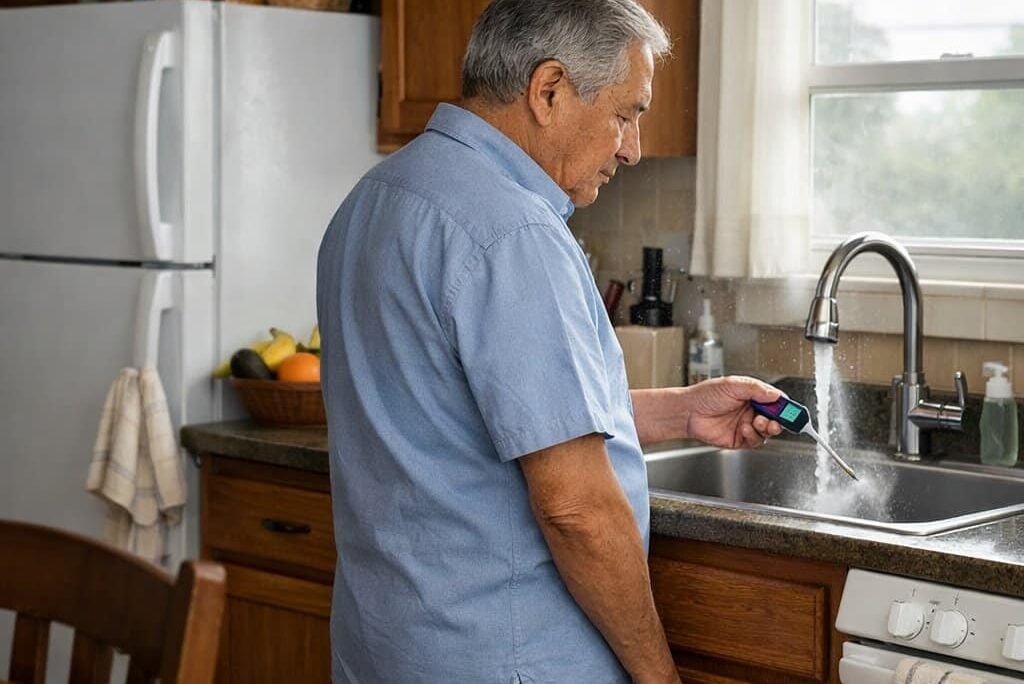
Testing after installation. Run hot water at the tap for 30 seconds, then hold a thermometer in the stream. That reading — after 30 seconds of flow, at the tap farthest from the heater — is the real-world delivered temperature. This test belongs at installation and annually thereafter. Feel alone is not a reliable measurement, especially for older adults whose sensitivity has shifted.
Thermostatic Mixing Valves — Whole-House Protection at the Water Heater
A thermostatic mixing valve (TMV) installed on the hot water outlet of the water heater blends cold water into the hot supply before it reaches any fixture in the home. This single change allows the water heater itself to run at 140°F (60°C) — hot enough to suppress Legionella bacteria, which thrive between 77°F and 113°F (25°C–45°C) — while every tap in the house receives mixed water at 120°F or lower.
This is the right solution for homes where every tap is a potential burn risk: households with a resident who has reduced skin sensation from diabetic neuropathy, post-stroke changes, or dementia. It’s also the right answer when the water heater thermostat is unreliable or poorly calibrated. Caregivers managing a parent’s home from a distance often find this the most efficient intervention — one professional installation addresses the whole house.
What it does not do: a whole-house TMV at the heater does not address fixture-level pressure fluctuations. When a toilet flushes and cold-water pressure drops momentarily, the ratio of hot to cold reaching a shower can shift, creating a temperature spike at the showerhead regardless of what the water heater is delivering. Think of this valve as the foundation layer — essential, but not a complete system on its own.
Cash Acme 3/4 Inch Tank Booster Thermostatic Mixing Valve
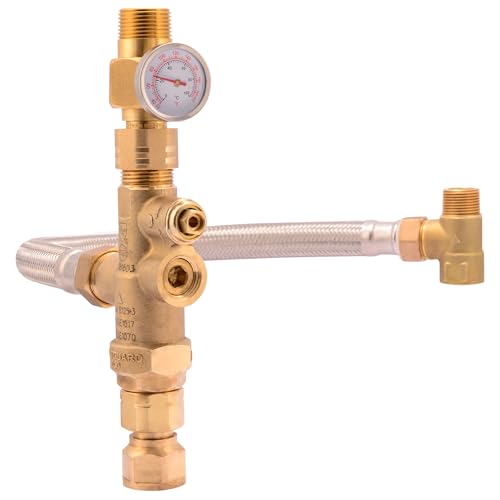
This is a ¾-inch NPT whole-house thermostatic mixing valve designed to install directly on the water heater’s hot outlet. It blends cold water into the hot supply and delivers mixed water to every fixture in the home — allowing the heater to run at Legionella-suppressing temperatures while capping what reaches the taps.
The valve is factory-set and field-adjustable within a residential-appropriate range. The ¾-inch NPT connection fits the standard residential water heater outlet. Installation requires a licensed plumber in most jurisdictions, and that cost should be factored into the total investment.
The honest limitation here is that this valve — like every whole-house TMV in this category — does not prevent pressure-spike temperature surges at the shower. It is the first layer of a complete system, not the only layer needed.
Honeywell AMX300 Series DirectConnect Thermostatic Mixing Valve

The Honeywell AMX300 is a whole-house thermostatic mixing valve designed for direct installation at the water heater. The DirectConnect designation refers to the fitting style, which is intended to simplify the connection to the water heater’s hot and cold ports compared to traditional NPT threading.
For a caregiver coordinating a plumber for a parent’s home, the more straightforward connection can reduce installation time and the potential for fitting errors. The valve maintains delivered temperature within the adjustment range and includes check valves to prevent cross-contamination between hot and cold supply lines — an important feature that not every mixing valve in this category includes.
As with all whole-house valves, this requires professional installation. The protection it provides is real and broad, but the pressure-spike gap at the shower remains unaddressed until a fixture-level valve is also in place.
Cash Acme 1/2 Inch HG110 Crimp Thermostatic Mixing Valve

This is the ½-inch version of the Cash Acme HG110 line, using crimp (barb) connections intended for PEX tubing rather than threaded NPT fittings. If the home’s plumbing uses PEX — common in newer construction and post-2000 renovations — this connection style is appropriate and avoids adapters.
The smaller ½-inch size suits lower-demand installations: a single-bathroom home or a small apartment where peak demand is modest. Pairing a ½-inch valve with the main supply line of a multi-bathroom home would create pressure drop and temperature inconsistency, which is the most common sizing mistake in this category.
This valve includes integral check valves, which prevent hot and cold supply lines from cross-contaminating each other — a feature that matters in any installation where both supply lines connect at the same valve body. Professional installation is required.
Cash Acme 3/4 Inch HG110-D FNPT Thermostatic Mixing Valve With Integral Checks

The HG110-D in ¾-inch FNPT (female NPT) threading is the traditional threaded-connection version in Cash Acme’s whole-house line. FNPT connections are standard in homes with copper or CPVC plumbing and are what most residential plumbers work with routinely.
The integral check valves built into the body prevent backflow between the hot and cold supply lines. This matters because without check valves, cold water can migrate into the hot line or vice versa, affecting temperature delivery at fixtures throughout the house — a problem that is difficult to diagnose once it develops.
The ¾-inch sizing is appropriate for multi-bathroom homes with normal residential peak demand. This valve is a straightforward professional installation for a plumber familiar with water heater work.
Cash Acme 3/4 Inch HG110-D Thermostatic Mixing Valve with SharkBite Direct Connections

The SharkBite version of the HG110-D uses push-to-connect fittings rather than threaded NPT connections. SharkBite fittings are compatible with copper, CPVC, and PEX tubing, which makes this valve adaptable to a wider range of existing plumbing without requiring soldering or specialized tools for the connection itself.
This is worth noting for homeowners whose plumber charges by the hour: push-to-connect fittings are genuinely faster to install than soldered connections, and that time savings can reduce labor cost. The fittings are also more accessible for a licensed plumber working in a cramped utility space around a water heater.
The same whole-house caveats apply: this is a professional installation, it does not address shower pressure spikes, and the combined cost of valve plus labor is the number to budget against when evaluating value.
Anti-Scald Shower Valves and Cartridges
Pressure-balancing and thermostatic shower valves address the specific hazard a whole-house mixing valve cannot reach: the temperature spike that occurs at the showerhead when a toilet flushes and cold-water pressure drops momentarily. For any senior who cannot step back quickly from a sudden surge of hot water, a properly rated shower cartridge is the direct fix for this documented burn risk.


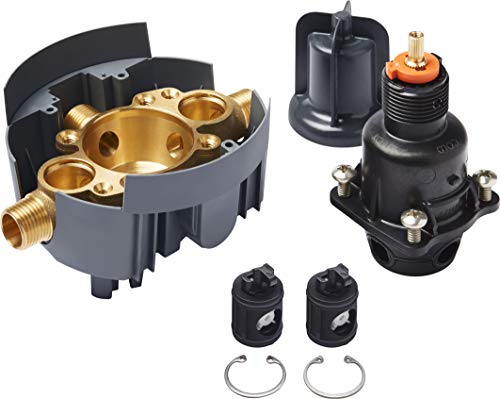


This is the category that directly addresses the toilet-flush spike. A pressure-balancing valve (ASSE 1016 Type P) senses a change in the hot-to-cold pressure ratio and adjusts automatically to maintain shower temperature within ±3°F of the set point. When someone flushes a toilet and cold-water pressure drops, the valve responds — the person in the wet bathtub does not feel the spike.
A thermostatic shower valve (ASSE 1016 Type T or TP) goes further. It maintains a user-set temperature independently of both pressure changes and incoming water temperature variations. It also typically separates volume control from temperature control — the user sets a comfortable temperature once and adjusts flow without touching the temperature setting. This is the right choice where incoming hot water temperature varies, as it often does with older water heaters or tankless systems with slow response times.
This protection is fixture-specific. The shower where the cartridge is installed is protected. The kitchen sink, bathroom lavatory, and bathtub fill spout remain at heater temperature unless separately addressed. Think of this as the second layer — added to a whole-house TMV, not a replacement for it.
One critical note for cartridge replacements: a replacement cartridge must be compatible with the existing valve body’s manufacturer and generation. An incompatible cartridge may fit physically but will not regulate temperature correctly. Confirm the valve body brand and model before ordering.
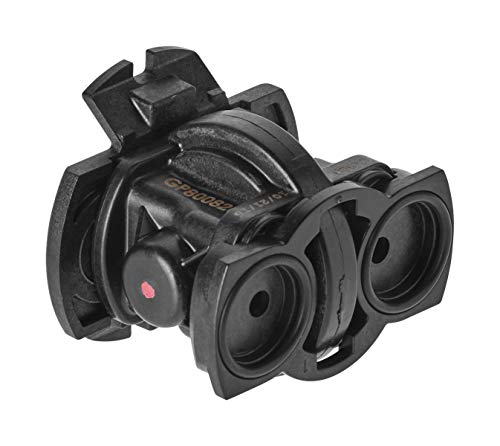
Kohler GP800820 Rite-Temp Pressure-Balancing Unit Cartridge
This is a replacement cartridge for Kohler Rite-Temp valve bodies — it is not a complete valve assembly. If the existing shower valve in the home is a Kohler Rite-Temp, this cartridge replaces the pressure-balancing unit inside the existing body without requiring wall opening or rough-in work.
The pressure-balancing function addresses the toilet-flush temperature spike directly. The cartridge maintains shower temperature within the ±3°F tolerance defined by ASSE 1016 Type P when cold-water pressure drops from another fixture’s demand. For a senior with reduced mobility who cannot step back from the showerhead quickly, this is a meaningful safety improvement at a fraction of the cost of a full valve replacement.
The honest limitation: this cartridge is only compatible with Kohler Rite-Temp valve bodies. Before purchasing, confirm the existing valve body brand and series. A Kohler cartridge installed in a non-Rite-Temp body — or a Delta, Moen, or Pfister body — will not function as intended.
Kohler 8305-NA Rite-Temp Universal Pressure-Balancing Cartridge
The Kohler 8305-NA is described as a universal Rite-Temp pressure-balancing cartridge, intended for broader compatibility across Kohler Rite-Temp shower valve generations than the GP800820. Where an older Rite-Temp body is in place, the universal designation may resolve compatibility questions that arise with generation-specific cartridges.
The function is the same: the cartridge senses pressure imbalances between hot and cold supply and compensates to keep shower temperature stable. This is the direct fix for the toilet-flush spike problem that a water heater thermostat adjustment cannot touch.
Cartridge replacement in a Kohler Rite-Temp body is typically within a confident DIYer’s capability — the supply stops are shut, the handle and trim are removed, the cartridge is pulled and replaced, and the handle is reinstalled. That said, confirm the valve body generation and model before purchasing, as the word “universal” does not mean compatible with every Kohler shower valve ever made.
Aottykro Pressure Balanced Cartridge #9740420 for Pfister Valves
This cartridge is a third-party replacement designed to fit Pfister valve bodies with model numbers in the 0X8, JX8, VB8, and JV8 series. If the shower in a parent’s home uses a Pfister valve in one of these series, this cartridge provides pressure-balancing function — the toilet-flush spike protection — without requiring a full valve body replacement.
Third-party cartridges in this category carry a reasonable caution: the performance spec should match the ASSE 1016 Type P tolerance. Confirm before purchasing that this cartridge meets that standard, and test delivered temperature at the showerhead after installation using a thermometer rather than relying on feel.
The installation process is the same as with any cartridge replacement: shut the supply stops, remove the handle and trim, pull the old cartridge, and install the new one. Pfister valve bodies are generally accessible for DIY replacement, but an unfamiliar plumbing layout or corroded fittings can complicate any retrofit.
Kohler K-8304-KS-NA Rite-Temp Pressure-Balancing Valve Body and Cartridge Kit
This is a complete valve body and cartridge kit — the rough-in valve body plus the pressure-balancing cartridge — intended for new installation or full valve body replacement where the existing body is damaged, incompatible, or absent. This is not a cartridge-only retrofit.
Installing a new valve body requires opening the wall to access the plumbing, soldering or connecting supply lines to the new body, and closing the wall before the trim is installed. This is professional territory in most cases, not because the logic is beyond a determined DIYer, but because the wall access and connection work carry real consequences if done incorrectly.
The value of a complete kit is that the body and cartridge are guaranteed compatible — there is no compatibility question to resolve. For a bathroom renovation already underway, or a shower valve that has failed and needs full replacement, this kit provides the anti-scald protection built in from the rough-in stage.
FOURHOME Replacement Cartridge for Gerber Safetemp II Valves
This cartridge is designed specifically for Gerber Safetemp II single-lever tub and shower valves. Gerber is a less common brand than Kohler or Moen, but it is found in many homes built or renovated in the 1990s and 2000s. If the shower valve is a Gerber Safetemp II, this cartridge provides replacement function for the anti-scald and pressure-balancing components.
The Safetemp II name reflects that the original Gerber valve included a maximum temperature stop as a factory feature. A replacement cartridge that restores this function is preferable to a generic cartridge that may not replicate it. Verify that the installed Gerber valve is the Safetemp II series — not an earlier or later Gerber product — before ordering.
As with all cartridge retrofits, the supply stops must be shut before work begins, and the delivered temperature at the showerhead should be confirmed with a thermometer after installation.
ZephyrJazz Pressure Balance Cartridge for American Standard Valves
This is a third-party pressure-balance cartridge designed to be compatible with American Standard valve body model A954.4400070A. American Standard valves are common in U.S. homes across a wide installation period, and finding compatible cartridges for older bodies can be more difficult than for current-production Kohler or Moen valves.
The pressure-balancing function — maintaining shower temperature within ±3°F when cold-water pressure drops from toilet flushing or other fixture demand — is the relevant safety protection here. For a senior who uses an American Standard shower and is experiencing toilet-flush temperature spikes, this cartridge addresses the specific mechanism behind that problem.
Confirm compatibility with the specific American Standard body model before purchasing. Third-party cartridges for older valve bodies sometimes require minor fitment adjustments; a post-installation thermometer test is especially important here to confirm the valve is functioning correctly at the temperature stop.
Point-of-Use Tempering Valves
A point-of-use tempering valve installs at a single tap — typically under the sink — and limits delivered hot water to 110°F at that one outlet, with no need to modify the water heater or the rest of the home’s plumbing. This is the right first step for renters, for families acting quickly on the highest-risk tap, and for anyone who needs meaningful protection at a specific fixture today while a broader solution is planned.

A point-of-use tempering valve installs at or near a single fixture — typically under the sink or at the tap inlet — and tempers the hot water to a fixed maximum at that one outlet. The ASSE 1070 standard for this valve type specifies a maximum delivered temperature of 110°F (43°C), which is meaningfully below the 120°F residential threshold and closer to the temperature specified for care facilities.
Every other tap in the home remains at water heater temperature. This is a targeted fix — not a whole-house solution, and not a substitute for a shower pressure-balancing valve. But for a renter who cannot modify the building’s plumbing, or a family that needs fast protection at the one tap posing the most immediate risk while a broader plan is developed, this is the right first step.
The installation barrier is lower than any other valve type in this article. Most point-of-use tempering valves connect to existing supply lines using compression or push-fit fittings — no soldering, no permits, no licensed plumber required in most cases. A confident non-plumber can install one in under an hour.
Caleffi 521342A Scald Protection Thermostatic Mixing Valve
The Caleffi 521342A is a three-way thermostatic mixing valve designed for point-of-use installation — under a sink or at a single fixture’s supply lines. It blends hot and cold water to deliver a tempered outlet at a controlled maximum temperature, consistent with the ASSE 1070 specification for point-of-use scald protection.
Caleffi is a manufacturer with a track record in the hydronic and plumbing industry; this is not a generic import product. The low-lead brass body meets NSF/ANSI standards for potable water contact, which matters for a valve that will be in continuous contact with drinking and washing water.
The honest assessment for this category: the Caleffi 521342A protects one tap. If the highest-risk fixture in the home is a single bathroom lavatory or kitchen sink — and the shower already has a pressure-balancing cartridge — this valve closes the remaining gap efficiently. If the reader needs whole-house protection, this is the wrong product to lead with, and the article’s earlier sections are the place to start.
Tap Thermometers and Temperature Indicators
A thermometer is the verification layer that confirms whether any valve, thermostat adjustment, or plumbing modification is actually delivering safe water at the point of use — because thermostatic valves drift over time and feel alone is not a reliable measurement, especially for older adults whose heat sensitivity has changed. Every home that has addressed scald risk through valves should also have a way to confirm those valves are working.

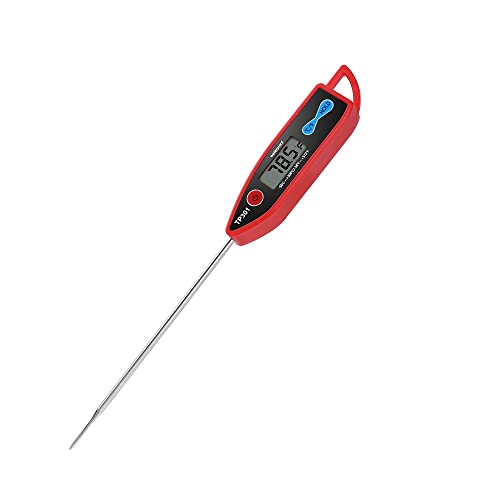


These are not valves. That matters, and it is worth saying plainly before describing any specific product.
Tap thermometers and temperature-indicating devices are the verification layer — the tool that confirms whether a valve, thermostat adjustment, or plumbing modification is actually delivering safe water at the point of use. A thermometer does not prevent a scald. A color-changing indicator does not prevent a scald. Purchasing one of these products instead of addressing the plumbing is spending money to watch a problem happen more visibly.
What these products do — and do well — is answer the question that every other intervention in this article leaves open: is it actually working? Thermostatic cartridges drift over time. Water heater thermostats lose calibration. A valve adjusted by a plumber last year may be delivering 128°F today. The only way to know is to measure.
Color-changing indicators are specifically useful for seniors who may not notice gradual temperature creep, or who have difficulty reading a digital display. The color signal — visible and unmistakable — provides a continuous warning without requiring any action from the user. For a resident with cognitive changes who might not reliably report that the water feels too hot, a visual indicator at the tap adds a layer that a valve alone cannot provide.
BOMATA Digital Water Thermometer
The BOMATA is a handheld digital thermometer rated IPX7 waterproof — it can be submerged in water without damage, which is relevant when holding a probe in a running tap or shower stream. The IPX7 rating means a dropped thermometer into a sink full of water is recoverable, not a loss.
For the 30-second tap test described throughout this article — run hot water, hold the probe in the stream, read the steady-state temperature — this thermometer’s waterproofing makes the process cleaner and the tool more durable over time. It reads water temperature, not surface temperature, which is the correct measurement for this application.
The honest limitation for this and every handheld thermometer in this section: it is only useful when someone uses it. A thermometer purchased and placed in a kitchen drawer does not protect anyone. Build the 30-second test into an annual routine — ideally tied to a date like the water heater’s annual drain flush — and this tool earns its place.
Yacumama Digital Water Thermometer with Long Probe
The Yacumama thermometer features a long probe, which is the practical advantage in a shower or bathtub application. A standard short-probe thermometer requires holding the device close to the water stream, which means getting a hand wet and maintaining an awkward position. A longer probe allows the reader to hold the device outside the stream while the probe reaches into it.
For testing the bathtub fill or a showerhead at standing height — the tests most relevant to bathroom fall prevention and scald risk — the extended reach is a genuine functional advantage over compact models. It also makes the thermometer easier to use for someone with reduced hand flexibility or grip strength.
Like all handheld thermometers, this is a periodic testing tool, not a continuous monitor. Annual testing plus any time a valve is adjusted or a plumber has done work is the appropriate use pattern.
ECOWITT WN34BL Digital Pool Thermometer
The ECOWITT WN34BL is a waterproof digital thermometer with an LCD display designed primarily for pool and outdoor water temperature monitoring, but its function — reading liquid temperature quickly and accurately — transfers directly to tap water testing.
The LCD display is a relevant feature for older adults with some degree of vision change: larger characters on the display are easier to read than the small digits on compact cooking thermometers. If the person performing the annual temperature test is the senior resident themselves rather than an adult child, display readability matters.
The waterproof construction handles the running-water test without concern about moisture damage. The temperature range covers the residential hot water spectrum comfortably. This is a straightforward verification tool at a modest cost.
U UNNI Wireless Pool Thermometer
The U UNNI is a floating wireless pool thermometer — it transmits temperature readings to a separate receiver rather than requiring the user to read a probe held in the water stream. The IPX8 waterproof rating means full submersion is not a concern.
The wireless design has a specific application in the home safety context: a caregiver or family member who wants to monitor tap temperature without being present at the fixture can read the transmitted value from a separate location. This is a modest advantage for someone checking multiple taps in sequence without walking back to a central display.
For most households, a wired handheld thermometer is simpler and sufficient for annual tap testing. The wireless feature adds value primarily in situations where the person performing the test has mobility limitations that make moving between fixtures and a display difficult.
Javjicy Shower Thermometer
The Javjicy is designed specifically for shower water temperature measurement, with an instant-read design intended for use in a running water stream. The “smart” designation refers to the rapid temperature read — faster response time is genuinely useful when testing running water, where temperature can vary second to second.
A thermometer that takes 15 seconds to stabilize is less useful than one that reads in 3 seconds when the goal is measuring steady-state shower temperature after 30 seconds of flow. Response time is one of the meaningful differentiators in this product category, and it is worth confirming before purchase.
For a household where the shower has recently had a cartridge replaced or adjusted, a dedicated shower thermometer kept in the bathroom makes the verification test a natural part of the routine rather than something requiring a trip to find a tool.
AQUANEAT 2 Pack Aquarium Thermometer
The AQUANEAT is an aquarium and fish tank thermometer — a digital temperature sensor designed to read liquid temperature in a submerged or flowing application. It reads in the temperature range relevant to hot water safety and the probe is designed for continuous water contact.
The two-pack format has a practical application in the home safety context: one unit can be placed at the tap farthest from the water heater (the most informative test point) and one at the tap with the highest daily use, such as a bathroom lavatory or kitchen sink. Leaving one in place as a semi-permanent monitor — not designed for this product, but physically feasible — gives a visible reference without requiring a dedicated testing session.
The honest limitation: this is an aquarium thermometer, and its accuracy and response time specifications are calibrated for tank monitoring rather than flowing-water testing. For a quick annual verification, it performs the required function. For precise calibration work after a valve installation, a thermometer with tighter stated accuracy tolerance is more informative.
Frequently Asked Questions
My water heater is already set to 120°F. Do I still need an anti-scald valve?
Probably yes — for two reasons. First, 120°F at the heater is not 120°F at the tap. Pipe length, ambient temperature, and fixture condition all affect the delivered temperature. A thermostatic mixing valve solves this by allowing the heater to run at a higher, Legionella-suppressing temperature while capping what every tap in the house receives. Second, 120°F at the heater does nothing to prevent a pressure-driven temperature spike at the shower when someone flushes a toilet. Those are two separate problems, and the water heater thermostat only addresses one of them — partially.
What is the difference between a pressure-balancing valve and a thermostatic shower valve?
A pressure-balancing valve (ASSE 1016 Type P) reacts to changes in the pressure ratio between hot and cold supply, maintaining shower temperature within ±3°F when cold-water demand shifts elsewhere in the house. This is the toilet-flush fix. A thermostatic shower valve (Type T or TP) maintains a user-set temperature independently of both pressure changes and incoming water temperature variations. It also typically separates volume control from temperature control. For most seniors in a standard residential home, a pressure-balancing valve is adequate. A thermostatic valve is the right choice where incoming hot water temperature is inconsistent — older water heaters, tankless systems with slow response, or homes where the whole-house TMV has not yet been installed.
Can I install an anti-scald valve myself, or do I need a plumber?
It depends on the valve type. Shower cartridge replacements in an existing valve body are typically within a confident DIYer’s capability — shut the supply stops, remove the handle and trim, replace the cartridge, reinstall. Point-of-use tempering valves under a sink often use compression or push-fit fittings that require no special tools. Whole-house thermostatic mixing valves at the water heater almost always require a licensed plumber. The connection is on the main hot water supply line, often requires soldered or press-fit fittings, and may be subject to local permit requirements. Getting that installation wrong can void the water heater warranty and create a cross-contamination problem that’s genuinely difficult to diagnose.
What temperature should I set my anti-scald valve to?
The U.S. Consumer Product Safety Commission recommends 120°F (49°C) as the maximum safe residential delivery temperature. For households with a resident over 70, or anyone with reduced skin sensation from diabetes, neuropathy, or stroke, a setting of 110°F–115°F (43°C–46°C) provides a wider safety margin. The ASSE 1070 standard for care facility point-of-use valves specifies 110°F as the maximum. Lower settings reduce burn risk but may feel unsatisfying for showers — a thermostatic shower valve with a temperature stop lets users choose within a safe range while preventing exceedance.
How do I know if the valve I have is actually working?
Run hot water at the tap for 30 seconds, then hold a thermometer probe in the stream and read the steady-state temperature. Do this at the tap farthest from the water heater — that is where pipe-run temperature loss is greatest and where a drifting valve will show its problem first. Repeat this test at installation and annually. A reading above 120°F means the valve requires adjustment or replacement. Feel alone is not a reliable test for anyone, and especially not for older adults whose heat sensitivity has shifted.
Do anti-scald valves reduce water pressure?
A properly sized valve on a line that matches its rated flow rate will not produce a noticeable pressure reduction. A valve undersized for the home’s peak demand — for example, a 2 GPM valve serving the main supply line of a three-bathroom home — will cause pressure drop and temperature inconsistency. Matching the valve’s GPM rating to the home’s peak demand before purchasing is the most common buyer error in this category, and it is one that a product review won’t catch for you. Know your home’s peak demand before you select a valve size.
Hacks and Practical Advice
Do the cold-pipe test before you buy anything. Turn off the water heater and run only the cold tap for 60 seconds. If the water coming out feels warmer than it should, you may have a cross-connection — hot and cold lines mixing somewhere before the fixture. No anti-scald valve will fix a cross-connection. Identify it first; then address the valve.
The tap farthest from the heater is your canary. It shows the widest temperature variance and the slowest response. If it passes the 30-second thermometer test, the taps closer to the heater almost certainly will too. If it fails, start there with your diagnosis.
Write the installation date on the valve body with a paint pen. Thermostatic cartridges and mixing elements have service lives — typically 5–10 years in residential use. Without a recorded date, no one knows when to inspect or replace. A paint pen takes 10 seconds and saves a future plumber’s diagnostic time.
Pressure spikes are worse in the morning. The toilet-flush temperature surge in the shower is most pronounced when supply-line pressure is highest — typically early morning. If a family member reports the shower is “fine except sometimes in the morning,” that is the pattern of a pressure-balancing failure, not an inconsistent water heater. A pressure-balancing cartridge addresses this directly; a water heater adjustment does not.
Consider the wet-tub context. The person most at risk from a shower temperature spike is the one who cannot step back quickly. Addressing anti-slip protection in the shower and tub alongside valve installation is treating the complete problem — not just the temperature, but also the inability to move away from it. These two interventions belong together.
A renter’s workaround for the water heater. A landlord who won’t adjust the water heater or permit plumbing modifications generally cannot object to a point-of-use tempering valve installed with compression fittings under the sink. It connects to existing supply lines and can be removed and the original connections restored in under 20 minutes on move-out day. For renters managing a parent’s safety in a rental property, this is the path forward while broader solutions are negotiated.
Verify after any plumbing work. Any time a plumber has been in the home — for any reason — run the 30-second thermometer test at the tap farthest from the heater. Plumbing work can inadvertently shift supply pressures or valve positions. Verification is not a distrust of the plumber; it is the correct close to any hot water system work.
Anti-Scald Valve Shopping Guide: Print & Carry
Download this practical shopping guide to confidently select and install the right anti-scald valve for your situation—no guesswork, no overpaying for features you don’t need, and a simple 30-second test to verify it actually works.
Conclusion
The water heater thermostat is one control point in a longer chain. It sets the maximum temperature at the source, but it cannot prevent pressure spikes at the fixture, cannot compensate for pipe-run variation, and cannot protect a person standing in a wet bathtub who cannot move quickly.
The four types of products in this article address four different links in that chain. A whole-house thermostatic mixing valve solves the Legionella-vs-scald trade-off at the source, allowing the heater to sanitize while protecting every tap. A pressure-balancing shower cartridge handles what happens when someone flushes while a family member is in the shower. A point-of-use tempering valve targets the single tap posing the most immediate risk when a whole-house solution isn’t yet in place. And a thermometer — used regularly — confirms that any of it is actually working.
Here is the diagnostic action I’d suggest before you buy anything: run hot water at the tap farthest from your water heater. Hold a thermometer in the stream for 30 seconds. Read the number. That number tells you whether your current setup is protecting the most vulnerable person in the house — or only appearing to.
If that test, combined with this article, raises more questions than it answers — about the whole house, not just one tap — I offer a Home Safety and Independent Living Assessment for families who want a comprehensive review rather than a fixture-by-fixture fix. One tap is a start. Understanding the whole house is the goal.
Have you checked your hot water temperature recently — or discovered a surprise when you did? Share what you found in the comments. Your experience might help another reader know where to start.