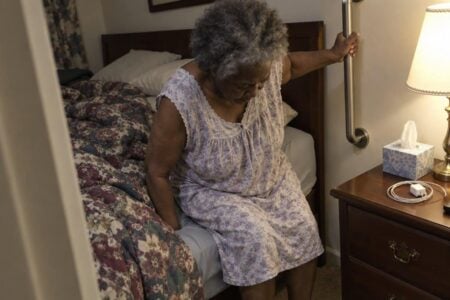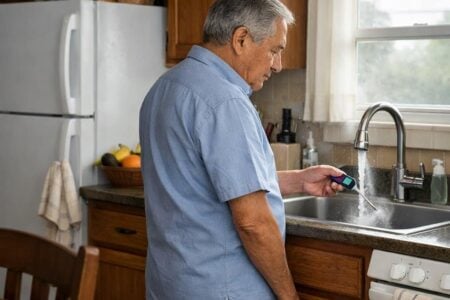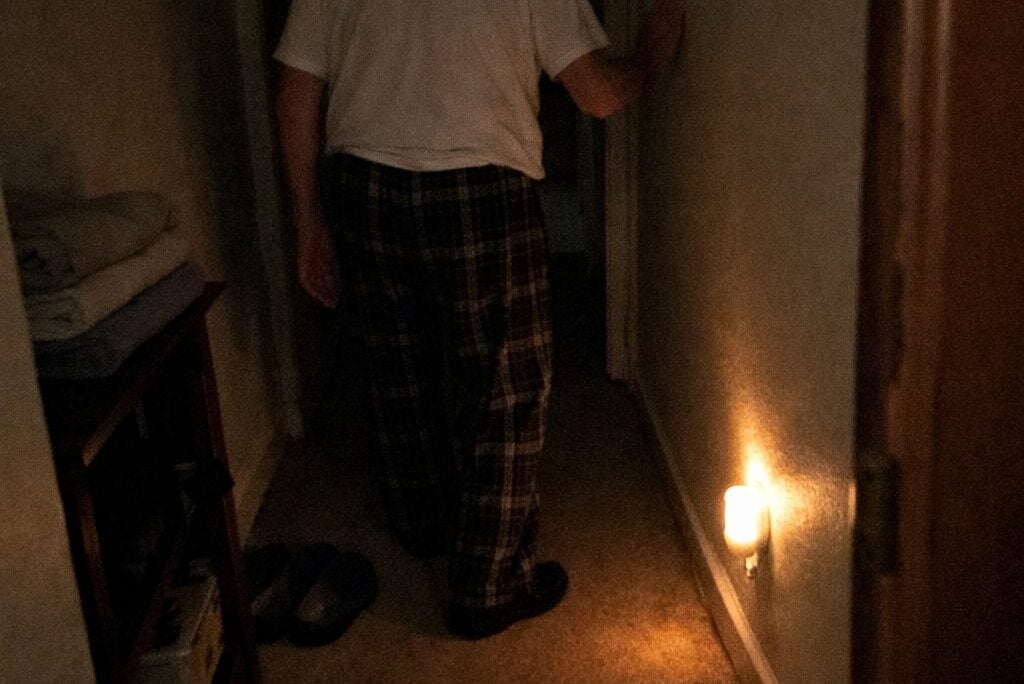
Picture this: it's 2 a.m., your parent swings their legs off the bed, and the floor is completely invisible. That first step — taken when blood pressure has just dropped and eyes haven't adjusted to any ambient light — is when falls happen. Not in the middle of a lit hallway. Right there, at the edge of the mattress.
Most people respond by buying one plug-in night-light and placing it somewhere in the hallway. That solves exactly one of three distinct danger moments on the nighttime route. The other two stay unaddressed.
Here's the problem those three moments create, and why each needs a different solution.
The standing-up moment. Orthostatic hypotension — the blood pressure drop that follows lying still for hours — causes light-headedness in the first seconds of standing. The floor needs to be visible before the first step, not after the senior has already navigated to the hallway.
The route itself. The stretch between bedroom door and bathroom door is typically the longest dark segment. A single night-light may not cover the full length, especially if outlets are not positioned along the walking path.
The destination. A white toilet bowl against white tile in a dim bathroom is a low-contrast target. For a senior with vision changes or early cognitive decline, locating the fixture at the end of the route is its own challenge.
One more thing to check before you buy anything: color temperature. Most inexpensive night-lights emit blue-white light. That light suppresses melatonin at the exact moment the goal is to return to sleep quickly. Warm amber output — below 2,700K — matters as much as brightness. It's the specification most buyers never check, and it's the one that determines whether the light helps or quietly disrupts sleep night after night.
Senior Night-Light Shopping Guide: Print & Carry
Download this printable shopping guide to choose the exact night-lights that fit your parent’s home layout and nighttime risks—no more guessing about brightness, color temperature, or sensor placement.
What to Look For
This section gives you the numbers to evaluate any product in this category, regardless of which specific ones you choose.
Color temperature is measured in Kelvin. Warm amber night-lights should output at or below 2,700K. Products marketed as "warm white" vary widely — the packaging language is not reliable. Look for the actual Kelvin rating in the product specifications. Anything above 3,000K is blue-shifted enough to interfere with melatonin recovery for older adults who are already likely to have shorter, lighter sleep cycles.
Brightness for a nighttime route is about orientation, not illumination. Ten to 30 lumens is sufficient for most hallways and bathrooms. Higher outputs — 60 to 100 lumens — can actually increase disorientation by creating harsh contrast between lit and dark areas. Brighter is not always safer. This surprises most buyers, and it's worth keeping in mind when you're comparing specs.
Motion sensor range and angle both matter, but angle matters more. A 120-degree sensor covers a hallway approach well. A 180-degree sensor is better at a bedroom door where the senior approaches from an angle. The off-delay should be at least 30 seconds. Lights that cut off in 10 seconds can leave a slow-moving older adult in complete darkness mid-route — which is worse than no motion sensor at all.
Installation height affects detection reliability. Plug-in units sit at outlet height, roughly 12 to 18 inches from the floor. That's adequate for hallway detection in most cases. For someone who moves slowly at a bent posture or uses a walker, under-bed and stick-on units with adjustable sensor placement offer better detection.
Battery capacity for rechargeable units should cover a full night. Six to eight hours minimum on a full charge is the floor. Magnetic charging bases are worth seeking out specifically for this audience — they eliminate the need to locate and plug in a cable, which matters for older adults with reduced grip strength or limited reach.
Waterproofing is non-negotiable for bathroom units. Any light mounted in a bathroom should carry at minimum an IPX4 splash-resistance rating. IPX6 or higher is appropriate near a shower or sink.
A complete nighttime lighting setup addresses all three danger moments. For readers who want to extend that thinking to the full bedroom environment, How to Prevent Falls for Elderly: The Ultimate Fall Prevention Checklist covers the broader picture room by room.
Plug-In Motion Night-Lights
Plug-in motion night-lights draw power directly from a wall outlet and activate automatically when someone moves through the space, providing reliable, maintenance-free illumination along the hallway and bathroom sections of the nighttime route. Because they require no batteries or recharging, they are the most consistent long-term option for covering any stretch of the route where an outlet is available and correctly positioned.


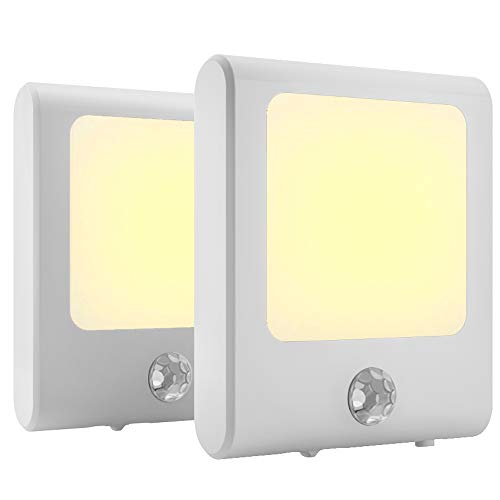

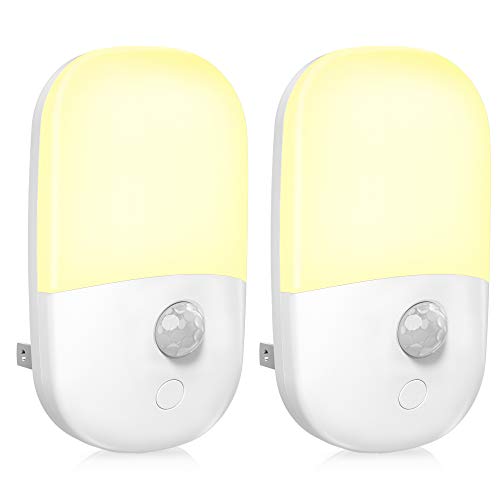
A plug-in motion night-light draws power from a standard wall outlet and uses a passive infrared sensor to activate when someone enters its detection zone. No batteries, no recharging, no maintenance beyond occasional dusting.
Where this type belongs on the nighttime route: hallways between the bedroom and bathroom are the primary placement. Any stretch of the route that has an outlet at the right position on the right wall is a candidate. Bathrooms work well when the outlet sits on the wall opposite the door — the unit triggers as the senior enters, which is the correct behavior. Stairs with an outlet near the top or bottom landing are also appropriate.
Where it is the wrong choice: any wall section where the outlet faces the wrong direction. A sensor aimed at a perpendicular wall won't detect a senior walking parallel to it. If the nearest outlet is behind a piece of furniture, the unit will be blocked. Walk the actual route before purchasing — this problem is more common than buyers expect. Plug-in lights also don't address the standing-up moment. By the time the senior reaches the hallway, they've already navigated the highest-risk transition.
The advantage over rechargeable units is reliability. There's nothing to monitor and nothing to recharge. For caregivers managing a parent's home remotely, that matters.
L LOHAS LED Motion Sensor Night Light
The L LOHAS offers two brightness settings — 30 and 60 lumens — giving you a choice between orientation-level light and something closer to task light. For most hallway placements, the 30-lumen setting is the right choice. The 60-lumen setting creates more contrast than older eyes need at 2 a.m.
The motion sensor triggers within a reasonable range for hallway use. The unit is compact enough that it won't block the adjacent outlet socket, which matters when an older home may have limited outlet placement options.
The honest limitation: like all plug-in units, this one is constrained by outlet placement. Verify the outlet on your specific wall faces the walking direction before assuming this will work in your hallway.
GE LED Motion Sensor Night Light
The GE unit puts out 40 lumens and is one of the more straightforward options in this category — plug in, walk past, light activates. There's no brightness adjustment, which simplifies setup but removes flexibility.
This is a reasonable choice for a hallway where you want a set-and-forget solution without additional controls to manage. The sensor and off-delay behavior are predictable, which matters when the goal is consistent performance night after night.
The limitation is the same as any fixed-output unit: 40 lumens may be slightly brighter than ideal for a route where the priority is returning to sleep quickly. If you have multiple outlets along the route, consider using this in the hallway and pairing it with a lower-output unit at the bedroom door.
AUVON Plug-in LED Backlit Night Light, 2-Pack
The AUVON includes both a motion sensor and a dusk-to-dawn sensor, which means it can operate as a passive ambient light when motion isn't detected and switch to active light when someone moves through the space. The 2-pack allows you to cover two points on the route with a single purchase.
The dusk-to-dawn feature is particularly useful for a bedroom-adjacent hallway where you want some baseline visibility without relying entirely on motion triggering. For older adults who move slowly or pause mid-route, having a unit that doesn't go fully dark between steps is a practical advantage.
Verify the color temperature specification against the 2,700K threshold before purchasing. "Warm white" labeling across manufacturers is inconsistent.
MAZ-TEK Plug-in Motion Sensor Light with Adjustable Brightness
The MAZ-TEK includes adjustable brightness, which is one of the more useful features in this category for seniors. Being able to dial down the output to the minimum needed for safe navigation reduces blue-light exposure and limits the contrast shock of sudden bright light in a dark room.
Warm white output and the adjustable sensor make this a strong candidate for bedroom doorway placement, where the detection angle matters and the light level should be low. It suits older adults who are sensitive to sudden brightness changes at night.
The limitation: the rotating plug design that some units in this line offer can be convenient for tight outlet configurations, but always test the sensor direction after installation to confirm it faces the walking path.
AUVON Plug-in Night Light, Motion Sensor and Dusk to Dawn, 4-Pack
The 4-pack format means you can cover an entire nighttime route — bedroom door, hallway mid-point, bathroom entry, and one spare — in a single order. For a caregiver setting up a parent's home in one visit, that's a practical advantage.
The dual-sensor design (motion plus dusk-to-dawn) provides the same hybrid behavior as the 2-pack version: ambient light when the space is dark, motion-triggered brightening when someone moves through. Four units at consistent color temperature means no mismatched lighting along the route.
The trade-off is that 4-packs are most cost-effective when all four outlets are in the right positions. Walk the route first and confirm placement before ordering.
MAZ-TEK Plug-in Motion Sensor Dimmable Night Light with Dusk-to-Dawn
This MAZ-TEK model adds dusk-to-dawn functionality to the adjustable-brightness design, meaning it handles both the ambient-light and motion-triggered modes. The combination is well-suited to a bathroom where you want some baseline glow through the night rather than complete darkness between uses.
The dimmability is the feature that earns this unit its place in a senior-specific lighting setup. Being able to set the output to the lowest effective level — just enough to see the floor — is more useful than a fixed output that may be brighter than needed.
As with all plug-in units, the sensor must face the walking direction. In a bathroom, that typically means the outlet on the wall opposite the door. Test after installation before assuming the placement works.
Rechargeable Stick-On Motion Lights
Rechargeable stick-on motion lights mount to any flat surface without an outlet, making them the solution for stairs, closets, and walls between outlets where plug-in units cannot reach. Their flexibility fills the coverage gaps that leave parts of the nighttime route in darkness, though they require a regular charging routine to stay reliable.


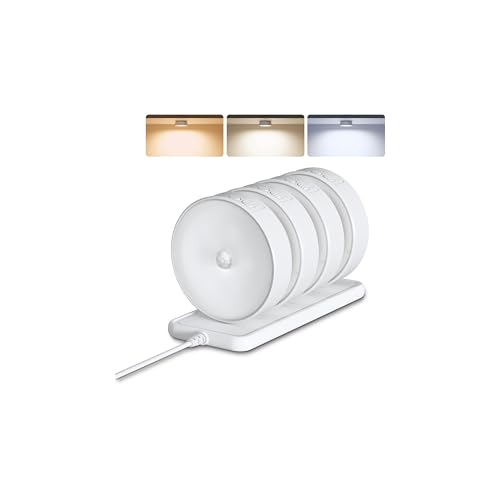


A rechargeable stick-on motion light is a battery-powered, self-contained unit that mounts to any flat surface without an outlet — wall, cabinet face, stair riser, closet interior, or underside of a handrail. It recharges via USB or a magnetic dock when the battery runs low.
Where this type belongs: stair runs with no outlet at the right height. Closets. Walls between outlets where a plug-in unit would leave a gap in coverage. Inside a bathroom cabinet. This is the most versatile mounting type in this roundup and the one that fills gaps plug-in lights can't reach.
Where it is the wrong choice: any situation where battery monitoring is not realistic. For an older adult living alone who is unlikely to notice a dimming indicator, a plug-in unit is more reliable on that same surface — if an outlet can be positioned there. Rechargeable units are also the wrong choice in high-humidity environments unless the IPX rating explicitly covers bathroom condensation.
The magnetic charging detail matters for this audience. Units where the battery pack detaches magnetically for charging are meaningfully easier for older adults with reduced grip strength. Units that require locating a small USB port and plugging in a cable are harder to maintain consistently. That maintenance gap is where rechargeable lights fail in real-world use.
Runtime claims from manufacturers often assume intermittent triggering. A light that activates many times per night discharges faster than the stated figure. For caregivers, a monthly battery-check habit — tied to another routine, like a bill payment or medication refill — is worth building from the start. If you're thinking about other gap-filling safety measures inside the home, 10 Best Bathroom Safety Products for the Elderly covers the broader category well.
WOBANE Rechargeable Motion Sensor Strip Light
The WOBANE is a strip-format light, which gives it a different coverage profile than a compact puck unit. A strip illuminates a longer section of a stair riser or cabinet edge rather than a single point, which can be more effective for covering the full width of a step.
Warm white output and motion activation make this a reasonable stair-riser candidate in a home where no outlet exists along the stairway. The strip format also works under a bathroom vanity where even floor-level light is better than none.
The limitation is that strip lights are less adaptable to tight or angled mounting surfaces than compact units. Measure the surface before ordering and confirm the adhesive will hold on that material.
MCGOR Under Cabinet Lighting, 14.7", 2-Pack
At 14.7 inches, this MCGOR unit covers a meaningful length of underside surface — useful under a kitchen cabinet near the counter where a senior prepares nighttime medications, or under a bathroom vanity. The magnetic mounting means the unit can be removed for charging without tools.
The 2-pack allows for paired placement — one on each side of a hallway, or one at the stair top and one mid-run. The motion sensor triggers on approach, which is the correct behavior for a route that a slow-moving senior needs to navigate safely.
The magnetic base is the standout feature for this audience. It removes the dexterity barrier that makes some rechargeable units hard to maintain.
EZVALO 4-Pack Motion Sensor Closet Lights with Charging Station
The charging station format changes the maintenance equation for this type of product. Instead of tracking four separate charging cycles, all four units dock to a single station — making it easier to build a reliable charging habit. For a caregiver who visits weekly, docking all four units before leaving is a single action.
Four units at 1,200mAh each provide enough runtime for typical nighttime-route use, assuming the lights aren't triggering continuously. The pack is well-suited to covering an entire route — closet, hallway segment, stair riser, bathroom — with a consistent product and a unified charging approach.
Confirm the sensor angle on each unit after placement. Four units installed incorrectly still leave gaps.
GOODEA 17.5-inch Under Cabinet Lighting, 4500mAh, 4-Pack
The 4,500mAh battery capacity is the highest in this section. For a unit that's triggering multiple times per night, that capacity buffer means fewer nights where the light goes dark unexpectedly. The 17.5-inch strip length covers more surface than most compact units, which is useful under a kitchen counter or along a longer stair riser.
The 4-pack allows coverage of multiple route segments without mixing products. Consistent color temperature and sensor behavior across the route is a practical advantage.
The limitation: a longer strip is less adaptable to surfaces with limited flat area. Confirm the mounting surface dimensions before ordering.
MCGOR 10-inch Under Cabinet Lighting, 2-Pack, 5-Level Brightness
The five-level brightness adjustment is the feature that distinguishes this MCGOR unit. Being able to set the output to the lowest effective level — rather than accepting a fixed output — reduces light exposure for a senior who needs to return to sleep quickly after a nighttime bathroom trip.
At 10 inches, the strip is compact enough to fit most cabinet undersides and stair risers without modification. The 2-pack allows placement at two points on the route with matched settings.
For any older adult who is sensitive to sudden brightness, the adjustable output on a motion-triggered unit is a meaningful practical feature.
EZVALO 10-inch Under Cabinet Lighting, 2-Pack, 2400mAh
At 2,400mAh and 10 inches, this EZVALO unit is a mid-capacity option in a compact form. The wireless operation means no cord management, which simplifies installation on a stair riser or under a cabinet where cord routing would be difficult.
The motion sensor activates on approach, and the warm white output stays within the range appropriate for nighttime use. This is a practical choice for a single gap in a route where a plug-in unit isn't possible and the space is too limited for a longer strip.
Runtime will depend on trigger frequency. For a route that's used only once or twice per night, 2,400mAh provides comfortable coverage.
EZVALO 3-Pack 8" Motion Sensor Light Indoor Rechargeable
The 8-inch length and 3-pack format make this EZVALO option well-suited to covering three distinct short segments — stair riser, closet interior, and a hallway wall between outlets — with a consistent product. Smaller strips are easier to position precisely on narrow surfaces.
The stick-on mount works on most flat surfaces, and the rechargeable design means no outlet is needed at any of the three locations. For a caregiver identifying multiple gaps in a route with limited outlet access, three matched units simplify the purchasing and setup process.
The honest limitation of any 8-inch strip: it covers a short segment. If the gap in coverage is longer than the strip, two units in sequence are needed.
Toilet Bowl Night-Lights
Toilet bowl night-lights clip to the inside rim of the toilet and project light downward, making the fixture visually distinct from surrounding white tile in low-contrast nighttime conditions. For seniors with low vision or dementia, this destination cue solves the specific challenge of locating the toilet at the end of the nighttime route — something no path light can accomplish.


A toilet bowl night-light clips to the inside rim of the toilet and projects LED light downward, illuminating the bowl itself. Most units are motion-activated and run on small batteries. Installation takes under two minutes.
The purpose of this type is different from every other product in this article. Path lights illuminate the floor between here and there. The toilet bowl light illuminates the destination itself — making the fixture visually distinct from the surrounding white tile and white wall in low-contrast conditions. For a senior with early macular degeneration, cataracts, or diabetic retinopathy, that contrast matters. For a senior with dementia who can navigate a lit hallway but then cannot locate the toilet in a dim bathroom, this product addresses what path lighting cannot.
Where it is the wrong choice: it does not illuminate the floor, so it cannot prevent a trip on the way to the toilet. It should never replace hallway or bathroom path lighting. It's also unsuitable for toilets with a bidet seat or other rim attachments that prevent a secure clip fit.
On color: many toilet bowl lights cycle through colors or default to multicolor rotation. Red is actually the most appropriate fixed color for this application. It has the least blue-shift of any visible wavelength, creates strong contrast against a white bowl, and does not activate the receptors that suppress melatonin. A warm red or amber setting is preferable to cool white. For a senior with dementia, a rotating color display can disorient rather than guide — fix the color to warm amber or red if the unit allows it.
If you're working through the full bathroom safety picture, 12 Bathroom Accessories for Seniors covers the complete environment.
Ailun Toilet Night Light, 8-Color Changing, 2-Pack
The Ailun comes in a 2-pack, which is useful if there are two bathrooms on the nighttime route or if you want a backup on hand. The 8-color cycling includes warm options, though the unit should be set to a fixed warm color for dementia users rather than left in cycling mode.
The motion sensor activates on approach from across the room, which means the bowl is illuminated before the senior reaches it — the correct behavior for a destination-cue light. Clip fit works on standard elongated and round rims.
The limitation common to all toilet bowl lights: battery replacement requires access to the inside of the rim, which may be difficult for someone with limited reach or dexterity. A caregiver should handle battery changes.
MIEFL 2-Pack Motion Activated Toilet Night Light, 16 Color
The MIEFL offers 16 color options, which provides flexibility in setting a fixed warm or amber output rather than relying on a cycling default. For any user — and especially for someone with dementia — fixing the color to a single warm tone is worth the extra setup step.
The motion sensor range is adequate for a standard bathroom size. The 2-pack allows for consistent product across two bathrooms.
Like all rim-clip units, verify the clip fits your specific toilet before finalizing the purchase. Rim thickness and shape vary between manufacturers and toilet ages, and a poor clip fit reduces reliability.
PZSUNLY Toilet Light Motion Sensor
The PZSUNLY is a single-unit option for households where one bathroom is the focus. The motion sensor activates the light before direct approach, giving a senior visual confirmation that they've reached the correct fixture before they need to position themselves.
The clip design is straightforward, and the unit's compact profile means it doesn't interfere with normal toilet use or standard cleaning.
For any senior with low-contrast vision — where white fixtures blend into white surroundings in low light — even a modest colored glow in the bowl creates the visual separation that makes the difference between locating the fixture confidently and searching for it in a dim room.
Chunace 4-Pack Toilet Lights with Motion Sensor
The 4-pack format at this price point allows coverage of multiple bathrooms or provides spares for easy replacement when batteries run low. For a caregiver maintaining a parent's home, having spares on hand removes a maintenance barrier.
The motion sensor and color options follow the same pattern as other units in this category. The priority at purchase is verifying the clip fits the toilet rim and confirming a warm or red color is available as a fixed setting.
Four units also means you can place one in a guest bathroom that a nighttime visitor might use, extending the safety benefit without additional ordering.
Chunace Toilet Bowl Night Lights, 3-Pack
The 3-pack sits between the 2-pack and 4-pack options in this section. Three units covers two primary bathrooms with one spare — a practical configuration for a two-bathroom home where the nighttime route may vary.
The motion sensor activates on movement detection, and the color range includes warm options. For consistent nighttime-route use, fix the color to warm amber or red after installation.
The Chunace units use a clip design suited to standard rim profiles. Measure or check your toilet's rim type before ordering if there's any question about fit.
VINTAR Toilet Light Motion Sensor, 16 Color
The VINTAR includes 16 color options and motion-activated illumination. The wide color range means warm amber or red can be selected and fixed, which is the right configuration for any senior user and essential for someone with dementia or sleep-maintenance concerns.
The sensor triggers reliably on approach. For a senior navigating a dim bathroom at 2 a.m., the visual target created by even a low-output bowl light is meaningfully different from no destination cue at all.
Battery life on toilet bowl lights varies by trigger frequency. In a single-occupant home with one or two nighttime bathroom trips, most units last several months between changes.
Under-Bed Motion Lighting
Under-bed motion lighting activates the moment a senior sits up or swings their legs toward the floor, illuminating the ground at the highest-risk moment of the nighttime route before a single step is taken. This is the only product type that directly addresses the standing-up moment, when blood pressure drops and balance is most compromised.


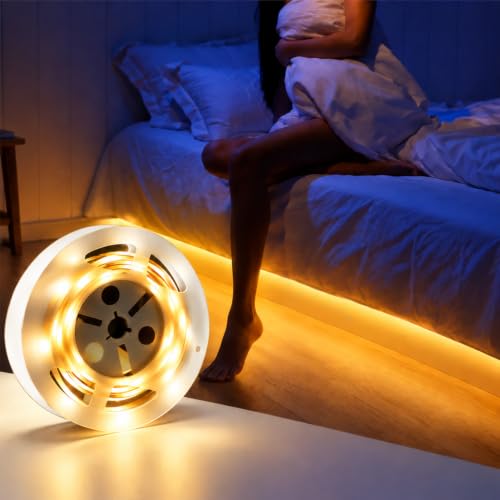


Under-bed lighting is an LED strip or bar that mounts beneath the bed frame and activates via motion sensor when it detects movement from the sleeping position. When a senior sits up or swings their legs toward the floor, the light activates — illuminating the floor area immediately beside and in front of the bed.
This is the only product type in this article that addresses the standing-up moment. When an older adult stands after lying still for several hours, blood pressure drops temporarily — a condition called orthostatic hypotension. Vision takes several seconds to adjust. Balance is at its most compromised. Under-bed lighting activates at that exact moment, showing the floor before the first step is taken and providing a visual anchor that helps with orientation.
Most people think of night-lights as hallway or bathroom products. Under-bed lighting is the piece most nighttime lighting setups overlook entirely. It's also the one most worth adding if only one product type from this roundup is new to you.
Where it is the wrong choice: beds with solid platform bases where no light can project to the floor. Very low-profile beds where the sensor can't detect the torso movement of sitting up. Adjustable beds with moving bases that could shift or pinch a mounted strip. In those cases, a plug-in night-light at baseboard height near the bed is a partial substitute — it doesn't activate at precisely the right moment, but it provides floor visibility before the senior reaches the hallway.
On color temperature: this is the most sleep-critical placement in the entire system. Under-bed lights activate when a senior is trying to return to sleep, not when they're starting a task. Warm amber output — as close to 2,700K or below as possible — is essential here. A bright or blue-white under-bed light defeats the purpose of every other warm-output choice in the setup.
For the full bedroom safety picture beyond lighting, Best Bed Rails for Seniors & Elderly covers the complementary safety measures at the bedside.
Ameistor Smart Plug-in Dual Motion Sensor COB LED Strip Light
The Ameistor uses dual motion sensors — one on each end of the strip — which improves detection reliability for larger beds and for seniors who may sit up anywhere along the length of the mattress, not just in the center. A single-sensor strip can miss movement at the far end of the bed.
The COB (chip-on-board) LED format produces more even illumination along the strip than individual LED points, reducing the risk of bright spots and dark gaps in the floor coverage.
The plug-in design means no battery monitoring. For a caregiver managing a parent's home remotely, that reliability advantage matters. Verify the outlet position allows cord routing under the bed without crossing the walking path.
LitThis Under Bed Light, Ready-To-Use, 360° Motion Activated
The LitThis is designed to be operational out of the box with minimal setup — a meaningful advantage for an older adult setting this up independently, or for a caregiver with limited time during a home visit. The 360-degree motion detection covers movement from any direction around the bed, which reduces the sensor positioning challenge that affects other under-bed units.
This type of unit suits a senior who moves slowly and may sit up at an angle that a directional sensor would miss. The broader detection field compensates for unpredictable sleep positions.
The limitation: 360-degree sensitivity can trigger on a partner's movement in a shared bed. If false activation is a concern, a unit with adjustable sensitivity is a better choice.
illumiForce Under Bed Lights Motion Sensor, 12V Power Adapter
The 12V power adapter design provides consistent, stable power without battery management — similar to the plug-in advantage described in Section A, but applied to the under-bed placement. For a senior who is unlikely to monitor a rechargeable battery, the corded format removes a maintenance variable.
The motion sensor activates on approach or movement from the sleeping position. Strip length and mounting options should be verified against the specific bed frame dimensions before ordering.
For households where cord routing under the bed is manageable — and where an outlet is accessible near the bed without creating a trip hazard — this is a reliable long-term option.
Vansky Motion Activated Bed Light, Flexible LED Strip
The Vansky flexible strip format allows it to conform to bed frames that aren't perfectly straight — which is common in older furniture. Flexibility in the strip itself means the light can be routed around obstructions inside the frame without gaps in coverage.
The motion sensor mounts separately from the strip, which allows positioning the sensor where it will best detect the senior's specific sleeping and sitting-up movements, rather than where the strip happens to end.
Warm white output and the flexible mounting make this a practical choice for a bed with a non-standard frame configuration. Verify the warm output Kelvin rating before purchasing.
Taormey Under Bed Lights Motion Sensor COB Strip, 2-Pack, 6.56ft
At 6.56 feet per strip, the Taormey covers queen and king beds fully along one side. The 2-pack means both sides of the bed can be covered — useful when a senior gets up on either side, or when the bed is accessible from both sides for caregiving purposes.
The COB format provides even floor illumination without bright-spot variation. Warm white output at this format keeps the light appropriate for nighttime use.
Two matched strips allow symmetric placement, which means the floor is visible regardless of which side the senior exits from on any given night.
Vansky Motion Activated Bed Light, Flexible LED Strip (B0DF5F3PNB)
This Vansky configuration offers the same flexible strip advantage as the B01FDEO5SK model, with differences in strip length or sensor configuration suited to different bed sizes and frame types. The flexible strip format remains the practical advantage for non-standard frames.
The separate motion sensor allows deliberate positioning to match the specific senior's sleep position and typical rising movement. Testing the sensor placement before finalizing the mount is worth the few minutes it takes.
The honest limitation of any flexible strip: the adhesive must bond to a clean, dry frame surface. Older bed frames with paint or finish variation may require additional mounting support.
MATICOD Motion Sensor LED Strip Lights, 3500K
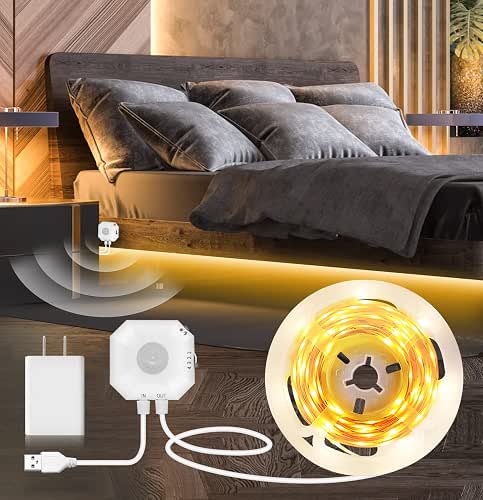
The 3500K color temperature on the MATICOD is at the upper edge of the warm-acceptable range — close enough to the 3,000K threshold that buyers should weigh this against other options with confirmed lower Kelvin output. For a senior who is particularly sensitive to light during nighttime waking, a unit with confirmed output below 2,700K is the more conservative choice.
The motion sensor strip format covers the standard under-bed placement. For households where other products in this section are unavailable or the MATICOD's specific features — strip length, mounting system — are a better fit for the frame, it remains a functional option.
Always verify the sensor is positioned to detect the specific senior's torso movement from their sleeping position. A brief test in darkness before permanent mounting confirms the setup works as intended.
Frequently Asked Questions
Should I put a night-light in every room, or just the hallway?
Cover the nighttime route, not the rooms generally. Map the path from the bed to the bathroom and identify every stretch where the floor is not visible. That usually means the bedroom exit, the hallway, and the bathroom entry. Living rooms and dining rooms not on that route are lower priority.
How do I know if the color temperature is okay on the light I already own?
If the light looks white or blue-white, it's probably above 3,000K and it's disrupting sleep chemistry. If it looks clearly yellow or orange — similar to a dim incandescent bulb — it's in the right range. When in doubt, check the product specifications for a Kelvin number. Anything labeled "daylight" or "cool white" is the wrong choice for nighttime use.
My parent's hallway doesn't have an outlet in the right place. What are my options?
Two practical options that don't require an electrician. First, a rechargeable stick-on light (Section B above) mounts anywhere and needs no outlet. Second, a low-profile outlet adapter can reposition an existing outlet's socket to a different angle — useful when an outlet is present but facing the wrong direction. Do not run extension cords across a walking path.
Will a night-light bother my parent's sleeping partner?
Motion-activated lights only illuminate when someone moves through the space. In the bedroom, an under-bed light activates only when the senior sits up or swings their legs out — it shouldn't wake a sleeping partner. Soft warm amber light causes less arousal than white or blue-white regardless. If sensitivity is high, choose a unit with an adjustable sensor and set the off-delay to the minimum needed.
Is the toilet bowl light sanitary?
The unit clips to the inside of the rim, not into the water. It isn't submerged. Cleaning the toilet normally doesn't require removing it, though following the manufacturer's instructions is worth a quick read. Look for a unit with a smooth, non-porous housing that wipes clean.
My parent has dementia. Does lighting actually help at night?
Yes, but the type matters more for dementia than for other users. Path lighting helps with navigation. The toilet bowl light helps with locating the fixture — which can become genuinely difficult. Blue-white light is more disruptive to sleep architecture in people with dementia, making warm amber output especially important. For a senior with dementia, also fix any color-cycling lights to a single warm tone. If nighttime wandering extends beyond the bathroom route, consult with their care team — lighting is one part of a broader nighttime safety strategy.
Hacks and Advice
Walk the route yourself, in the dark, exactly as your parent does. Not with the lights on so you can see what to fix. In the dark, starting from the bed, moving at a slow pace, not fully awake. Every point where you can't see the floor or can't locate the next destination is a gap the lighting system needs to fill. This is the most useful 30 seconds a caregiver can spend before purchasing anything.
Cover the nighttime route in order, not by room. The useful sequence is: bed (standing-up moment) → bedroom door threshold → hallway entry → hallway length → bathroom entry → toilet approach. Each segment has a specific need. Thinking by room leads to hallway coverage while leaving the standing-up moment and toilet destination unaddressed.
Check sensor direction before assuming a product will work. A plug-in motion sensor in an outlet on the wall perpendicular to the walking direction often won't detect someone approaching from the hallway. The sensor needs to face the incoming walker. Test it before committing to the placement.
Replace batteries on a schedule, not on failure. Rechargeable and battery-powered lights that go dark without warning are worse than no light at all — the senior may not realize the change until they're navigating in complete darkness. Set a monthly phone reminder or tie the check to another routine.
Avoid cycling color lights for anyone with dementia. Units that rotate through colors can disorient rather than guide. Choose a fixed warm amber or red output for any user with cognitive decline, and confirm the setting holds after a power interruption.
Check the off-delay on any motion light before assuming it's adequate. A 10-second off-delay is not enough for a slow-moving older adult. Thirty seconds is the minimum. Sixty seconds is better for anyone who moves carefully or uses a walker. This is the specification most buyers skip past and most frequently causes problems in real-world use.
If you're working through the broader home safety picture, Choosing the Right Night Lights for Seniors to Overcome Nighttime Safety Fears covers placement philosophy in more depth, and 10 Best Bathroom Safety Products for the Elderly addresses the destination room comprehensively.
Senior Night-Light Shopping Guide: Print & Carry
Download this printable shopping guide to choose the exact night-lights that fit your parent’s home layout and nighttime risks—no more guessing about brightness, color temperature, or sensor placement.
Conclusion
No single product solves the nighttime fall problem. The four types in this article address four distinct moments on the route: the standing-up moment, the hallway path, the bathroom path, and the toilet destination. A complete lighting system uses at least two of them. Most households need three.
The investment for a full system — under-bed strip, two or three plug-in or rechargeable path lights, and a toilet bowl light — is modest. The consequence of leaving any segment dark is not.
Tonight, after dark, walk your parent's nighttime route — or your own — from the bed to the bathroom, moving slowly, without turning on overhead lights. Note every step where the floor is not clearly visible and every moment where the destination is not obvious. That walk creates the shopping list.
If you want to extend this work beyond lighting to the complete bedroom and bathroom safety environment, the [Home Safety and Independent Living Assessment] walks through the full picture room by room.
For readers who want to continue with bedroom-specific safety measures — beyond lighting — Best Bed Rails for Seniors & Elderly: A Secure Sleep Solution covers the complementary side of nighttime fall prevention at the bedside.
Want more practical guidance on keeping your home safe as you age? Subscribe to the Graying With Grace newsletter for expert-tested tips and product recommendations delivered straight to your inbox.