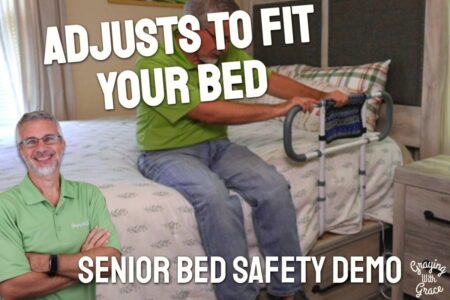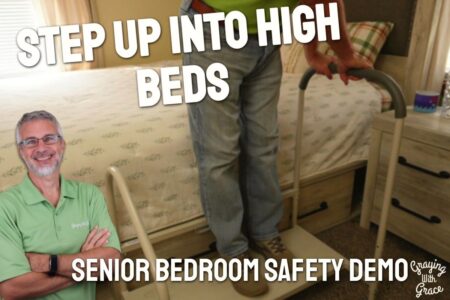
Most people who land on this page are looking for a product name and a price. I understand that — but before we get there, I need to share something that two decades of working with older adults has made very clear to me.
The injury pattern in this category is not from falling over a bed rail. It is from being trapped in the gap between a rail and a mattress.
The FDA has issued formal guidance on this risk, and it rises sharply when a mattress shifts, compresses under body weight, or is thicker or thinner than the rail was designed to accommodate. Adults who roll or reposition during sleep are most vulnerable.
Anyone with confusion, cognitive impairment, or dementia is at significantly higher risk — because a confused person who rolls against a rail will push harder, not call for help.
This guide will help you identify which product type fits your specific bed and your specific person before any product name matters.
Bed Rails and Transfer Aids: Shopping Checklist
Download this hands-on shopping checklist and measure your bed once—you’ll instantly know which transfer aid is safe for your mattress, your bed frame, and your specific situation, eliminating costly mistakes and dangerous guesses.
What to Look For
The Gap Measurement — the Single Most Important Number
The FDA and industry safety guidelines identify any gap of 4 inches or larger between a rail and an adjacent surface — mattress edge, headboard, footboard, or bed frame — as a potential entrapment zone.
That measurement must be taken with the mattress compressed under body weight, not at rest. Memory foam compresses significantly. A rail that fits safely on a firm 10-inch innerspring may gap dangerously on a 12-inch foam mattress after a person lies down on it. Check the gap at the mattress edge, at the headboard side, and at the footboard side.
The target is zero gap at the mattress edge. If a zero gap cannot be confirmed and maintained with your specific mattress and frame, the assist rail is not the right product type for that bed.
Mattress Thickness and Rail Compatibility
Most adjustable bed assist bars are rated for mattresses between 7 and 12 inches thick. Mattresses sold today frequently run 10 to 14 inches, and some foam and hybrid models reach 16 inches. Always confirm the rail’s stated mattress-thickness range before purchasing.
Mattress toppers add depth and compress differently than the mattress itself. A rail fitted before a topper was added may no longer fit safely after one is in place.
Weight Capacity — What It Tells You and What It Does Not
Most assist bars and bed canes are rated for 250–300 lbs of static downward force. That tells you whether the rail can support a transfer push. It says nothing about whether the rail will stay positioned against the mattress through the night.
A rail that flexes or migrates even half an inch during sleep creates a gap that did not exist during installation. Weight capacity and gap stability are two different things.
Frame Compatibility and Retention
Rails that clamp to the bed frame require a solid, horizontal surface to grip. Platform beds with a lip, adjustable bases, and slatted frames each create different attachment scenarios.
Check whether the rail includes a strap, bolt, or clamp mechanism — and whether that mechanism allows any lateral play after tightening. For floor-standing canes and poles, confirm whether the product depends on mattress weight for stability (canes) or ceiling tension (poles), and verify the ceiling height range. Most tension poles adjust from 7 to 10 feet; some models reach 12 feet.
Bed Assist Bars and Rails
Bed assist bars and rails attach to the bed frame or slide under the mattress to provide a firm lateral grip surface during push-up and pivot transfers — the most direct support for getting in and out of bed independently. The critical safety variable is the gap the rail creates between itself and the mattress edge, which must be confirmed at zero before any rail is relied upon.

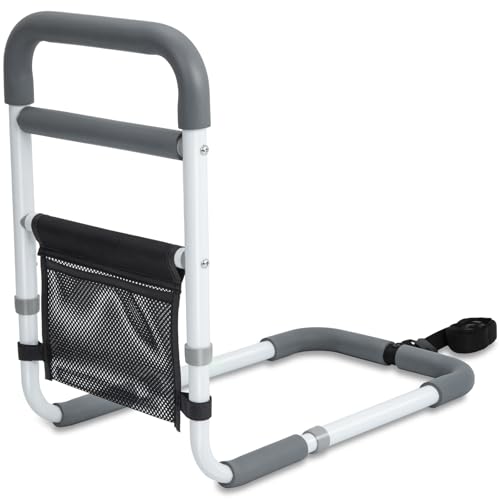


A bed assist bar or rail attaches to the bed frame or slides between the mattress and box spring, then extends upward along the side of the mattress. It provides a lateral grip surface for getting in and out of bed. Some models are fixed; others fold down when not in use. Some include a small pocket organizer on the rail face.
This type is a strong fit for adults who need firm lateral support during the push-up and pivot phase of a transfer, whose mattress thickness falls within the product’s stated range, and whose bed frame provides a stable attachment point. It also works well when the person is a predictable, limited mover during sleep — meaning the rail is likely to stay in the same position relative to the mattress through the night.
Where it is the wrong choice:
- Any bed where a zero gap between the rail and the mattress edge cannot be confirmed and maintained. This is non-negotiable.
- Anyone with cognitive impairment, dementia, or significant nighttime confusion. The entrapment risk rises sharply when a person cannot interpret the rail’s presence and self-rescue.
- Very thick foam or hybrid mattresses over 12 inches, where most standard rails cannot close the mattress-side gap.
- Adjustable bases, which flex and change geometry. A fixed rail fitted to one position will not remain fitted as the base angle changes.
The assist bar is the most intuitive product in this category — and the one most buyers arrive intending to purchase. Its advantage is direct lateral support at mattress level, exactly where the body is during a transfer. Its liability is the entrapment gap, which is present in every installation to some degree and which increases as the mattress ages and compresses unevenly.
A floor-to-ceiling pole eliminates the entrapment risk entirely by removing the product from contact with the mattress. A bed cane reduces it by placing the grab point above the mattress rather than alongside it. But neither of those alternatives provides the same lateral bracing a rail does.
KingPavonini Bed Rail for Elderly Adults Safety (Model BM03-1)
The KingPavonini BM03-1 is a slide-under assist rail rated for 380 lbs, with a strap anchor system to resist lateral migration during sleep. It is designed for mattresses in the standard 7–12 inch thickness range, and the stated mattress-thickness compatibility should be confirmed against your specific bed before ordering.
The higher weight rating here is meaningful — not because 380 lbs changes the entrapment calculus, but because a higher-rated rail typically uses a heavier gauge frame that is less likely to flex under transfer-level force. Flex is what creates post-installation gap growth. This is a detail worth factoring in if the person using the rail is a vigorous mover during transfers.
The honest limitation is the one that applies to every product in this section: the rail cannot close a gap it was not designed for. If the mattress runs thicker than 12 inches, or if the frame geometry does not allow a firm anchor, this rail will not solve the fit problem.
YrHeiper Bed Rail for Elderly Adults Safety (350 LB Heavy Duty Grab Bar)
The YrHeiper heavy-duty grab bar variant is a bedside assist rail rated to 350 lbs, positioned in the category alongside its legged sibling (reviewed below in the bed cane section). This model focuses on the lateral grab function — it provides a gripping surface along the mattress edge for push-up and pivot transfers.
What distinguishes it within this type is the heavy-duty framing, which reduces the flex under transfer force that can silently widen a gap after installation. The attachment mechanism should be verified against your specific frame type before purchase, particularly if the bed has a platform base or slatted support.
The limitation to name honestly: like all slide-under or clamp-style rails, this product’s safety depends entirely on the gap it creates with your mattress under body weight. Measure before you rely on it.
BigDolphin Bed Rail for Elderly Adults Safety (Model BS05, 350 LB)
The BigDolphin BS05 is a 350-lb-rated bed assist rail designed for standard mattress depths. It offers a grab surface along the mattress edge and is built for users who need lateral support during morning transfers rather than continuous nighttime bracing.
The BS05’s design is straightforward: a gripping bar, a frame, and an attachment mechanism that must be verified against the bed’s structure. If the bed frame does not offer a firm horizontal surface for the clamp or strap, the rail’s lateral stability during use will be reduced.
This is a product for alert, oriented users with predictable sleep movement and a mattress that falls cleanly within the stated thickness range. If either condition is uncertain, a bed cane or pole warrants a closer look before this one.
YrHeiper Bed Rail for Elderly Adults Safety with Bedside Support Legs
This YrHeiper model adds bedside support legs to the standard rail frame — a meaningful design difference. The legs contact the floor directly, distributing transfer-force load between the bed frame and the floor rather than relying solely on the mattress-side attachment.
That load-sharing reduces the risk of rail migration during a firm transfer push, which is one of the quieter failure modes in this category. It also makes the product a closer conceptual relative of the bed cane reviewed below, though the lateral grab surface along the mattress edge still creates the entrapment-gap consideration that the cane avoids.
The honest trade-off: the support legs introduce a floor-contact footprint that may not suit all bedroom layouts. Confirm that the legs will reach the floor cleanly given your mattress height and bed-frame geometry before purchasing.
PELEGON Adjustable Bed Rail (ASTM Compliant, Non-Slip Grab Bar)
The PELEGON rail carries ASTM compliance — a meaningful marker in this category, because ASTM standards for bed rails address gap dimensions and structural performance, not just weight ratings. An ASTM-compliant product has been evaluated against a defined gap-safety threshold, which is a higher bar than a weight capacity number alone.
That compliance does not eliminate the need for a site-specific gap measurement. ASTM compliance means the product was designed to meet gap thresholds under standard test conditions. Your mattress, under your body weight, on your frame, may produce different results.
The adjustable design is useful for households where mattress height or thickness may change — a new topper, a different mattress, or a transition to an adjustable base all affect fit. Recheck the gap after any change.
Lunderg Bed Assist Rail with Motion Light and Non-Slip Grab Bar
The Lunderg rail adds a motion-activated light to the standard assist bar design — a practical feature for nighttime transfers that often gets overlooked in this category. The light activates when the person reaches for the rail in the dark, which addresses a separate but related fall risk: the moment between waking and fully orienting before standing.
The rail itself follows the standard slide-under design, and the usual gap-measurement and mattress-thickness checks apply. What makes this product worth noting is that it addresses two problems at once — the transfer support need and the lighting gap — without requiring a separate night light installation beside the bed.
For readers who want to go further on bedroom lighting, choosing the right night lights for seniors covers placement and motion-activation strategies beyond what a single rail light provides. The honest limitation: the motion light is a supplementary feature, not a substitute for confirming that the rail fits safely on the specific bed it will be installed on.
Bed Canes with Base Plates
Bed canes use a wide base plate held in place by mattress weight to anchor a height-adjustable vertical handle above the mattress surface, giving a stable push-up point without creating a mattress-side entrapment gap. They suit alert, predictable users who need a transfer grab point but whose bed frame or mattress geometry makes a rail attachment unsafe or impractical.


A bed cane is a freestanding vertical grab bar with a wide, flat base plate that slides under the mattress. The mattress weight holds the base in place; the handle extends above the mattress surface at a height that supports a push-up transfer. Most models are height-adjustable. Unlike a rail, the handle does not run along the mattress edge — it rises above it. That changes the entrapment profile entirely.
This type suits adults who need a solid grab point to push up from and pivot out of bed, but whose bed frame or mattress geometry makes a rail attachment impractical. Because the cane does not create a mattress-side gap the way a rail does, it is a lower-entrapment alternative for people who do not have cognitive impairment and who will predictably use the handle during transfers rather than roll against it.
Where it is the wrong choice:
- Lightweight mattresses, air mattresses, or latex mattresses under approximately 60–70 lbs. The base plate depends on mattress weight to resist lateral force. If the mattress can shift, the cane can shift.
- Adjustable bases where the base plate cannot slide fully under the mattress to a stable anchor point.
- Situations where the person needs lateral bracing along the mattress surface, not just a vertical grab point. The cane handles a push-up and a pivot — not a full-side brace.
- Platform bed frames with high side rails that prevent the base plate from sliding under far enough to anchor properly.
The bed cane occupies useful middle ground between the assist rail and the floor-standing pole. It requires no installation, adjusts to different mattress heights, and does not create a mattress-side entrapment gap. Its dependency on mattress weight for stability is the limit that a pole eliminates. Against the assist rail, the cane trades lateral bracing for a lower entrapment profile.
If the person needs support beyond the bed — getting up from a recliner or toilet — our guide on choosing the right mobility aids covers the full picture of what is available and when each type applies.
HeywoodCabin Adjustable Stand Assist for Elderly
The HeywoodCabin stand assist is a base-plate cane designed to slide under the mattress and provide a height-adjustable handle for push-up transfers. The adjustable handle height is the key specification to check against the specific bed: confirm the handle’s range covers the distance from the floor to a useful grab height for this person, given the mattress’s finished height off the floor.
This product suits a person who transfers predictably — same side, same time, same motion — and who is alert and oriented during the transfer. The base plate holds under standard mattress weight, but the device should not be relied upon with a lightweight or adjustable-base mattress without verifying stability first.
The honest limitation is shared by every product in this section: the cane is only as stable as the mattress weight holding its base. Confirm that the base plate slides fully under the mattress and cannot migrate laterally before trusting it for an unassisted transfer.
HygiVital Adjustable Stand Assist Aid (Quad Walking Cane for Seniors)
The HygiVital stand assist takes a quad-base approach rather than a flat plate — four contact points rather than one wide plate. This changes the weight distribution under the mattress and may reduce migration on mattresses with uneven compression zones.
The quad-base geometry is worth noting for anyone whose mattress has a pillow-top or zone-differentiated construction. A flat plate seats differently than four points on such surfaces. The height adjustability should be confirmed against the specific bed’s floor-to-mattress-top measurement before ordering.
This is still a mattress-weight-dependent product. The base does not anchor to the frame independently. If the mattress shifts — during a firm transfer push or a restless night — the device shifts with it.
Hopelight Portable Stand Assist Aid (Height Adjustable, Recliner and Toilet Compatible)
The Hopelight portable stand assist is notable for its multi-surface compatibility: it is designed to work beside a bed, a recliner, and a toilet, not solely at bedside. For a person who needs consistent transfer support across multiple locations in the home, a single portable device is meaningfully simpler than installing separate grab bars at each location.
The portability trade-off is stability. A device moved between locations is also a device that may not be perfectly positioned or fully seated at any given location. The person using it needs to confirm the base is correctly placed before each use — which requires the cognitive and physical ability to do that check reliably.
For readers also working on bathroom safety, bathroom safety products ranked by an industry expert covers grab bars and shower support options in the detail this article cannot.
YrHeiper Bed Rail with Bedside Support Legs (Cane Section)
This YrHeiper model appears in both the rail section and here because its support-leg design places it conceptually between a rail and a cane. The floor-contact legs distribute transfer force between the mattress attachment and the floor, which is the defining characteristic of a stand assist rather than a pure rail.
In a cane-section context, the relevant question is whether the lateral grab surface along the mattress edge is needed or whether a single vertical handle would serve the transfer equally well. If lateral bracing is not needed, a simpler base-plate cane may reduce the installation footprint without reducing function.
The floor-contact legs do meaningfully reduce the migration risk that affects pure base-plate designs. For users on higher mattresses or firmer frames, that stability improvement may be the deciding factor.
AERRTIS Mobility Stand Assist Aid for Elderly (Portable Self Lift)
The AERRTIS stand assist is a portable design built around a flat base plate with a single vertical handle. The emphasis in this product’s design is portability — it is intended to move with the user across locations, not to be permanently installed at bedside.
The same portable-vs-stability trade-off applies here as with the Hopelight above. A device that moves is a device that must be re-seated each time. For a person who is alert and has the physical capacity to confirm placement, that is a manageable step. For a person whose transfer safety depends on not having to think through setup, a fixed installation is a more reliable solution.
The handle height range should be verified against this person’s specific bed before purchase.
TerseFit Stand Assist Aid for Elderly (Getting Up from Lower Seats)
The TerseFit stand assist is positioned for lower-seat applications — recliners, low beds, and chairs — where the transfer requires pushing up from a greater depth. The handle geometry on lower-seat-oriented products is typically angled or positioned to give leverage at a lower starting point than a standard bedside cane.
For someone whose primary transfer challenge is a bed that sits lower than comfortable — where a bed-height adjustment has already been considered and ruled out — a product designed for lower-seat leverage addresses the actual mechanics of the problem better than a standard height-adjustable handle.
Before purchasing any stand assist for a low-bed situation, also confirm whether raising the bed height is possible. Making getting in and out of bed easier covers bed risers and height-adjustment options that may reduce the force the assist device needs to handle — making the transfer safer regardless of which product is chosen.
Floor-to-Ceiling Transfer Poles
Floor-to-ceiling transfer poles are tensioned between the floor and ceiling beside the bed, requiring no attachment to the frame and making no contact with the mattress — eliminating the entrapment gap entirely. They are the recommended choice when cognitive impairment is present, when mattress geometry prevents a safe rail fit, or when a stable grab point is needed at full standing height throughout the transfer.


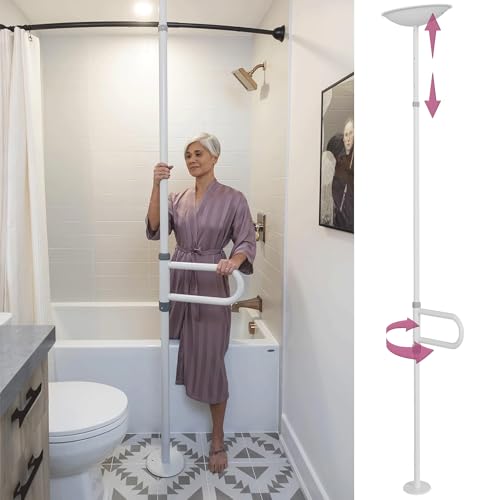

A floor-to-ceiling transfer pole is a vertical bar tensioned between the floor and ceiling, positioned beside the bed. It requires no attachment to the bed frame and makes no contact with the mattress, eliminating the entrapment gap entirely. The user grabs the pole to push up, stabilize, and pivot during a transfer. Some models include a horizontal bar or pivoting arm for a two-point grip. Installation involves measuring ceiling height, positioning the base plate, and tensioning the pole until it holds firmly against both surfaces.
This type suits adults whose bed frame cannot accept a rail attachment, whose mattress geometry makes a cane base plate impractical, or where entrapment risk is high enough that removing the rail-mattress interface entirely is the right call. It is also appropriate when the person transfers from multiple positions or needs a grab point for standing balance beyond the immediate transfer — the pole is available at standing height throughout the movement.
This is the option to recommend when cognitive impairment is present and a mattress-side gap is not acceptable.
Where it is the wrong choice:
- Ceilings that are structurally unsound, have thick acoustic tile, drop-ceiling panels, or are otherwise unable to bear sustained tension load. The pole must be tensioned against a solid surface — drywall over joists, not suspended ceiling panels.
- Homes with ceilings above or below the product’s adjustment range. Confirm the pole’s stated range. Most models cover 7 to 10 feet; some extend to 12 feet.
- Users who need the pole to substitute for lateral bracing at the mattress level. The pole is a vertical grab point, not a side support.
- Renters or situations where a floor-pressure base plate is not acceptable, though most poles leave no permanent mark.
The floor-to-ceiling pole is the most installation-intensive option in this category, but it is also the safest from an entrapment standpoint. Its limitation is ceiling dependency: if the ceiling cannot hold the tension safely, the product cannot be used safely. Against the assist rail, it trades lateral bracing for zero entrapment exposure. Against the bed cane, it trades portability for a more stable, mattress-independent anchor.
For families working through a broader safety assessment after a fall has already occurred, the first steps after a senior falls covers the full fall-prevention checklist, room by room.
Stander Single Handle Non-Rotating Floor to Ceiling Grab Bar
The Stander single-handle model is the entry-level product in the Stander pole line — a fixed vertical bar with a single horizontal grab handle, tensioned between floor and ceiling with no rotation. The non-rotating design means the handle stays at a fixed orientation, which is an advantage for users who benefit from consistent, predictable placement and a disadvantage for users who transfer from varying angles.
This product is well-suited to a person who transfers in a single consistent direction and who needs a solid vertical anchor at standing height. The ceiling height range should be confirmed before purchase — verify the specific model’s stated range against the actual ceiling, measured with a tape measure, not estimated.
The installation step that matters most is ceiling verification. Drywall over joists is suitable; suspended drop-ceiling panels are not. If the ceiling structure is uncertain, a handyman or occupational therapist can assess it before the pole is installed.
Stander Wonder Pole with Security Pole and Curve Grab Bar
The Stander Wonder Pole adds a curved horizontal grab bar to the vertical pole — a two-point grip system that gives the user a choice between the vertical bar for standing transfer and the horizontal curve for pivoting or steadying. That two-point geometry addresses a wider range of transfer movements than a single vertical handle.
The curve grab bar’s position relative to the mattress height should be confirmed before installation. The horizontal bar needs to sit at a height that is useful for the push-up phase, not just the standing phase. This is a check that requires knowing the mattress’s finished height off the floor before the pole is ordered.
For users who are also managing balance challenges beyond bedside transfers, walking canes and stability aids covers the broader picture of what different mobility aids provide once the person is on their feet.
Stander Wonder Pole Plus with Rotating Double Grab Bar
The Wonder Pole Plus adds rotation and a double grab bar to the Wonder Pole design. The rotating mechanism allows the horizontal bars to be repositioned for transfers from different angles — a meaningful upgrade for users who may exit the bed from varying positions or who need the bar at different orientations for the push-up versus the standing phase.
The rotating joint introduces a mechanical component that should be checked periodically. Rotation mechanisms can develop play over time under repeated transfer force. Confirm the rotation locks firmly in the position used for transfers — a bar that shifts mid-transfer is a stability hazard.
The double-bar design gives two grip points at horizontal height, which supports a more symmetric push-up. This is useful for users with uneven grip strength between hands.
HEALTHCRAFT SuperTrapeze 8-FT Floor-to-Ceiling Bed Transfer Pole (300 Lbs)
The HEALTHCRAFT SuperTrapeze is rated to 8 feet in height and 300 lbs, with a design that incorporates a trapezoidal overhead handle in addition to the vertical pole — a distinctive addition that allows a pull-up assist rather than only a push-up grab. For users with sufficient upper-body strength, a trapeze handle changes the mechanics of the transfer from a push (which requires stable arm extension) to a pull (which engages the arm and shoulder differently).
The 8-foot height range covers standard residential ceilings; confirm the specific ceiling height before ordering. The 300-lb weight rating applies to the static transfer load, not to dynamic or impact forces — the product should not be used for swinging or sustained load.
The ceiling-verification point is the same for this product as for every pole in this section: the tension anchor must bear against a structurally sound surface. A SuperTrapeze incorrectly tensioned against a weak ceiling is a fall risk, not a fall solution.
HEALTHCRAFT uPole with Pivot Bar (7–10 ft Transfer Pole, No-Drill)
The HEALTHCRAFT uPole is a no-drill tension pole with an integrated pivot bar — a horizontal arm that rotates around the vertical pole rather than being fixed at one orientation. The pivot function allows the horizontal grab bar to be repositioned without loosening the tension, which is useful in households where the user’s transfer approach varies or where the pole serves multiple people.
The 7–10 foot adjustment range covers most standard residential ceilings. Ceilings above 10 feet require a different product; confirm before ordering. The no-drill design leaves no permanent marks, which matters in rentals or situations where the installation footprint is a concern.
The pivot mechanism should be confirmed to lock firmly in the transfer position. A bar that pivots freely is useful for repositioning; a bar that pivots under load is a hazard. Check that the locking mechanism engages positively before the first transfer.
Stander Wonder Pole HD Heavy Duty Security Pole and Curve Grab Bar
The Wonder Pole HD is the heavy-duty variant in the Stander line — a heavier-gauge construction designed for users who require a higher-load pole or who want additional structural confidence in the tension assembly. The curve grab bar is included, providing the two-point vertical-plus-horizontal grip geometry of the standard Wonder Pole in a more robust frame.
The heavier construction adds weight to the installation process. For a household where the pole will be set up and taken down frequently, the added mass is a consideration. For a household where the pole will be permanently positioned at bedside, the additional structural margin is an advantage.
The ceiling verification step applies here as it does to every product in this section. A heavy-duty pole incorrectly tensioned against an unsuitable ceiling is not safer than a standard pole in the same situation — the ceiling surface, not the pole’s gauge, is the limiting factor for safe installation.
Frequently Asked Questions
What gap size is considered dangerous between a bed rail and a mattress?
The FDA and safety guidelines identify gaps of 4 inches or larger as potential entrapment zones. That measurement should be taken with the mattress compressed under body weight — not at rest — and checked at the mattress edge, at the headboard, and at the footboard. A gap that cannot be fully closed with the specific mattress and frame in the home means an assist rail is the wrong product type for that bed.
Is a bed rail safe for someone with dementia or nighttime confusion?
Not without a thorough entrapment assessment by someone familiar with that individual’s movement patterns — and in many cases, not at all. A person who rolls or pushes against a rail during confusion cannot self-rescue the way an alert person can. The FDA has specifically flagged cognitive impairment as a risk factor for serious entrapment injury. A floor-to-ceiling pole or an environmental modification — lowering the bed, adding a non-slip floor mat beside it — is often the safer path.
My parent has a thick memory foam mattress. Will a standard bed rail fit?
Likely not safely. Most standard assist bars and rails are designed for mattresses between 7 and 12 inches thick. Memory foam and hybrid mattresses commonly run 10 to 14 inches at rest and compress under body weight in ways that a resting measurement does not capture. Confirm the rail’s stated mattress-thickness range, then measure the mattress compressed under body weight and check the gap. If it cannot close to zero, consider a bed cane or a floor-to-ceiling pole. For more on how mattress choice affects sleep comfort and safety, adjustable beds and arthritic hip pain is worth reading if an adjustable base is being considered alongside the assist device.
Can a transfer pole damage my ceiling?
A correctly tensioned pole against a structurally sound ceiling leaves no permanent mark in most cases, because the load is pressure rather than penetration. The risk is not to the ceiling surface — it is to the user if the ceiling cannot hold the tension load. Suspended drop-ceiling panels, thick acoustic tile, and unsupported drywall between joists are not suitable surfaces. If there is any doubt about the ceiling’s structure, a handyman or occupational therapist can assess it before installation.
My parent only needs help getting out of bed in the morning. Is a full bed rail necessary?
Not necessarily. If the transfer is predictable — same direction, same time, person is alert and oriented — a bed cane with base plate may be sufficient and creates a lower entrapment risk than a rail extending along the mattress edge through the night. The cane gives a push-up and pivot point without placing a barrier beside the mattress while the person sleeps. The honest question is whether the person uses the device only during transfers or might roll against it during sleep.
How do I know if a bed cane’s base plate will hold?
The base plate is held in place by mattress weight. Most manufacturers do not state a minimum mattress weight, which is a gap worth knowing. As a general principle: a standard innerspring or foam mattress of typical depth (8 to 12 inches) in a full or queen size will hold a base plate against transfer-level lateral force. A twin mattress, a lightweight latex mattress, an air mattress, or any mattress on an adjustable base that raises at one end is a situation where base-plate stability should be verified before relying on the cane for an unassisted transfer.
Hacks and Practical Advice
Measure before you order, not after. Stand at the bedside with a tape measure. Measure mattress thickness with someone lying on it, not with the bed empty. Measure the distance from the floor to the top of the mattress — this determines whether a bed cane’s handle will reach a useful grab height. Measure ceiling height before considering a pole. These three measurements cost nothing and prevent a return.
A mattress topper changes the fit. If a topper has been added since a rail was installed — or if a new topper is being considered — the gap and mattress-depth measurements must be retaken. A 3-inch topper on a 10-inch mattress creates a 13-inch surface that compresses and shifts differently than the original mattress alone.
Check for play after every bed change. When sheets are changed, pull the rail or cane handle with light lateral force. Any movement means the attachment has loosened. Rails that slide under the mattress can migrate as the person shifts during sleep; re-seat them before every night.
Lower the bed first. Before purchasing any assist device, check whether adjusting the bed height solves part of the problem. Many platform beds and adjustable frames allow height modification. A bed at the correct height — so feet reach the floor flat during a transfer — reduces the force a rail or cane must handle and makes the transfer safer regardless of which product is chosen.
The floor mat is not optional. Any bed with a rail, cane, or pole still needs a non-slip mat on the floor at the transfer point. The device handles the push-up; the mat handles the landing. They are not substitutes for each other. Our guide on non-slip bath mats covers grip and suction features to look for — many of those same criteria apply to a bedside mat.
Bed Rails and Transfer Aids: Shopping Checklist
Download this hands-on shopping checklist and measure your bed once—you’ll instantly know which transfer aid is safe for your mattress, your bed frame, and your specific situation, eliminating costly mistakes and dangerous guesses.
The Decision Is About Fit, Not Price
Here is what I want you to take away from everything above: the decision is not about weight capacity or price. It is about fit, gap, and whether the product type matches the bed, the body, and the cognitive picture in the home.
Before purchasing anything, stand at the bedside and take three measurements: mattress thickness with someone lying on it, floor-to-mattress-top distance, and — if a pole is being considered — ceiling height. Then confirm whether the gap between a proposed rail and the mattress edge can be closed to zero with the specific mattress and frame in the home. If it cannot, a rail is not the right product type.
If you are working through this alongside other home-safety questions — bathroom, hallways, lighting, kitchen — my Home Safety and Independent Living Assessment is built to evaluate exactly this kind of fit-and-risk question room by room, before anything is purchased or installed.
You now understand this category better than most people who sell it. The right product is within reach.
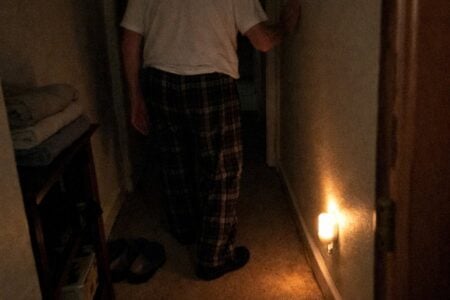
For families who want to continue improving bedroom safety beyond the transfer device, preventing senior nighttime falls covers the full checklist of changes that make the greatest difference.


![Keep older woman walking lit bedroom pathway night lights[1]](https://www.grayingwithgrace.com/wp-content/uploads/2026/05/KEEP-older_woman_walking_lit_bedroom_pathway_night_lights1-e1779139524852-450x300.jpg)