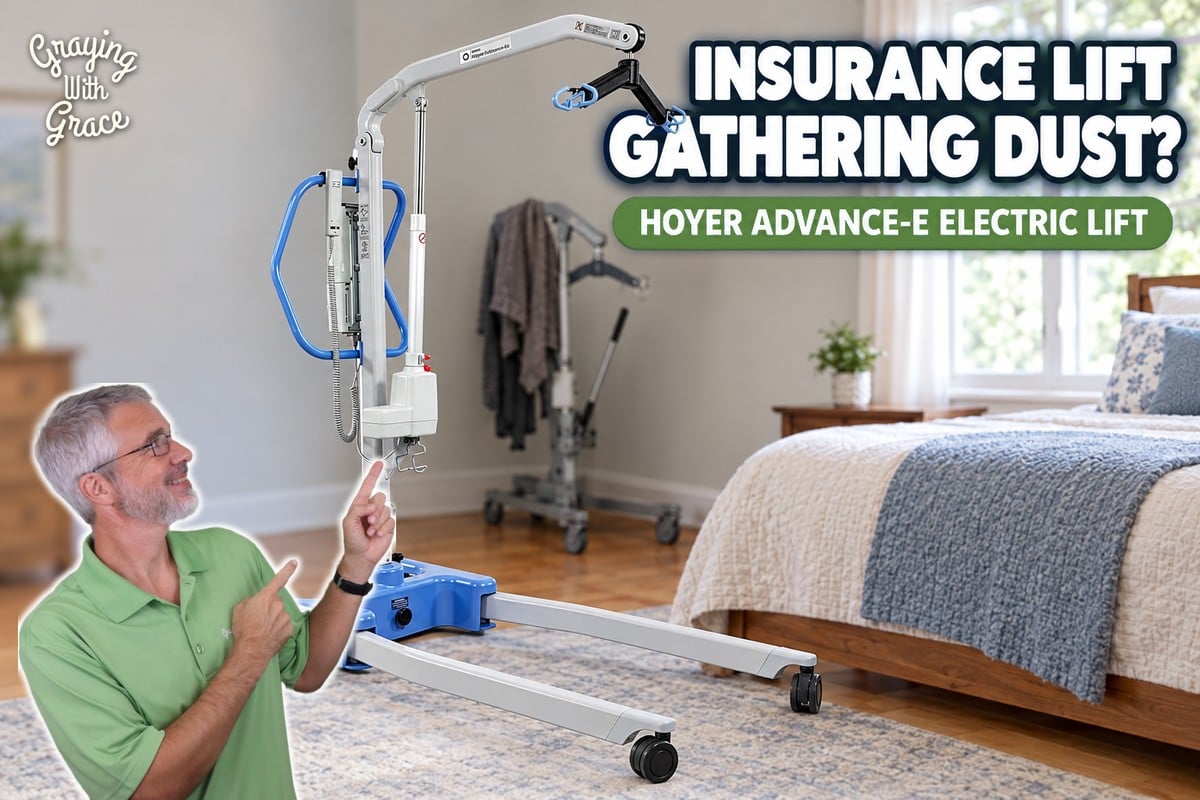
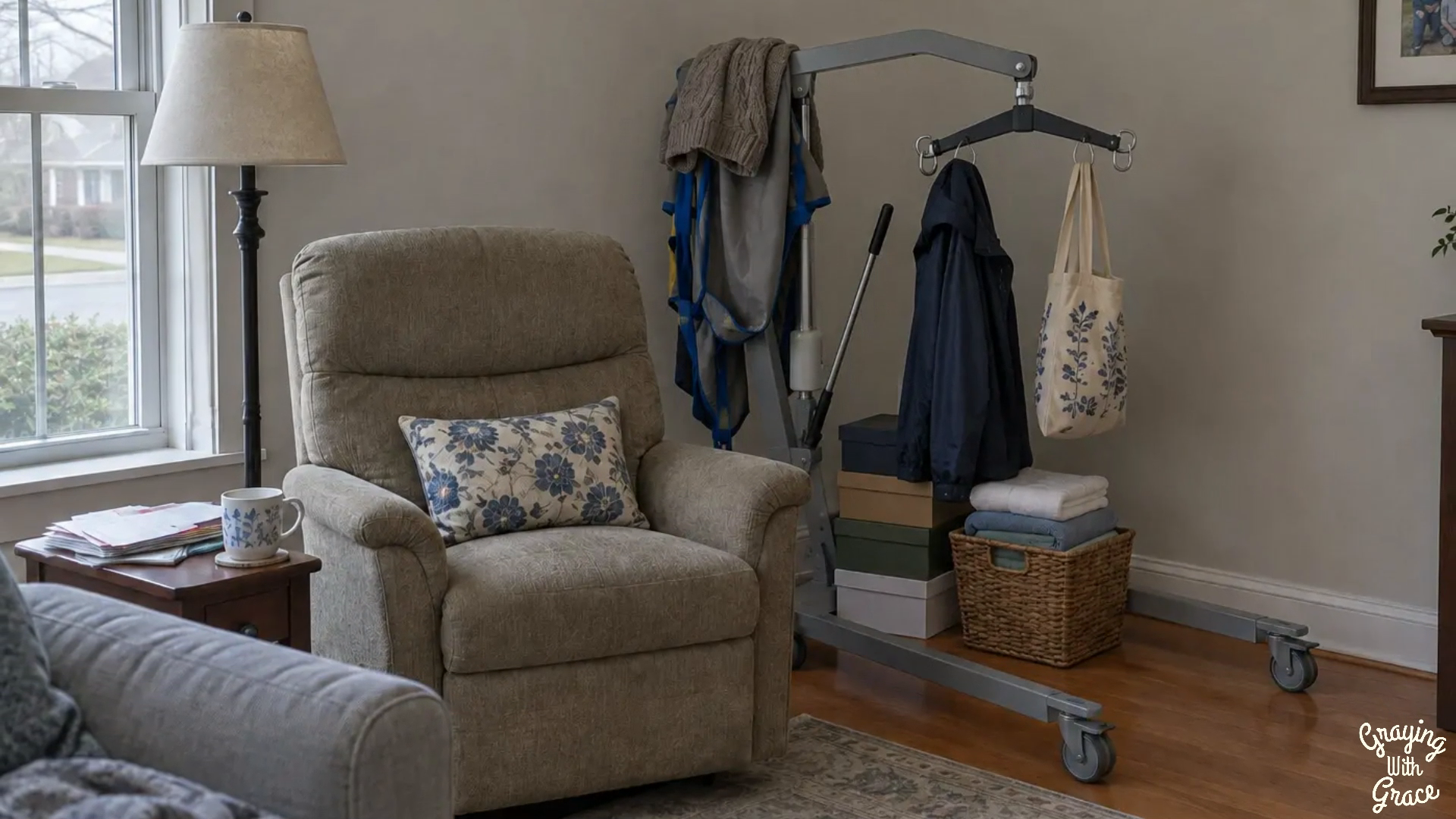
Is there a patient lift sitting in the corner of your mom’s bedroom because every transfer with it turns into a wrestling match? You are far from alone.
Insurance usually pays for the least costly lift that gets the job done, and that is most often a manual lift you raise and lower with a hand pump. In this article I’ll walk you through a different kind of lift, the Hoyer Advance-E 340, a folding electric patient lift.
I’m Scott Grant, a Certified Senior Advisor (CSA) and Senior Home Safety Specialist (SHSS). I haven’t used this particular unit in my own home, but I sold lifts like it for years, set them up in people’s homes and taught families how to use them safely.
This video is sponsored by My Hoyer Lift.
Below you’ll find what each feature does, how it works and why it matters on a real day of caregiving. You’ll also find the things to measure and check before you order one.


Quick Takeaways
- What it fixes: the hand pump and the arm work of a manual lift, with a motor and a push pad
- Who it suits: someone who can’t bear weight, cared for at home, often by one caregiver
- Worth a look if: your insurance lift has become the thing everyone avoids
- The feature I’d point out first: the rear push pad, which uses your body weight instead of your arms
- Plan for: a sling bought separately and sized to your person
Who This Lift Is For
I’d point you to it if you’re caring for someone at home who can’t bear weight, especially if you’re doing it alone. It also fits homes with tight spaces and families with appointments to get to.
The Hoyer Advance-E 340 uses a motor to do the lifting, so you press a button instead of pumping a handle. That matters most to a caregiver doing transfers two or three times a day.
If your person can stand with help, a sit-to-stand lift may suit them better. You might also start with how to help a parent stand up without hurting your back, since that kind of help needs far less equipment.
Manual Lift vs. Electric Lift
A manual lift works, and it costs less. The catch is that every lift means pumping a handle over and over, and that wears on a caregiver’s shoulders and forearms over months.
An electric lift moves that work to a motor. It doesn’t change the rest of the job, though, so the habits below still matter just as much.
The Features, One at a Time
The push pad and the low base
Hoyer put a push pad on the back of the base. You start the lift rolling by leaning your body weight into it instead of pulling with your arms.
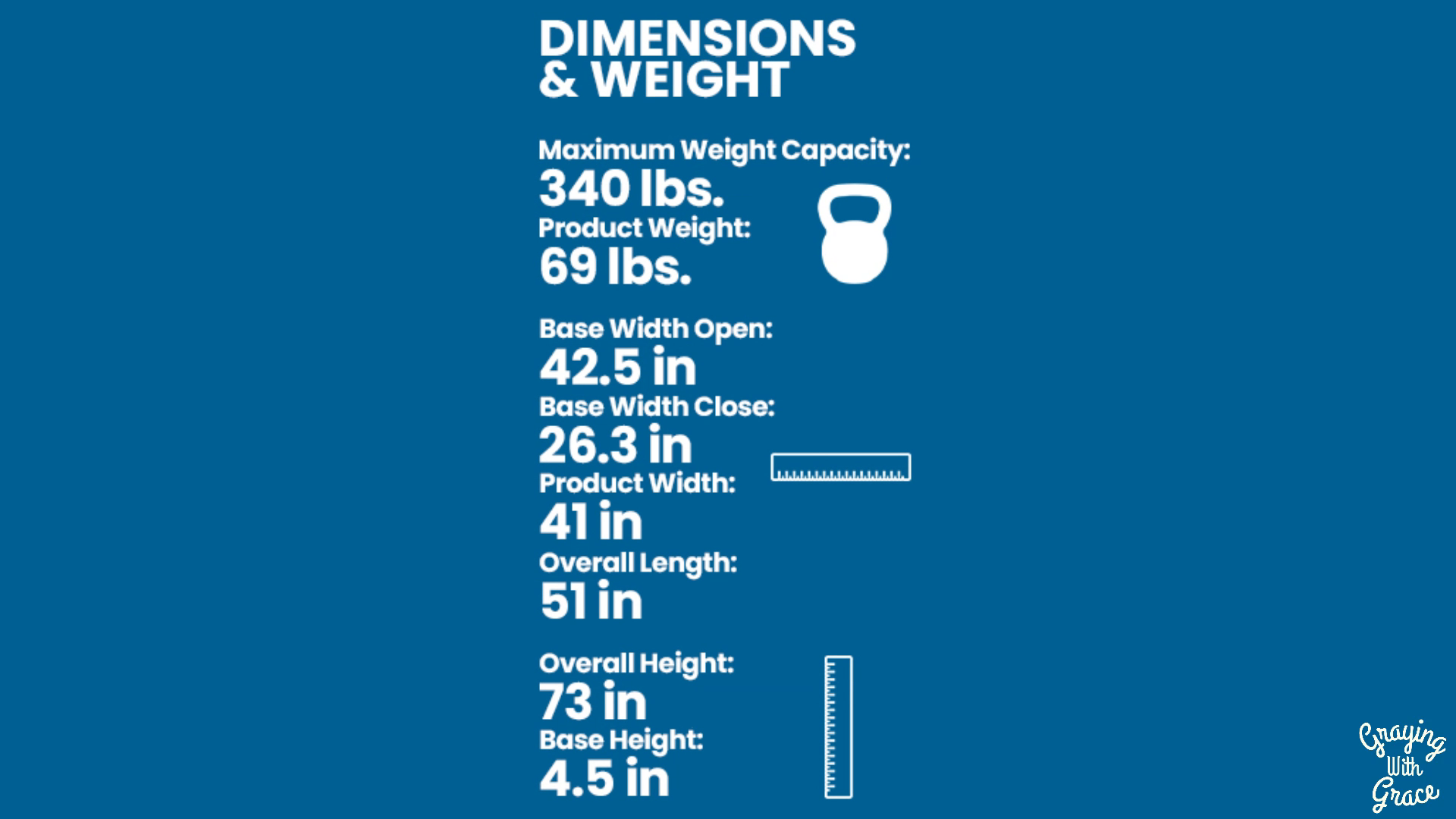
The base sits about four and a half inches off the floor, low enough to slide under most beds and recliners. Check under your own bed first, because some frames sit lower.
The foot pedals and the legs
Two foot pedals open and close the swan-neck legs. Open, the legs go around a wheelchair or recliner, and closed, they fit through a standard doorway.
With the legs closed, the base is 26.3 inches wide, so measure your narrowest doorway before you order. Check the bathroom first, since it’s usually the tightest in the house.
The remote
The hand control has one button that raises the arm and one that lowers it. That simplicity helps if your hands aren’t as strong as they used to be.
The sling bar and the discs
The sling hangs from the bar by its loops, and discs on the bar keep the loops from slipping off. Even so, check every loop before every lift.
Then lift the person about an inch, stop, and look again to make sure everything is secure. I taught that habit to every family I trained, and it catches problems while the person is still an inch off the bed.
Floor to bed height
This lift can raise someone from the floor all the way to bed height, with a lifting range of roughly 15.3 to 66.5 inches. That matters if your person falls and can’t get up.
If someone has fallen and might be hurt, don’t move them right away. Call for help first, and for more ways to handle a fall, see 12 helpful devices to lift the elderly off the floor after a fall.
The battery
The battery lifts out, so you can charge it in another room or plug it in right on the base. The lift also has an emergency stop and backup controls.
Keep the battery charged between uses. A battery that dies in the middle of a transfer makes for a bad afternoon for everybody.
Folding and storing it
It folds without tools, stands up on its own in a closet and rolls while folded. That’s a small thing until you’ve tried to park a bulky lift in a hallway.
The whole lift weighs about seventy pounds. That’s light for a powered lift, but not light enough that you’ll want to heave it into the trunk of your car.
Car Transfers
The Advance-E is built to help with car transfers, which most lifts can’t do. Before you count on that, check three things: flat ground where you park, a car door that opens all the way and room for the lift’s arm to clear the doorframe.
Practice the whole thing the day before an appointment, not the morning of. Equipment you’ve never used under pressure has a way of fighting you at the worst moment.
The Sling Is Sold Separately
No sling comes with the lift, and that’s on purpose. Each sling is matched to the person’s size and needs, and the right one matters as much as the lift.
My Hoyer Lift keeps a Hoyer sling compatibility chart that shows which slings fit which lifts. Use it alongside your therapist’s or home health nurse’s advice on size and type.
Will You Be Able to Use It?
The motor does the lifting and the push pad helps with the rolling, so the lift itself takes little strength. What the motor can’t do is get the sling under your mom.
You’ll still roll her onto her side to place it, the way your home health company probably showed you. That’s the part worth practicing, and if you can’t roll her safely on your own, plan on a second set of hands at first.
Talk with your doctor, nurse or occupational therapist before you choose transfer equipment. They know your person’s weight-bearing status and can tell you which lift and sling type fit.
Sizes to Check Against Your Home
- Weight limit: 340 pounds
- Lifting range: about 15.3 to 66.5 inches, floor to bed height
- Base height: 4.5 inches off the floor
- Base width: 26.3 inches with the legs closed, 42.5 inches open
- Overall size: 41 inches wide, 51 inches long, 73 inches tall
- Weight of the lift: 69 pounds
Measure your narrowest doorway and the space under the bed before you order. Ten minutes with a tape measure beats a return.
Understanding the Cost
An electric lift costs well more than the manual lift insurance usually provides. Whether it’s worth it comes down to how many transfers you do a day and how hard the current lift is on you.
Budget for the sling as part of the total, since it’s a separate purchase. Check the current price at My Hoyer Lift before you plan.
Where to Get It and Who to Call
My Hoyer Lift is an independent, authorized Joerns Hoyer dealer, and it sells the lift, slings and replacement parts such as batteries and casters. Ask them about sling sizing, warranty and returns before you order.
My Recommendation
If a manual lift has turned into a daily fight in your home, the Hoyer Advance-E 340 is worth a serious look. It fits best when your person can’t bear weight, the house is tight and there are appointments to get to.
If your person can stand with help, look at a sit-to-stand lift first. Your call, and your therapist can help you make it.
If you have a question about fit, slings or whether this is the right step up from what you have, leave it in the comments. I read them all.