
Reaching across a hot burner to adjust a rear control is where burns and lost balance happen. The problem is the reach, not you.
A portable induction cooktop puts the controls up front, costs under $200 and needs no installer. The one catch is that it needs magnetic cookware, so this guide starts with a check you can do today.
If you’re in a hurry, my top picks are right here, and the details on each one are further down the page.




Portable Induction Cooktop Buying Checklist
Download this printable checklist and find the right portable induction cooktop for your kitchen in minutes—with built-in safety checks for arthritis-friendly controls, outlet placement, and cookware compatibility.
What to Look for Before You Buy
Here are the criteria that rule a single burner induction cooktop in or out:
- The magnet test comes first: Hold a refrigerator magnet to the bottom of a pan. If it sticks firmly, the pan works. Cast iron and many stainless steel pans pass. Aluminum, copper and glass do not.
- Pan size: The base should be about 4.5 to 5 inches wide to be detected reliably. Confirm the minimum pan size on each product's listing.
- Wattage: Most units run roughly 1,300 to 1,800 watts on a standard 120-volt outlet. About 1,800 boils water faster. 1,300 to 1,500 is fine for simmering and eggs.
- Front-facing, easy-to-read controls: Look for large buttons or a dial, a clear display and an audible beep. A dial is easier on stiff fingers than repeated tapping.
- Automatic shutoff and pan detection: An induction cooktop with auto shutoff should stop heating when the pan is lifted away. A timer and overheat protection are worth having.
- Surface heat: Induction heats the pan, not the glass, but the glass still warms from the pan. It is cooler than a coil or flame, not cold, so a hot-surface indicator light helps.
- Weight and stability: Many units weigh about 5 to 8 pounds. Look for non-slip rubber feet.
- Cord and placement: Cords are often 3 to 5 feet. Never use an extension cord. Set it on a level, heat-safe counter with a few inches of clearance around the vents.
- Pacemakers: Induction produces an electromagnetic field. If you have a pacemaker or other implanted device, ask your doctor or the device manufacturer first.
- Total cost: The cooktop (under $200) plus cookware only if the magnet test fails.
Counter height and layout matter too. I cover that in the kitchen fall risk no one talks about.
Ready to discover more innovative strategies for healthy, comfortable aging? Subscribe to our newsletter for expert-tested tips and product recommendations designed specifically for older adults.
Portable Induction Cooktops
Reaching across hot burners to adjust rear controls is where burns and lost balance happen. A countertop induction cooktop puts the controls up front, with pan detection and automatic shutoff, without replacing your range.
This is a single-burner countertop unit that plugs into a regular outlet. It suits older adults who want front controls, a cooler surface and automatic shutoff without replacing the range. It handles soups, eggs, oatmeal, sauces and boiling water for pasta.
It is the wrong choice for large family meals, for kitchens with no safe counter space near an outlet, and for anyone whose pots all fail the magnet test and who won't buy new ones.
If you're helping a parent with memory changes, pair it with stove safety devices for aging in place and the habits in kitchen safety tips for dementia. Both are easy afternoon add-ons.
If the magnet test passes, the cooktop alone solves the reach problem. If it fails, add cookware from the next section.
Amazon Basics 1800W Portable Induction Cooktop
This one is built around safety features at a budget price. The listing highlights a child lock and overheat protection, which suit a household where a grandchild visits or a parent might press the wrong button.
The catch is the control style. Check the listing photos, because many lower-priced units use buttons rather than a dial, and repeated pressing can be harder on arthritic fingers.
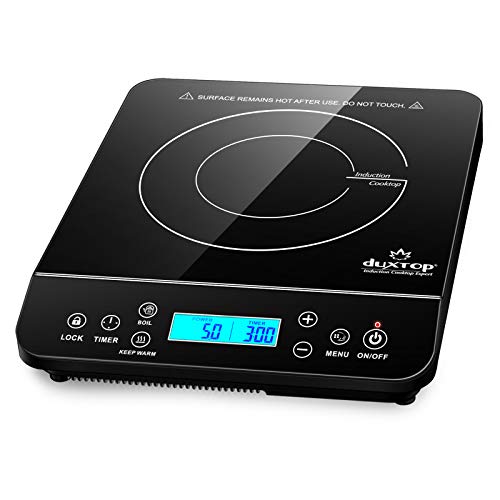
Duxtop Portable Induction Cooktop 9610LS
This 1800W unit is designed for faster boiling, which helps if you cook pasta or heat soup often. It suits someone who wants more power and a clear display.
The downside is the touch-style control panel, which can be fiddly with stiff fingers. Check the current price against your $200 ceiling too.
Nuwave Flex Precision Induction Cooktop
The Flex is listed with a 6.5 inch heating coil and precise temperature settings. It suits someone who cooks small portions and likes steady, controlled heat for simmering.
The trade-off is the smaller cooking zone. Wide pans will not sit well on it, so measure your pan bases against the stated size before you buy.
Induction-Compatible Cookware
Induction only heats pots and pans with a magnetic base, so cookware that fails the magnet test needs replacing. These sets give you pans that work with a countertop cooktop.
This is cookware with a magnetic base. It suits anyone whose pans fail the magnet test, and it is the required companion purchase in that case. It also suits you if you want lighter, easier-to-handle pans while you're replacing anyway.
Skip it if your current pans pass the magnet test. Heavy cast iron is durable but hard on wrists and shoulders, so it's the wrong pick with limited grip strength.
Cookware adds cost on top of the cooktop. A small starter set costs less than a full replacement, and two or three well-chosen pans often cover daily cooking. For more on easier-to-lift pans, see lightweight cookware for seniors.
What to check:
- Weight: Lighter is easier to lift when full.
- Handles: Look for a comfortable shape and a stay-cool design.
- Flat base: A warped base heats unevenly and may not be detected.
- Base diameter: It should match your cooktop's minimum pan size.
- Care: Dishwasher safe or hand-wash only. Secure lids reduce splatter.
If lifting a full pot to the sink is the hard part, the MyLifeUNIT Spaghetti Strainer Spoon review shows one way around it.
Cuisinart Chef's Classic Stainless Steel Set, 11 Piece
Stainless steel is durable and easy to maintain, which suits someone who wants one set to last. Run the magnet test on a pan before you rely on it, since induction performance depends on the base.
The downside is size. Eleven pieces is more than a single-burner cook needs, and stainless is usually heavier than lighter-weight options. Check the listed weight against your grip strength.
Circulon A1 Series Induction Cookware Set, 9 Piece
This set is sold specifically as induction cookware with a nonstick surface, which suits anyone who wants easier cleanup and less scrubbing.
The catch is nonstick care. Coatings wear over time and often need gentler handling than stainless, so read the care instructions before you commit. Nine pieces is also more than most single-burner cooks will use.
Aufranc Stainless Steel Nonstick Induction Set, 6 Piece
A six-piece set is the smaller starter option. It suits you if you only need a couple of pots and a pan for daily cooking on one burner.
The downside is that a small set gives you fewer sizes. If you often cook large batches, you may outgrow it. Check the base diameters against your cooktop's minimum.
Subscribe to our newsletter for more tips: Join here
Frequently Asked Questions
Does an induction cooktop stay cool? It stays far cooler than a coil or flame because it heats the pan. The glass still warms from the pan, so wait for the hot-surface light to go off.
Can a portable induction cooktop replace my stove? For most daily cooking, yes. It is a single burner, so it won't replace a full range for large meals.
Do I need new pots and pans? Only if a magnet doesn't stick firmly to the bottom of your current ones.
Is induction safe with a pacemaker? Ask your doctor or the device manufacturer before using one.
Hacks and Advice
- Do the magnet test first: Check every pan in the cabinet. Many people already own two or three that work.
- Set it at the front of the counter: Keep the controls facing you and leave room around the vents. Read more in A Guide to Stove Safety for the Elderly.
- Use a dedicated outlet: Don't share a circuit with a microwave or kettle, and never use an extension cord.
- Mark a landing zone: Put a heat-safe trivet or silicone mat beside the unit so hot pans have somewhere to go.
- Do an annual check: Wipe the vents, inspect the cord for fraying, confirm shutoff still works and recheck pots for warping.
While you're making safety upgrades, the bathroom deserves a look too. The 7 bathroom danger zones come with a $20 fix for each.
Portable Induction Cooktop Buying Checklist
Download this printable checklist and find the right portable induction cooktop for your kitchen in minutes—with built-in safety checks for arthritis-friendly controls, outlet placement, and cookware compatibility.
Your First Step Costs Nothing
The problem is the reach, and a front-control countertop unit fixes it for a fraction of the cost of a new range.
Today, walk into your kitchen, hold a refrigerator magnet to the bottom of your most-used pan and see whether it sticks. You'll know before spending a dollar whether your cookware would work with induction.
Then take the Home Safety and Independent Living Assessment to check the rest of your home.
Which pan in your kitchen passed the magnet test? Tell me in the comments. And share this with a friend or family member who has a rear-control stove.