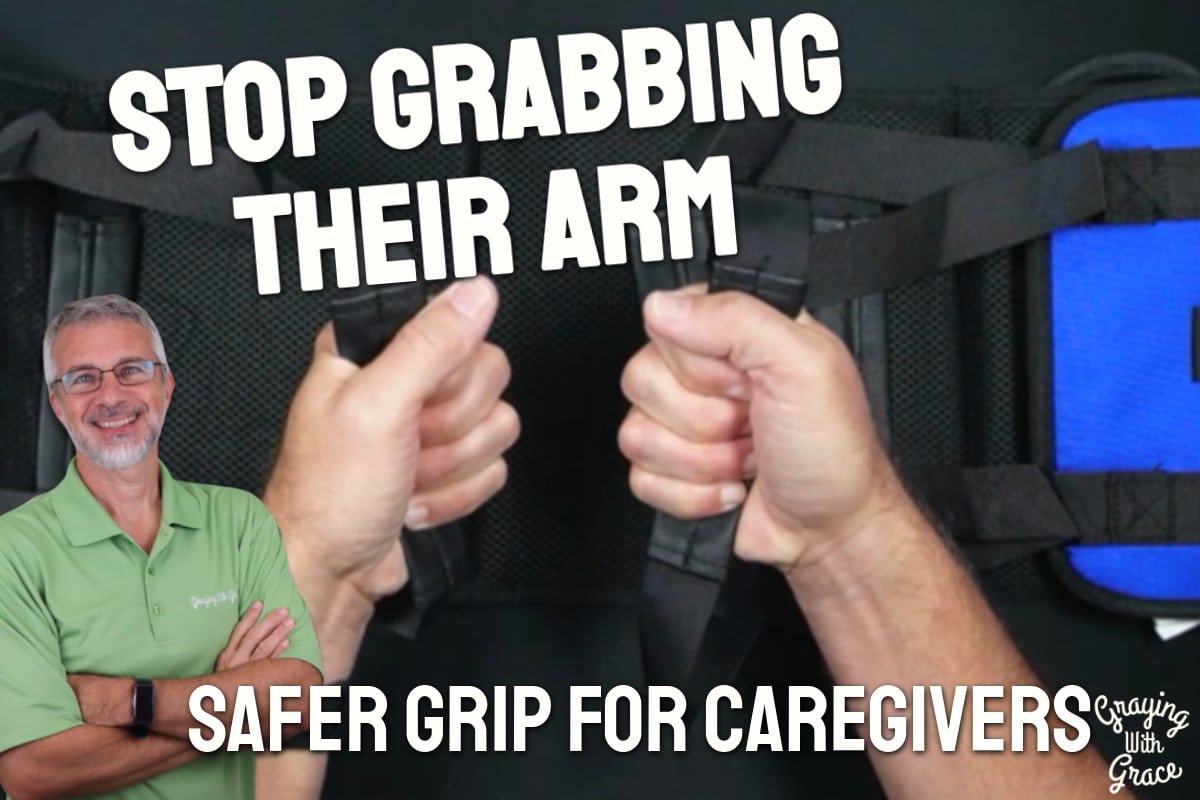
If you have ever helped a parent or partner move from the bed to a chair by grabbing their arm or pulling at their clothing, you already know how wrong that can feel — for both of you. You are not getting a good grip, they are not feeling secure, and somebody’s back is quietly paying the price.
That is exactly the problem a transfer sling for elderly lifting aid is designed to solve. The right sling gives you real grip points, distributes the load properly, and protects the person being transferred from the kind of awkward pulling that leads to bruises, falls, or worse.
I am Scott Grant, Certified Senior Advisor (CSA) and Senior Home Safety Specialist (SHSS) at Graying With Grace. NurtureCare sent me their transfer sling to evaluate hands-on, and I put it through its paces so you can decide whether it belongs in your home care routine.
In this review, I will cover the build quality, how the handles actually work in real transfer scenarios, the sizing range, the bed rail attachment, and who this sling genuinely serves — and who might need something different.


Quick Takeaways
- Problems it solves: Unsafe arm-grabbing transfers, caregiver back strain, shifting and bunching during lifts
- Who benefits most: Family caregivers assisting a parent or partner with limited mobility at home
- Worth the investment: Yes — particularly if you are doing daily or multiple-times-daily transfers
- Best feature for seniors: Non-slip inner lining that grips clothing and holds position throughout the transfer
- Biggest limitation: Requires a caregiver to use — this is not a self-transfer or solo-use device
Who This Is For
If you have been helping a parent stand up from their recliner every morning and every evening, and you have been doing it by grabbing their arms or hooking under their shoulders, the NurtureCare Transfer Sling Lift Aid is designed specifically for your situation. It gives you proper grip points so you are lifting with control, not desperation.
If your spouse or partner uses a wheelchair and you are the one doing all the transfers — bed to chair, chair to toilet, toilet back to bed — this sling makes those transitions safer and more consistent. The six handles mean you can approach from different angles and still have a secure grip no matter which direction the transfer is moving.
If you are a home care aide working with a client who tends to slide or shift during repositioning, the non-slip inner lining and the bed rail attachment make this a practical tool for maintaining positioning and keeping the sling where you can find it when you need it.
Ready to discover more innovative strategies for healthy, comfortable aging? Subscribe to our newsletter for expert-tested tips and product recommendations designed specifically for older adults.
How This Could Help You
Have you ever felt that sickening moment during a transfer when you realize your grip is slipping and you are not sure what is going to happen next? That is the moment this sling is built to prevent.
The NurtureCare Transfer Sling gives the caregiver six reinforced handles — three on each side — so you always have the right grip for the direction you are moving. Standing a person up from a chair? Use the front handles. Steadying them from the side? Grab the lateral handles. Guiding movement forward? The positioning works with you, not against you.
One of the most common questions I hear from caregivers is about the difference between a transfer sling and a transfer belt. A standard gait belt wraps around the waist and gives you one or two grab points near the front. A transfer sling like this one wraps the same way but adds six dedicated handles at strategic positions — which means far more control across a wider range of transfer scenarios.
What about caregiver injury? Grabbing clothing or arms during a transfer puts enormous and uneven strain on your lower back and wrists. A proper sling lets you use your whole body, your legs and core, rather than just your arms. That is the difference between doing ten transfers a day for years and throwing out your back after a month.
Important Details You Should Know
As I demonstrated in the video, the sling fits a waist range of approximately 28 to 43 inches. That covers the majority of adults, but it is worth measuring before you order.
The inner surface is an air mesh fabric, which I noticed allows for better heat transfer during use. You will not get the heat buildup under the sling that you sometimes see with solid fabric construction — that matters when a person is wearing it for repositioning over an extended period.
The sling supports up to 330 pounds according to the product listing. Always check the product label at the time of purchase to confirm that specification is current and unchanged.
The handles are leather-wrapped and reinforced with an anti-slip texture. When I evaluated this product, I noticed that the texture gives your palm something to grip even under load — a detail that really matters when you are holding a position and need to maintain that hold.
Getting Started
The sling arrives with the transfer belt itself and a bed rail attachment accessory included in the box. No tools or assembly are required.
Wrap the sling around the waist of the person being transferred, feed the strap through the metal buckle, and adjust the slide buckle to fit snugly. In the video, you can see that the metal buckle clicks in with a satisfying, audible clink — a small thing that gives you a real confidence boost when you are about to do a transfer.
The bed rail attachment loops through a handle on the sling and wraps around the rail. It takes about thirty seconds to set up, and once it is on the rail, the sling is right there every time you need it — no hunting under the bed or in the closet.
Features That Matter to You
The metal buckle is the standout feature here. When I evaluated this product, I physically felt the difference between the metal click of this buckle and the lighter, less reassuring snap of a plastic buckle. As I noted in the video, if you have ever had a plastic buckle fail mid-transfer, you understand why this matters.
The six handles are not just a marketing number — each position serves a real purpose. In the video, you can see that the front handles are positioned for standing assists, the lateral handles are angled for side guiding, and the rear handles allow for forward and backward movement control. You are not improvising; you are using the tool as designed.
The non-slip inner lining on the NurtureCare Transfer Sling Lift Aid grips the person’s clothing during a transfer rather than riding up or sliding around. For someone who tends to shift or for a transfer that requires holding a fixed position, that lining is doing quiet, important work.
The adjustable waist belt means one person can cinch it comfortably while another needs it fully extended — the same sling works across a household or care setting without needing multiple sizes on hand.
Real Life Experience
When I first unfolded the sling on camera, the construction immediately felt substantial — not flimsy or overly stiff, but genuinely well-built. The reinforced stitching is visible and even, which is the kind of detail that tells you a manufacturer was paying attention.
As I demonstrated in the video, folding the sling back up is straightforward: tuck the handles under each side and fold it over into a compact package. That matters more than it sounds. If you are traveling with a parent or taking the sling to a medical appointment, you want something that fits in a bag without a wrestling match.
The air mesh fabric I mentioned earlier is not just a comfort feature — it is a hygiene and skin care consideration too. Heat and moisture buildup under a sling during multiple daily transfers can contribute to skin irritation. The breathable construction reduces that risk.
In the video, you can see that releasing the metal buckle is a two-finger squeeze on the side tabs — clean and deliberate. It does not release accidentally, but it does not require significant hand strength to open when you are ready. That balance is harder to get right than it looks.
Day to day, the biggest practical benefit is consistency. When you have the right grip point every time, transfers become a routine rather than an improvised lift. That consistency is what protects both people involved over months and years of daily use.
Will You Be Able to Use It?
This sling is operated by the caregiver, so the physical requirements fall on the person assisting rather than the person being transferred. The individual being transferred does not need to grip anything or hold a position actively.
The caregiver will need enough hand strength to grip the wrapped handles under load and enough core strength to perform the actual transfer. The sling provides grip and load distribution — it does not replace the physical effort of the lift itself.
If the caregiver has limited hand strength or wrist issues, the reinforced handles with anti-slip texture do reduce the grip effort required compared to grabbing at clothing. But if hand strength is a significant concern, it is worth discussing with an occupational therapist before relying on this as your primary transfer method.
Important Considerations
This sling is not designed for fully dependent transfers where the person being moved cannot bear any weight. For complete non-weight-bearing transfers, a mechanical lift with a full body sling is typically the safer choice.
If the person being transferred has dementia or significant cognitive impairment, they may not understand or cooperate with the sling being placed around them. A calm, step-by-step introduction to the sling before use is worth taking time on.
Always consult with your doctor or occupational therapist before making health-related product decisions, particularly for complex mobility situations or after a fall, hospitalization, or significant change in physical function.
The 28-inch minimum waist measurement means this sling may not be appropriate for very slender individuals. Measure carefully before purchasing.
Help When You Need It
NurtureCare backs this product with their quality assurance commitment. For specific warranty terms, return policies, and customer support options, check the current product listing on Amazon at the time of purchase — these details can change and it is always best to confirm directly.
Amazon’s standard return window applies to most purchases, which gives you a reasonable period to evaluate the sling in your actual care situation before committing to it long-term.
Understanding the Cost
Transfer slings occupy a wide price range, from basic gait belts with one or two handles to multi-handle slings like this one with upgraded hardware. The NurtureCare Transfer Sling Lift Aid sits in the mid-range of that category, and the metal buckle, reinforced handles, and bed rail attachment justify the step up from a basic belt.
When you consider that a single caregiver back injury can result in weeks of lost function and significant medical costs, investing in proper transfer equipment is not an optional upgrade — it is basic risk management.
If budget is a real constraint, a standard gait belt is better than nothing. But if you are doing daily transfers and want a tool built to last and protect both people in the transfer, this sling is a reasonable investment for what it delivers.
Making It Work for You
Before the first transfer, practice putting the sling on and adjusting it while the person is seated and relaxed — not in the middle of a mobility need. Familiarity with the buckle and handle positions before you need them makes every subsequent transfer smoother.
Use the front handles for standing assists from a chair, the lateral handles for side guidance and steadying, and the rear handles for controlled forward movement. Matching the handle to the scenario is what makes those six positions worth having.
Attach the sling to the bed rail when not in use. As I noted in the video, transfer aids have a way of disappearing to under the bed or into a closet right when you need them most. The bed rail attachment solves that problem simply and reliably.
If you are new to using a transfer sling, consider asking an occupational therapist or a home health aide to walk through one or two transfers with you before going solo. Proper body mechanics on the caregiver’s side make an enormous difference in both safety and sustainability.
Our Recommendation
If you are doing regular transfers at home — bed to chair, chair to toilet, standing assists from a sofa — the NurtureCare Transfer Sling is a well-built tool that addresses the real risks of improvised transfers. The metal buckle, the six positioned handles, and the non-slip lining are not marketing checkboxes; they are features that make a genuine difference in daily use.
I recommend it most for family caregivers who are handling transfers largely on their own and need reliable grip points and load distribution to protect themselves and the person in their care. It is also a solid choice for home care aides who want a durable, portable sling that travels well.
If the person you are caring for requires full lift transfers with no weight bearing at all, look into a ceiling lift or a mechanical floor lift with a full body sling instead — this sling works best when the person being transferred has at least some ability to participate in the movement.
Where to Get It
You can check current pricing and availability for the NurtureCare Transfer Sling Lift Aid on Amazon using the link on this page. Stock and pricing can change, so check the current listing for the most up-to-date details and to read what verified buyers are saying about their experience.
Conclusion
Proper transfer equipment is one of those things that feels optional right up until the moment it is not. The NurtureCare Transfer Sling gives caregivers what they actually need — real grip, real stability, and real confidence — without overcomplicating what should be a practical, repeatable process.
If you are currently doing transfers by grabbing whatever you can reach, this is the upgrade that protects you both.
Have questions about transfer aids or want to share what has worked in your own care situation? Drop a comment below — your experience might be exactly what another caregiver needs to hear today.