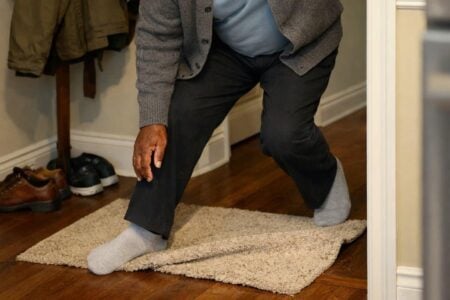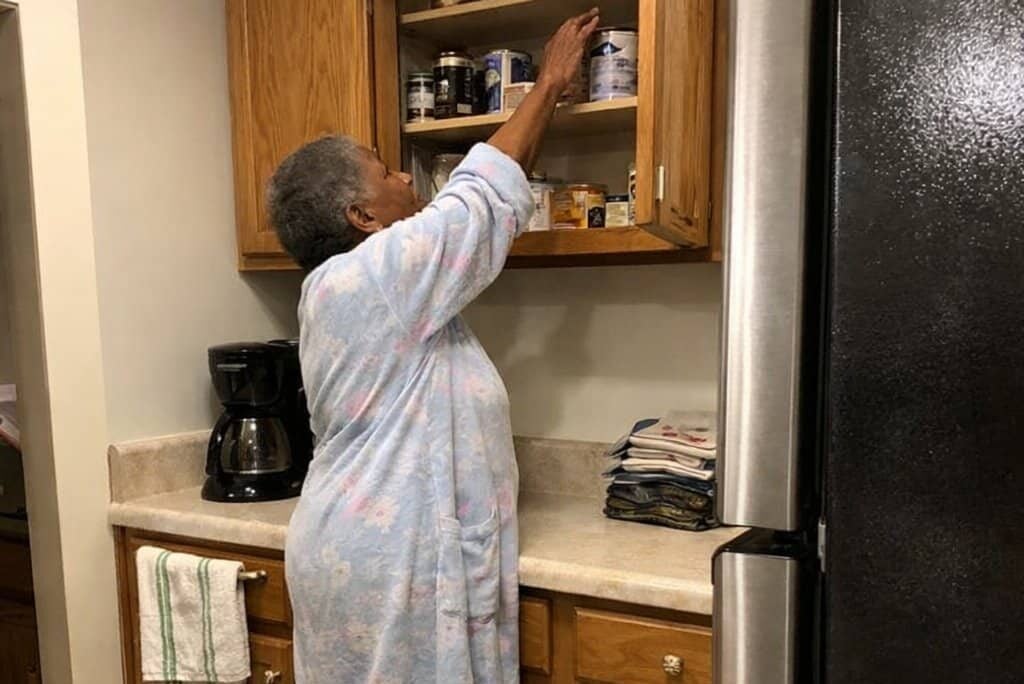
Most older adults who fall while reaching aren’t falling off ladders. They’re stretching toward a top shelf with one hand while their weight shifts backward — or bending toward the floor and losing their balance on the way back up.
Both movements are ordinary. Both are survivable at 45.
After 60, with changes in reaction time and center-of-gravity control, they’re exactly the kind of thing that ends a hospital-free year.
Reacher grabber tools and long-handled dressing aids exist to eliminate those movements entirely — not to help you do them more carefully. These aren’t convenience items. They’re fall-prevention tools that remove the dangerous moment before it happens.
This article covers two distinct categories. Reacher grabbers solve a distance problem: overhead shelves, dropped items on the floor, things in the back of a deep closet. Long-handled dressing and bathing aids solve a motion problem: the deep forward bend at the hip that putting on socks, shoes, or washing your feet requires.
Some readers need one; some need both. By the end, you’ll know which fits your situation — and what to look for before you buy.
Reacher & Grabber Shopping Guide: Print & Carry
Download this printable shopping guide and know exactly which reacher or bathing aid will work for your specific situation—no guessing, no returns, no wasted money on tools that don’t fit your needs.
What to Look For
Buying criteria matter more in this category than in most. The wrong length or the wrong jaw design doesn’t just make the tool less useful — it can make the task harder than doing it by hand. Here’s what the specifications actually mean.
Reach length
Standard reachers run 19 to 32 inches. A 26-inch reacher handles most floor retrieval without stooping and most shelf retrieval at 7–8 feet for a standing user. Wheelchair users typically need 32 inches. Longer isn’t automatically better: a 32-inch reacher is harder to control precisely, and for users with arthritic hands, the added leverage torques the wrist.
Weight capacity and jaw design
Most standard reachers are rated to 5–8 pounds. That sounds like plenty — until you picture a full 2-liter soda bottle (4.4 pounds), a full jar of pasta sauce (roughly 2 pounds), or a cast-iron pan (which no reacher should touch). The jaw design determines what the tool can actually grip. Rotating jaw models swivel up to 360°, which helps with items at odd angles. Suction-cup jaws grip smooth-bottomed items; claw or pincer jaws work better on irregular shapes. Neither replaces two hands on anything that matters.
Handle grip and trigger mechanism
Pistol-grip handles distribute hand pressure better than straight handles — important for users with arthritis. The trigger should close the jaw with no more than a few pounds of finger pressure. Look for a push-button locking mechanism if grip strength or hand fatigue is a concern: it holds the jaw closed without sustained squeeze, so you’re not fighting the tool every step of the way.
Weight of the tool itself
A reacher that weighs more than 7–8 ounces becomes fatiguing. Aluminum models typically weigh 4–6 ounces. Some “heavy-duty” models trade weight for capacity. Check the product weight before ordering — not just the rated capacity.
Dressing and bathing aids: shaft length and attachment design
For long-handled bath sponges and back brushes, the shaft should be at least 18–22 inches to reach the feet without bending. Look for a flexible or rotating sponge head that adjusts to curved surfaces, and a sponge material soft enough for fragile or sensitive skin. Rigid plastic shafts outlast foam-core handles. Long-handled shoehorns should be at least 18–24 inches and non-flex — a shoehorn that bends under pressure defeats the purpose.
What to skip
Retractable or telescoping reachers are convenient for travel but typically have lower load ratings and more flex in the shaft. For daily home use, a fixed-length aluminum reacher is more reliable and easier to control.
Reacher Grabber Tools
Reacher grabbers extend your arm by 19 to 32 inches, letting you retrieve lightweight items from high shelves or the floor without climbing, stooping, or shifting your weight in the ways that cause falls. They are one of the most practical and lowest-cost fall-prevention tools available for daily home use.


A reacher grabber extends your reach by 19 to 32 inches, letting you retrieve lightweight items from high shelves or the floor without climbing, stooping, or significantly shifting your weight. That last part matters. The tool removes the ladder or the forward bend — it does not remove the physics of what happens when your arm rises overhead.
The limitation worth stating plainly: When you reach overhead, your weight shifts backward as your arm rises. That backward pull is the same destabilizing force that makes stepstool climbing risky. A reacher eliminates the stepstool; it doesn’t eliminate the physics. For that reason, anything you regularly retrieve from a high shelf should be lightweight — dish towels, paper goods, light containers. If the item is heavy, the right solution is reorganizing storage, not ordering a longer reacher.
Where this tool is the right choice:
- Retrieving lightweight items from shelves at or above shoulder height
- Picking up items dropped on the floor — an underestimated fall risk, since the forward bend plus weight shift on the return trip is genuinely dangerous
- Reaching items at the back of deep closets or under furniture
- Grabbing items from floor level while seated in a wheelchair or chair
Where it is the wrong choice:
- Retrieving anything heavy from overhead (cast iron, large bottles, anything over 5–6 pounds)
- Tasks involving foot, sock, or lower-leg management — that’s the next section
- Replacing the judgment that certain items need to be moved to a reachable height permanently
Reachers handle spatial distance. Dressing aids handle a different physical problem: the dangerous forward bend at the hip. These tools address different risk patterns. Some readers will need both.
POPDA Grabber Reacher Tool — 32″ Extra Long Foldable
The POPDA reacher is a 32-inch fixed-length tool that folds for storage — a useful feature for keeping one accessible in multiple rooms without it becoming a tripping hazard when not in use. The jaw rotates, which means it can angle toward items stored at the back of a shelf or at floor level without requiring the user to reposition their feet.
At 32 inches, this is on the longer end of the standard range. That makes it a good fit for wheelchair users and for anyone who cannot bend at the waist at all, but it adds leverage that requires a bit more wrist control than a 26-inch model. Users with significant wrist weakness should keep that tradeoff in mind.
The folding mechanism is a practical daily feature rather than just a travel convenience. A reacher that can be collapsed and hung or set aside is one that actually gets used regularly — which is the only way it prevents falls.
RMS 2-Pack 32 Inch Extra Long Grabber Reacher with Rotating Jaw
The RMS reacher comes in a two-pack, which solves a real problem: most households need more than one. One lives in the kitchen for the top shelf; one lives near the bed or in the bathroom for floor retrieval. Buying them together also means both have identical jaw mechanisms, so there’s no relearning which grip does what.
The rotating jaw on this model allows the grabbing head to swivel, which is particularly useful for retrieving items at awkward angles — such as a sock that landed under the bed, or a light item pushed to the back of a cabinet. The 32-inch length suits floor retrieval from a standing position without stooping.
The yellow color is intentional. A brightly colored tool is easier to locate in a closet or against a wall, which matters when the point of having it is that it’s reachable in the moment you need it.
REWKCY 32″ Grabber Reacher Tool, 2-Pack Foldable with 360° Rotation
The REWKCY comes as a foldable two-pack with a 360-degree rotating jaw — combining the convenience of a foldable design with full swivel capability. The 360-degree rotation is worth noting specifically: it allows retrieval of items facing any direction without repositioning, which reduces the compensatory body movements that create fall risk in the first place.
This model suits users who want a foldable tool but don’t want to give up jaw rotation to get it. Some foldable reachers sacrifice jaw design for the folding mechanism; this one keeps both features functional.
At 32 inches, the length guidance from the buying criteria section applies: adequate for most floor and high-shelf tasks from a standing position, and appropriate for wheelchair users. Users who prioritize precision over raw reach may find a 26-inch model easier to control.
FitPlus PowerGrip T9 Grabber Reacher Tool, Wide Jaw, Foldable, Steel Cable
The FitPlus T9 uses a steel cable internal mechanism rather than a plastic trigger assembly — a design choice that affects durability over time. Plastic trigger mechanisms can develop slack or lose spring tension with heavy use; a steel cable mechanism is less likely to degrade in the same way.
The wide jaw is the other distinguishing feature. A wider jaw opening can grip bulkier or irregularly shaped items that a standard jaw would struggle to close around — a crumpled newspaper, a stuffed animal, a shoe. For users whose dropped items aren’t always small or flat, that additional opening width is practically useful.
The foldable design keeps it manageable for storage. This is a well-suited option for users who want durability as a priority alongside the flexibility of a foldable form.
EZPIK Classic 32″ Folding Grabber Reacher Tool with Dual Magnets
The EZPIK adds dual magnets to the jaw — a feature that sounds like a gimmick but has a legitimate use case. Dropped metal items (keys, coins, bottle caps, pill organizer lids) are difficult for any pincer jaw to grip cleanly, because the jaw needs something to close against. A magnet picks them up without requiring the jaw to close at all.
For users who regularly drop small metal items — a common occurrence with reduced hand dexterity — this is a genuinely functional addition rather than a marketing feature. The 32-inch folding design is otherwise standard for this category.
The dual-magnet design is not a substitute for jaw grip on non-metal items. Think of it as an additional capability layered onto an otherwise conventional reacher, not a replacement for the pincer mechanism.
GrabRunner 32 inch Heavy Duty Reacher Grabber Tool (up to 10 lbs) with Strong Magnetic
The GrabRunner is rated to 10 pounds — higher than the 5–8 pound standard for most reachers in this category. That higher rating reflects a reinforced jaw and shaft construction. It also comes with a strong magnetic feature for picking up metal items without jaw contact.
The 10-pound rating deserves the same honest framing as all overhead retrieval: the jaw may hold 10 pounds, but the user’s posture and balance while extending a loaded arm overhead is the limiting factor, not the tool’s rated capacity. For floor retrieval of heavier items — a full water bottle, a hardback book — the higher rating is genuinely useful. For overhead retrieval, the physics still apply.
This model suits users who regularly need to retrieve items that fall into the 6–10 pound range from floor level, and who want a reacher that won’t flex or drop under that load. It is a heavier tool than aluminum models; factor that in if hand fatigue is a concern.
Long-Handled Dressing and Bathing Aids
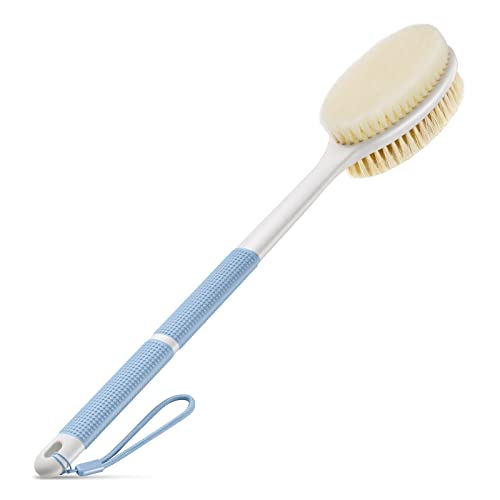
Long-handled bathing aids eliminate the deep forward hip bend required to wash feet and lower legs — a movement that demands flexibility and balance that many older adults no longer have safely, and that post-surgical restrictions often prohibit entirely. A shaft of 18 to 22 inches reaches the foot from a standing or seated position without bending.


The deep forward bend at the hip — the one required to reach your foot — shifts your center of gravity far forward, demands hip and hamstring flexibility that diminishes with age and worsens after surgery, and can cause lightheadedness in some older adults as the head drops below the heart. This isn’t a convenience problem. It’s a balance problem.
Long-handled bathing aids solve a specific version of this: washing feet and lower legs without bending in the shower or bath. A shaft of at least 18–22 inches reaches the foot from a standing or seated position. A flexible or rotating sponge head adjusts to the contours of the foot and ankle without requiring the user to reposition.
These tools are distinct from reachers. A reacher handles distance. A bathing aid handles a motion. The reach required to wash your foot isn’t long — the danger is the bend, not the distance. A reacher won’t substitute here.
Where this tool is the right choice:
- Limited hip flexibility from arthritis or general age-related stiffness
- Post-surgical restrictions (hip, knee, or back surgery)
- Back pain that makes bending to the floor painful
- Washing feet and lower legs safely in the shower or bath without leaning forward
- Morning stiffness that makes the early-day routine a balance challenge
Where it is the wrong choice:
- Overhead or floor retrieval — that’s what reachers are for
- Users with significant hand tremor or very limited grip who may struggle to control a long-handled brush (an occupational therapist evaluation is worth considering in that case)
If you’re also managing sock-and-shoe routines independently, a dedicated sock aid and long-handled shoehorn address those needs — but that’s a separate tool category from the bathing sponges reviewed here. These two product types are complementary, not competing.
LFJ 19″ Long Handle Shower Sponge Brush Set, 3-in-1 Body Brush, Bath Sponge and Lotion Applicator
The LFJ set covers three functions with interchangeable heads: a body brush, a bath sponge, and a lotion applicator. For users who want to avoid bending both in the shower and after — applying lotion to feet and lower legs after drying off requires the same forward bend the bath sponge eliminates — a single handle with multiple heads is a practical solution.
The 19-inch shaft is on the shorter end of this category. For most standing users, 19 inches reaches the foot without full hip flexion, though users with very restricted hip mobility may find a 22-inch shaft more comfortable. The three-head design keeps the purchase cost lower than buying each function separately.
This set suits users who are addressing both in-shower and post-shower foot and leg care in one purchase. The interchangeable heads are useful only if the connection mechanism is secure enough to hold under light pressure — check that detail in the product listing before ordering.
Yetene Long Handled Sponge 22.4″ Back Scrubber for Shower
The Yetene offers a 22.4-inch shaft — closer to the longer end of this category — which gives additional clearance for users with limited hip flexibility or post-surgical restrictions. The extra shaft length reduces how far the arm needs to extend downward, which keeps the upper body more upright during use.
This model functions primarily as a sponge for washing, rather than a scrubbing brush. For older adults with sensitive or fragile skin — common after 70, and especially common in users on blood thinners — a softer sponge surface is a genuine safety consideration, not just a comfort preference.
The straightforward single-sponge design suits users who want a simple, dedicated tool for foot and lower-leg washing rather than a multi-head system. No interchangeable parts means no mechanism to fail.
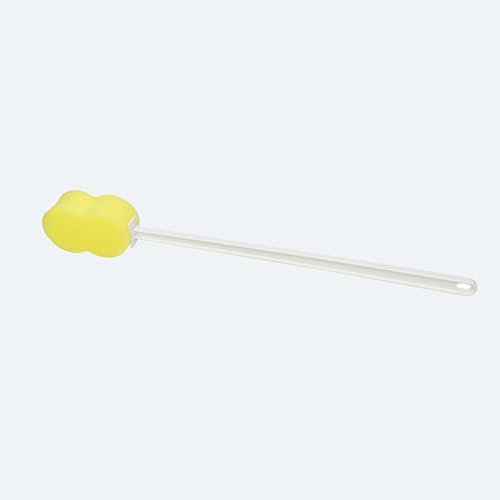
Rehabilitation Advantage Long Handle Bath Sponge — 18″ Extra Long Handle, 5″ x 2″ Soft Yellow Sponge
The Rehabilitation Advantage bath sponge is designed and positioned explicitly for rehabilitation and assistive use — not just a standard bath product with a longer handle. That positioning matters because the sponge dimensions (5″ x 2″) and soft material are selected with skin sensitivity and limited-range-of-motion use in mind.
The 18-inch handle is the minimum length I’d suggest for foot care without bending; users who need more clearance should look at the 22-inch options in this section. For users with mild-to-moderate hip restriction who can still manage a slight forward lean, 18 inches is workable.
This is a straightforward, purpose-built tool that suits users whose primary need is gentle foot and lower-leg washing with a soft material. The brand’s rehabilitation focus means the design decisions reflect actual assistive use rather than general personal care.
RASDDER Back Scrubber for Shower & Body, Long Handle Bath Brush with Loofah Sponge
The RASDDER combines a loofah sponge with a scrubbing brush — two different textures on the same handle. The loofah side suits general washing; the brush side suits users who need light exfoliation or have areas of thickened skin, which is a common foot-care concern for older adults.
The dual-surface design is useful if washing and light exfoliation are both part of a routine. It is not appropriate for users with fragile skin or open wounds on the lower legs or feet — in those cases, a soft-sponge-only option is the safer choice.
Handle length and shaft rigidity matter for this type of tool. A shaft that flexes too much under light scrubbing pressure makes control difficult, especially for users with limited grip strength. Verify the shaft material and rigidity in the product listing before ordering.
Backski Back Scrubber Anti-Slip for Shower, Shower Brush Long Handle with Stiff and Soft Bristles
The Backski features both stiff and soft bristles on the same brush head, with an anti-slip handle design. The anti-slip handle is worth noting specifically for this audience: a wet brush handle in a shower or bath setting presents its own grip challenge, and a textured or contoured grip reduces the chance of the tool slipping during use.
The combination of stiff and soft bristles suits users who need different textures for different areas. Stiff bristles are appropriate for the soles of the feet; soft bristles suit the tops of feet and lower legs where skin is thinner.
This model suits users who are comfortable using a brush rather than a sponge for foot and lower-leg care, and who want anti-slip grip as a built-in safety feature rather than an afterthought.
Cubii Health Long Handled Bath and Shower Scrub Sponges, 22.5″ Long Handle with Polyfoam
The Cubii Health sponge uses polyfoam as its sponge material. Polyfoam holds lather well and has a softer, less abrasive texture than loofah — a meaningful consideration for users with sensitive or thin skin. At 22.5 inches, the shaft length is at the longer end of this category, providing additional clearance for users with restricted hip flexion.
The Cubii Health name and product positioning suggest a focus on health and accessibility rather than general personal care. That’s a useful signal: design decisions in products positioned for health use tend to reflect actual assistive needs rather than aesthetic choices.
This is a well-suited option for users whose primary concern is gentle washing with adequate reach, particularly those managing post-surgical restrictions or significant hip stiffness. The soft polyfoam material makes it one of the gentler options in this section.
Frequently Asked Questions
What weight limit should I expect from a standard reacher grabber, and what can’t it safely hold?
Most standard reachers are rated to 5–8 pounds. To make that concrete: a full 2-liter soda bottle weighs 4.4 pounds, a dinner plate runs roughly 1.5 pounds, and a full jar of pasta sauce is about 2 pounds. A cast-iron skillet is well beyond what any reacher should handle. The jaw rating is only part of the picture. When you retrieve something overhead, the weight of the item pulls your arm — and your center of gravity — backward. That backward pull is a fall risk regardless of whether the jaw can hold the weight. Heavy items belong at reachable height permanently, not on high shelves with a longer reacher as the workaround.
Is a reacher grabber safe for retrieving items from overhead shelves?
It depends on the item’s weight and position. A lightweight item — a dish towel, a box of crackers, a paper bag — stored at the front edge of a shoulder-height shelf is manageable. A heavy item at the back of an overhead shelf requires both arms and creates backward lean when retrieved with a reacher. That’s a fall setup regardless of the tool. The honest answer: reachers are safe for overhead retrieval of genuinely lightweight items. For anything heavy, the right move is relocating that item to a lower shelf, not extending your reach.
What length reacher grabber do I need?
For most standing users managing floor retrieval and mid-to-high-shelf tasks, 26 inches is the practical starting point. It reaches the floor without stooping and handles shelves at 7–8 feet from a standing position. Wheelchair users, or anyone who cannot bend at the waist at all, typically need 32 inches. Keep in mind that longer shafts are harder to control precisely — a 32-inch reacher requires more wrist steadiness than a 26-inch model. If you’re uncertain, 32 inches gives more flexibility and is what most products in this roundup offer.
Will a long-handled bath sponge help if I have hip replacement surgery?
Yes — this is one of the primary reasons occupational therapists recommend long-handled bathing aids after hip replacement. The surgical restriction typically prohibits hip flexion beyond 90 degrees and forward bending toward the floor. A long-handled sponge of 18–22 inches allows foot and lower-leg washing from a seated shower chair position without violating that restriction. Confirm your specific post-surgical limits with your surgeon or physical therapist before use. For sock and shoe management after hip surgery, a dedicated sock aid and long-handled shoehorn address those needs — the bathing sponges in this section are for washing, not dressing.
What’s the difference between a sock aid and a dressing stick — do I need both?
A sock aid is a rigid cradle that holds the sock open so you can insert your foot and pull the sock up without bending. A dressing stick is a dowel with a hook or loop at the end, used to push, pull, or guide clothing — pants, underwear, shoes — over the foot and up the leg. For most people, a sock aid handles socks and a dressing stick handles the rest of lower-body dressing. Post-surgical patients with hip rotation restrictions often benefit from both. Neither is covered in this article’s product section, but both are worth researching if dressing independence is the primary goal alongside bathing.
My parent has arthritis and limited grip strength. Can they still use a reacher grabber?
Yes, with the right specifications. Look specifically for: a low-force trigger (often described as “easy-grip” or “arthritis-friendly” in the product listing), a pistol-grip handle rather than a straight handle (pistol grips distribute pressure across the palm rather than concentrating it in the fingers), and a jaw-locking feature that holds the jaw closed without sustained hand pressure. Also check the tool’s own weight — anything over 7–8 ounces will become fatiguing for a user with limited grip strength. The right reacher can be genuinely usable with arthritic hands; the wrong one will be abandoned after two uses.
Hacks and Practical Advice
Do the room walk first. Before ordering anything, walk through your home and note every place where you or your parent currently climbs something, stretches overhead, or bends low to the floor as part of a daily task. That list tells you which tool to prioritize and how many you actually need. Most households need one reacher for the kitchen, one for the bedroom or bathroom, and a bathing aid near the shower. Buying the right tools for the right rooms matters more than buying the most featured tool.
Reorganization beats a longer reach. If the item you’re retrieving is heavy, the right solution is moving it to a reachable shelf before buying any tool. Canned goods, bottles, and pots belong at counter height or below. A reacher extends range; it doesn’t change physics. Reserve reachers for genuinely lightweight items — and if you find yourself wondering whether a specific item is safe to retrieve with a reacher, that’s a signal to move the item, not extend the reach.
Keep it accessible, not stored. A reacher left in a closet isn’t a fall-prevention tool. It should be leaned against the wall in the kitchen, hung within arm’s reach in the bathroom, or placed beside the bed. If it takes effort to retrieve, it won’t be used when it matters. The same applies to a long-handled bath sponge — it belongs hanging in the shower, not under the sink.
Check the jaw every few months. Reacher jaws wear over time, especially the rubber or foam gripping surfaces. A worn jaw drops items unpredictably. If items are slipping, replace the reacher rather than adjusting technique. The cost of a new reacher is far lower than the cost of what gets dropped — or what happens when you reach to catch it.
For bathing aids: test the reach before relying on it. The first time you use a long-handled sponge, test it before you’re already wet and standing on a slippery surface. Sit in a chair, place the sponge at foot level, and verify you can reach and control it comfortably. That dry run matters. You want to know the tool works before the moment when balance is already a factor.
If you find bathing without bending is a consistent challenge, exploring bathroom safety products designed for older adults alongside these tools is worth doing — grab bars, a shower chair, and a handheld showerhead work together with a long-handled sponge to make the whole routine safer, not just one step of it.
Reacher & Grabber Shopping Guide: Print & Carry
Download this printable shopping guide and know exactly which reacher or bathing aid will work for your specific situation—no guessing, no returns, no wasted money on tools that don’t fit your needs.
Conclusion
You identified the specific spot before you started reading. The top shelf in the kitchen. The morning sock routine. The moment you grab the towel bar for balance while reaching toward the floor. Those moments are ordinary — and they carry real risk for exactly the reasons this article described.
Both categories of tools covered here exist to eliminate those movements entirely. Not to help you manage them more carefully, but to remove them from the equation.
A reacher grabber handles the overhead shelf and the dropped item on the floor. A long-handled bathing aid handles the forward bend toward the foot. They solve different problems, and — as I’ve worked with older adults over the years — I’ve found that people who treat them as complementary rather than interchangeable get the most out of both.
If you’re not sure where to start, I’d suggest a single walk through your home today. Note one spot where you or your parent currently climbs, stretches overhead, or bends low to the floor as part of daily life. That one spot tells you exactly which tool belongs on your list first.
For a broader look at what else might need attention, this guide to bathroom accessories designed for older adults is a useful next step — the bathroom is where the forward-bend risk shows up most often, and a few well-placed tools can change the whole routine.
And if you want to go room by room through the full picture, the Home Safety and Independent Living Assessment walks you through every area of the home — and helps you build a prioritized plan before any problem becomes urgent.
The movement that carries risk is the one worth eliminating first. You now know which tool does that.