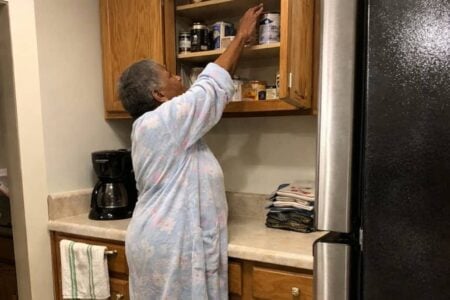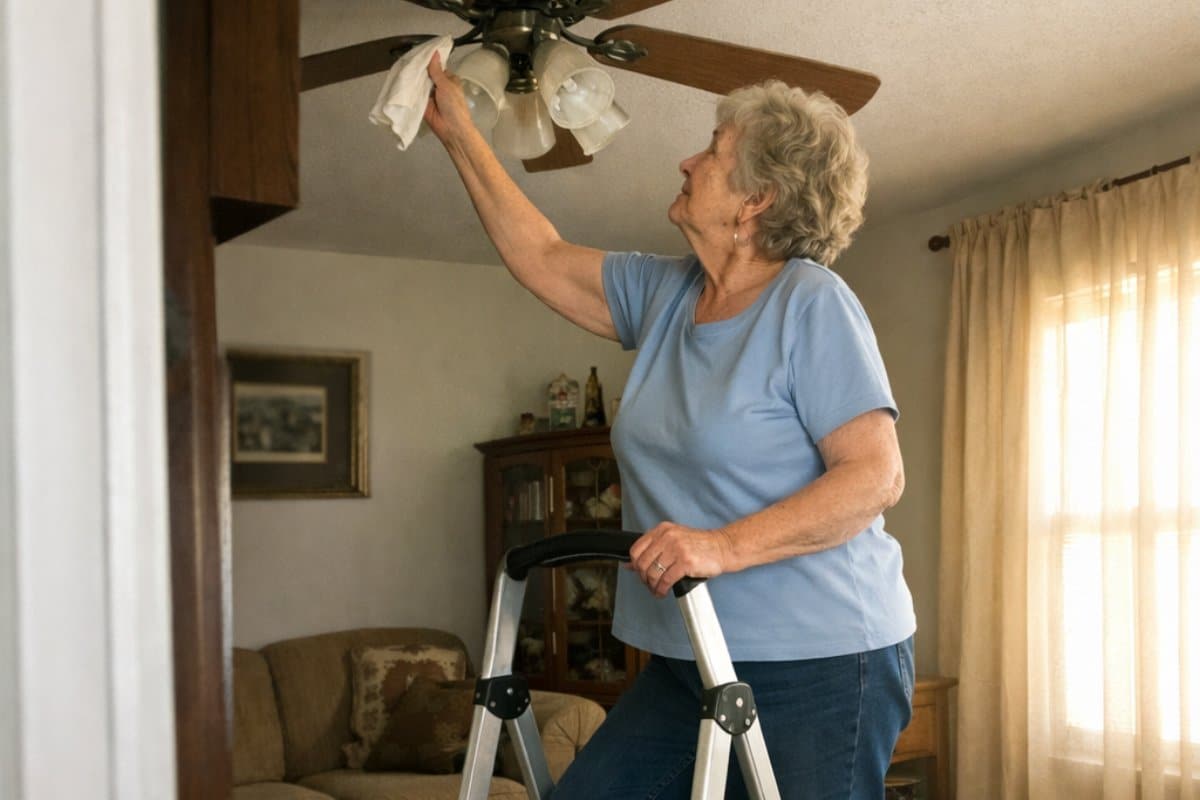
Picture this: you walk into your mother’s living room and there she is — standing on the second step of a folding ladder, cloth in hand, reaching up toward the ceiling fan. She doesn’t see you at first. You freeze. Your stomach drops.
She finishes, steps down safely, and smiles at you like nothing happened. Because for her, nothing did. This is just Tuesday.
But something about that moment didn’t feel right — and that instinct was correct. Ladder use during routine cleaning is one of the most underestimated fall risks inside the home for older adults. If you’ve watched this scene play out and felt a quiet dread you couldn’t quite name, this article is for you.
I’m going to explain exactly why ladder falls during cleaning are so dangerous, when they’re most likely to happen, and how one simple tool change removes the risk entirely — without taking anything away from your loved one’s independence, or your own.
The Caregiver’s Ladder-Free Cleaning Safety Checklist: 20 Steps to Remove Fall Risk From Your Loved One’s Home Before the Next Cleaning Day
Download this room-by-room checklist to identify every ladder-dependent cleaning task in your loved one’s home and replace it with safer, floor-level alternatives—before the next cleaning day.
The Hidden Fall Risk Already Inside Most Homes
Where Home Safety Conversations Usually Stop
When most people think about fall prevention for older adults, they think about bathrooms. Grab bars. Non-slip mats. Maybe a comprehensive fall prevention checklist covering stairways and rugs.
Those are the right places to start. But they miss a hazard that’s quietly present in nearly every home: the step stool or folding ladder pulled out of the closet every few weeks for routine cleaning tasks.
How the Body Changes After 60
After 60, balance, reaction time, and lower-body strength all shift — often gradually enough that neither the older adult nor their family fully notices until a near-miss happens.
Imagine a 45-year-old stepping off a step stool. Their muscles compensate automatically for a slight wobble — it’s instinctive, nearly instantaneous. Now imagine a 75-year-old in the same moment. That same wobble may travel from sensation to conscious response to physical correction in just enough extra time that the correction never comes.
That’s not a judgment about capability. That’s physics, and it’s predictable.
The Highest-Risk Moment Is the Dismount
Most ladder falls during cleaning don’t happen on the way up. They happen on the way down — when the task is done, attention has shifted, and the body is already moving toward what’s next.
The dismount requires coordinated weight transfer, stable footing, and the ability to react if the ladder shifts. All three of those things become less reliable with age. And because stepping down feels routine and familiar, the risk rarely registers as risk at all.
This isn’t about what someone can or can’t do. It’s about understanding that the physics of a fall change with age — and that a straightforward solution exists that removes this specific risk entirely.
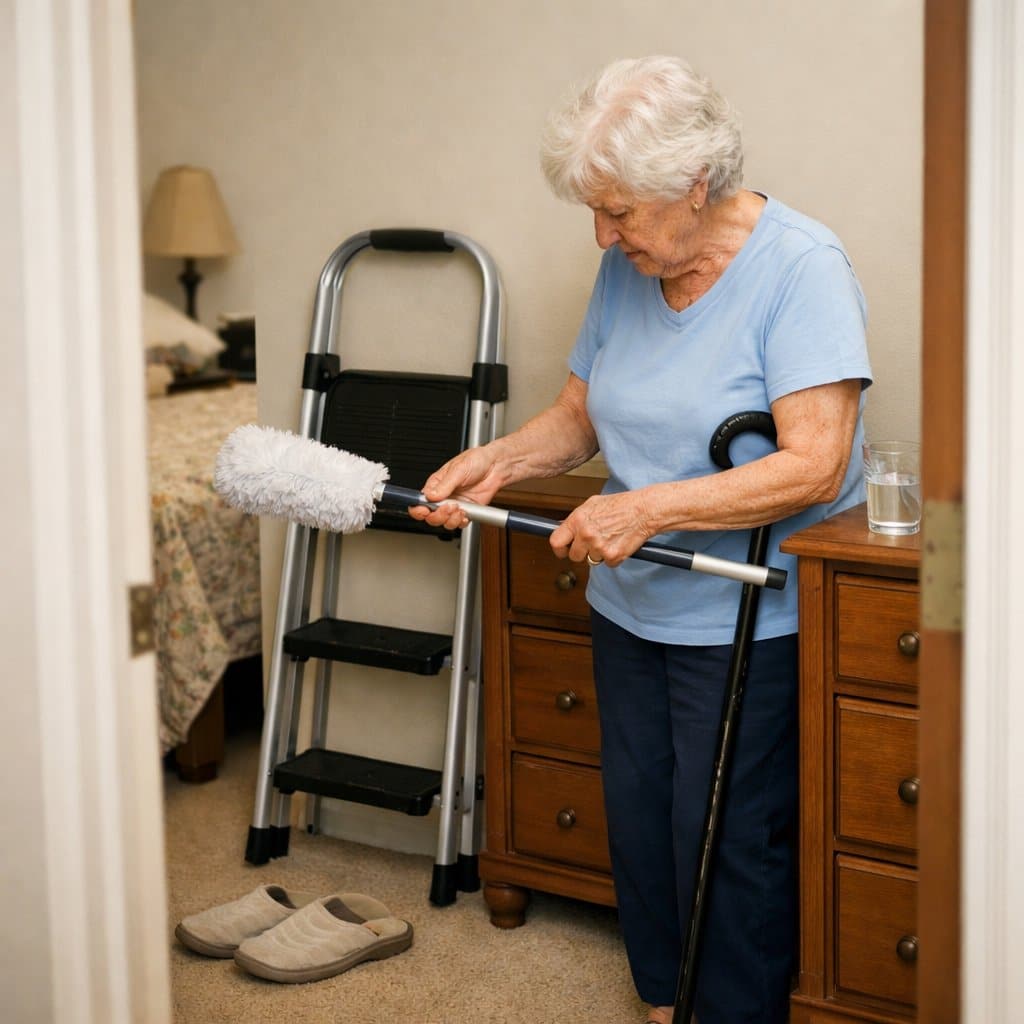
Why Cleaning Chores Are One of the Most Common Times Older Adults Climb
The Tasks That Quietly Create the Problem
Ladder falls during cleaning aren’t random. They happen at predictable moments, during predictable tasks, with predictable triggers. Understanding the pattern makes prevention specific instead of vague.
The household chores most likely to send an older adult up a ladder or step stool include:
- Dusting ceiling fan blades
- Wiping down light fixtures
- Cleaning upper cabinet exteriors
- Reaching high windowsills and crown molding
- Changing or adjusting ceiling-mounted items
Why Ceiling Fans Are a Recurring Trigger
Ceiling fans are a particular problem. They accumulate visible dust quickly — especially on the top of each blade, where it builds into thick gray ridges that are hard to ignore. They’re usually in high-traffic rooms like the living room and bedroom. And older adults who take pride in a clean home notice them and feel compelled to do something about them regularly.
That combination of visibility, frequency, and location makes ceiling fan cleaning one of the most common sources of fall risk during household chores for older adults.
The Compounding Risk of Carrying a Tool While Climbing
Here’s a detail that often gets overlooked: when someone climbs a step stool to dust a ceiling fan, they’re usually carrying something — a cloth, a duster, a spray bottle. That means at least one hand isn’t available to grip the ladder.
Walk through the sequence: drag out the step stool, carry it to the right position, climb up while holding a cloth, twist the torso to reach each fan blade in turn, then reverse the whole process to step down. Each of those moments is a point where a fall could begin.
Confidence Built Over Decades Can Be Part of the Problem
Older adults who have been cleaning their own homes for forty or fifty years often feel completely confident doing tasks their bodies may no longer safely support. That confidence isn’t misplaced — it’s earned. But it can also mean the risk never surfaces as a concern, because the task has always gone fine before.
Knowing exactly when and why the risk occurs turns ladder fall prevention from a vague anxiety into a specific, solvable problem.
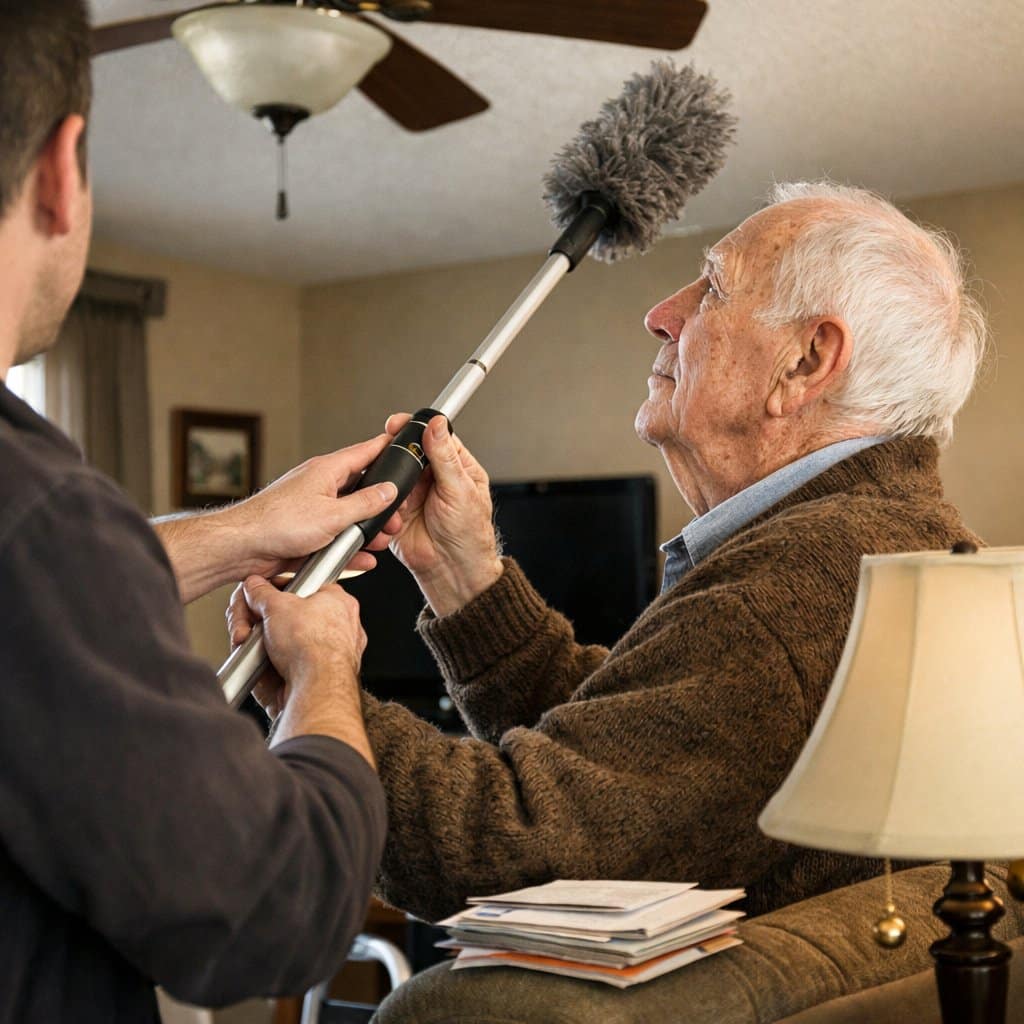
And this particular problem has a direct solution. A quality ceiling fan duster with a long handle — or a well-designed extendable duster built for high surfaces — eliminates the need to climb entirely. The task gets done from floor level, safely, and often more thoroughly than it did from a step stool. If you want to see one in action, I wrote up the extendable ceiling fan duster for seniors that reaches fan blades from the floor.
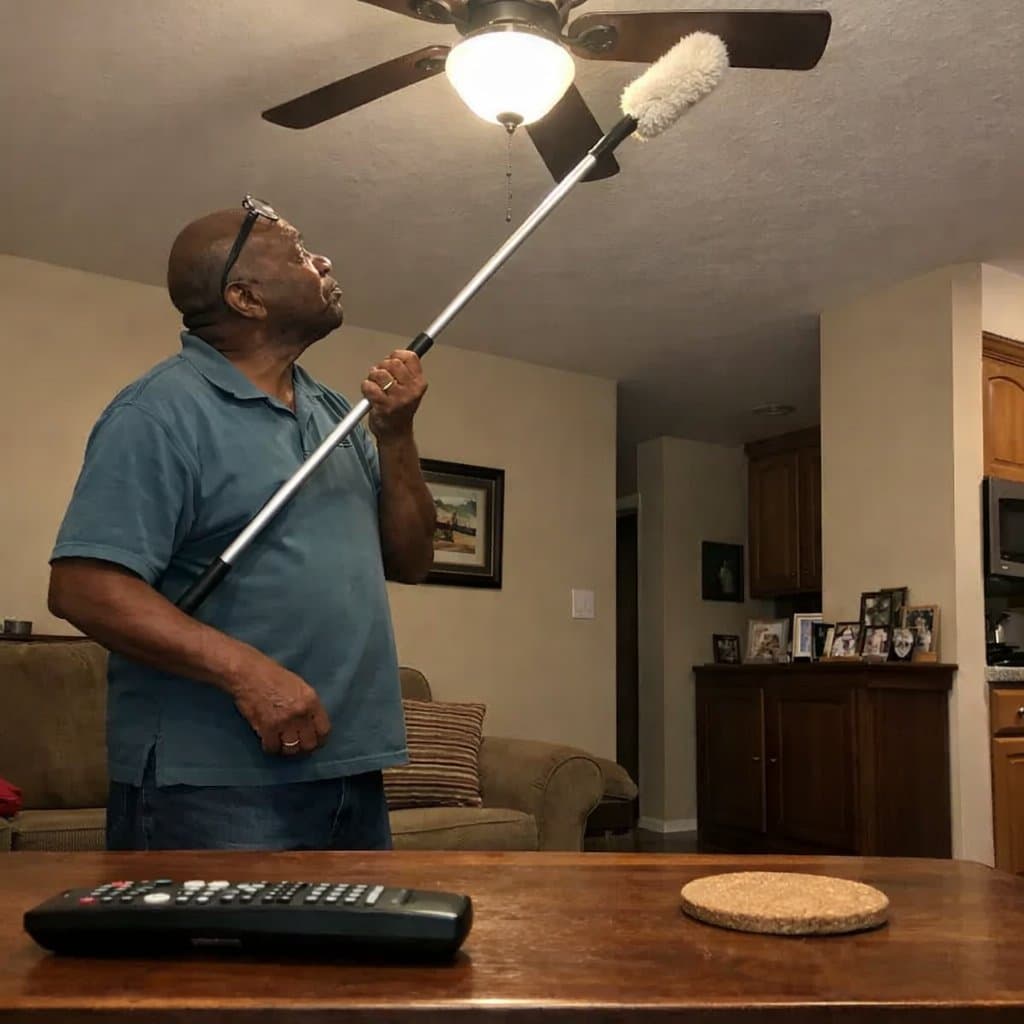
What Caregivers Can Do Before the Next Cleaning Day
You Don’t Have to Wait for a Fall to Act
One of the most common things I hear from adult children after a parent falls is some version of: “I knew something was going to happen. I just didn’t know what to say.”
The good news is that you don’t need a dramatic conversation. You need a low-key approach and the right tool.
How to Frame the Conversation
The ladder conversation goes better when it doesn’t feel like a ladder conversation. Instead of “I don’t want you climbing anymore,” try something like: “I found this duster that’s supposed to reach ceiling fans from the floor — want to try it?”
That framing positions the change as an upgrade, not a restriction. And if the tool actually works well — which a good one will — your loved one may start preferring it entirely on their own, without a single word about fall risk ever being spoken.
A Quick Home Walkthrough Before the Next Cleaning Day
Take fifteen minutes to walk through the home and identify the specific spots that currently require climbing to clean. Prioritize:
- Every ceiling fan in the home
- Light fixtures that collect dust
- Upper cabinet surfaces in the kitchen
- Any high shelves or ledges used for display or storage
- Crown molding and high window trim
For each one, ask: could this be reached from the floor with the right tool? In most standard 8–9 foot ceiling rooms, the answer is yes.
When to Bring in Professional Help Instead
For very high ceilings — vaulted rooms, second-story fixtures, anything above ten feet — even a long-handle tool may not be the full answer. Those situations may call for a professional cleaning service a few times a year. But for the everyday tasks that drive most ladder use, a tool upgrade solves the problem completely.
The goal isn’t to take over your loved one’s home. It’s to quietly remove the most dangerous moments so they stay in charge of everything else. That’s worth spending an afternoon on before the next cleaning day arrives.
Want more practical, caregiver-tested tips for keeping your loved one safe at home? Subscribe to the Graying With Grace newsletter for trusted advice and product recommendations designed for real caregiving situations.
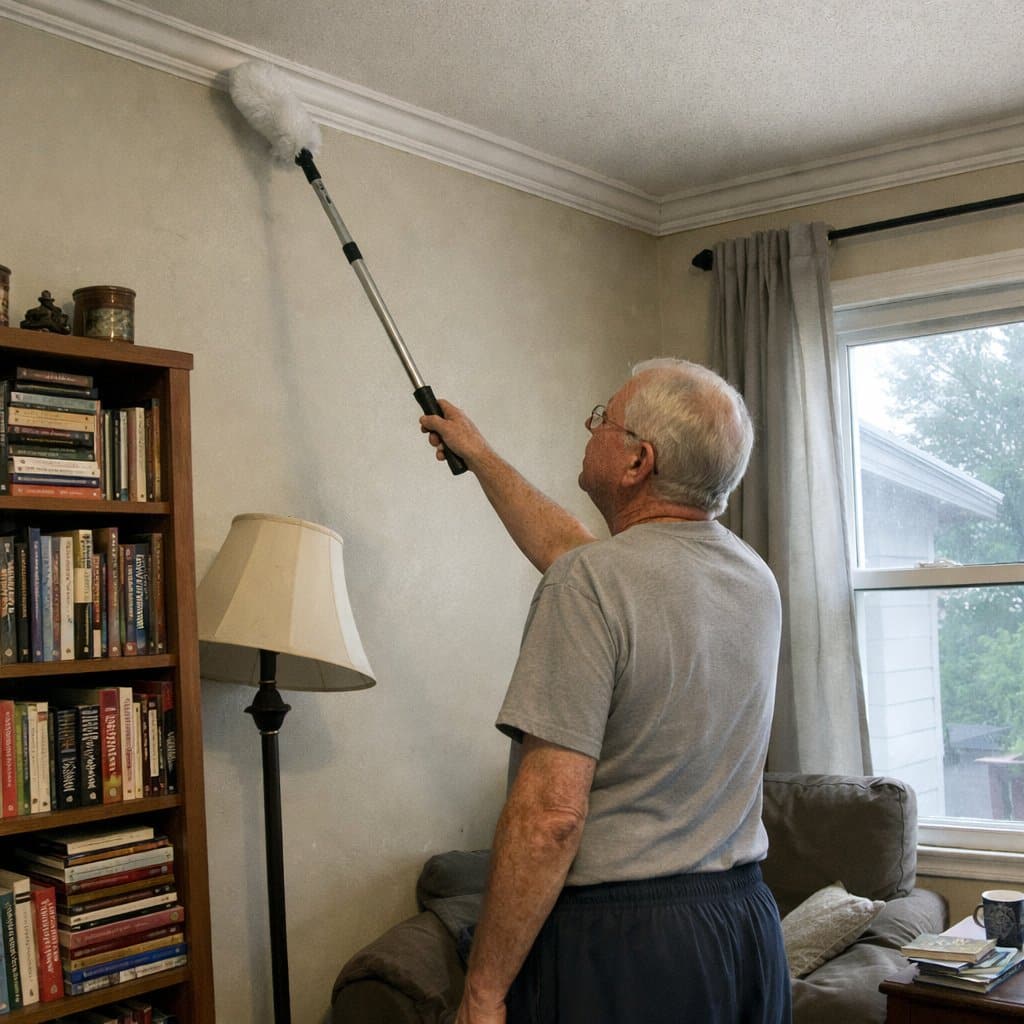
How to Choose the Right Extended-Reach Cleaning Tool for High Surfaces
Product offers are temporarily unavailable.
Not Every Long-Handle Duster Is Worth Buying
I’ve seen plenty of people buy a cheap extendable duster, use it once, find it frustrating, and go back to the step stool. The tool has to actually work — and work easily — or it won’t replace the old habit.
Here’s what to look for when selecting tools designed specifically to clean high surfaces without climbing.
What Makes a Good Ceiling Fan Duster
A ceiling fan duster designed for this specific task should have:


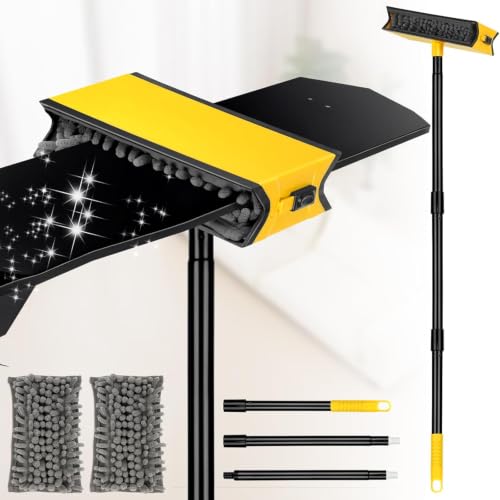
- A flexible or angled head that wraps around each fan blade rather than just sweeping across the top surface — this is what actually removes the thick dust buildup instead of redistributing it
- Lightweight construction that stays manageable at full extension — a heavy tool becomes difficult to control when held above shoulder height
- A handle long enough to reach from floor level in standard ceiling height rooms without straining or stretching past the point of stability
What Makes a Good Extendable Duster for General High-Surface Cleaning
For dusting light fixtures, upper shelves, crown molding, and other elevated surfaces, look for:




- A telescoping mechanism that locks securely at different lengths — a handle that slides or collapses unexpectedly is both frustrating and unsafe
- Microfiber or electrostatic material that actually traps dust rather than scattering it into the air and back onto surfaces
- A comfortable grip that works for users with mild arthritis or reduced hand strength — this matters especially for older adults who will be using the tool independently
Simplicity Is a Feature, Not a Limitation
Tools with too many attachments, complicated adjustment mechanisms, or fiddly locking buttons are less likely to be used consistently — especially by someone managing their home independently.
The best long handle duster for an older adult is the one they’ll actually reach for instead of the step stool. That means it needs to feel straightforward from the very first use.
Picture the difference between a flimsy short-handled duster that still requires stretching and straining to reach a ceiling fan, versus a well-designed extendable duster that reaches the same fan from a comfortable standing position — no climbing, no twisting, no reaching past the point of balance.
The right tool doesn’t just prevent a fall. It makes the cleaning job faster and easier than the old method, which means older adults are genuinely more likely to keep using it on their own terms.
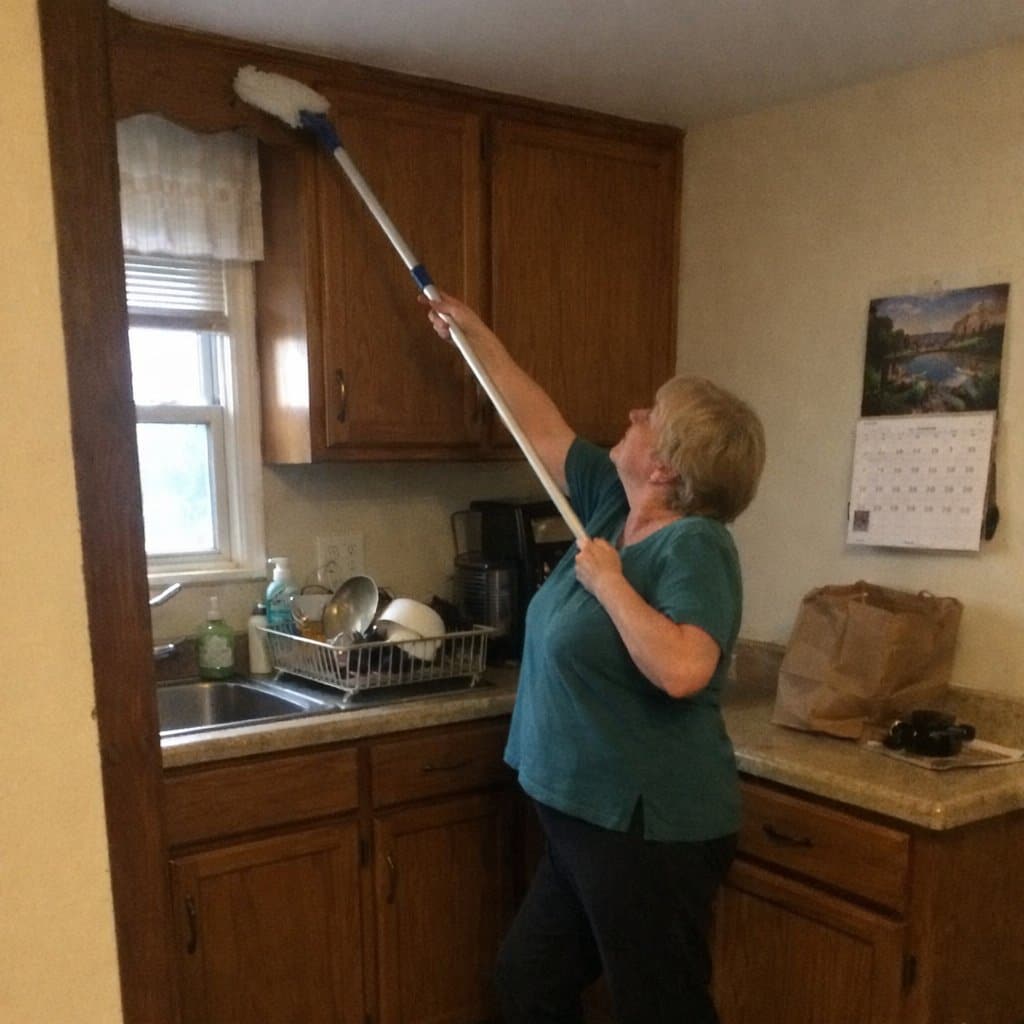
Making the Home Safer Beyond the Ladder — A Quick Caregiver Checklist
Small Changes That Add Up to Real Protection
Addressing ladder fall risk during cleaning is one piece of a broader home safety picture. These targeted changes take an afternoon and make a meaningful difference — both for bathroom safety and across the rest of the home.
Work through this checklist before the next cleaning day:
- Replace step stools and folding ladders used for cleaning with extended-reach dusting tools that allow the same tasks to be done from the floor
- Confirm every frequently cleaned surface — fans, fixtures, upper shelves — can be reached from floor level with the right tool in hand
- Clear pathways used during cleaning routines — the route from the supply closet to the living room fan matters, especially when hands are full
- Check lighting in all cleaning areas, including corners, upper surfaces, and any spot where a shadow could obscure a misstep — good lighting is one of the simplest and most overlooked safety upgrades in any home
- Secure rugs and mats near supply storage areas with non-slip backing — a mat that shifts underfoot while carrying cleaning supplies is its own fall risk
- Consider non-slip surfaces in areas where wet cleaning tools or spills are common
Fall Prevention Is a Series of Small Decisions
No single product or conversation eliminates all fall risk. But a series of small, targeted decisions — removing the ladder, improving the lighting, clearing the path — add up to meaningful, lasting protection.
This checklist turns what can feel like an overwhelming task into a manageable afternoon project. And once it’s done, the home is genuinely safer than it was before.
The Caregiver’s Ladder-Free Cleaning Safety Checklist: 20 Steps to Remove Fall Risk From Your Loved One’s Home Before the Next Cleaning Day
Download this room-by-room checklist to identify every ladder-dependent cleaning task in your loved one’s home and replace it with safer, floor-level alternatives—before the next cleaning day.
The Right Tool Protects Independence — It Doesn’t Limit It
Ladder falls during cleaning are preventable. That’s the most important thing to take away from everything above.
For caregivers: the best time to act on this is before a fall, not after. You don’t need to have a difficult conversation, set new rules, or intervene in how your loved one runs their home. You need to bring home the right tool and let it do the work quietly.
For older adults: choosing a smarter cleaning tool isn’t admitting defeat. It’s protecting the independence you’ve built — the clean home, the routines you’ve maintained for decades, the satisfaction of managing your own space. A long-handle duster keeps all of that intact. A ladder fall puts all of it at risk.
Start with one thing today. Walk through your home — or your loved one’s home — and identify the single spot that currently requires climbing to clean. Ask whether a ceiling fan duster or extendable long-handle duster would reach it from the floor. In most cases, it will.
If you’ve had a close call with a ladder at home — a wobble, a slip, a moment that made your heart race — I’d love to hear about it in the comments. What happened, and what did you do about it? Your experience might be exactly what someone else needs to read today.
And if you’re looking for more guidance on keeping your home safe and your independence intact, the fall prevention checklist is a great next step — along with a closer look at the safest step stool options for the rare occasions when reaching high is truly unavoidable.