High rods and deep cabinets push people onto step stools and down onto their knees. In my experience, the stool is the real danger, not the storage.
This guide shows you how to choose a pull-down closet rod for seniors, a pull-out shelf, or a corner organizer by matching the product's motion to your problem space. There are three motions: down, out, and around.
Reach-Friendly Storage Buying Checklist
Download this printable shopping checklist and measure your problem spaces once—then confidently choose storage solutions that actually match your reach, strength, and daily needs without guesswork or expensive mistakes.
What to Look for Before You Buy
Reaching overhead from a stool is where things tend to go wrong. A step stool can be a safe tool, but it shouldn't be your daily shelf-reaching plan.
The fix is to bring the storage to you. Here is what rules options in or out:
- Direction of travel decides the type: A pull-down rod moves vertically toward you. A pull-out shelf moves horizontally toward you. A corner organizer rotates the back of a space forward. Buying the wrong motion is the most common mistake.
- Measure rods first: Many pull-down mechanisms need roughly 8 to 12 inches of open space in front of the rod's travel path, plus enough closet width for the rod's stated length range. Confirm the exact figures on the manufacturer's spec sheet for your model.
- Measure shelves next: Measure the face-frame opening, not the cabinet box, because hinges and door frames reduce clearance. Then measure interior depth and door swing, and compare them to the manufacturer's stated minimums.
- Measure corners last: Note the door opening width, the interior space, and whether the cabinet is a blind corner or a standard L-shape.
- Check load ratings: Heavier loads need more pull force. Match the rating to what you store (cast iron is very different from plastic containers).
- Be honest about grip and strength: Ask whether you can work the bar, handle, or lever with the shoulder and hand strength you have today. Soft-close and ball-bearing slides reduce effort.
- Plan the installation: All three types need a one-time install. Wall-mounted closet hardware must anchor into studs or solid backing.
- Check materials: Steel is sturdy, plastic is lighter and cheaper, and wood looks warmer. Look for a finish that resists wear.
The trade-off is plain: each type needs enough depth or clearance and a proper installation. That makes this a planned home modification, not an impulse purchase.
Pull-Down Closet Rods
Brings a high hanging rod down to a comfortable height so you can reach clothes without a step stool. Helps anyone with reduced shoulder mobility or balance concerns.

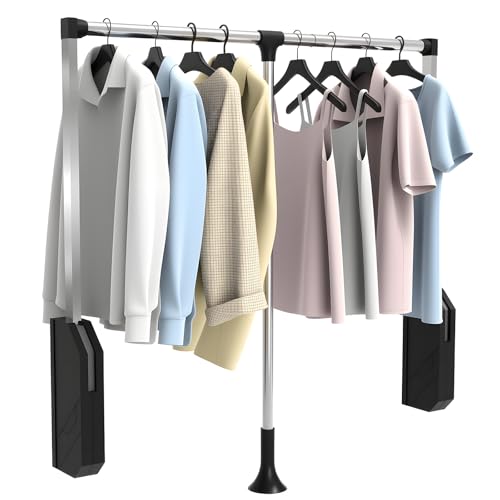


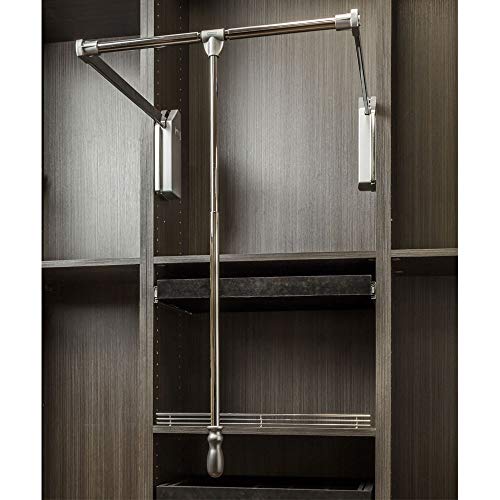
A pull-down rod lowers your hanging clothes toward you, then returns them to the high position. It is the only type here that solves vertical reach.
It suits anyone with reduced shoulder mobility who can no longer reach a high rod, especially in a closet with a single high rod and a tall ceiling.
It is the wrong choice if the closet lacks clearance above and below the travel path. It is also wrong if you can't manage the arm and grip effort the mechanism needs.
Pull-out shelves and corner organizers do nothing for a high rod. But a pull-down rod demands more installation precision than the others. Good light helps too, so see my guide to lighting that makes reaching and reading easier.
XIIW Pull Down Closet Rod
This stainless steel rod adjusts from 26 to 35 inches wide and is listed at a 60 pound capacity. That width range suits a narrower closet or a single section of a larger one.
The catch is the width limit. If your closet is wider than 35 inches, it won't fit. A full armload of heavy winter coats can also approach the stated capacity.
Ksdolip Pull Down Closet Rod
This one is the wider cousin, adjusting from 35 to 48 inches with the same listed 60 pound capacity. It fits a standard closet section where the XIIW is too short.
A longer rod carries more clothes across a wider span, so the load adds up quickly. Check the weight of what you hang before you buy.
Wardrobe Lift Soft-Close Pull Down Rod
This model is built from expanding heavy duty steel tubing and is listed as soft-close. A soft-close action means the rod returns gently instead of snapping up, which is easier to control.
The downside is installation. Heavier hardware needs solid anchoring into studs or backing, so plan on a handy relative or handyman, and confirm the stated capacity and clearance on the spec sheet.
Ready to discover more innovative strategies for healthy, comfortable aging? Subscribe to our newsletter for expert-tested tips and product recommendations designed specifically for older adults.
Pull-Out Cabinet Shelves
Slides the contents of a deep base cabinet out to you so you stop kneeling and reaching blindly. Helps with pots and pans cabinets and under-sink storage.


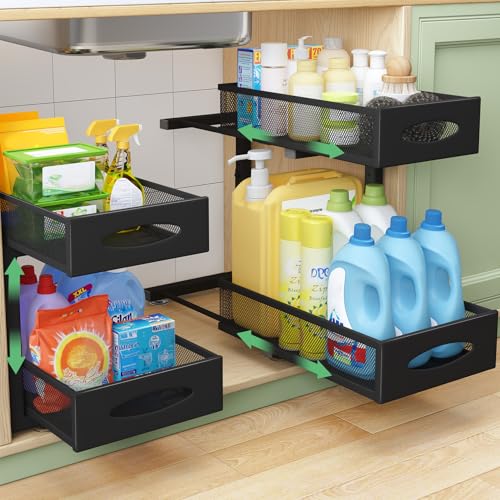

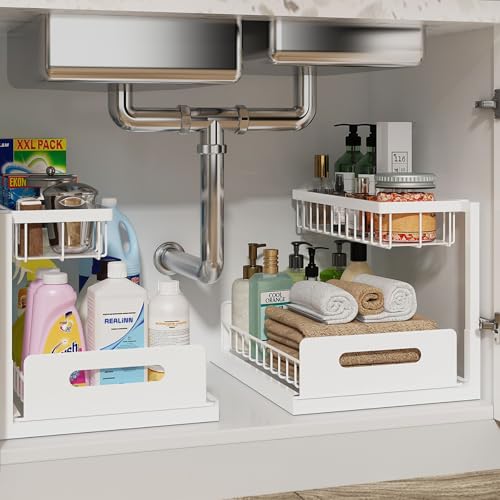
A pull-out shelf slides inside a base cabinet so items come to you. You stop kneeling and blindly reaching for the back of the pots and pans cabinet.
It suits anyone who crouches or kneels at low cabinets. It is wrong for cabinets that are too shallow or narrow for the hardware, or that have center stiles or inside hinges blocking the slide.
It solves depth better than anything else here, but it does nothing for high storage or deep corners. Pull force also climbs with load. If your pots are heavy, consider lightweight cookware so the shelf stays easy to pull.
Under-sink cabinets can use the same approach, and it pairs well with the bathroom accessories that keep that room safer.
Kitstorack Pull Out Cabinet Organizer
This heavy duty slide-out drawer is listed as expandable from 12 to 20 inches, so it adapts to different cabinet sizes. It suits someone who wants a fitted shelf without custom carpentry.
The limit is fit. Your opening has to be wide and deep enough, and pull force rises as you load it, so keep the heaviest items lighter than you think.
Seinloes Expandable Pull Out Cabinet Organizer
This two-pack is listed at 21 inches deep and includes a raising pad for framed cabinets. That pad matters when a face frame lip would otherwise snag the sliding drawer.
The trade-off is depth. A cabinet shallower than the listed depth won't take it, so measure inside before ordering.
REALINN L-Shaped Under Sink Organizer
This two-tier, L-shaped organizer is designed to work around under-sink plumbing. It suits a bathroom or kitchen sink cabinet where a plain shelf won't fit.
The downside is that plumbing layouts vary. Compare the L-shape to your pipes and the opening before you commit.
Subscribe to our newsletter for more tips: Join here
Lazy Susans and Corner Organizers
A lazy susan is a rotating tray that brings the back of a corner cabinet forward. It suits corner cabinets where fixed shelving leaves a dead zone you can only reach by leaning in.
It is wrong for high storage, and it won't recover every inch of the corner. Items on the outer edge can still need a moderate reach.
It is the only type designed for blind corners, and generally the easiest and cheapest to install. But it reclaims less space than a custom pull-out. Match the shape to your door opening: kidney, pie-cut, or full-circle.
Rev-A-Shelf 24 Inch Kidney Shaped Dual Tier Lazy Susan

This dual-tier kidney shape is made for corner base cabinets. Two tiers let you split items by weight, with heavier things on the lower level.
The limit is size. A 24 inch unit only fits a corner cabinet that can hold it, and a higher rim keeps things from sliding but makes reaching in harder.
JOWBOOW Kidney Shape 28 Inch Corner Cabinet Lazy Susan

This is sold as replacement shelves, so it suits someone whose existing lazy susan hardware still works. It is a 28 inch kidney shape.
The catch is compatibility. Replacement shelves only help if they match your current pole and mounting, so check before you buy.
Rev-A-Shelf 28 Inch Two Tier Pie-Cut Lazy Susan

This plastic pie-cut model suits a standard L-shaped corner base cabinet. Plastic is lighter, and it is easy to wipe clean.
The downside is capacity. Plastic suits lighter loads, so keep cast iron and other heavy items elsewhere.
Frequently Asked Questions
How much clearance does a pull-down closet rod need? Many mechanisms need roughly 8 to 12 inches of open space in front of the rod's travel path. Confirm the exact figure on your model's spec sheet.
What cabinet depth do I need for pull-out shelves? It depends on the product. Seinloes, for example, lists 21 inches deep, so check each manufacturer's minimum depth and opening width.
Do pull-down rods require a strong grip? It depends on the model and how much you hang. Soft-close or lever designs and lighter loads reduce the effort, but check the stated force on the spec sheet.
Can I install these myself? If you are comfortable with a drill and finding studs, yes. Otherwise a handy relative or handyman can do it, and home repair help for seniors may be available locally.
Hacks and Advice
- Do this first: List every spot where you reach above shoulder height or bend below knee level.
- Measure twice: Record depth, width, and clearance before you open any shopping tab.
- Move heavy items first: Relocate the heaviest pots and containers to waist-to-chest height before choosing hardware.
- Avoid the common mistake: Don't buy by appearance. Match the motion to the problem.
- Check once a year: Tighten screws, test slides, and re-check the load as your storage habits change. My fall prevention checklist is a good companion for that walkthrough.
Reach-Friendly Storage Buying Checklist
Download this printable shopping checklist and measure your problem spaces once—then confidently choose storage solutions that actually match your reach, strength, and daily needs without guesswork or expensive mistakes.
Conclusion
The stool is the hazard, and matching direction of travel is the fix: down for high rods, out for deep cabinets, around for corners.
Because these products need depth, clearance, and a proper install, treat them as a planned modification, not an impulse buy.
Today, walk through one kitchen cabinet and one closet. Note every spot where you reach above shoulder height or bend below knee level. That list is the starting point for a Home Safety and Independent Living Assessment conversation, which I'm glad to offer if you'd like a second set of eyes. Just reach out to me through Graying With Grace.
Which closet or cabinet is your biggest reach problem? Tell me in the comments.