Seniors with dementia or Alzheimer’s disease may show agitation or anxiety through fidgety hands. Signs include rubbing or pulling at bedding or clothes, wringing hands, twisting fingers, rubbing hands together, and keeping their hands in motion.
Sometimes they choose activities that can cause injury and lower their quality of life. I hope to give you plenty of ideas that improve their well-being instead.
If you want easy activities for a loved one with dementia, or crafts they can enjoy, you’ll find both here. If you’re after sit-down games, you’ll also find how to match activities to the early, middle and late stages.
If you’re in a hurry, my top picks for keeping busy hands busy are right here, and the details on each one, good and bad, are further down the page.



Why Do Dementia Patients Fidget?
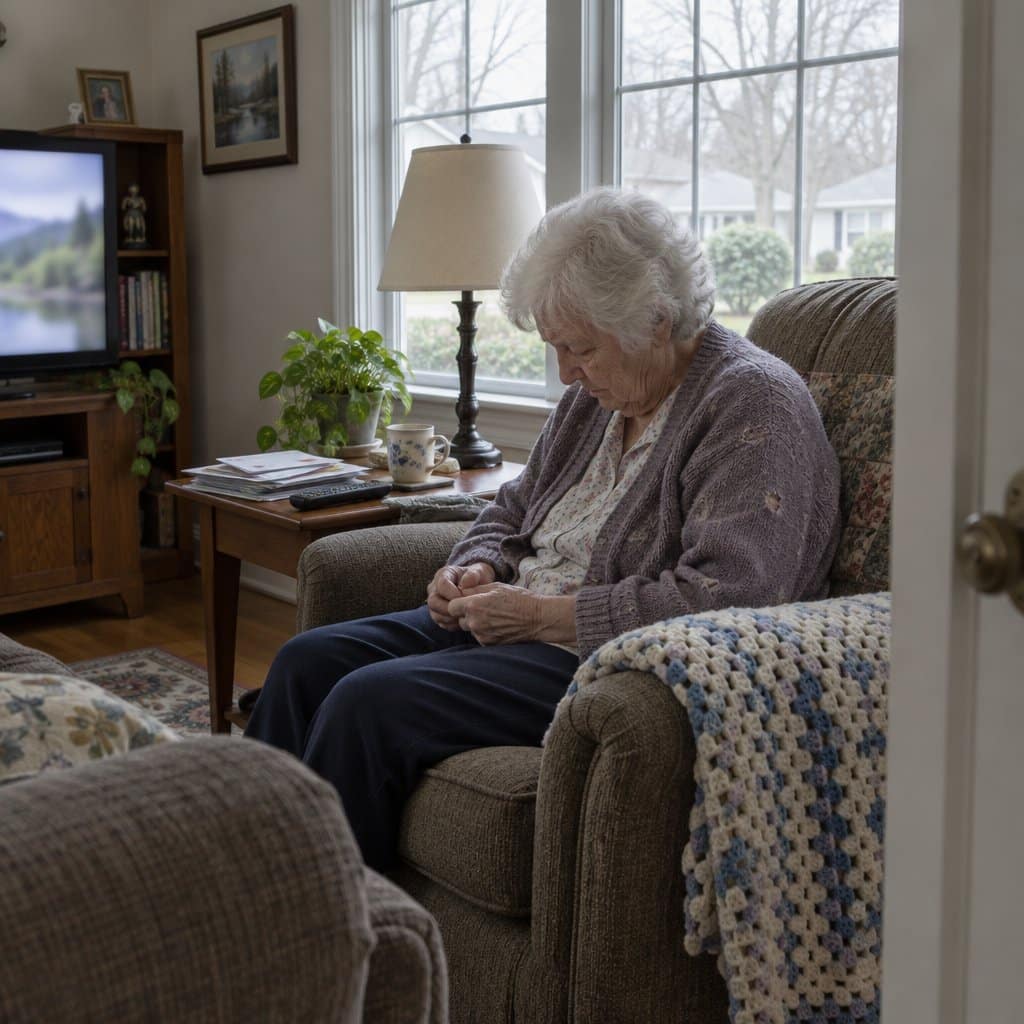
If a dementia patient is anxious or stressed, you can usually see it in their hands.
They are likely to pull at their clothes, wring their hands, rub their skin, or twist their fingers if they are afraid, upset, or agitated.
Fidgeting and associated behaviors are how people with dementia deal with their discomfort.
How Can You Choose Activities for People with Dementia that Are Safe?
Activities are key to keeping a dementia patient’s hands busy to help with the fidgeting, but it isn’t always easy to choose the right ones. Ideally, you should plan activities that the person with dementia enjoys in his/her daily routine.
To ensure that you only choose activities that are safe and help the person enjoy them:
- Match the activities with the person’s capabilities and cognitive function
- Pick activities that are fun for all
- Watch to see whether or not the person becomes frustrated
- Determine whether the person can do the activity alone or needs help
- Avoid overstimulating the person – try a new activity for only a few minutes the first time
- Focus on enjoyment as opposed to achievement
- If it’s more enjoyable, let the person watch
- Help the person get started
- Be careful with small items that can easily be placed in the mouth.
Matching Activities to Early, Middle and Late Stage Dementia
What works in the early stage will frustrate someone in the middle stage, and the late stage is a different job again. Here is how I would match things up, and it is fine to move back a step on a bad day.
Early stage. Your loved one can still enjoy many favorite pastimes with small changes. Aim for just enough challenge to build confidence.
For the mind, try large-piece jigsaw puzzles, crosswords and word searches in large print, sudoku, and matching games. Slide puzzles and bubble word search are two more options.
For company, try classic board games and card games, and relax the rules as needed. For movement, try beanbag toss, seated exercise to music, or virtual reality games.
Tablets can offer word game apps and virtual board games with adjustable difficulty. Hobbies can carry on too, such as a gardening station with raised beds, adapted cooking with pre-measured ingredients, or a reading nook with large print.
Middle stage. Your loved one needs simpler activities and more support. Pick things that use the abilities still there, and do not correct mistakes or rush.
Good choices are puzzles with fewer, larger pieces, sorting games, stacking toys, and fidget blankets. Scented hand massages, nature baskets, singalongs, simple shakers or drums, big crayons, play dough, and photo albums or memory boxes also suit this stage. Focus on color, texture and motion rather than the finished product.
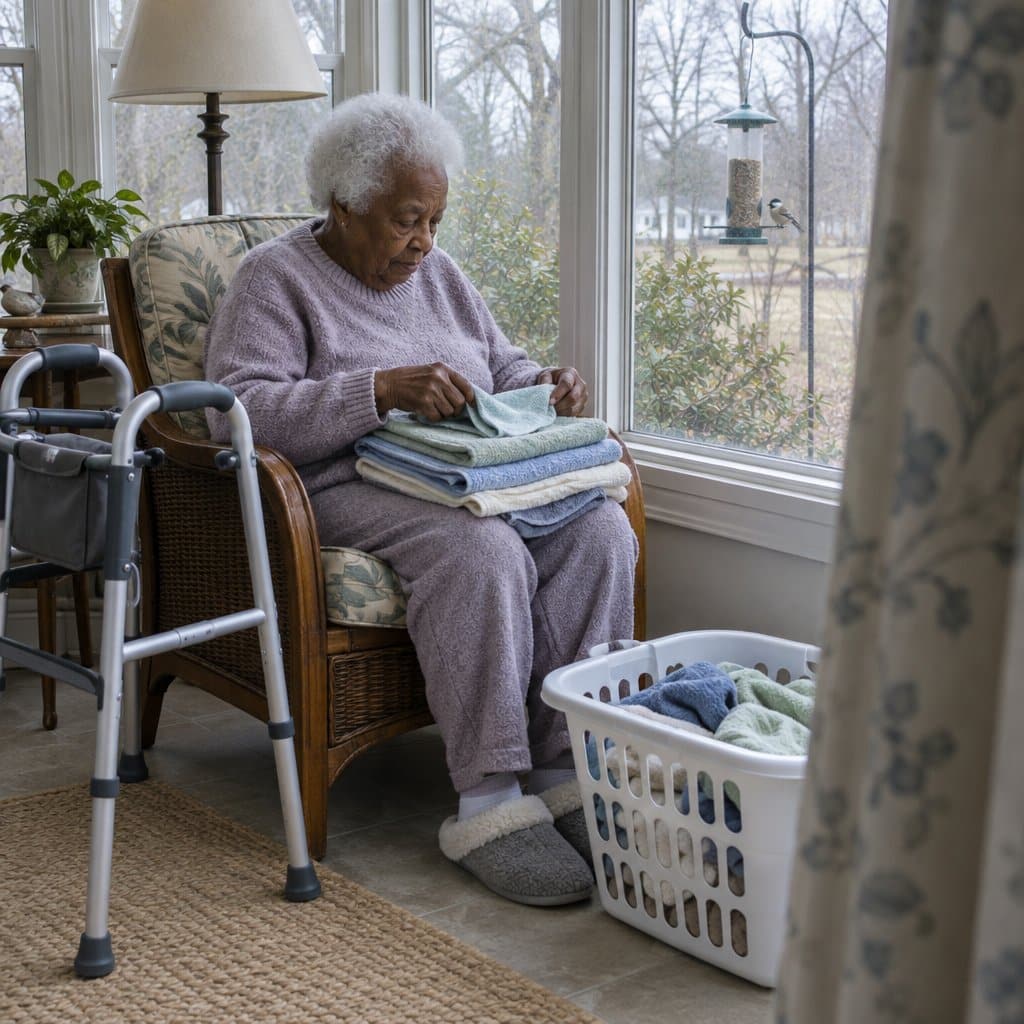
Late stage. Structured games may no longer be possible, so the focus shifts to comfort and dignity. Try hand massages, soft brushing of the hair, calm music, or sitting by a window to watch birds.
Folding soft towels or sorting socks still gives a sense of purpose. So can familiar hymns or prayers, or holidays with special foods or decorations. Sitting quietly and holding hands counts as an activity too.
Wherever your loved one is, set up a calm space with good lighting. The activity space guide covers this, and a corner of the living room can work well, with mobility aids kept in reach. If relatives live far away, a video chat can carry a game or a singalong.
One trade-off: stages do not change on a schedule, so expect to adjust as you go.
Top Ideas to Help Seniors with Dementia Keep Their Hands Busy
1. Fidget Blankets
People with dementia or Alzheimer’s disease often develop repetitive motions or fidgeting patterns. Unfortunately, while fidgeting can be soothing for some people, it can be distressing and cause anxiety for people with dementia or Alzheimer’s.
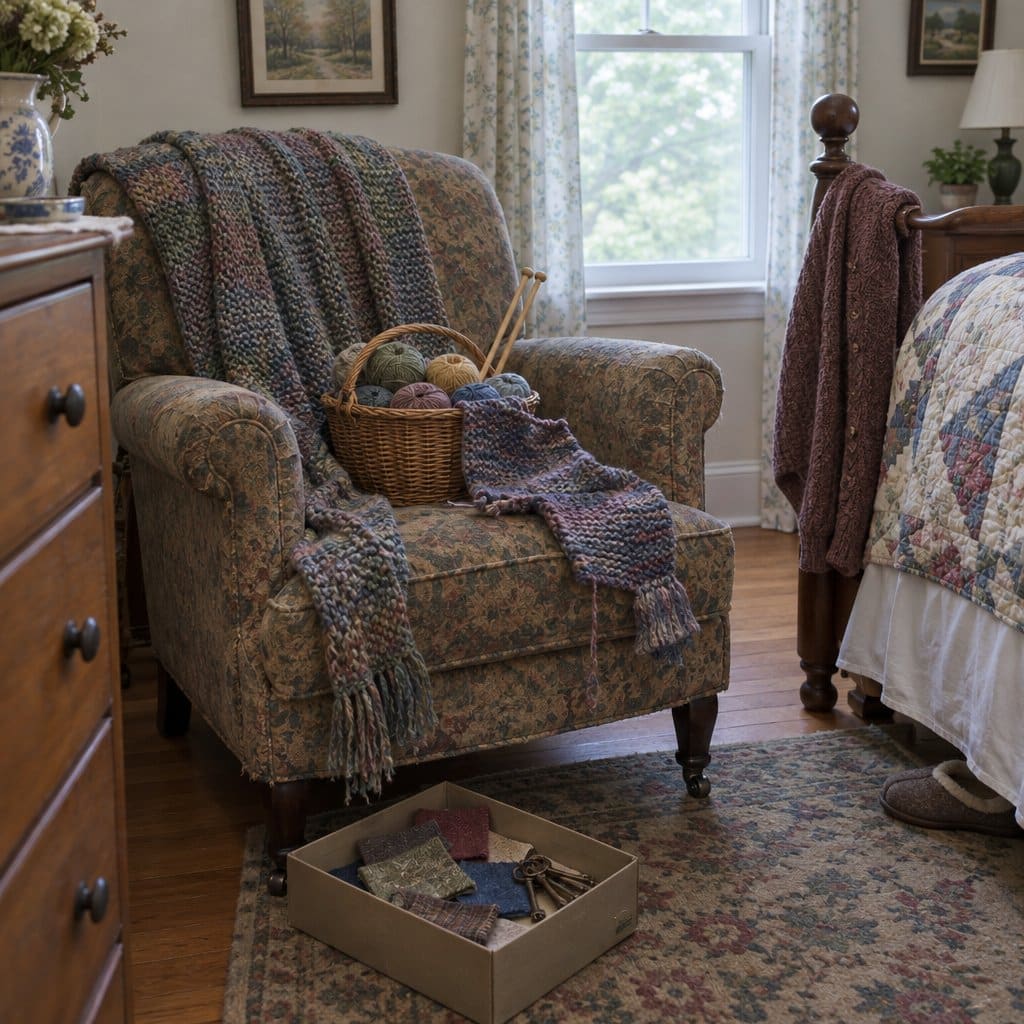
Fidget blankets can be an effective way to restore calm in dementia patients. Fidget blankets, which are also known as sensory mats provide a stimulating and soothing activity for people living with dementia or Alzheimer’s disease.
2. Fiddle Boxes/Busy Boards
Fiddle Boxes or busy boards are a similar concept to fidget blankets. A fiddle box is simply a box filled with items that provide a variety of tactile stimulation. Similarly, a busy board is a board filled with items that offer various tactile experiences too.
You can either buy ready-made fiddle boxes or busy boards or you can make your own for the elderly person in your care. When you put together a fiddle box or busy board, you should consider the person’s interests or hobbies.
You don’t even have to spend a fortune making fiddle boxes or busy boards. You can fill the container/board with readily available inexpensive materials.
Gather items in different textures and colors such as:
- Cloth swatches of various textures
- Mini stuffed animals
- Brightly colored plastic springs
- Little wind-up toys
- Items with Velcro closures or zippers
- Old keys on a keyring
3. Hand Muffs
Dementia patients often have restless hands especially if they had been accustomed to performing manual activities such as typing, knitting, or even playing a musical instrument prior to the onset of dementia/Alzheimer’s.
Hand muffs are a type of sensory band, usually a glove or pocket with attachments both inside and out. The attachments are a variety of items the person can fiddle and twiddle with their fingers.
Fiddling and twiddling provide a soothing sensation for those with dementia.
4. Sensory Toys and Activities for Seniors with Dementia
Sensory stimulation challenges the 5 senses in new ways in dementia patients and this can help spark old memories. Sensory activities and toys can help dementia patients recall positive emotions and memories.
Here are some of the sensory toys and products that dementia patients can enjoy:
- Stroking an animal
- Stroking different textured materials
- Smelling fresh flowers
- Rubbing a soft fleece blanket
- Brushing hair
- Flipping and spinning coins.
- Dressing and caring for dolls, especially in late stages
- Foot, neck, and hand massage
- Visiting a flower show or herb farm
- Using fragrant essential oils
5. Knitting/Crotchet
If the dementia patient used to crotchet or knit, you can consider getting some large gauge hooks or needles along with brightly colored yarn.
Activities such as knitting or crotcheting require a good deal of concentration and skill. The person may still find the repetitive activity enjoyable even if they don’t end up making the best scarves.
6. Household Chores/Everyday Activities
You might assume that household chores are tedious, but for dementia patients, they are rewarding. They help the senior gain a sense of accomplishment and independence.
In fact, the person may get agitated if you leave them alone to take care of essential household tasks such as laundry.
If so, try finding ways for the dementia patient to help with the following:
- Folding laundry
- Organizing paperwork
- Smoothing crumpled tissue paper
- Playing with paperclips
- Shuffling and arranging a deck of cards
The activities above might not always be performed up to your standard by the dementia patient, but he/she will enjoy feeling helpful.
7. Games for Dementia
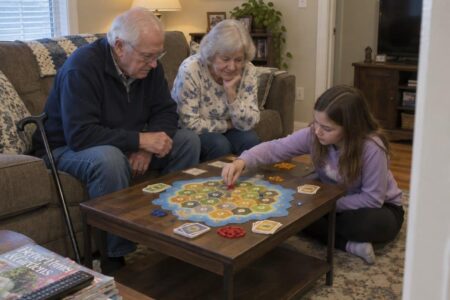
Simple but fun activities such as games sometimes produce the best results. Not only are such games familiar to your loved one and relatively easy to participate in, but they can help the person feel productive.
You probably have several options of games for people with dementia in your closets you can use right now.
Here are some games you should try playing with the dementia patient:
- Dominoes
- Matching game
- Playing cards
- Crosswords
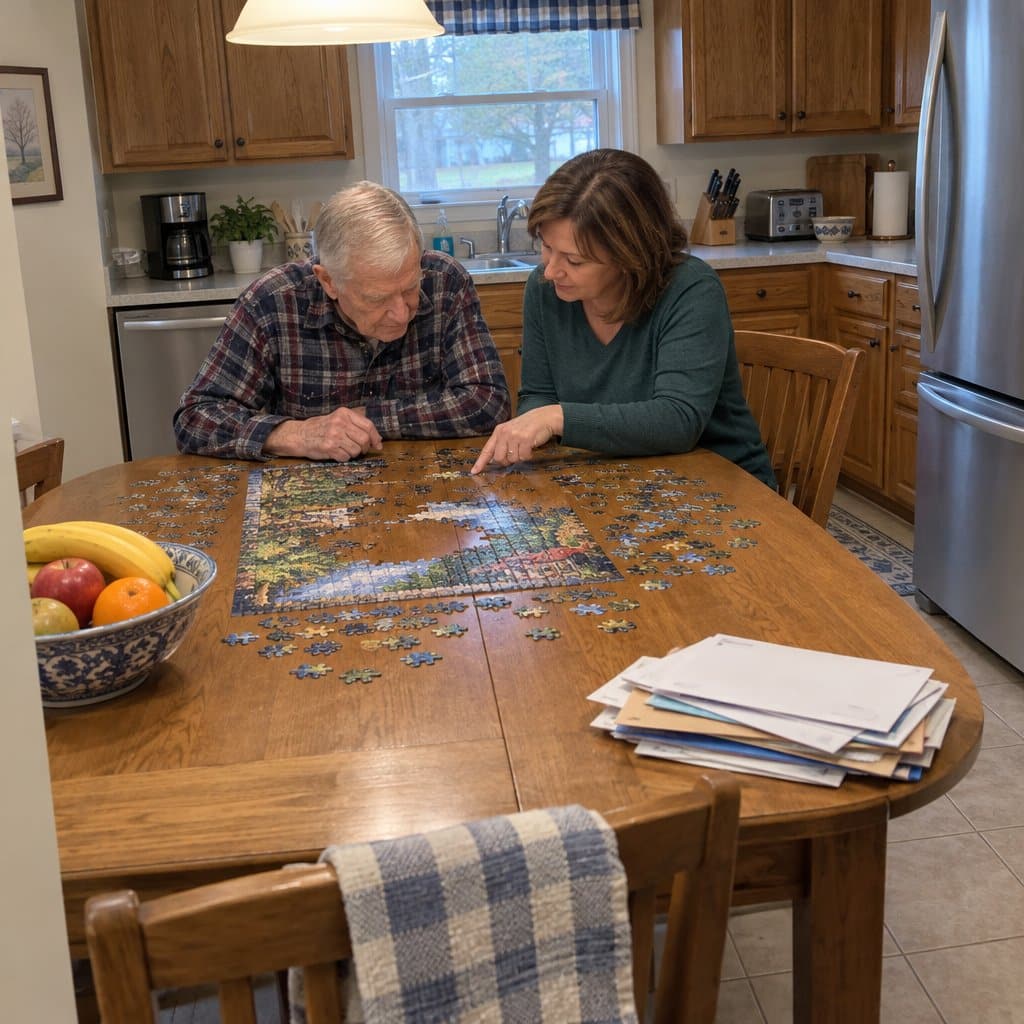
- Jigsaw puzzles with large pieces
- Old board games such as Scrabble and Snakes and Ladders
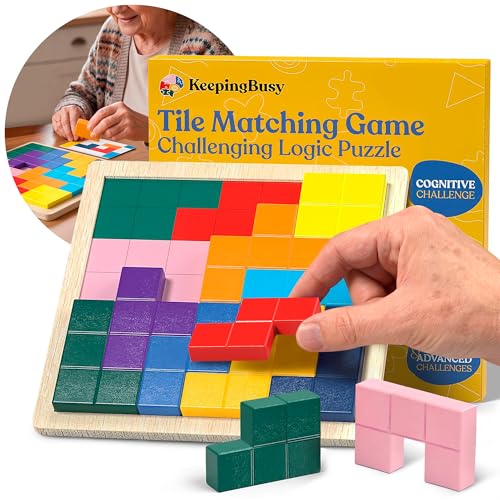
Keeping Busy Tile Matching Game

This is a wooden tile-matching kit made for people with dementia. You match chunky solid-wood pieces to a template, so the goal is clear and the activity can be finished.
It has three difficulty levels, and that is the best part. A caregiver can start easy and move up, or step back down on a tougher day. The same set can also keep working as abilities change over time. The pieces are easy to grip and built to handle daily use.
It comes with 26 templates and a compact storage box, so it works at home or in a memory care setting.
The trade-off is that it works best when you start at the right level. That takes some judgment from you at the beginning, and a level that is too hard will frustrate the person quickly. Also watch the templates. Paper sheets wear faster than laminated card if they get handled every day.
QUOKKA Memory Card Game

This is a phrase-matching card game made for older adults with memory concerns. It comes with 202 cards across two difficulty levels, with visual clues to help, so there is plenty of variety before anything repeats.
The text is extra-large, bold, and high contrast, so the cards are easy to read at arm’s length. The card backs are numbered and there is an answer sheet, so a person can check their own answers and play alone. Nobody has to sit there refereeing, and nobody feels quizzed.
The trade-off is that it is built on phrases. Someone in more advanced dementia may find it too much, even with the visual clues. It is also a way to keep a mind and a pair of hands busy, not a medical treatment, so expect a pleasant activity and not a cure.
8. Puzzles
Dementia deteriorates the brain, which is why patients need cognitive stimulation to keep the brain active and engaged.
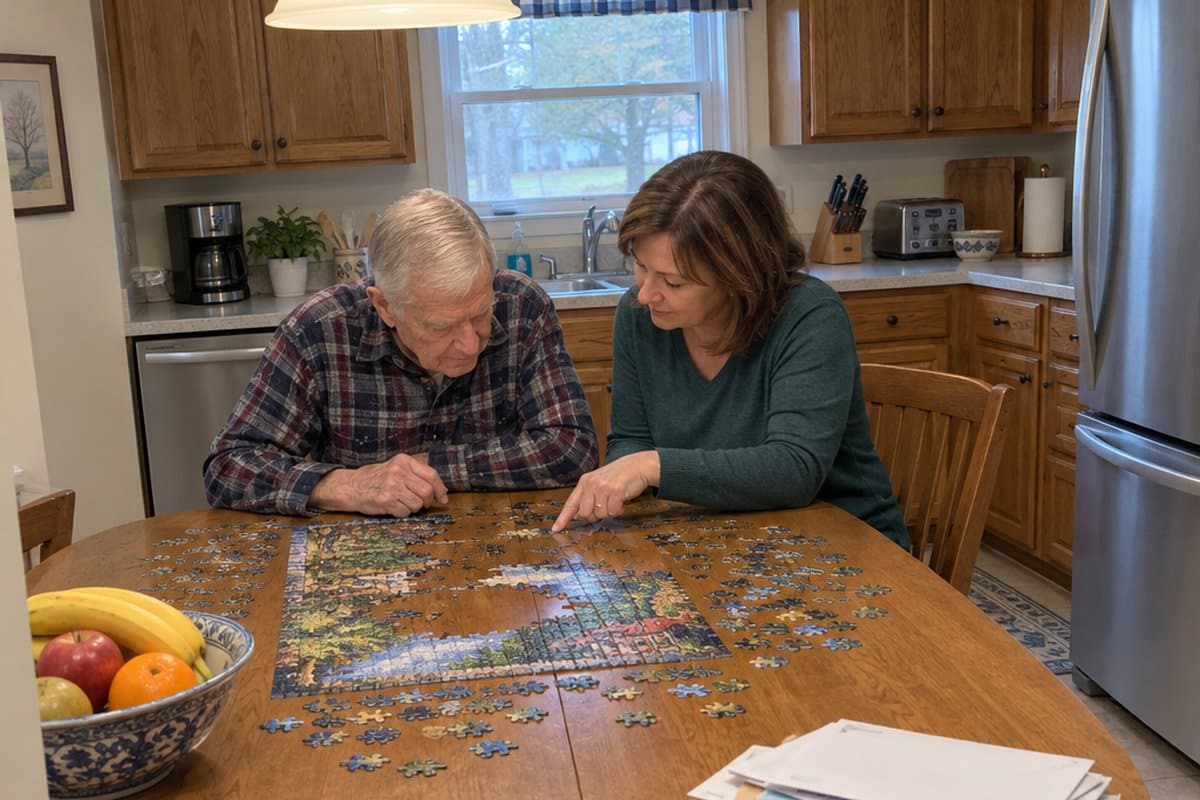
Fortunately, puzzles provide dementia patients with mental stimulation, provide comfort, and could potentially ease some of the symptoms of the disease since they are a wonderful discussion that can be done individually or as a group activity.
Large print puzzle books are available in easier versions that may provide a few minutes of mental stimulation.

Yigney Jigsaw Puzzle for Seniors

This is a set of six large-format jigsaw puzzles, 48 pieces each, packed together in one storage box. The piece count is aimed at the difficulty range occupational therapists recommend for mid-stage dementia, so it’s enough to feel like a real puzzle without turning into a chore.
Each puzzle has a different picture, and each comes with a full-size reference poster of the finished image. That helps a lot. Someone who gets stuck can look at the poster and keep going instead of giving up. The box doesn’t mention dementia or Alzheimer’s anywhere, so it also works as a gift without feeling like a label. Everything stores back in the one box, which is handy at home or in a care setting.
The trade-off: 48 pieces may feel too easy for someone in the early stage, or for a lifelong puzzle fan who will want more of a challenge. And if the puzzles get heavy daily use, keep an eye on the pieces, since durability under repeated use isn’t fully confirmed.
9. Hobbies and Crafts
Activities to keep dementia patients’ hands occupied can include tasks they engaged in prior to the condition.
Hobbies such as flower arranging and baking can be enjoyed by the dementia patient and the finished results are something that they can be proud of.
Gardening is another popular activity that a dementia patient can enjoy. You can consider providing specially constructed raised beds that are easier for seniors to work on.
Growing their own vegetables can also give dementia patients a sense of achievement. Plus a physical activity like this helps overall health.
Crafts too can be a great way to keep the hands of dementia patients occupied and provide some creative expression.
Simple crafts that guarantee good results are usually ideal for dementia patients such as stacking up party cups, making scrapbooks, matching and sorting picture cards, playing with homemade play dough, etc.
QUOKKA Water Painting Activities
This is a water painting kit with a farm memories theme. You wet the brush, brush over the picture, and the colors appear. There is no paint, no choosing colors, and no scissors or glue, so there is nothing to spill and nothing to get wrong.
That is what makes it a good fit for early- to mid-stage dementia. With so few decisions to make, there is less room for frustration. The sheets are also reusable: the picture disappears as it dries and comes back when you add water, so one set can last through many sessions.
Two things to know. The picture fades as the paper dries, so if you or your loved one expects a finished piece to hang on the fridge, this will not give you one. The kit also comes with only one brush, and the handle may be too thin for someone with arthritis or a weak grip. A thicker-handled brush from the craft aisle could solve that.
10. Exercise and Outdoor Activities for Dementia
Exercise and outdoor activities can have numerous benefits for people with dementia.
They can help improve brain function and thinking skills, regulate their sleep, and can help maintain a positive mood in dementia patients and lower the risk of them developing depression.
Physical activities help overall cardiac and breathing health as well.
Exercise and outdoor activities dementia patients can engage in include:
- Riding Three Wheeled Bikes
- Fishing and Hiking
- Walking around the local park
11. Music and Art Activities for Seniors
Art and Music are a wonderful way of letting dementia patients explore their creative side through self-expression. Such activities can elicit powerful emotional responses and help them reconnect with memories.
Nostalgia can be an excellent way to help the person with dementia connect with their past.
Activities to consider include:
- Knitting
- Painting pictures of fruits and other common objects
- Drawing homes they have lived in
- Adult coloring
- Reproducing their favorite photo of a loved one
- Listening to their favorite songs, band, singer, or genre together
- Creating a Spotify playlist of their favorite genre or artist
- Explore art museums.
The Simplest Music Player Available
Audiocrazy Vintage Alarm Clock Radio


The Audiocrazy Vintage Wooden Radio in Deep Walnut is an alarm clock, an AM/FM radio and a Bluetooth speaker in one device. It has a warm walnut look that fits on a nightstand, and it needs no apps or streaming accounts.
For someone with dementia, the appeal is a radio that looks and works like the ones they grew up with. It holds 80 AM/FM presets, so a caregiver can save favorite stations once and nobody has to retune each morning. Tap-to-snooze and a sleep timer are handy at bedtime, and the clear display makes the time easy to read.
The trade-off is setup. Saving the presets and setting the alarm takes patience and may need a family member’s help. If the power flickers, the clock may also need to be reset, so it works best where a caregiver checks in regularly. It also has more features than some people need, so if you want a single button and nothing else, a simpler player may suit better.
12. Social and Emotional Activities
Engaging people with dementia in regular physical, social, and emotional activities is a promising strategy for keeping the condition at bay. The activities you choose should result in lifestyle change and long-term activity participation.
Examples include:
- Reading with or to them
- Going on a short outing in nature
- Baking something or cooking meals together
- Watching a movie, TV show, or family videos together
- Sing their favorites songs as a group
- Go to museums and festivals as a group
- Make a memory box with other members of the family
- Have them tell stories or read books out loud
13. Technological Activities
Technologies such as computers, tablets, and smartphones allow seniors to stay connected with family and friends. Technology allows a person with dementia to create and express himself/herself in a wide range of ways, which include:
- Using a desktop PC, laptop, or tablet to play screen-based games
- Using an easy-to-use digital camera to capture new memories in the form of photos and/or video
- Accessing the Internet to search for photos or other resources
- Using a console to play video games
- Using a scanner to digitize existing photos or documents.
Frequently Asked Questions:
Do activities matter for a person in the later stages of dementia?
Activities do matter for a person in the later stages of dementia. They help keep the person occupied and engaged and allow them to use their energy in a positive way.
Activities also help in reducing common but challenging dementia behaviors such as repeated questions, agitation, and anger.
How do you make a dementia patient happy?
If a person with dementia gets suitable surroundings, they can lead productive, satisfying, and most importantly, happy lives for many years after the initial diagnosis.
The happier they are the less likely they are to get angry or start exhibiting worrisome behavior. Here are some effective tips for making a dementia patient happy:
- Providing emotional support and a relaxed environment
- Helping the person feel safe and comfortable
- Spending time talking to them and relaxing with them
- Adding fun activities
- Adding meaningful activities
Do dementia patients feel bored?
Yes, just like everyone else, dementia patients may feel bored from time to time. Unfortunately, when they are no longer able to plan their own activities, the boredom may easily turn to frustration.
The person may become agitated and start wandering the house, simply because his/her mind has been idle for too long. Activities that will keep dementia patients busy and engaged can help get rid of boredom.
Should dementia patients watch TV?
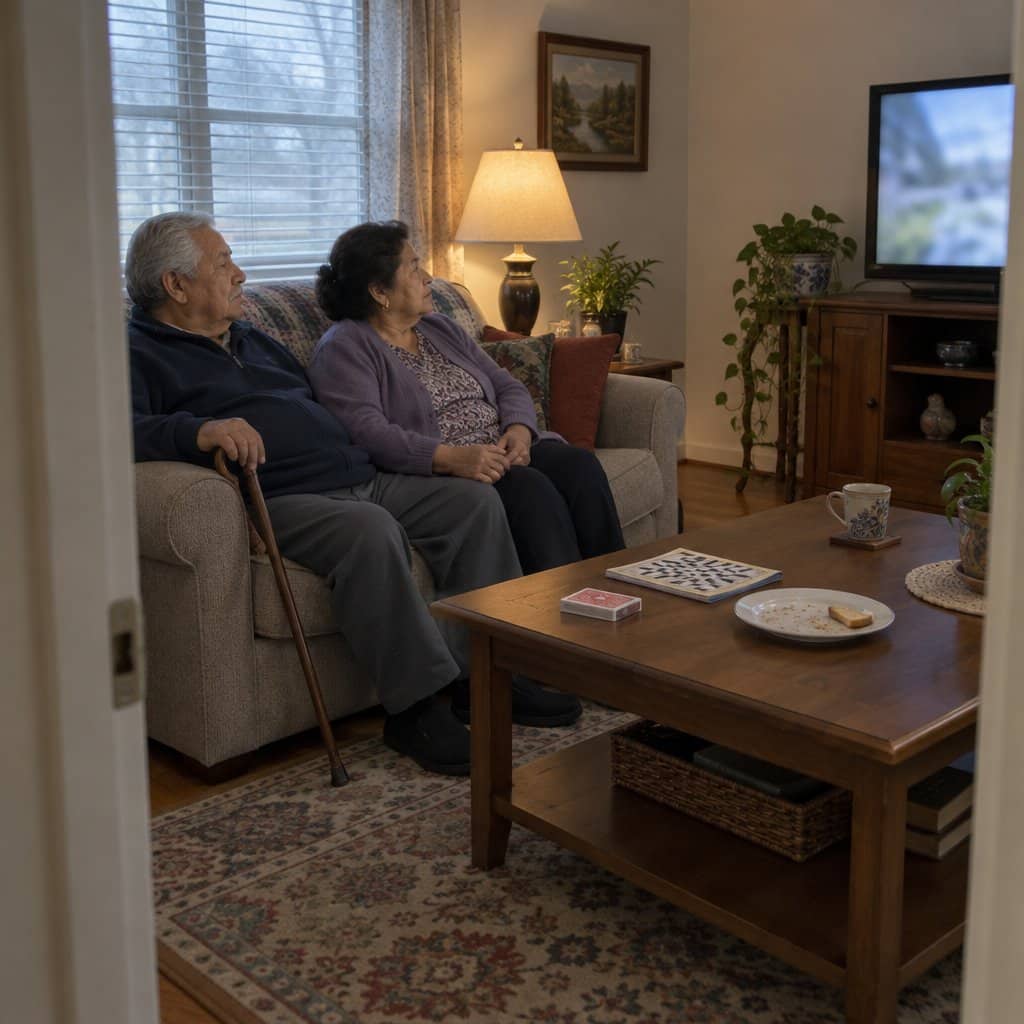
Watching TV is a popular leisure activity for many older people, but it can become a challenge when disturbed by dementia symptoms. It is generally advisable not to allow dementia patients to watch TV unsupervised.
However, watching TV with a caregiver or a person close to them can be good for the emotional well-being of the dementia patient.
Is coloring good for dementia patients?
Coloring is a good activity for dementia patients since it shows positive outcomes, most notably a decrease in anxiety and agitation.
The therapeutic value of activities like coloring partly comes from the person’s need to concentrate and participate so that they essentially stop thinking about their troubles while coloring.
Do dementia patients feel lonely?
Dementia patients can still experience emotions such as loneliness.
The person may no longer move independently or even hold a conversation but he/she will respond positively to close attention using the eyes for communication or hands for touching and making connections.
Summary
Seniors with dementia need to keep their hands engaged to ensure that they don’t become agitated or frustrated. The best way to do that is by engaging in activities.
This resource of activities for seniors in various stages of dementia should be meaningful and appropriate to their manual dexterity and logic processing ability.
They should also be simple to accomplish and judgment-free. They should help improve their quality of life not add to their frustration.
Try finding a balance between tactile and cognitive activities since the dementia patient is likely to find them more interesting if both the mind and body are stimulated.
Provide lots of verbal communication and written instructions and don’t be afraid to provide a demonstration if necessary. The activity area should also be kept uncluttered, clean, and well-lit.
I hope this article has given you several ideas for activities that a senior you love can do to keep their hands busy. Choose a few activities you think are a good fit based on their illness level and try them out.
Be prepared to make a few notes – this could be a trial-and-error exercise until you find the best choice you them.
Sources:
- https://www.betterhealth.vic.gov.au/health/ConditionsAndTreatments/dementia-activities-and-exercise
- https://www.dementia.org.au/about-dementia/i-am-a-carer-family-member-or-friend/activities-for-people-with-dementia
- https://www.nia.nih.gov/health/adapting-activities-people-alzheimers-disease
- https://www.nia.nih.gov/health/managing-personality-and-behavior-changes-alzheimers
- https://www.ncbi.nlm.nih.gov/pmc/articles/PMC2585781/
- https://www.scie.org.uk/dementia/living-with-dementia/keeping-active/activity-in-later-stages.asp
- https://www.ncbi.nlm.nih.gov/pmc/articles/PMC4404928/#:~:text=Conclusion,may%20even%20provide%20quality%20time.