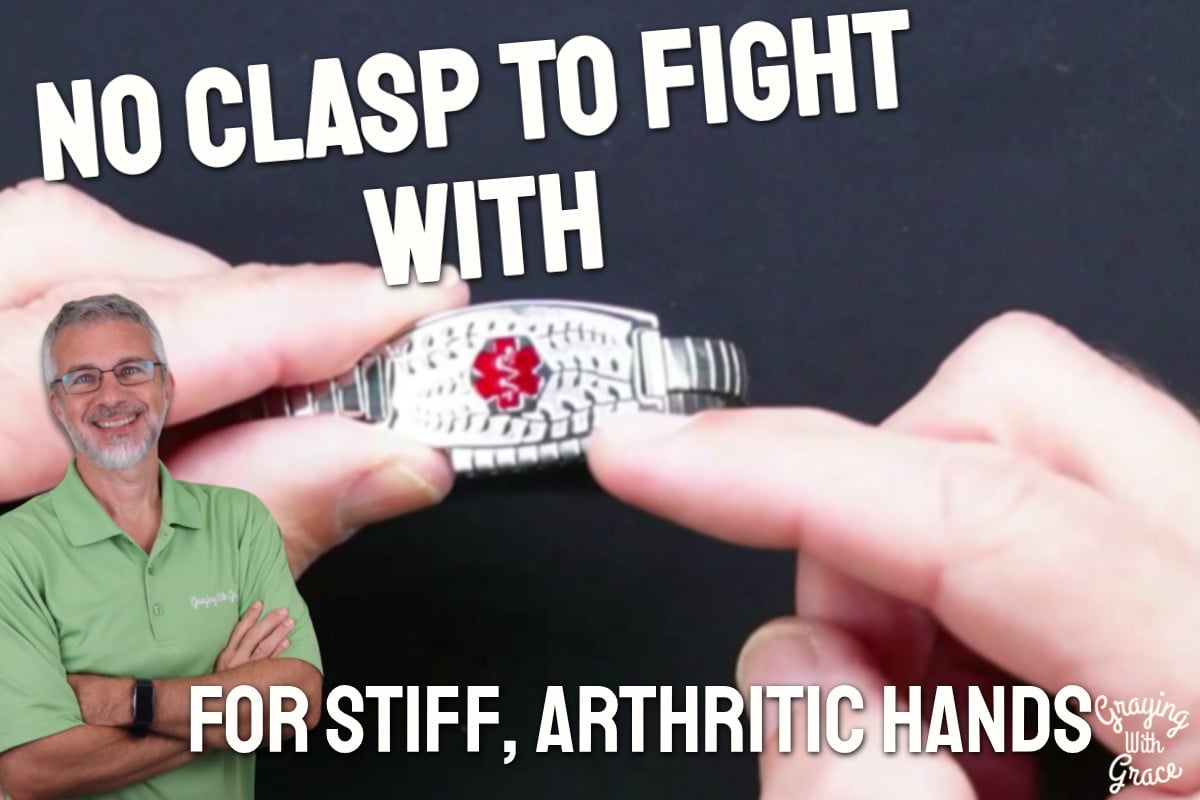
Here’s a question I ask a lot of folks in my work as a Senior Home Safety Specialist: do you have a medical ID bracelet sitting in a drawer somewhere because you just can’t deal with the clasp anymore?
If you nodded yes, you’re far from alone. A medical ID bracelet for arthritis needs to solve one very specific problem: tiny clasps, hooks, and buckles that stiff or shaky fingers simply cannot manage, especially first thing in the morning or at the end of a long day.
I’m Scott Grant, a Certified Senior Advisor (CSA(R)) and Senior Home Safety Specialist (SHSS(R)), and I got my hands on this one so I could test the fit, the engraving, and the everyday feel for myself.
Divoti sent me this product at no cost so I could test it out and show you how it works.
In this review, I’ll walk you through exactly what I found when I slipped it on, measured it against my own wrist, and dug into the engraving and privacy design. Let’s take a closer look at whether this is the easy-on medical alert bracelet you’ve been searching for.


Quick Takeaways
- Problem it solves: No more fighting with a tiny clasp just to wear your medical ID.
- Who benefits most: Women with arthritis, tremors, limited grip strength, or anyone who’s given up on traditional medical ID bracelets.
- Worth the investment: Yes, if daily wearability has been your biggest obstacle to wearing a medical ID at all.
- Best feature for seniors: The slip-on, no-clasp stretch design that goes on in one motion.
- Biggest limitation: It’s one size fits most within a specific wrist range, not a trim-to-fit or fully adjustable band.
Who This Is For
If you’ve typed “medical ID bracelet for stiff fingers” into a search bar at some point, this is exactly the situation the Divoti Stretch Medical ID Bracelet was built for. The stretch band eliminates the clasp altogether, so there’s nothing small to pinch, twist, or line up.
If you’ve got a parent or spouse who “can’t work a bracelet clasp” anymore and has quietly stopped wearing their medical alert jewelry, this solves that exact frustration. It slides on like a watch band and tightens itself, no assistance required.
If you’ve been searching for a slip-on medical alert bracelet because tremors make fine motor tasks unpredictable, this band’s self-tightening design means you don’t need steady hands to get it secured. You just need to get it over your knuckles.
How This Could Help You
Think about how many times a day you touch your wrist without thinking: washing dishes, buttoning a sweater, reaching for a coffee cup. A medical ID that fights you every time you put it on just doesn’t get worn, and an unworn medical ID helps no one in an emergency.
Will a stretch bracelet fit over your knuckles? That’s one of the most common questions I hear, and for most adult women, the answer is yes, comfortably.
The band opens wide enough to pass over your hand and then settles back down to size on your wrist.
Are stretch medical ID bracelets good for daily wear, or do they loosen over time like some stretch watch bands can? From my own test, this one felt snug and well-built, not flimsy, and it’s designed with the same stainless construction used in higher-end watches.
This isn’t just about convenience. It’s about actually having your medical information on you when it matters, whether that’s a fall, a diabetic episode, or a moment where you can’t speak for yourself.
Important Details You Should Know
This bracelet is sized specifically for wrists between 6.5 and 7.5 inches. That’s a fairly standard women’s range, but if you have a notably small wrist, it may sit a bit loosely rather than snugly.
If your wrists or hands swell from an arthritis flare, heat or fluid, take a stretch band off when it starts to feel tight. Swelling that is new or keeps coming back is worth a call to your doctor.
How do you size a stretch medical ID bracelet before buying? Grab a fabric tape measure, wrap it around your wrist where you’d normally wear a watch, and compare that number to the 6.5 to 7.5 inch range.
The band is made from 316L surgical-grade stainless steel, which is lead-free and resists rust or tarnish even with constant water exposure. That matters if you shower, wash dishes, or garden without taking jewelry off.
It’s also impressively light. We’re talking about just over half an ounce, roughly 18 grams, so it won’t feel like you’re lugging around a weight on your wrist all day.
Getting Started
In the box, you’ll find the stretch bracelet itself, already engraved with the custom information you choose at checkout, plus a wallet card for any additional medical details that won’t fit on the band.
There’s no assembly and no tools needed. You slide it over your hand, it tightens to your wrist, and you’re done.
The only real “setup” step is deciding what to engrave. I’d recommend keeping it concise: name, primary condition, an allergy if relevant, and an emergency contact number.
Always consult with your doctor or occupational therapist before making health-related product decisions, especially if you’re unsure what medical information is most critical to have visible in an emergency.
Features That Matter to You
The biggest feature here, hands down, is the lack of a clasp. For anyone with arthritis, tremors, or reduced grip strength, that one design choice is the difference between wearing a medical ID and leaving it in a drawer.
Privacy is another thoughtful touch. Your name and medical details sit on the back of the tag, out of view, so strangers glancing at your wrist don’t see your personal health information at a glance.
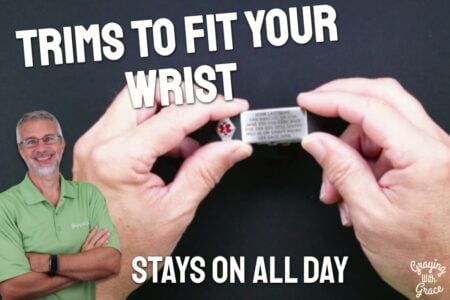
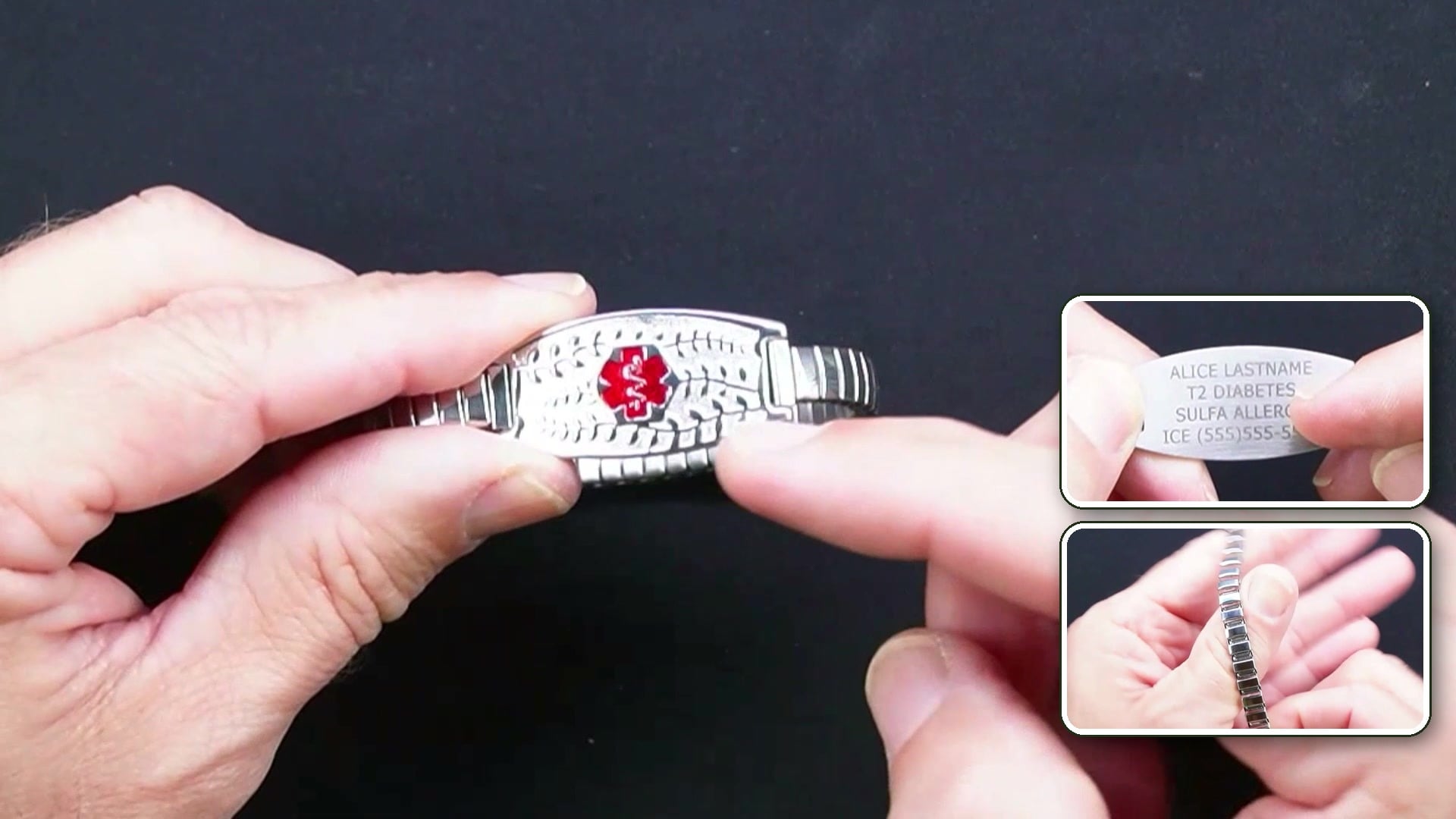
The front features a refined olive-branch pattern with a small red Caduceus symbol, a familiar medical symbol that tells responders this is a medical ID. It reads as jewelry first and medical alert second, which a lot of women genuinely appreciate.
The deep laser engraving on the Divoti Stretch Medical ID Bracelet isn’t printed on. It’s cut into the stainless steel itself, so it’s far less likely to fade or rub off than printed text, though it’s still worth checking now and then that it reads clearly.
As I demonstrated in the video, putting it on is as simple as sliding it over your hand and letting it settle into place, no clasp, no fumbling, no second pair of hands required.
In the video, you can see that the band opens wide enough to pass comfortably over the hand and then self-tightens back down to the wrist, staying put wherever you position it, whether that’s lower on the wrist or higher if you also wear a watch.
I also pointed out that the engraving is genuinely embedded in the steel. You can feel the texture under your finger where it’s cut in, not just stamped on the surface.
Something I specifically called out: many long-term reviewers compare the comfort to a stretch herringbone watch band, which is a familiar, trusted feel for anyone who’s worn that style before.
Will You Be Able to Use It?
If you can slide a stretch watch band over your hand, you can use this bracelet. There’s no clasp to manipulate, no small hook to line up, and no pinching motion required.
For someone with significant tremors or very limited hand mobility, it may help to have a family member assist the first time just to confirm the right placement and fit. After that, many people find they can put it on by themselves, but keep a helper in mind on harder days.
If you or a loved one is also managing arthritis in other areas, like hands that struggle with buttons or belts, it may be worth browsing our review of arthritis compression gloves for additional daily comfort support.
Important Considerations
This isn’t an adjustable, trim-to-fit band. If your wrist falls well outside the 6.5 to 7.5 inch range, you’ll want to look at a different style of medical ID entirely.
It’s also designed specifically for women, both in sizing and in the olive-branch, feminine aesthetic. Men or those wanting a more neutral or masculine look should look elsewhere.
Four lines of engraving is plenty for most people, but if you manage multiple complex conditions, you may need the included wallet card to communicate everything first responders should know.
If clasp difficulty is only part of the challenge and the real sticking point is someone with memory concerns removing or misplacing jewelry, our article on why the clasp matters more than the engraving for dementia care digs into that specific situation in more depth.
Help When You Need It
As with most Divoti products, you’ll want to reach out directly to the seller through Amazon’s messaging system for any engraving corrections, sizing questions, or warranty concerns.
Amazon’s standard return policy applies to unworn, unengraved items, though personalized engraved products often have more limited return windows, so double check before ordering if you’re unsure about sizing.
Understanding the Cost
I won’t quote specific pricing here, but in terms of value, this sits squarely in the mid-range for custom-engraved stainless medical IDs. You’re paying for surgical-grade steel, permanent laser engraving, and a specialty clasp-free mechanism, all of which add real value over a basic engraved tag on a cheap chain.
If budget is a bigger concern and you’re open to a necklace format instead of a bracelet, our review of the Custom4U Medical Alert Necklace is worth a look as a comparison point.
Long term, there’s no battery, no subscription, and no ongoing cost. You engrave it once and wear it for years.
Making It Work for You
Keep your engraving simple and prioritize what matters most: name, one or two critical conditions, allergies if life-threatening, and an emergency contact number.
If you use a phone-based medical ID app as a backup, consider using one of your four engraved lines to note “Med ID on phone” so responders know to check there too.
Position the bracelet higher on your wrist if you also wear a watch, since the self-tightening design helps it stay where you place it. Check now and then that it hasn’t slid out of view.
Pair it with the included wallet card for anything that doesn’t fit on the tag itself, like a full medication list or a secondary emergency contact.
Our Recommendation
If a stubborn clasp has been the reason you or someone you love stopped wearing a medical ID, I think this bracelet genuinely solves that problem. It’s well-built, comfortable, and designed with real thought toward privacy and everyday wearability.
It’s best suited for women whose wrists fall in that 6.5 to 7.5 inch range and who want something that looks more like jewelry than a hospital tag. If you’re outside that size range or you’re shopping for a man, you’ll want a different style.
Where to Get It
Check the current availability and sizing details for the Divoti Stretch Medical ID Bracelet through the link above, since engraving options and stock can shift over time.
Conclusion
At the end of the day, a medical ID only helps you if you actually wear it, and this one is designed from the ground up to remove every excuse for leaving it in a drawer. No clasp, no fuss, just slide it on and go about your day knowing your information is right there if you need it.
I’d love to hear from you: has clasp trouble kept you from wearing a medical ID in the past? Drop a comment and let me know, I read every one.