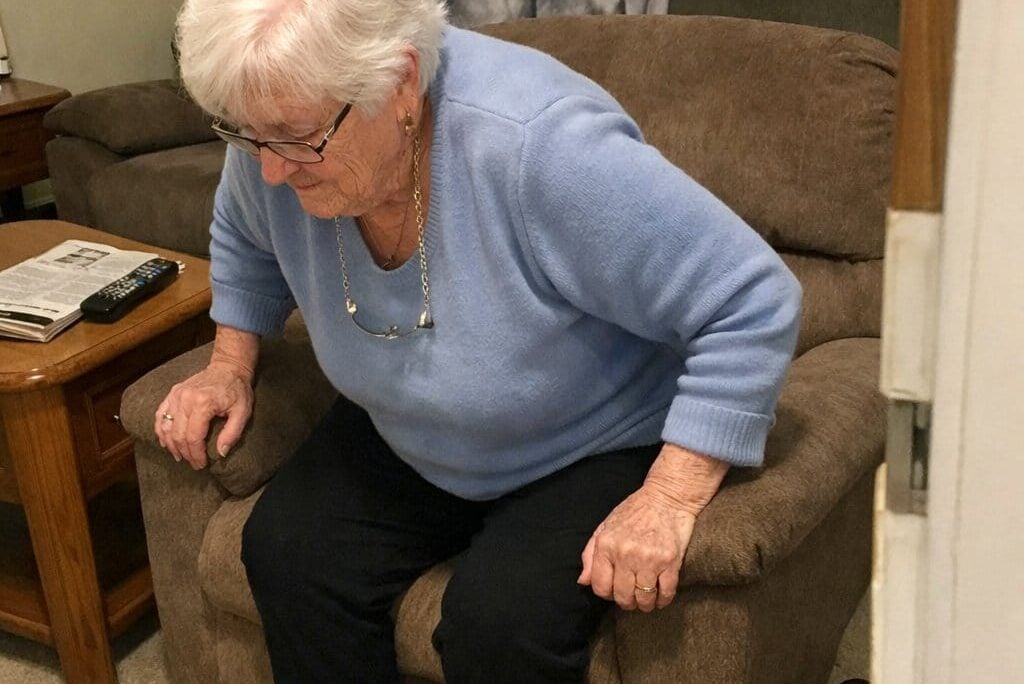
You've seen it happen — maybe you've done it yourself. You rock forward once, twice, maybe three times to build momentum. You grip the armrests hard. You reach for the side table. And then you're up, slightly out of breath, wondering when standing from a chair got this hard.
That moment matters more than most people realize. Falls among older adults happen most often during transitions — and the stand-from-seated transition is one of the highest-risk moments in an ordinary day at home. A chair that is too low, too soft, or too deep puts every stand in that danger zone.
Here's the complication most people run into: when they go looking for a lift chair or a standing aid, they shop the wrong dimension first. They measure the corner of the room. They match the fabric to the sofa. The chair has to fit the person's body — specifically, seat height relative to the user's leg length — before any lifting mechanism can do meaningful work.
This article covers four product types, the Medicare coverage question, and the sizing framework you need before any money changes hands.
Lift Chair & Standing Assist Shopping Guide
Download this printable shopping guide and get the exact measurements, product checklist, and comparison framework you need to confidently choose the right standing assist solution—without wasting time or money on the wrong fit.
What to Look For
Seat Height and Leg Length — The Primary Fit Variable
The lifting mechanism only helps someone stand if the chair gets them close enough to a standing position that their legs can take over. That requires matching seat height to the user's inseam measurement.
A reliable rule: the seat height when raised should allow the user's feet to rest flat on the floor with knees at roughly 90 degrees when seated. For most adults, that means a seat height between 18 and 21 inches in the lowered position.
- Petite users (typically under 5'3"): look for seat heights of 16–17 inches in the lowered position
- Standard users (5'3"–6'0"): 18–21 inches
- Tall users (6'0" and above): 21 inches and up, with some models accommodating users to 6'6"
To measure: sit on a firm surface with feet flat on the floor. Measure from the floor to the crease at the back of your knee. That number is your inseam reference.
Seat Depth
Seat depth determines whether the user sits fully back against lumbar support or perches at the front edge. Standard seat depths run 19–21 inches; petite models typically run 17–18 inches.
A seat that is too deep pushes the lumbar forward and puts pressure behind the knees. That defeats both comfort and the standing-assist function.
Weight Capacity
Standard models are typically rated to 300–375 lbs. Heavy-duty and bariatric models extend to 500–700 lbs.
Weight capacity affects both the frame construction and the motor rating. A motor sized for a 300-lb. load will wear prematurely if the user consistently exceeds it.
One-Motor vs. Two-Motor
This distinction is routinely undersold in showrooms, and it matters.
A one-motor chair links the footrest and back recline as a single motion. You cannot raise your legs without reclining the back, and you cannot sit upright with your legs elevated.
A two-motor chair operates the back and footrest independently. That independence matters for:
- Edema management — legs elevated, back upright
- Post-surgical recovery — partial recline with minimal footrest raise
- Reading or watching TV — feet up without lying flat
If any of those situations apply, a two-motor chair is worth the additional cost.
Heat and Massage
Optional features relevant for users with chronic joint pain or poor circulation. They do not substitute for correct sizing — they add comfort to a chair that already fits.
Upholstery and Cleanability
Vinyl and performance fabric clean more easily than microfiber. For users with incontinence concerns, this is a practical consideration, not just an aesthetic one.
Power Requirements
All power lift recliners require a standard 120V outlet within cord reach. Confirm outlet placement before the delivery window — most manufacturers advise against extension cords for safety reasons.
Medicare Coverage — What the Benefit Actually Covers
Medicare Part B covers the seat-lift mechanism as Durable Medical Equipment when a physician certifies that the user has a severe arthritic, neuromuscular, or musculoskeletal condition and cannot stand without the mechanism.
Coverage applies at 80% of the Medicare-approved amount after the Part B deductible. The user or supplemental insurance covers the remaining 20%. The supplier must be Medicare-enrolled.
Medicare does not cover the recliner features — only the lift mechanism itself. Coverage requires physician documentation and an enrolled supplier, not any furniture retailer. One call to your Medicare plan before purchasing can save you significant money.
Power Lift Recliners
Power lift recliners use a motorized base to tilt the entire seat forward and upward, returning the user to a near-standing position without requiring them to generate any momentum on their own. They provide full seated support throughout the day alongside standing assistance, making them the highest-capability option for older adults with significant lower-body weakness or conditions like Parkinson’s, severe arthritis, or post-surgical recovery.


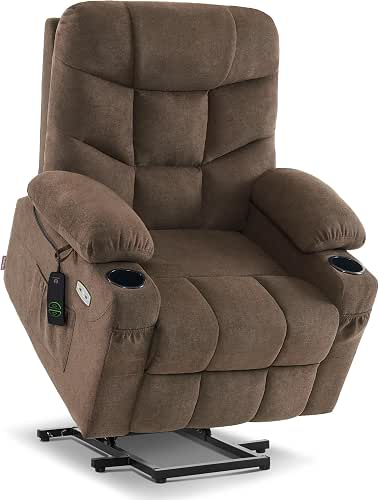

A power lift recliner is a freestanding upholstered chair with a motorized base that tilts the entire seat forward and upward, returning the user to a near-standing position before the motor stops. The user does not need to generate standing momentum — the chair does the work.
This type suits people who need full seated support throughout the day — lumbar, hip, and leg — in addition to standing assistance. Anyone with significant weakness in the hip flexors or quadriceps who cannot transfer momentum from seated to standing belongs in this category. It's also appropriate for post-surgical recovery, Parkinson's, severe arthritis, and COPD, where repeated standing attempts create real fall risk.
A power lift recliner is not the right first step for someone who simply finds their current chair too low but can stand normally once they get momentum. It's also a fixed piece of furniture — someone who moves between rooms frequently or travels will find it less useful than a portable option. If those descriptions fit, understanding how a lift chair fits into a broader fall-prevention plan is a useful starting point before committing to this category.
The trade-off is straightforward: highest capability, highest cost ($500–$3,000+), requires a dedicated space and 120V outlet, and replaces an existing piece of furniture. The mechanism does the most work; the user does the least.
BOSMILLER Electric Power Lift Recliner Chair with Massage and Heat
This is a standard-width lift recliner with integrated massage and heat functions. The chair includes a two-point massage system and a heated lumbar zone, which can provide comfort for users managing chronic joint pain or poor circulation. The remote is straightforward with clearly labeled controls.
This model suits a standard-sized adult who wants the combination of heat, massage, and lift function in a single chair. It's a reasonable choice for someone who currently uses a heating pad or massage cushion on a separate chair and would prefer those features built in.
The honest limitation: if the user is petite or tall, confirm seat height specifications against the inseam measurement before ordering. Heat and massage add value, but they do not compensate for a seat height that does not match the user's leg length.
CANMOV Large Power Lift Recliner Chair with Massage, Heat, and USB
The CANMOV is a larger-frame lift recliner designed for users who need more seat width and depth than a standard model provides. It includes massage, heat, and a USB charging port on the side panel — a practical addition for users who keep a phone or tablet within reach. The overstuffed back and arms are designed for extended seated comfort.
This model suits a taller or broader user who has found standard lift chairs uncomfortable across the seat or through the shoulders. The additional seat dimensions reduce the perching-at-the-front-edge problem that can occur when a seat is too narrow or shallow.
Confirm the specific seat height measurement against your inseam before ordering. A chair with a generous width profile may still sit too high or too low for a particular user — seat width and seat height are separate variables.
Korser Power Lift Recliner Chair for Elderly — Small Recliner
The Korser is designed explicitly for petite users — a category that is frequently underserved in the lift recliner market. Smaller seat dimensions and a lower seat height in the standard position mean that a shorter adult is more likely to sit with feet flat on the floor and knees at the correct angle.
This model suits adults under approximately 5'3" who have been told by a physical therapist that a lift chair would help, but who have sat in standard models and found their feet dangling or their back not reaching the lumbar support. A correctly fitting petite chair does the job that a standard chair cannot.
The limitation is the other side of the sizing coin: this chair is not appropriate for taller or heavier users. Petite-sized frames and motors are rated for petite-sized users. Check weight capacity against the user's current weight before purchasing.
MCombo Power Lift Recliner Chair — Fabric 7287
This is a mid-range one-motor lift recliner in a fabric upholstery. The 7287 model is a standard-configuration chair: footrest and back recline as a single linked motion. It suits a standard-height adult who does not have a specific need for independent leg elevation.
The fabric upholstery is worth noting for users who find vinyl or bonded leather uncomfortable against skin, particularly in warmer months. Fabric also tends to be less slippery than vinyl, which can be a practical comfort consideration for users who shift position frequently.
Because this is a one-motor design, it is not the right choice for users managing edema who need legs elevated with back upright, or for anyone whose physician or occupational therapist has specified independent back and footrest positioning.
MCombo Power Lift Recliner Chair with Heat and Massage — 7040
The 7040 is the heat-and-massage version in the MCombo line, otherwise sharing the one-motor configuration of the 7287. The addition of heat and massage functions makes it relevant for users with chronic arthritis pain or muscle stiffness who want therapeutic features alongside the standing assist.
This model suits a standard-height user who has found sitting in a regular recliner uncomfortable due to joint pain or muscle tension, and who wants the standing assist paired with built-in therapeutic options. The combination avoids the need to layer a separate heating pad or massage cushion on top of a chair.
The same one-motor limitation applies: linked footrest and back motion only. Users who need to position legs and back independently should look at two-motor options, including the Gehtmnl reviewed below.
Gehtmnl Triple Motor Large Power Lift Recliner Chair with Heat and Massage
The Gehtmnl is a three-motor chair — a configuration that adds a third motor for lumbar or head positioning beyond what a standard two-motor design provides. The additional motor means back, footrest, and a third positioning zone can be adjusted independently, offering a level of postural customization not available in one- or two-motor designs.
This model suits a user with complex positioning needs: someone managing edema who needs to change leg elevation throughout the day, a post-surgical user who requires specific angles for recovery, or someone with significant lumbar involvement who needs head and back positioned separately. The large-frame build also means it accommodates taller or broader users who need more room.
The trade-off is cost and footprint. A three-motor chair with heat and massage at a large-frame size is among the most capable — and most expensive — options in this category. Confirm that the room placement allows the chair to fully extend without contacting a wall; large lift chairs need more clearance than their footprint suggests.
Portable Lifting Seat Cushions
Portable lifting seat cushions sit on top of an existing chair and use springs, air pressure, or an electric motor to gently raise the user toward standing — no furniture replacement required. They suit older adults who need a powered standing boost at one or more chairs in the home but want to keep their existing furniture and avoid the cost and footprint of a full lift recliner.
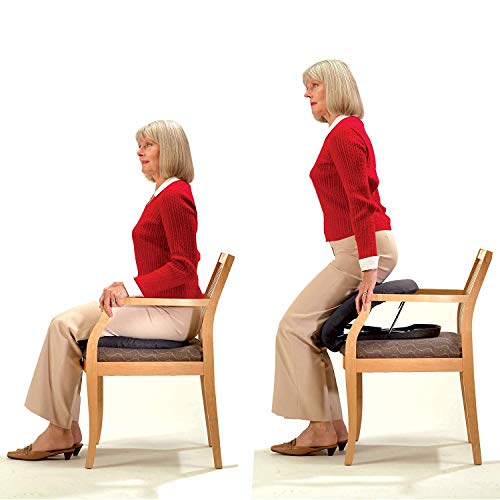
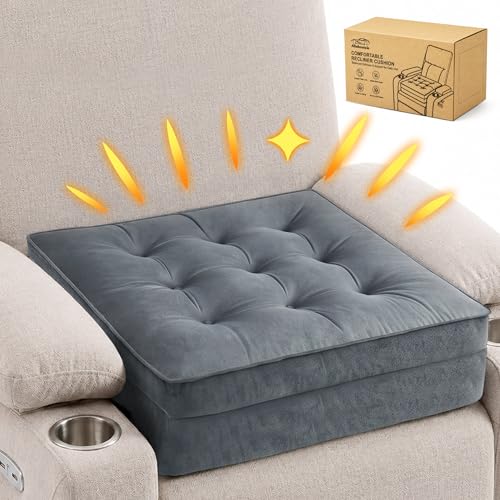


A portable lifting seat cushion sits on top of an existing chair seat and gently tilts or inflates to raise the user toward standing. No installation. No replacing furniture. The user keeps the chair they already own.
This type suits people who need a standing assist but have no intention of replacing a favorite chair — a recliner, a dining chair, a living room armchair. It also suits people who move between multiple seats in the home and need help at each one, or whose budget does not support a full lift chair. If the living situation involves a rented home or shared space where replacing furniture is not practical, this is the right category to start in.
A lifting cushion is not the right choice for someone who needs full seated support, lumbar positioning, or independent leg elevation throughout the day. The cushion provides a standing boost — it does not recline, elevate legs, or provide postural support. Most portable lifting cushions are rated to 250–300 lbs.; users approaching or above that range should verify capacity for each specific product before purchasing.
The cost range ($100–$400) is a fraction of a full lift chair, and battery-powered models require no outlet in any particular location. The trade-off is that a cushion does only one job. It boosts standing; nothing more.
Carex Upeasy Seat Assist Plus
The Upeasy Seat Assist Plus is a spring-loaded, non-electric lifting cushion. It uses a calibrated spring mechanism that provides 70% of the user's body weight in lift assistance. There is no battery to charge and no power source required — the mechanism is entirely mechanical.
This model suits a user who wants a simple, reliable standing assist without managing battery life or power cords. Because it is mechanical, it functions anywhere — in the car, at a restaurant, at a family member's home — making it genuinely portable in a way that battery-powered cushions may not always be.
The honest limitation is that the spring is calibrated to a weight range. Users outside that calibrated range will find the cushion either too stiff (insufficient boost) or too active (lifting before they intend to stand). Confirm the model's weight calibration against the user's current weight before ordering.
Allaboutsla Recliner Seat Cushion
The Allaboutsla is a foam seat cushion designed to add height and sitting comfort on top of an existing recliner or chair seat. At 20x20x5 inches, it adds a consistent 5-inch height increase without any powered mechanism.
This model suits a user whose primary issue is that their existing chair sits too low to exit safely, but who can stand normally once they reach an adequate height. For that user, a thick foam cushion accomplishes the same goal as powered alternatives at a significantly lower cost.
The limitation is that foam compression reduces height over time, particularly for heavier users. A cushion that starts at 5 inches may sit closer to 3.5 inches after several weeks of regular use. Consider this when comparing it to fixed-height chair risers, which do not compress.
HAVARGO Recliner Cushion for Elderly — Soft Version
The HAVARGO cushion in the soft configuration offers a 20x20x5-inch profile with a patent-design construction intended to balance support and comfort. The soft variant is designed for users who prioritize cushioning over firm support.
This model suits a user who finds hard or firm cushion surfaces uncomfortable — particularly relevant for users with coccyx pain, tailbone sensitivity, or pressure sores in the seated area. The added height helps with standing transitions while the softer material distributes sitting pressure more evenly.
Softer foam compresses more readily than firmer variants. For users whose primary need is height correction for standing, the firmer HAVARGO variant (reviewed below) may maintain its height more reliably over time.
HAVARGO Recliner Cushion for Elderly — Firm Version
The firm-variant HAVARGO shares the same 20x20x5-inch dimensions as the soft version but uses a denser foam construction. Greater density means less compression under load and better maintenance of the full 5-inch height over extended use.
This model suits a user whose priority is consistent height correction rather than cushioning comfort — someone who needs the chair to stay at a predictable height for safe standing, rather than someone seeking pressure relief. It is also a better fit for heavier users, where soft foam compresses more significantly.
For users who need both height correction and pressure relief, a firm cushion combined with a thin pressure-relief topper layer is a practical combination. The load-bearing function should not be compromised by softness.
Seat Boost Air Pneumatic Seat Assist Lifting Cushion
The Seat Boost Air uses a pneumatic mechanism — air pressure rather than springs or electric motors — to assist standing. The user activates the cushion, and the air-assisted lift helps raise them from seated to a near-standing position.
This model suits a user who wants a powered-feeling lift without the weight or cord requirements of an electric cushion. Pneumatic designs are typically lighter than electric alternatives, which matters for users who move the cushion between chairs throughout the day.
The limitation to understand is durability: pneumatic components require maintenance over time, and any compromise of the air seal degrades performance. Confirm the warranty and return policy before purchasing, and assess whether the activation mechanism is compatible with the user's hand strength and dexterity.
SuperHandy Electric Seat Lift Assist Cushion
The SuperHandy is a battery-powered electric lifting cushion. An electric motor lifts the seat surface, providing a consistent, mechanically assisted boost to standing. Controls are designed to be simple and accessible.
This model suits a user who needs a more consistent and reliable lift than spring or pneumatic mechanisms provide — particularly relevant for users with very limited lower-body strength who need the full lift cycle rather than partial spring assistance. The electric mechanism is also easier to calibrate to the user's specific weight and timing.
Battery life and charging logistics are practical considerations. A cushion that needs charging daily — or one whose battery degrades quickly — becomes a management task for the user or caregiver. Confirm battery life under realistic daily use before committing.
Chair Risers and Leg Extenders
Chair risers slide under the existing legs of a chair to raise its overall height by a fixed increment, addressing the most common and overlooked cause of difficult standing transitions: a seat that is simply too low. They require no power, no installation, and no furniture replacement, making them the right first step for anyone whose chair height is the primary obstacle to safe standing.


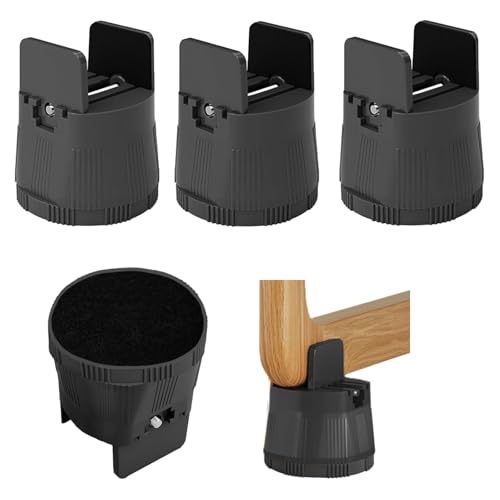


Chair risers and leg extenders are non-powered blocks, cups, or frames that slide under the existing legs of a chair to raise its overall height by a fixed increment — typically 2, 3, or 4 inches. No motor. No electricity. No meaningful assembly beyond placement.
This is the correct first step before considering any powered product. If the chair is simply too low, raising it costs $15–$60 and addresses the root cause directly. Readers who are unsure whether they need a lift chair or a cushion should try chair risers first — and many will find they need nothing else.
Chair risers are not the right answer for someone who needs standing momentum or a forward-tilting assist. A riser raises the chair height; it does not help generate the motion of standing. Also note: standard riser cups fit chair legs up to approximately 1.5–2 inches in diameter. Buyers must measure their chair legs before ordering. On thick carpet, risers may require a non-slip pad underneath for stability. Most standard riser sets are rated to 1,000–1,200 lbs. per set — verify weight capacity per product.
The trade-off is the simplest in this article: lowest cost, lowest complexity, addresses height only. For users who need more than a height correction, risers are the starting point, not the endpoint. Pair them with bathroom safety aids and other fall-prevention tools as part of a broader approach to reducing transition risk at home.
Sephyroth Adjustable Furniture Risers — 4 Pack with Screw Clamp
The Sephyroth risers use an adjustable screw-clamp design to secure around the chair's existing legs. The clamp mechanism adds stability compared to cup-only designs, particularly on smooth floors where the riser might otherwise shift under load.
This model suits a user whose chair legs are within the compatible diameter range and who is concerned about riser stability — particularly relevant on hardwood, tile, or laminate floors. The adjustable height adds flexibility if the user is uncertain about the exact increment needed.
Confirm the leg diameter of the intended chair against the riser's clamp range before ordering. A clamp riser that cannot close fully around the leg provides no benefit and may actually reduce stability.
Yookwutar 8 Pack Furniture Risers — 1 or 2 Inch Adjustable
The Yookwutar 8-pack provides risers for multiple pieces of furniture in a single purchase — relevant for households where the standing-from-seated problem occurs at more than one chair. The 1-or-2-inch adjustability means a single riser can be configured to either increment, providing some flexibility without requiring separate products.
This model suits a caregiver or family member who is addressing multiple seating surfaces in the home at once — a dining chair, a living room chair, and a bedroom chair, for example. The 8-pack unit cost is typically lower than purchasing separate 4-packs for each surface.
At 1–2 inches, the maximum height increment is smaller than other risers in this section. For chairs that are significantly too low, stacking risers is not recommended — consider a product with a larger fixed increment or a stackable-rated design instead.
ZEMINIOR Bed Risers Heavy Duty — 4 Pack with Adjustable Screw Clamp
The ZEMINIOR uses the same screw-clamp approach as the Sephyroth, applying the clamp to the existing leg for added grip. Heavy-duty construction addresses weight capacity concerns for heavier users or heavier furniture.
This model suits a user who needs confident stability under a heavier chair or who has a higher body weight that approaches the limits of standard-rated risers. The heavy-duty designation should be verified against the stated weight capacity in the product specifications — confirm the number, not just the label.
As with all clamp-style risers, leg diameter compatibility is the first measurement to make before ordering. Confirm the riser's clamp range against the actual leg dimensions of the intended chair.
Yookwutar 4 Pack Furniture Risers — 1 Inch Fixed Height
The 4-pack fixed 1-inch riser is the simplest option in this section. There is no adjustment mechanism — each riser adds exactly 1 inch. This suits a user who has measured the height deficit precisely and determined that 1 inch is the correct increment.
This model is particularly relevant for situations where the existing chair is only slightly too low — a small correction that makes the difference between a safe stand and a difficult one. Overthinking a 1-inch problem with a more complex product adds cost without benefit.
The fixed height is also a limitation: if the user's needs change, or if the measurement turns out to be slightly off, a fixed-height riser cannot be adjusted. A 2-inch riser is harder to solve for than a 1-inch riser if the increment is wrong, so starting with the smaller increment and assessing is a reasonable approach.
Genisai 4 Pack Adjustable Furniture Risers — 2.36" to 3.15"
The Genisai risers offer an adjustable range from 2.36 to 3.15 inches — a narrower band than some adjustable risers, but one that sits in the most commonly needed increment range for chairs that are too low for safe standing.
This model suits a user who needs approximately 2.5–3 inches of height correction and wants to fine-tune within that range rather than committing to a single fixed increment. The clamp design adds grip stability on smooth floors.
The 2.36–3.15 inch range means this riser is not suitable if the chair needs less than 2 inches or more than 3 inches of correction. Measure the height deficit before selecting — the adjustment range must match the need.
BTSD-home Furniture Risers — 2 Inch Fixed Height
The BTSD-home 2-inch fixed riser is a cup-style riser without a clamp mechanism. The cup receives the chair leg and raises the full chair 2 inches. The design is simple, and simplicity is a genuine advantage when the goal is a reliable, non-mechanical height correction.
This model suits a user who needs a consistent 2-inch height correction and has chair legs that fit within the standard cup opening. Cup-style risers are typically easier to place and remove than clamp designs, which matters if the chair needs to be moved periodically.
Without a clamp, stability depends on leg-to-cup fit and floor type. On carpet, a 2-inch cup riser is generally stable. On smooth floors, some movement may occur over time. A non-slip pad under the riser base addresses this.
Over-Chair Support Frames
Over-chair support frames straddle or anchor alongside an existing chair, providing raised grab handles that give the user a firm leverage point to push themselves to standing. They suit older adults who can stand once they have something solid to grip, but whose chair has soft, low, or poorly positioned armrests that cannot support an effective push-to-stand motion.


An over-chair support frame is a freestanding metal frame that straddles or attaches to an existing chair, providing raised handle bars or grab rails on both sides of the seat. The user grips the handles and pushes themselves to standing. The frame provides the leverage point that the chair's existing armrests cannot.
This type suits people who can stand once they have something firm to push against, but whose existing chair has low, soft, or non-usable armrests. This is particularly relevant for sofas, recliners with padded rolled arms, and chairs where the armrests are too far forward or too low for effective push leverage.
A support frame is not the right answer for someone who cannot generate any standing momentum regardless of grip — they need a powered lift, not a leverage point. The push-to-stand motion requires meaningful grip strength and arm stability. Users with significant grip weakness or upper-extremity instability should discuss this category with an occupational therapist before purchasing. A support frame also does not change seat height; pair it with chair risers when the seat itself is also too low.
The cost range ($80–$200) makes this a targeted, accessible solution. It addresses leverage only — no seat height correction, no forward momentum assist, no seated postural support. Used correctly, it can restore safe independent standing from a chair the user already owns and prefers.
NIMOOD L2 Stand Assist Aid for Elderly
The NIMOOD L2 is a standing assist frame designed to straddle an existing chair, providing grab handles on both sides at a height that supports the push-to-stand motion. The frame is freestanding and does not require attachment to the chair.
This model suits a user who needs a stable leverage point to initiate standing from a soft or low-arm chair. The freestanding design means it can be repositioned between chairs without tools, which adds practical flexibility for users who move between a living room chair and a bedroom chair throughout the day.
Confirm that the frame width is compatible with the width of the intended chair before ordering. A frame that is too narrow to straddle the chair properly, or too wide to position the handles within comfortable reach, will not function as intended.
Support Way Mobility Standing Aid Rail for Couch and Chair with Adjustable Wide Base
The Support Way rail uses an adjustable wide base to accommodate different chair widths. The adjustability addresses one of the main frustrations with fixed-width support frames — a frame that fits one chair may not fit another.
This model suits a household where the standing assist is needed at more than one chair of different widths, or where the user is uncertain whether their specific chair falls within a fixed frame's compatibility range. Adjustable width reduces the sizing risk.
Check the adjustment range against the widths of all chairs where the frame will be used. An adjustable frame that does not span the full range of needed sizes still creates a sizing problem, just a smaller one.
Stander CouchCane Standing Assistance Aid
The Stander CouchCane is a well-established design in this category, with a tapered base that slides under the sofa or chair leg to anchor the frame in place. Rather than straddling the chair, it anchors alongside it — which suits chairs where straddling is impractical due to armrest position or chair width.
This model suits users who have found that freestanding frames shift or wobble during use, particularly on carpet. The under-leg anchor provides a fixed point that reduces movement. It's also compact enough to leave in place without significantly affecting the room layout.
The anchor design means it is positioned on one side of the chair, providing a single-side handle rather than bilateral grip points. For users who need to push from both sides simultaneously, a bilateral straddling frame may be more appropriate.
Support Way Heavy-Duty Chair/Couch Stand Assist — Width and Height Adjustable
The Support Way Heavy-Duty model combines width adjustability with height adjustability in the handle position. Both dimensions can be set to match the user's chair dimensions and the height at which their arms can generate effective push leverage.
This model suits a user who has found that standard handle heights are not in the right position for their arm length or the height of their existing chair. Handle height matters: too low and the user is pushing at an awkward angle; too high and the push motion becomes a pull motion, which is less effective and less safe.
The heavy-duty designation should be confirmed against the stated weight capacity in the product specifications. Heavier users should verify that the frame's rated capacity matches their own weight before relying on it for standing assistance.
Frequently Asked Questions
What size lift chair do I need for my height?
Measure your inseam: sit on a firm surface with feet flat on the floor and measure from the floor to the crease behind your knee. That number guides your seat height selection. Petite users (under 5'3") typically need a seat height of 16–17 inches in the lowered position. Standard users (5'3"–6'0") need 18–21 inches. Tall users (6'0" and above) need 21 inches or more, with some models reaching users up to 6'6". Seat height is the first measurement to take — before fabric choice, before feature selection, before anything else.
What is the difference between a one-motor and two-motor lift chair, and do I need two motors?
A one-motor chair links the footrest raise and back recline as a single motion — they move together. A two-motor chair operates them independently, so you can raise your legs while keeping the back upright, or recline the back while keeping the footrest down. You need two motors if you manage edema and need legs elevated with back upright, if you're recovering from surgery and need specific positioning, or if you want to read with your feet up without lying flat. If none of those apply, a one-motor chair may be entirely sufficient.
Does Medicare cover a power lift recliner?
Medicare Part B covers the seat-lift mechanism — not the recliner features — as Durable Medical Equipment. Coverage requires a physician's certification that you have a severe arthritic, neuromuscular, or musculoskeletal condition and cannot stand without the mechanism. Medicare pays 80% of the approved amount after the Part B deductible; you or your supplemental insurance covers the remaining 20%. The supplier must be Medicare-enrolled. Call your Medicare plan before purchasing anything — this one call takes ten minutes and can save you hundreds of dollars.
Should I buy a lift chair or a lifting cushion?
If the person needs the chair to provide seated support throughout the day — lumbar, hip, and leg — a lift chair is the right category. If they just need help getting up from a chair they already like and find comfortable, try a lifting cushion first. And if the chair is simply too low but standing itself isn't the problem, try chair risers before either.
Can I put chair risers under any chair?
Not quite. Standard riser cups fit chair legs up to approximately 1.5–2 inches in diameter — measure your chair's legs before ordering. Chairs with a center pedestal base cannot use leg risers at all. On thick carpet, a non-slip pad under the riser base adds stability. Clamp-style risers provide more grip on smooth floors. Most standard riser sets are rated to 1,000–1,200 lbs. per set; confirm the specific weight capacity for any riser you're considering.
What does "zero gravity" mean on a lift chair?
Zero gravity refers to a specific reclining position where the legs are raised slightly above heart level and the back is reclined, distributing body weight evenly across the chair. It reduces pressure on the spine and can improve circulation. This position requires at minimum a two-motor chair, since it involves independent back and footrest positioning. It's most relevant for users managing edema or lower-back pain. It is a comfort and therapeutic feature, not a safety feature.
Hacks and Advice
Try the free solution first. Before buying anything, raise the existing chair with a set of risers. If a 2-inch height correction solves the problem, the reader has spent $30 instead of $2,000. Many people discover the lift chair conversation was always a chair-height conversation.
Measure the person, not the room. The most common lift chair mistake I see is choosing a chair that fits the corner it's going into rather than the body sitting in it. Bring the user's inseam measurement and seated depth to any showroom. Have those numbers ready before placing any online order.
Sit in it before buying if at all possible. A lift chair is not a small purchase. If ordering online, confirm the return policy in writing before placing the order. A chair that looks correct on paper but leaves the user's feet 3 inches off the floor creates a new problem rather than solving the original one.
Ask the Medicare question before spending anything. One phone call to the Medicare plan takes ten minutes and costs nothing. Many people pay full price out of pocket for a chair they could have had partially covered because they assumed the process was too complicated. It often isn't.
Check the outlet location before delivery. A power lift recliner needs a standard 120V outlet within cord reach. Delivery teams will not run extension cords, and most manufacturers advise against them. Know where the chair is going and confirm outlet access before the delivery window.
Reassess annually. A chair that fits well at 68 may need re-evaluation at 73. Conditions change, strength changes, and what provided adequate support one year may not provide it the next. An annual review — ideally with an occupational therapist — keeps the setup matched to the user's current situation.
If you're reading this because a fall has already happened, understanding what to do in the immediate aftermath is the right next conversation.
Lift Chair & Standing Assist Shopping Guide
Download this printable shopping guide and get the exact measurements, product checklist, and comparison framework you need to confidently choose the right standing assist solution—without wasting time or money on the wrong fit.
Conclusion
Getting out of a chair safely is one of the highest-risk daily transitions for older adults. The right solution depends entirely on matching the product type to the person's actual situation — not the room, not the aesthetics, not what a salesperson recommends as an upsell.
The decision hierarchy is worth stating plainly: try chair risers first. If the chair height is the problem and standing is otherwise manageable, a riser set solves it for $30. If a powered boost is needed without replacing furniture, a lifting cushion is the next step. Move to a full lift chair only when seated support throughout the day is also part of the need — not before.
Two actions worth taking before anything else:
First, call your Medicare plan today. Ask specifically whether your physician's documented condition qualifies you for the Part B seat-lift mechanism benefit. The answer is one phone call away, and it may change what you spend.
Second, if you'd like to think through your home setup more broadly — not just seating, but the full picture of how your home supports safe, independent living — I'd encourage you to explore what a comprehensive fall prevention approach looks like. Seating is one piece. It's worth looking at the whole.
Have a question about sizing, or have you found a particular type of standing assist that made a real difference? Share it in the comments — your experience might be exactly what someone else needs to hear.