

You found a beautiful 500-piece puzzle — colorful, cheerful, the kind your parent would have loved. You set it up on the table, pulled up a chair, and within minutes watched them push the pieces away in frustration.
That moment stings. And it happens to nearly every caregiver at least once.
Here’s what I want you to hear right away: the puzzle wasn’t wrong. The piece count was. And that’s a completely fixable problem.
In my experience working alongside families navigating dementia care, puzzle piece count is one of the most overlooked — and most impactful — adjustments a caregiver can make.
Getting it right turns a frustrating afternoon into a genuinely joyful one.
This guide gives you a clear, stage-matched framework for choosing the right number of puzzle pieces for dementia at every stage, so you can stop guessing and start creating moments that work.

The Dementia Puzzle Piece Guide: A Stage-by-Stage Cheat Sheet for Caregivers
Download our free stage-by-stage puzzle guide and stop guessing what activity level is right for your loved one—get the exact piece counts, image types, and success signals that match each stage of cognitive decline.
Why the Number of Pieces Makes or Breaks the Experience
For someone living with dementia, a puzzle that’s too complex doesn’t just go unfinished — it triggers frustration, confusion, and withdrawal. The cognitive load of sorting too many pieces, identifying too many colors, and holding too many visual details in mind at once can quickly overwhelm a brain already working hard to process the world.
When that happens, the activity itself becomes associated with failure. And a person who has been pushed to failure once is far less likely to engage the next time.
On the flip side, when the piece count is matched to your loved one’s current cognitive stage, something remarkable happens. They settle in. They focus. They complete it — and feel genuinely proud.
That’s the goal. Not a perfect puzzle, but a successful experience.
The key insight I want caregivers to take from this: puzzle piece count should be matched to cognitive stage, not age or past ability. Someone who completed 1,000-piece puzzles for decades may now thrive with 48 pieces — and that’s not a step backward. That’s thoughtful caregiving.
Let’s walk through the framework stage by stage.
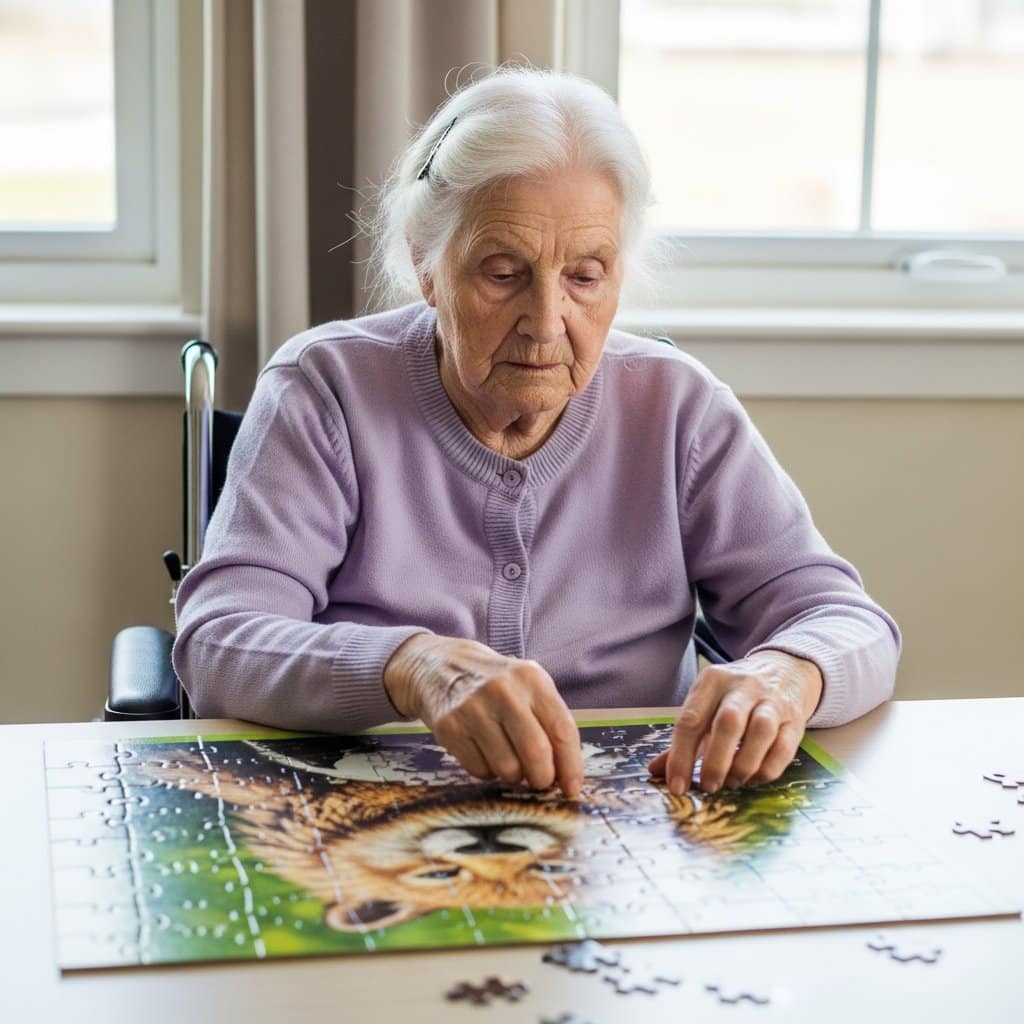
Mild Cognitive Decline: When 300–500 Pieces Still Works


In the earliest stages of memory loss, puzzles can still be a rich and rewarding activity — but the type of image matters just as much as the piece count.
The Right Piece Range
For mild cognitive impairment, a range of 300–500 pieces is often still manageable, particularly when the imagery is familiar, high-contrast, and clearly defined. Think nature scenes, animals, recognizable landmarks, or nostalgic images tied to a person’s life experience.
Abstract art, intricate patterns, or images with large sections of similar color (a cloudy sky, an open ocean) are far more challenging to process — even at lower piece counts.
Signs the Level Is Still Right
- Your loved one sustains engagement for 15–20 minutes or more
- They can sort pieces by color or edge without prompting
- They complete the puzzle, even across multiple sessions, with minimal help
- The activity generates visible pleasure — relaxed body language, conversation, smiling
Signs It’s Time to Step Down
- Repeated attempts to force non-matching pieces together
- Disengagement within the first few minutes
- Growing agitation or visible frustration
- Pushing the puzzle away and declining to return to it
Starting with large print puzzles for dementia patients that feature bold imagery and well-differentiated colors is a great approach at this stage before a significant piece count reduction becomes necessary.


Staying within an appropriate challenge zone keeps the activity meaningful and confidence-building — and that confidence matters enormously for overall engagement and mood.
For additional ideas on activities that keep the mind engaged at this stage, take a look at simple and fun board games for dementia patients — many of the same principles around simplicity and familiarity apply there too.

Mid-Stage Dementia: Why 48 Pieces Is the Right Place to Start


This is the section most caregivers searching for “how many puzzle pieces for a dementia patient” really need — so let me be direct.
For mid-stage dementia, 48 pieces is the recommended starting point.
Why 48 Pieces Works So Well
Forty-eight pieces hits a specific sweet spot. It’s manageable enough that the visual field doesn’t overwhelm, but substantial enough that finishing feels like a real accomplishment — not a trivial exercise.
At this stage, the brain struggles to hold multiple competing visual cues in working memory. Reducing piece count reduces that load without eliminating the genuine engagement that makes puzzles therapeutic in the first place.
What to Look for in a Mid-Stage Puzzle
- Large individual pieces — easier to handle, especially for those with some fine motor challenges
- Familiar, single-subject imagery — a dog, a garden scene, a cottage, a vintage car
- High contrast between colors — clear visual boundaries between puzzle sections
- Sturdy construction — thick pieces that don’t bend or slide easily
A Scenario I’ve Seen Play Out Many Times
A caregiver switches from a 100-piece puzzle to a 48-piece large-format puzzle and notices their parent settle almost immediately into the activity. They complete it. They look up. They smile.
That shift — from agitation to quiet satisfaction — is what the right piece count makes possible.
The best 48-piece puzzles for adults with dementia are specifically designed to feel age-appropriate and engaging, not childish — a distinction that matters deeply for dignity.


Ready to discover more tools and strategies for supporting a loved one with dementia? Subscribe to our newsletter for trusted, experience-tested recommendations designed specifically for family caregivers.
Signs the 48-Piece Level Is Working
- Calm, focused attention lasting 10 minutes or longer
- Independent placement of pieces without constant prompting
- Visible satisfaction at completion
- Willingness — even eagerness — to return to the activity
If you’re also thinking about other engaging activities alongside puzzles, large print games for elderly people offer another avenue for gentle cognitive engagement with the same dignity-first approach.

Late-Stage Dementia: Fewer Pieces, More Connection


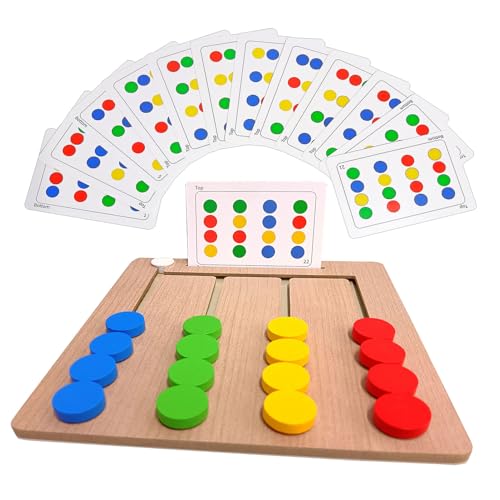

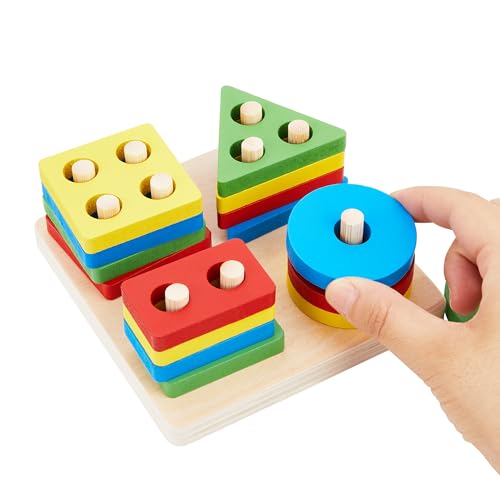
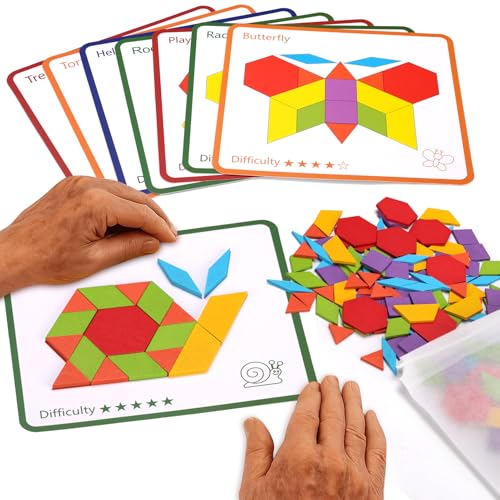

As dementia progresses, the purpose of a puzzle shifts. It’s no longer primarily about solving — it’s about connecting.
The Right Range: 12–24 Pieces
At late-stage dementia, 12–24 oversized pieces with bold, single-subject imagery create the best environment for meaningful engagement. These puzzles are less about cognitive challenge and more about sensory interaction — touching the pieces, recognizing the image, sharing the moment with someone they love.
How the Goal Changes
At this stage, completion matters far less than participation. A 12-piece puzzle that prompts a smile, a moment of recognition, or a few minutes of calm shared focus is a deeply successful activity.
Caregivers often find that sitting alongside their loved one — working on the puzzle together rather than watching — transforms it from an activity into connection time. That’s where the real value lives.
When to Transition Away from Traditional Puzzles
There will come a time when even 12-piece puzzles feel like too much. Watch for complete disinterest, inability to recognize the image, or distress when pieces don’t come together. At that point, therapeutic puzzles for memory care — oversized, tactile, designed for sensory engagement rather than traditional solving — can continue to provide meaningful stimulation.



A 12-piece puzzle completed together with joy is infinitely more valuable than a 100-piece puzzle that never gets touched.
If you’re exploring other ways to create moments of calm and connection, coloring books for seniors offer another gentle, low-frustration activity that works well at this stage.
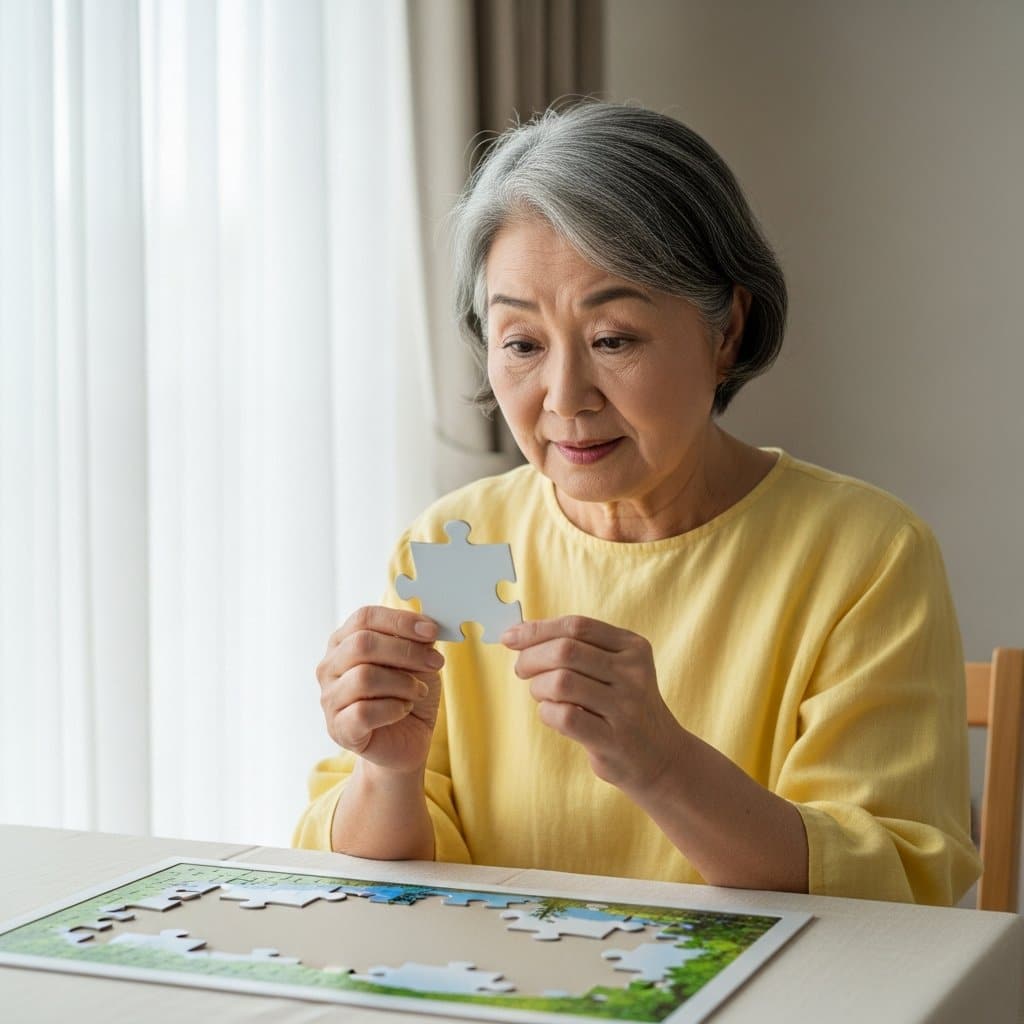
How to Know When It’s Time to Simplify: A Quick Caregiver Checklist
The best piece count is the one that creates calm focus and small victories — not any number on a chart. Knowing when to step down is just as important as knowing where to start.
Signs the Current Puzzle Is Too Complex
- ☐ Pieces are pushed away or scattered within the first few minutes
- ☐ Repeated attempts to force non-matching pieces together
- ☐ Visible agitation, sighing, or verbal frustration
- ☐ Complete disengagement — wandering attention, getting up from the table
- ☐ Refusal to return to the puzzle after the first session
Signs the Difficulty Level Is Just Right
- ☐ Calm, sustained focus for 10+ minutes
- ☐ Independent placement of pieces, even with occasional guidance
- ☐ Visible pleasure — relaxed posture, smiling, commenting on the image
- ☐ Satisfaction at completion, even partial completion
- ☐ Willingness or eagerness to try again another day
The Two-Session Rule
If a puzzle creates frustration across two separate sessions, it’s time to simplify. Don’t wait for a third attempt to confirm what you’ve already observed.
Dementia progression means piece count will likely need to decrease over time — and that’s expected. Adjusting as your loved one changes isn’t giving up on them. It’s paying close attention to them.
Easy adult puzzles for cognitive decline are available in sets at multiple difficulty levels, allowing you to move fluidly between piece counts as needs shift without starting over from scratch.


For a broader look at safe, engaging activities you can build into a daily routine, best hobbies for seniors is a wonderful resource to explore alongside this one.

The Dementia Puzzle Piece Guide: A Stage-by-Stage Cheat Sheet for Caregivers
Download our free stage-by-stage puzzle guide and stop guessing what activity level is right for your loved one—get the exact piece counts, image types, and success signals that match each stage of cognitive decline.
Putting It All Together
Here’s the stage-by-stage framework at a glance:
- Mild cognitive decline: 300–500 pieces, familiar high-contrast imagery, watch for early signs of struggle
- Mid-stage dementia: Start at 48 pieces, large format, bold single-subject images
- Late-stage dementia: 12–24 oversized pieces, focus on connection over completion
The right number of puzzle pieces for a dementia patient is simply the number that creates a moment of calm success — and that number will evolve over time. Trust what you observe. Adjust without guilt. And know that your attentiveness to this detail is exactly the kind of care that makes a real difference in your loved one’s daily experience.
The fact that you’re researching the right puzzle difficulty for Alzheimer’s and dementia care at all tells me everything I need to know about the kind of caregiver you are. Choosing a simpler puzzle isn’t lowering your expectations. It’s saying, clearly and lovingly: I see where you are right now, and I’m meeting you there.
Have you found a specific puzzle piece count that works well for your loved one? I’d love to hear about it in the comments — your experience could be exactly what another caregiver needs to read today.
And if you’re looking for additional ways to reduce caregiver stress while keeping your loved one engaged, automatic pill dispensers and electronic calendars for seniors with dementia are two practical tools that many families find genuinely helpful alongside activity planning.




![Bubble word search dementia activity 1200 x 800 px[1]](https://www.grayingwithgrace.com/wp-content/uploads/2025/01/bubble-word-search-dementia-activity-1200-x-800-px1-450x300.jpg)


