You drive home after three hours. You refilled the coffee. You watched two episodes of something. Nothing was wrong, exactly — but the whole way home, you replay it and think: that didn’t feel like much.
That quiet dissatisfaction isn’t about how often you visit. It’s about what happens during visits. Most families default to television not because they don’t care, but because nobody handed them a better plan.
This article is that plan. You don’t need more time. You don’t need to schedule elaborate activities. You just need one simple shift — the difference between passive presence and active connection — and even a single intentional idea changes everything about how a visit feels for both of you.
50 Meaningful Things to Do During Every Visit
Download our free financial planning guide designed specifically for older adults—get practical, step-by-step strategies to organize your money, protect yourself from fraud, and maintain independence without complicated jargon.
Why TV Creates the Illusion of Togetherness (But Not the Real Thing)
Television fills silence. It requires no planning. It feels comfortable — and that’s exactly why it becomes the default.
But here’s what actually happens during a passive visit: conversation stays surface-level, your parent doesn’t feel truly seen, and you leave carrying a vague sense of missed opportunity.
This matters more than you might realize. Genuine engagement directly supports emotional wellbeing and the sense of being valued — two things that television simply cannot deliver, no matter how long you sit together.
TV isn’t the enemy. But when it becomes the entire visit by default, both of you miss the connection you actually came for.
The ‘bring one thing’ habit: Before your next visit, decide on one simple activity idea. Not elaborate. Not planned to the minute. Just one intentional thing so the visit never defaults entirely to passivity. That single decision changes the whole shape of the afternoon.

How to Read the Room — The Flexible Visit Mindset
The biggest mistake most adult children make is arriving with a fixed plan and sticking to it regardless of how their parent actually feels that day.
A senior’s energy, cognitive clarity, and physical comfort fluctuate naturally — day to day, sometimes hour to hour. The visit that works beautifully one Saturday may fall flat the next if you’re not paying attention.
When you arrive, notice a few simple signals:
- Energy level: Are they animated and talkative, or quieter and slower today?
- Posture and movement: Do they seem physically comfortable, or are they managing pain or fatigue?
- Communication: Are they initiating conversation, or responding briefly?
Those signals tell you which visit mode to use:
- High energy / engaged: Conversation-based or hands-on activities — stories, games, a shared project
- Moderate energy: Game-based or sensory activities — a simple card game, looking through photos together
- Low energy: Gentle companionship — reading aloud, listening to music from their era, sitting outside together
You’re not managing a program. You’re spending time with someone you love. Adjusting to how they feel on a given day is the most respectful thing you can do — and it’s what separates a visit that feels forced from one that feels genuinely good.
Arrive with two or three ideas across different energy levels. That way you can pivot without stress, and no energy level leaves you scrambling.
For visits where your parent has limited mobility or is recovering from fatigue, keeping a small selection of large-print card games, a simple puzzle, or a reminiscence activity kit on hand specifically for visits makes these pivots effortless — no setup, no explaining, just something ready to go.



Conversation-Based Activities That Actually Go Somewhere
Here’s why ‘How have you been?’ almost always leads back to the television: it’s too open-ended. It invites a short answer, a comfortable silence, and then someone reaches for the remote.
The fix isn’t to talk more — it’s to ask differently.
The ‘tell me about’ technique anchors conversation to specific memories instead of general status updates. Memory-anchored prompts invite stories rather than brief replies:
- ‘Tell me about the neighborhood you grew up in.’
- ‘Tell me about the first car you ever owned.’
- ‘Tell me about what summers were like when you were young.’
- ‘Tell me about how you and Dad first met.’
These aren’t interview questions. They’re invitations. And for someone who has a lifetime of stories and rarely gets a genuinely curious audience, they’re a gift.
Looking through old photos together works the same way — but only if you’re asking specific questions rather than passively flipping pages. Ask about the people in the photo. Ask where it was taken. Ask what was happening that day.
The dual benefit here is real: your parent feels seen and valued, and you often learn things about their life you never knew. Reminiscence-based conversation has measurable benefits for older adults — but more immediately, it just makes the visit feel meaningful for both of you.
Before each visit, write two or three ‘tell me about’ prompts in your phone’s notes. When a silence opens up, you have something ready — and the remote stays where it is.



Want more practical ideas for staying connected with an aging parent? Subscribe to the Graying With Grace newsletter for expert-tested strategies delivered straight to your inbox — designed specifically for adult children and family caregivers.
Hands-On and Game-Based Activities That Work for Any Ability Level
Doing something together creates shared experience in a way that watching something together never can. The activity doesn’t have to be impressive — it just has to give both of you something to engage with in the moment.
Hands-on options:
- Cook or bake a familiar recipe together. Let your parent lead; you assist. Familiar recipes trigger memory, pride, and easy conversation — and you leave with something to eat.
- Sort through a box of photos or items together — not as a task to complete, but as an excuse to talk about what you find.
- Tend to a small indoor plant or herb pot. Simple, low-effort, and it gives you both something to look at and talk about.
- Sit outside or take a short walk — even just to the end of the driveway. Parallel activity makes conversation feel natural rather than forced.
Game-based options:
- Card games scaled to the day: Rummy, War, or Cribbage work well depending on your parent’s current cognitive comfort level. The point isn’t competition — it’s the side-by-side engagement.
- Era-specific trivia: Questions about music, events, or culture from your parent’s younger decades. They’ll often know the answers you don’t, which matters.
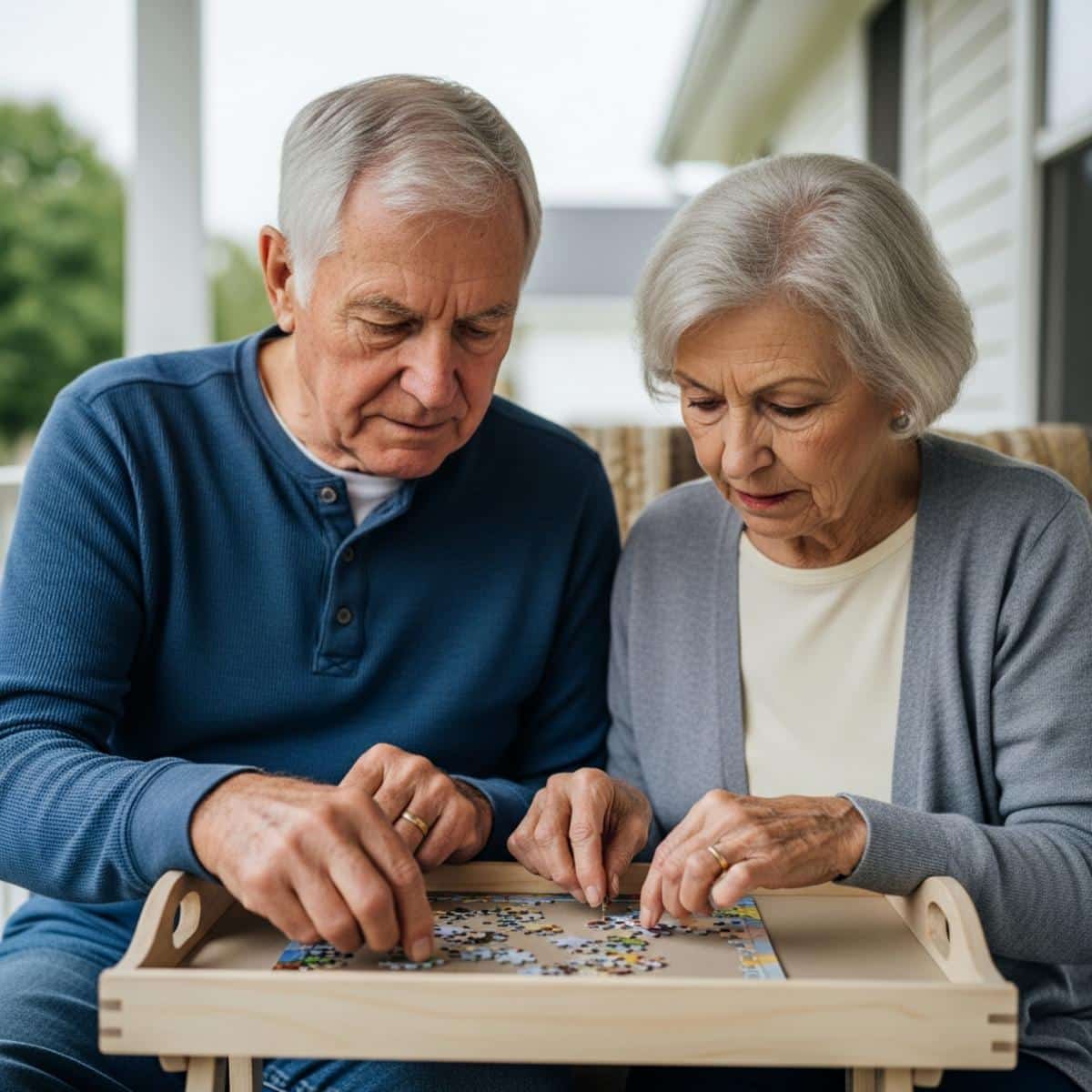
- A simple puzzle worked on together — not set out for them to do alone, but something you work on side by side. The act of doing it together is what creates the connection.
When grandchildren are part of the visit: Keep activities multi-generational. Simple card games, baking, looking at old photos, or an easy outdoor activity all work — and they naturally position your parent as the expert and teacher rather than a passive observer. That role reversal is genuinely meaningful. Staying mentally and socially engaged is one of the most powerful things older adults can do for their long-term wellbeing, and grandchildren make that engagement feel effortless.
Keep one or two go-to options at your parent’s home that require no setup — a deck of cards, a familiar cookbook, a small puzzle. The option is always there without anyone having to think about it.
For parents managing mild dexterity changes, large-grip playing cards or adaptive kitchen tools make these activities accessible without drawing any attention to limitations.



Why a 20-Minute Intentional Visit Beats a 3-Hour TV Marathon
This is the permission many adult children quietly need: shorter visits, done well, are genuinely better than longer passive ones.
The brain doesn’t encode memory by duration. We remember experiences by their emotional peak and their ending — not by how many hours they lasted. A 20-minute visit where you looked at old photos and laughed together will leave a stronger impression — for both of you — than three hours of sitting in the same room watching television.
This is practical news for busy adult children. You don’t need to carve out a full afternoon to make a visit matter. A shorter, intentional visit is not a compromise — it’s often the better choice.
Stop measuring visit quality by duration. Start measuring it by connection:
- Did your parent seem more animated when you left than when you arrived?
- Did you learn something you didn’t know before?
- Did you laugh together at least once?
If the answer to any of those is yes, that was a good visit. Full stop.
The compounding effect is real too: visits that feel genuinely connecting make both of you look forward to the next one, which naturally deepens the relationship over time — no schedule adjustment required.
One closing habit that works: At the end of each visit, ask a simple question — ‘What was your favorite part of today?’ It creates a positive ending, reinforces the connection, and gives you a quiet clue about what to bring next time.
50 Meaningful Things to Do During Every Visit
Download our free financial planning guide designed specifically for older adults—get practical, step-by-step strategies to organize your money, protect yourself from fraud, and maintain independence without complicated jargon.

Start With One Thing
You already show up. That matters more than you know.
This isn’t about becoming an activities coordinator or an entertainer. It’s about arriving with one simple idea, staying flexible about how the visit actually unfolds, and understanding that real connection comes from engagement — not proximity.
The ‘bring one thing’ habit, the flexible visit mindset, and two or three ‘tell me about’ prompts in your phone — that’s the entire framework. No elaborate planning. No special supplies. Just a small shift in how you use the time you’re already giving.
Choose one idea from this article and try it on your next visit. Just one. See how the drive home feels afterward.
And if something works particularly well — a question that unlocked a story you’d never heard, a game that surprised you both — share it in the comments. The idea that worked for your family might be exactly what someone else needed to read today.
For more on what meaningful connection with an aging parent actually looks like, this breakdown of why family visits matter more than most people realize is worth a few minutes of your time.