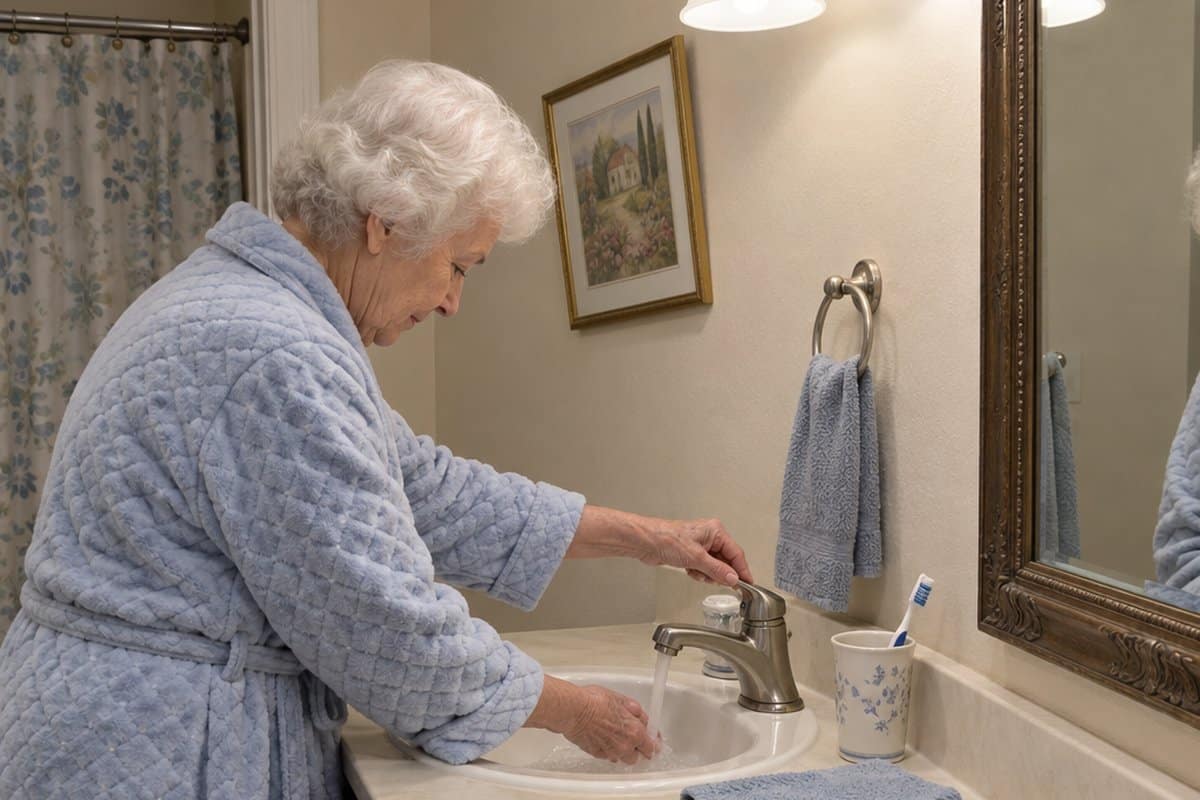
Picture yourself at the bathroom sink, hands braced on the edge of the basin, leaning in just to reach the water. If that sounds familiar, you are in the right place for easier faucets. This guide covers faucet extenders, single-lever faucets, and touch activation, including touchless brass bathroom faucets and how to choose one that fits your sink. It also explains what ADA faucet standards mean at home. The leaning is not your fault. It is a design problem, and a sink basin was never built to hold your weight.
This article covers four distinct fixes. The right one depends on which part of the task is actually hard for you:
- Reaching the stream → faucet extenders
- Operating the handle → single-lever mixing faucets
- Managing grip entirely → touch and motion-activated faucets
- Reaching into a deep basin → pull-down kitchen faucets
Identify your friction point and skip directly to that section. You may need more than one.
Faucet Shopping Guide: Extenders, Levers & Touch Faucets
Download this practical shopping guide to find the right faucet solution for your specific problem, whether it’s reach, grip, or operation, complete with specifications to check before you buy and a clear decision tree to avoid costly mistakes.
What to Look For
Before spending money on any faucet product, it helps to know what the specifications actually mean for your daily use. Here are the numbers and details worth checking.
Spout reach, not spout height. The measurement that determines whether a lean is eliminated is horizontal: the distance from the faucet body to the point where water exits. Spout height tells you how tall the arc is. Spout reach tells you how far forward the water falls. A faucet extender typically adds 3 to 5 inches of forward reach. When you are evaluating any faucet or extender, look for the reach measurement in the product specifications, not just the height.
Handle operation force. ADA-compliant faucets require no more than 5 pounds of force to operate. They must not require tight grasping, pinching, or twisting. Standard two-handle knob faucets often take much more force than that, more than an arthritic or weakened hand can reliably produce. If a product lists ADA compliance, that 5-pound standard is what it is confirming.
Temperature control legibility. Single-lever faucets encode temperature in the arc of movement: far left is hot, far right is cold, center is mixed. That positional cue is the key accessibility advantage of a lever over touch activation. Touch and motion faucets typically default to a preset temperature and offer no visible cue. The ADA recommends a maximum water temperature of 120°F. If someone has reduced skin sensation, check with their doctor or therapist about a safe setting, and follow the faucet’s manual.
Installation requirements. Faucet extenders need no tools and no installation. They clip or thread onto most standard round spouts. Single-lever and touch faucets require shutoff valve access, a standard 1-3/8-inch mounting hole (or a deck plate to cover a three-hole configuration), and either basic plumbing comfort or a professional. Pull-down faucets also require adequate under-sink clearance for the hose, typically 8 to 10 inches.
Battery and power requirements. Most battery-operated touch faucets run on AA batteries, so plan on replacing them now and then. AC-powered models eliminate battery replacement but require an outlet under the sink. Check which type applies to any model you are considering.
Finish durability. Chrome and brushed nickel are the most durable and easiest to clean. Matte black finishes show water spots more readily and may degrade faster in hard-water areas.

What ADA Faucet Standards Mean at Home
You will see “ADA compliant” on many faucet boxes. The ADA is the Americans with Disabilities Act, and its faucet rules were written for public restrooms. They still make a handy checklist for a home faucet.
First, force. You should be able to turn the water on with no twisting of the wrist and less than 5 pounds of force.
Second, one hand. A faucet that works with one hand, with no pinching or tight grasping, is easier for anyone with a physical limitation.
Third, height. The parts you operate should be no higher than 48 inches from the floor. Handles mounted on the faucet base are recommended.
Fourth, space underneath. There should be 27 inches between the floor and the bottom of the surface the faucet sits on, so someone seated can pull up close for knee clearance.
Fifth, timing, if the faucet has a motion sensor. The water should run for at least 10 seconds before it shuts off.
Touchless faucets do qualify. They suit anyone with a limited range of motion, as long as they keep the water running for that full 10 seconds.
Water temperature is a separate question from ADA rules. My article on managing water temperatures covers it.
One trade-off: the ADA rules were written for public restrooms. A faucet that meets them still has to fit your sink and your hands.
Faucet Extenders
A faucet extender clips or threads onto an existing spout and redirects water 3 to 5 inches forward, eliminating the forward lean that puts unsafe weight on a basin edge. No tools, no plumber, and often under $20.


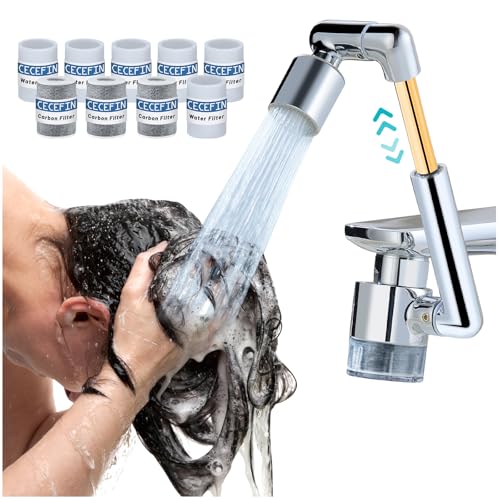
A faucet extender is the entry point for the lean problem, and often the only fix needed.
An extender clips or threads onto an existing spout and redirects water 3 to 5 inches forward, bringing the stream closer to the person standing at the sink. No tools. No plumber. No modification to the faucet itself. In many cases, under $20.
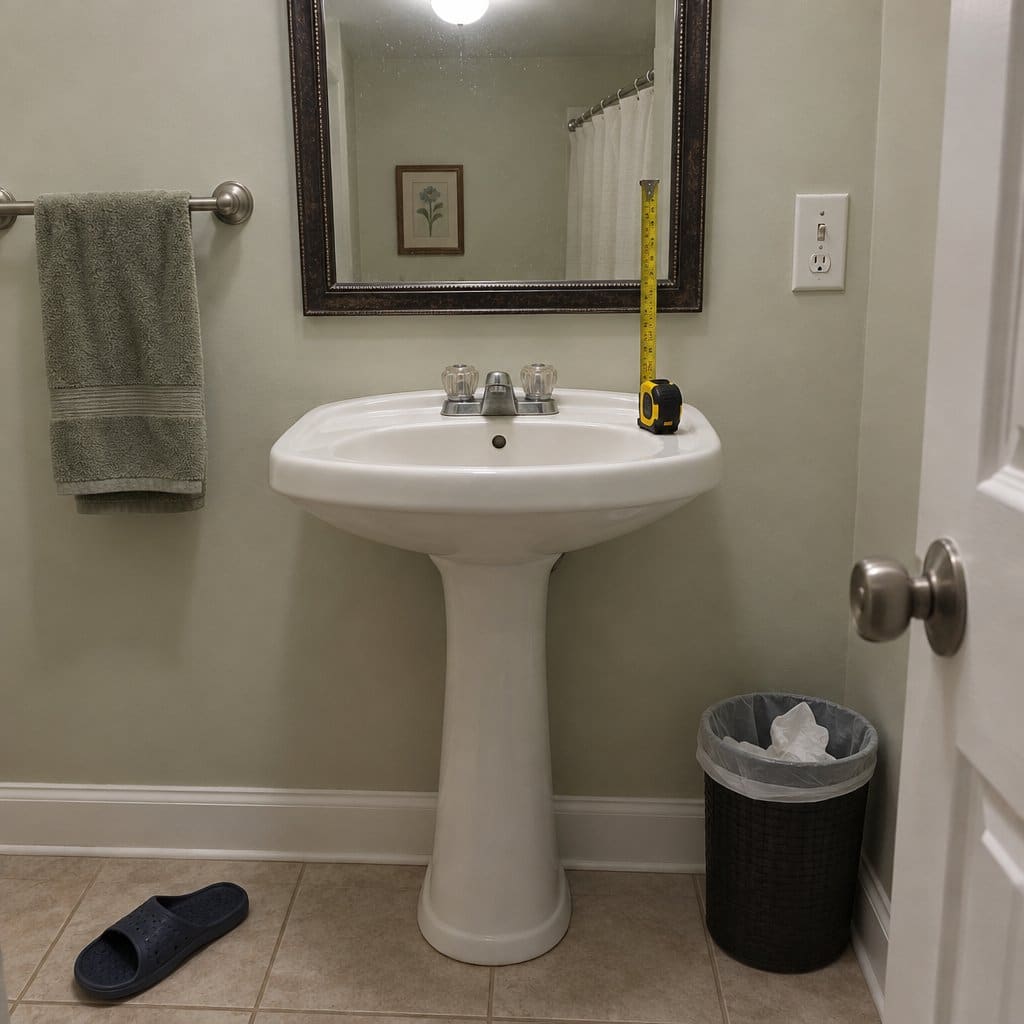
This is the right product for anyone whose primary difficulty is reach. It does not help with handle operation or temperature control, just the distance between where they stand and where the water falls. It works in bathrooms and kitchens equally. It is especially useful at pedestal or wall-mount sinks positioned deeper than a person's comfortable reach.
Where it is the wrong choice: an extender does nothing for someone who cannot operate the existing handles. If grip, twist, or pinch strength is the problem, the handles are the problem, and an extender leaves that untouched. It also does not address temperature control.
When comparing extenders, look at compatibility with your spout shape (round spout versus flat aerator versus gooseneck), the length of the extension, whether it reduces flow rate noticeably, and how it attaches. The most common failure mode is water leakage at the connection point. Check reviews for this specifically.
CECEFIN Patented Swivel Faucet Extender Sink Aerator NSF/ANSI 372 Standard
The CECEFIN swivel extender attaches to the aerator threads on most standard round spouts and allows the outlet to rotate so water can be directed toward the user rather than straight down. The NSF/ANSI 372 certification confirms it meets lead-free standards, which matters for a device in direct contact with drinking water.
The swivel range allows repositioning without removing the extender, which is useful if multiple people use the same sink and have different reach distances. The attachment is threaded, which tends to hold more securely than clip-on designs and reduces the leakage risk at the joint.
This works on spouts with standard male or female aerator threading. It is not compatible with flat-face aerators flush with the spout tip, or with angled gooseneck designs where the outlet already faces down at a sharp angle.
Hibbent NSF/ANSI/CAN 61 & cUPC Certified Faucet Aerator, Chrome
The Hibbent aerator extender carries both NSF/ANSI/CAN 61 and cUPC certifications, two independent safety standards for water-contact components. The chrome finish is consistent with most standard bathroom and kitchen fixtures, so it is less likely to look out of place on an existing faucet.
The forward extension brings the stream closer without significantly reducing flow rate, which is a practical concern with some aerator-style extenders. The threaded attachment is designed to fit the most common aerator sizes found on residential faucets.
This is a good first choice for anyone who wants a no-tool solution that meets documented safety standards and blends with a chrome finish. Confirm your existing spout has a threaded aerator before ordering. Spouts with press-fit or snap-in aerators require a different attachment method.
Longing Home 1080° Swivel Faucet Extender, Silver, 2 PCS
The Longing Home extender offers 1080° of combined swivel range across two joints, which allows the outlet to be positioned forward, to the side, or at a downward angle. That is more positioning flexibility than a single-joint swivel. The two-pack means both bathroom and kitchen sinks can be addressed at once without a second order.
That multi-joint flexibility is most useful in a bathroom where the sink is both deep and positioned off-center relative to where the person stands. Being able to angle the stream rather than just extend it forward adds a dimension of adjustability most single-joint extenders do not offer.
The silver finish matches brushed nickel and stainless hardware more naturally than bright chrome. As with all aerator-style extenders, compatibility depends on the existing spout's thread configuration, so check the spout diameter before installing.
Asllosce 1440° Swivel Faucet Extender Sink Faucet Aerator Extender
The Asllosce extends the swivel range further, to 1440° across multiple joints, giving it more repositioning range than most extenders in this category. For a sink where the lean is partly lateral (reaching sideways rather than just forward), that additional articulation can matter.
The filter element built into the aerator body is a secondary benefit: it reduces splashing and helps produce a more controlled stream, which is useful in shallow basins where standard aerators cause spray back onto the countertop or the user's clothing.
Installation is still tool-free and aerator-thread compatible. The higher swivel count does add slightly more joint connections, which increases the surface area where leaks can develop over time. Tightening the joints by hand firmly at installation reduces that risk.
ONESWI 360° Swivel Faucet Aerator: Fits Female M22 & Male M24 Threads, Dual Spray Water Saver
The ONESWI specifies compatibility with both female M22 and male M24 aerator threads, two of the most common residential thread sizes, which reduces the guesswork of matching it to an existing spout. The dual spray mode (stream and aerated flow) adds minor versatility for rinsing versus washing tasks.
The 360° swivel is a single-joint design, simpler mechanically than multi-joint options and less likely to develop leaks over time. For a straightforward forward-reach problem with no lateral component, the single-joint design is adequate and more durable.
The thread size specification on the packaging is genuinely useful. It is easier to measure your existing aerator and confirm a match than to order and return. A standard aerator key (often included with faucet purchases) helps with removal.
CECEFIN 1440° Sink Water Filter Faucet Extender 3.0, Telescopic Robotic Arm
The CECEFIN 3.0 is the most mechanically complex option in this section. The telescopic arm extends the spout reach beyond what a standard swivel extender provides, and the 1440° multi-joint swivel allows the outlet to be positioned in nearly any direction. The integrated water filter stage is an added feature not present in most extenders.
This suits a situation where the reach problem is significant (more than 3 inches) and where the existing faucet is otherwise functional and not being replaced. The robotic-arm style looks different from a standard aerator attachment, which may or may not matter depending on the kitchen or bathroom aesthetic.
The more complex the mechanism, the more connection points exist. Installing each joint firmly and checking for drips after the first use is a reasonable precaution. The filter element will need periodic replacement; check the replacement cartridge availability before committing to this model.

Single-Lever Mixing Faucets
A single-lever faucet replaces two-handle knob controls with one lever that moves side to side for temperature and forward and back for volume, meeting ADA standards for low operation force and encoding temperature in a physical position anyone can repeat from memory.

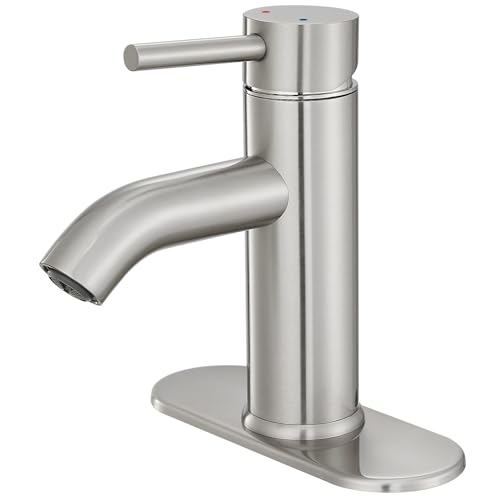
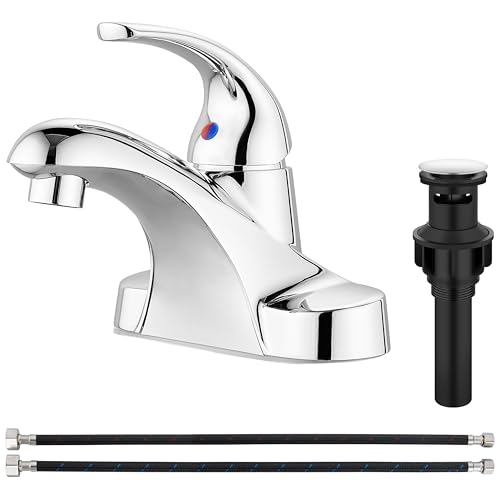
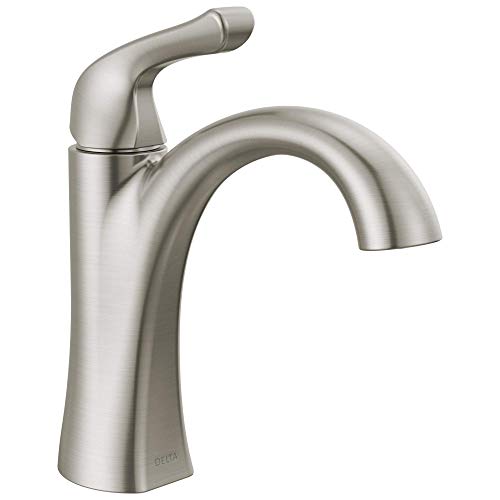

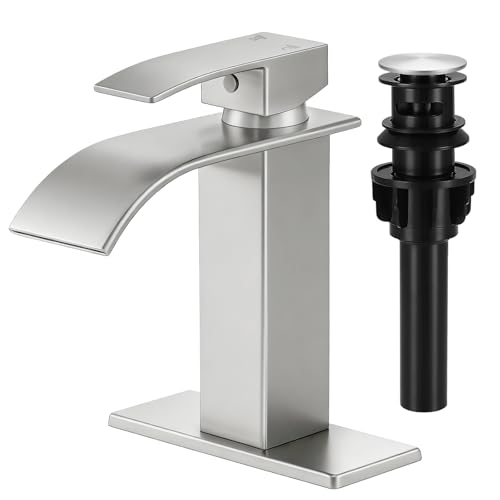
A single-lever faucet replaces a two-handle configuration with one control that moves in two planes: side to side for temperature, forward and back for volume.
The accessibility advantage is not just that it requires one hand. It is that the lever's physical position encodes temperature. A person who sets the lever to the same position every morning gets the same temperature every morning: no reading, no guessing, no recalibrating by feel. That positional memory is a meaningful cognitive reduction, especially early in the morning or for anyone managing early-stage memory change.
This is frequently the right choice for someone managing early arthritis who retains enough grip to move a lever but finds the torque required for round knobs painful or unreliable. It is also well-suited for a caregiver who wants to simplify a parent's faucet without removing all physical interaction with it.
Where it is the wrong choice: a lever still requires grip. Not a pinch or twist, but a wrap-and-push. For someone with moderate to severe hand pain, limited finger flexion, or significant weakness, the lever reduces effort but may not eliminate it. And unlike extenders, a lever faucet requires installation. This is not a no-tool solution.
When comparing single-lever faucets, look at lever length (longer levers provide more mechanical advantage), handle position (side-mount versus top-mount changes the direction of push), spout reach, ADA certification, and whether an anti-scald temperature limiter is included.
Moen Karis Spot Resist Brushed Nickel One-Handle Single Hole Bathroom Sink Faucet
The Moen Karis is a single-hole bathroom faucet with a side-mounted lever and Moen's Spot Resist brushed nickel finish, which actively resists fingerprints and water spots. That is a practical durability feature for a bathroom used daily. Moen's manufacturing standards consistently meet ADA operation requirements, making this a reliable choice for someone prioritizing reduced handle force.
The side-mounted lever on the Karis positions the control at the side of the faucet body rather than on top, which means the push-pull motion for volume is largely horizontal. For someone with shoulder or wrist limitations that make overhead or downward force uncomfortable, the side mount can be easier to operate than top-mounted levers.
The Karis is a bathroom vanity faucet for single-hole or three-hole (with a deck plate) configurations. It is not a kitchen product. Moen's customer service and parts availability are well-established, which matters for a faucet that will be in daily use for years.
VOTON Bathroom Faucet Brushed Nickel Modern Single Hole Bathroom Sink Faucet with Single Handle
The VOTON is a single-handle bathroom faucet in brushed nickel with a straightforward lever control and a clean, minimal profile. The single-hole mounting simplifies installation compared to three-hole configurations, and the brushed nickel finish resists water spot visibility better than polished chrome in most water conditions.
The lever arc on this model follows the standard single-lever convention: rotate to the left for warmer water, right for cooler, pull back for more flow, push forward to reduce or stop. For anyone new to single-lever operation, that convention is consistent across virtually all single-lever faucets and does not require relearning.
This is a functional, uncomplicated bathroom faucet at a price point that makes it accessible for a rental property or a secondary bathroom. It does not include an integrated temperature limiter. If anti-scald protection is a priority, that can be added as a separate inline device during installation.
Aolemi Polish Chrome Bathroom Sink Faucet, Single Handle 4 Inch Centerset
The Aolemi is a 4-inch centerset faucet, meaning the handles and spout are integrated into a single unit that mounts on a 4-inch spread, the most common configuration for standard bathroom vanities with three pre-drilled holes. The polish chrome finish is bright and easy to wipe clean.
The single handle is center-top mounted, which positions the lever directly above the faucet body. The push-pull motion for volume is vertical, and the side-to-side rotation for temperature spans the arc of the handle. For someone who prefers a faucet that looks conventional while still offering single-handle operation, the centerset format achieves that.
The 4-inch centerset configuration is important to verify against your existing sink. If your sink has holes drilled on a different spread, or a single hole, this faucet will not fit without a different mounting plate or sink modification.
DELTA Arvo Brushed Nickel Bathroom Faucet 1 Hole, Single Hole Bathroom Sink Faucet
Delta is one of the few manufacturers that explicitly lists ADA compliance across its residential faucet lines. The Arvo in brushed nickel is a single-hole bathroom faucet with Delta's standard single-lever control and the brand's documented commitment to 5-pound-or-less operation force.
Delta faucets use a ceramic disc valve rather than a rubber washer, which means the valve does not compress against a seat with each use. That design eliminates the torque increase that develops in rubber-valve faucets as the washer ages and hardens. It is a practical durability advantage for anyone who relies on low handle force over years of use.
The Arvo's profile is compact and straightforward. Delta's parts availability and repair documentation are among the most accessible in the residential faucet market, which makes long-term maintenance more manageable than with lesser-known brands.
LUFG Bathroom Faucet Single Handle Bathroom Sink Faucet Brushed Nickel
The LUFG single-handle bathroom faucet in brushed nickel is a clean, single-hole design with a lever-style handle and standard hot-left, cold-right arc. The brushed nickel finish works with most contemporary bathroom hardware and is more forgiving of water spots than polished finishes. If you want to compare more styles and finishes, I put together a look at the bathroom faucets for seniors that are easy and safe to use.
The faucet body is compact, which suits smaller vanity configurations where a taller or wider faucet would feel visually disproportionate. The lever length is moderate: sufficient for standard operation, though shorter than models designed specifically for reduced-grip users.
This is a practical choice for a bathroom where the primary need is replacing a two-handle knob faucet with a single-lever control, without a significant budget outlay. If maximum lever length for mechanical advantage is a priority, compare this model's lever dimensions against longer-armed options in this section.
LUFG Bathroom Faucet Brushed Nickel Waterfall Single Handle Vanity Faucet
The LUFG waterfall faucet delivers water in a wide, sheet-like flow rather than a standard aerated stream. The waterfall format positions the outlet at the front of the spout body, which reduces the horizontal reach required to get hands under the water. That is an incidental benefit for someone managing the lean problem at the bathroom sink.
The single-handle lever operates in the standard arc. The wide-flow outlet is visually distinctive and produces a quieter, lower-splash stream than a standard aerator. That is useful in a shallow basin where splash-back is a recurring nuisance.
The waterfall format is a stylistic choice as much as a functional one. If the existing bathroom has a contemporary or spa-influenced aesthetic, this faucet fits that context. If the bathroom has traditional hardware throughout, the waterfall spout may look out of place regardless of its functional merits.
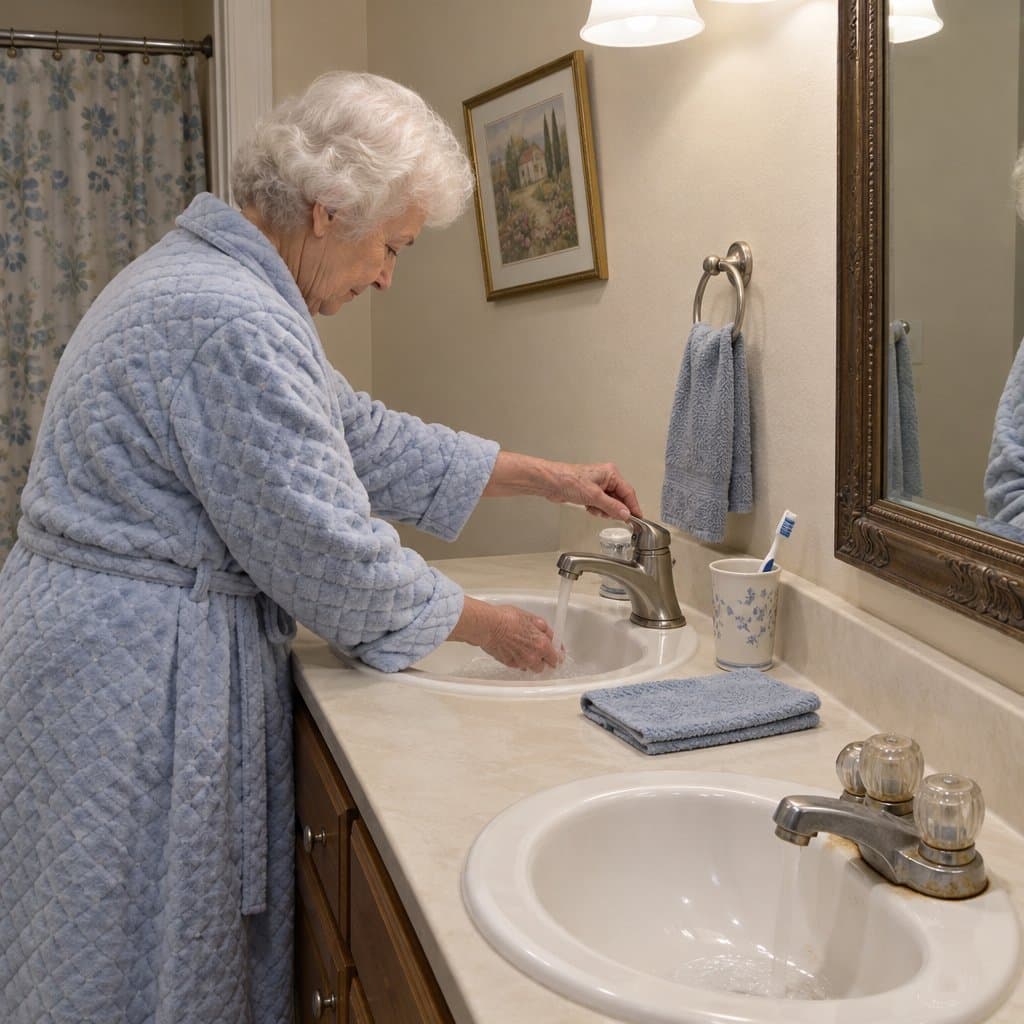
Touch and Motion-Activated Faucets
Touch and motion faucets eliminate the need to grasp, twist, or push a handle entirely. They turn on with a tap or a hand wave, making them the most effort-reducing option for anyone whose primary barrier is painful or unreliable hand strength.
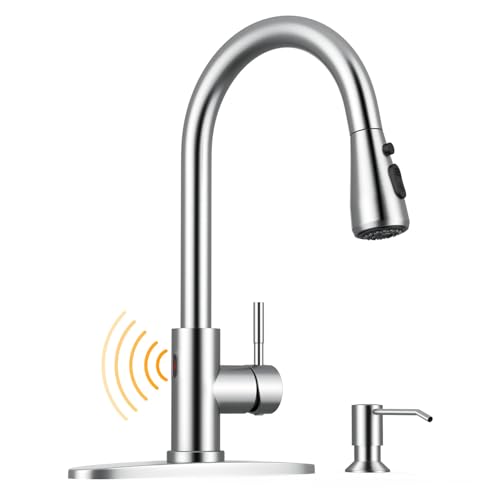


Touch-activated faucets turn on and off with a tap anywhere on the spout or handle body. Motion-activated faucets respond to a hand moving within a sensor field, with no contact required at all. Both eliminate the need to grasp, twist, or push a lever.
For someone with painful hands, swollen joints, or significantly reduced grip strength, this is the most effort-reducing faucet option available short of adaptive equipment. It is also well-suited for kitchen use, where a person may approach the sink with wet, soapy, or food-covered hands and cannot easily operate a conventional handle.
This section covers a real limitation. When a handle is removed, a familiar temperature cue goes with it. If you rely on the lever's position to know whether the water is safe before putting your hands under it, you lose that cue entirely with a touch or motion faucet. Most touch faucets default to a preset temperature, which is meant to be safe, but if you want full temperature control you have to use a secondary adjustment that is often less intuitive than the lever it replaced.
For someone with significant cognitive decline, the absence of a handle may cause real confusion about how to use the faucet. This depends on the person, so it is worth watching how they respond to the new faucet before relying on it.
Battery management is a real maintenance task with these faucets. Check the manual for the battery type and how long they should last. Set a calendar reminder so a dead battery does not leave the faucet stuck unexpectedly.
WEWE Touchless Kitchen Faucet with Soap Dispenser Set, Brushed Nickel
The WEWE touchless kitchen faucet uses motion sensing to start the water without contact, paired with an integrated soap dispenser in a matched brushed nickel finish. The bundled soap dispenser removes a separate pump to press, which helps if your grip is limited while you clean up the kitchen.
The motion sensor is positioned to respond to a hand approaching the faucet from below, which reduces the chance of incidental activation from nearby movement on the counter. The pull-down spray head offers two spray modes for rinsing and stream tasks.
The soap dispenser is the differentiating feature here. If eliminating soap pump operation alongside faucet handle operation is the goal, this combination addresses both in a single installation. If soap dispenser integration is not a priority, a simpler touchless model may offer better value.
Hiqufet Touchless Kitchen Faucet, Pull Down Sprayer, Brushed Nickel
The Hiqufet combines touchless motion activation with a pull-down spray head. Together, those two features address both handle operation and reaching into a deep basin. The motion sensor starts the water without contact, and the pull-down head brings water to the task rather than making you bring the task to the water.
The brushed nickel finish is consistent with most contemporary kitchen hardware. The motion sensor sensitivity is adjustable on some models in this line. Check the product specifications for this detail, as adjustable sensitivity cuts down on accidental activation.
This is a good fit for a kitchen where both grip difficulty and basin depth are daily annoyances. Installation is equivalent to a standard single-hole kitchen faucet replacement. Confirm you have enough under-sink clearance for the pull-down hose (at least 8 to 10 inches) before purchasing.
OWOFAN Touchless Pull Down Kitchen Faucet LED Light Brushed Nickel
The OWOFAN touchless pull-down faucet adds an LED light that changes color based on water temperature. It is a visual cue that partly replaces the lever position you lose when the handle is removed. Cool water reads one color and warm water reads another. This is a meaningful feature if you have low vision or reduced skin sensation and cannot rely on feel alone to judge temperature before use.
The touchless activation is motion-based, and the pull-down spray head operates in multiple modes. The LED is powered by the water flow itself, requiring no separate battery.
The color-temperature indicator does not replace a lever's positional precision, but it provides more information than a standard touchless faucet that offers no visual feedback at all. For a household where temperature awareness is a safety consideration, this feature is worth the modest premium over a standard touchless model.
APPASO Touchless Kitchen Faucet with Pull-Down Sprayer Bronze for 1 to 4 Hole

The APPASO touchless faucet is available in an oil-rubbed bronze finish and is designed to fit sink configurations from one to four holes. That wide range makes it easier to install in kitchens with existing three- or four-hole sinks without needing a separate deck plate.
The touchless activation uses motion sensing, and the pull-down sprayer adds reach flexibility for filling pots or rinsing produce. The bronze finish suits kitchens with warm-toned hardware where brushed nickel would be inconsistent.
Finish compatibility is often overlooked in faucet selection. If the existing kitchen has bronze or oil-rubbed hardware on cabinet pulls, light fixtures, and other faucets, choosing a matching finish reduces the visual disruption of a new installation. The functional specifications are otherwise comparable to other touchless pull-down models in this section.
FORIOUS Black Touchless Kitchen Faucet with Soap Dispenser, Hands-Free
The FORIOUS black touchless faucet pairs motion-activated flow with a matched black soap dispenser, so there is no hand contact for either water or soap. The matte black finish is distinctive and suits contemporary kitchens with black hardware.
The hands-free activation is the primary feature. For someone who regularly approaches the kitchen sink with hands that are heavily soiled, wet, or occupied with food prep, a fully hands-free system removes the need to touch any surface to begin washing. That is a genuine reduction in daily friction.
The matte black finish needs more attention to water spots than brushed nickel or chrome. In hard-water areas, mineral deposits show more on dark matte surfaces. If the kitchen has soft water or a water softener, this is less of a concern. If not, plan on periodic cleaning with a water spot remover.
GIMILI Touchless Kitchen Sink Faucet with Pull Down Sprayer 15 Inch

The GIMILI touchless kitchen faucet is notable for its 15-inch spout height. That is taller than most residential kitchen faucets and lets large pots and stockpots fit beneath the spout without tilting or repositioning them. If you regularly fill large containers and find the standard sink awkward to work around, the extra clearance is a real advantage.
The touchless activation is motion-based, and the pull-down spray head docks magnetically. Magnetic docking is more reliable than gravity docking and requires less precise hand positioning to seat the head correctly after use.
The 15-inch height is the differentiating specification here. If pot-filling is a regular kitchen task and clearance under a standard faucet is a friction point, this model addresses that specific problem. Confirm the under-sink cabinet has adequate depth for the pull-down hose before installing.

Touchless Brass Bathroom Faucets and How to Choose One That Fits
If you want one bathroom faucet that takes the handle out of the picture, a touchless model made of solid brass is a good place to start. A sensor turns the water on, so there are no handles or knobs to grip. Solid brass is a durable material that resists leaks.
The better touchless models let you set a limit on the water temperature. That helps prevent burns, and a mixing valve gives you both hot and cold water. For more on keeping water at a safe temperature, see my piece on managing water temperatures.
Look for one that runs on batteries or plugs into household power, and that comes with an instruction sheet and diagram. A touch-free sensor also means fewer germs passed around the sink.
Finishes come in brushed nickel, chrome and matte black. Pick the one that matches your towel bars and cabinet hardware. Chrome is durable and hides fingerprints, and brushed nickel is a step up from polished nickel.
Before you buy, check these things:
- Count the holes in your sink. Most have three: one for the spout and one for each handle.
- Measure the space between the handles. If the faucet is in the way, hold the tape measure above it.
- Check spout height and reach. A tall spout may not fit under a shelf, and a short reach may not cover every basin of a multi-bowl sink.
- Ask for ceramic valves if you do not want a drip.
If you now have a widespread faucet with two handles far from the spout, you cannot switch to a single-handle model. Extra holes can be covered with a baseplate or plugs.
One trade-off to know about: reviewers of one touchless brass model said its mounting hardware was too large to use. Check the mounting details against your sink before you order.
Pull-Down Kitchen Faucets
Pull-down kitchen faucets bring the spray head up and out to the task rather than making you lean down into a deep basin. The extra hose length and multiple spray modes make filling pots and rinsing dishes safer and less physically demanding.

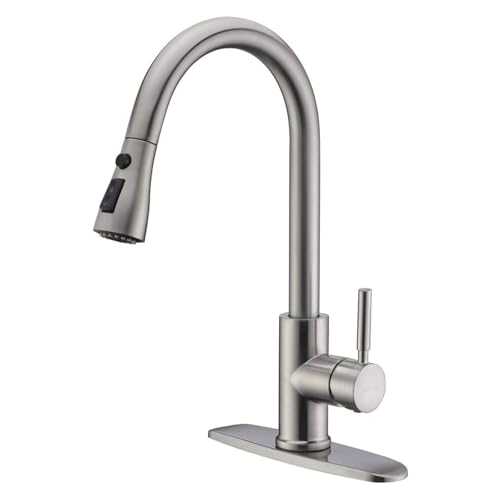
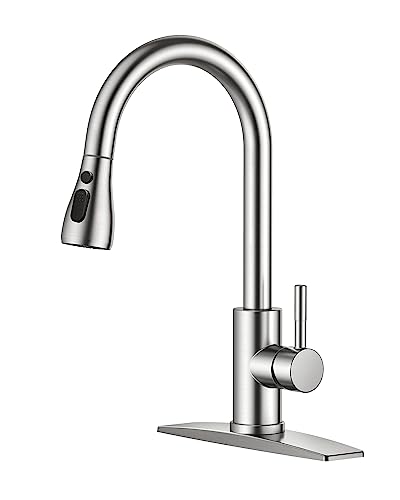
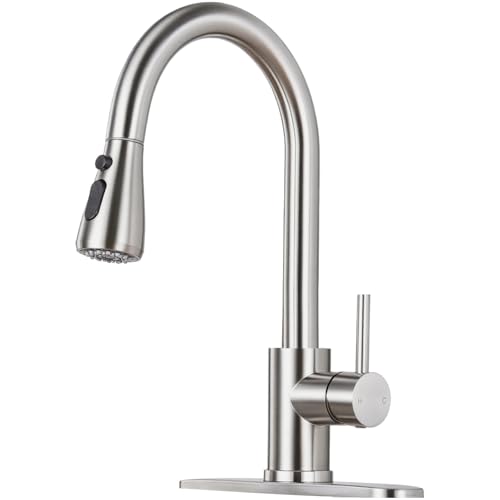
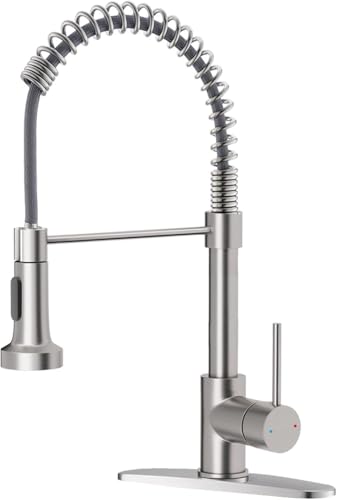


Pull-down faucets solve a different reach problem than extenders. The issue is not horizontal distance to the stream. It is vertical distance into a deep basin.
When a kitchen sink requires leaning forward and reaching down to rinse dishes or fill a pot, the pull-down head changes the equation. The spray head detaches from the spout and brings the water source up and out to the task. This is particularly valuable when a person is handling heavy pots or working with both hands occupied.
This suits anyone who struggles with the depth of a standard kitchen basin, rather than the distance from the faucet body. It is also useful if you fill containers that cannot easily sit directly under a fixed spout: a large stock pot, a pitcher, a pet bowl.
Where it is the wrong choice: the pull-down head must be docked back into the faucet body after each use. That takes a small upward motion and some hand coordination. Some people find this awkward, particularly if the magnetic dock is not strong enough to catch reliably. It is not a big barrier for most people, but it is worth knowing before purchasing. Pull-down faucets are kitchen-specific. The hose and spray head are not appropriate for bathroom sinks.
When comparing pull-down faucets, look at hose length and flexibility, docking mechanism (magnetic is more reliable than gravity), spray modes (stream, spray, and pause functions matter for daily tasks), spout height, and whether the control is a single lever or touch-activated.
Hibbent Pull Down Spray Head for Kitchen Faucet, 3-Function Sink Nozzle
The Hibbent pull-down spray head is a replacement head rather than a full faucet. It attaches to an existing pull-down faucet body and upgrades the spray functions without a full faucet replacement. If your kitchen faucet works fine but the spray head has worn out or offers only one mode, this is a targeted fix.
The three-function head offers stream, spray, and pause. The pause function is the most useful, because pressing it mid-rinse stops the water without reaching back to the faucet body or adjusting the handle. That means less back-and-forth movement, which helps when balance or reach is a concern.
Compatibility depends on your existing faucet's hose connection. Check the size before ordering. The Hibbent head is designed to fit common configurations.
WEWE High-Arc Pull-Down Kitchen Faucet, Brushed Nickel, 3-Mode Sprayer
The WEWE high-arc pull-down faucet combines a tall, arching spout with a three-mode pull-down spray head in brushed nickel. The high arc gives clearance for filling tall pitchers and stockpots without tilting them, which helps if you regularly work with large containers.
The three spray modes (stream, spray, and a third rinse pattern) give you flexibility for different kitchen tasks without changing tools or position. The single-lever handle on the faucet body moves side to side and push-pull.
The WEWE is a full faucet installation, not a head replacement. That means shutoff valve access and basic plumbing work are required. The hose length on this model fits standard under-sink depths, but confirm the specific measurement against your cabinet dimensions before purchasing.
FORIOUS Kitchen Faucets Pull Down Sprayer, Stainless Steel, Brushed Nickel
The FORIOUS pull-down kitchen faucet in brushed nickel uses a stainless steel construction that resists corrosion and handles hard-water mineral buildup better than chrome-plated brass alternatives. The pull-down spray head docks magnetically, and the hose retracts with a weight-based tensioning system that keeps slack from accumulating under the sink.
The single-lever handle on the faucet body controls both volume and temperature in the standard arc. The brushed nickel finish coordinates with most contemporary kitchen hardware without requiring a full hardware replacement to match.
A hose that does not retract well becomes a nuisance quickly. It ends up draped over the pipes or bunched against the cabinet wall. The weight-tensioned retraction system on pull-down faucets is a small detail that makes a real difference in daily use.
LUFG Brushed Nickel Kitchen Faucet with Pull Down Sprayer and Deck Plate
The LUFG kitchen faucet ships with a deck plate included, which matters for kitchens with three pre-drilled holes in the sink deck. Most single-hole pull-down faucets require a separate deck plate purchase to cover unused holes. Having it bundled saves that extra step and cost.
The pull-down spray head and single-lever handle operate in the standard configuration. The brushed nickel finish is consistent with the rest of the LUFG bathroom faucet line reviewed in the single-lever section, which is useful if coordinating finishes across kitchen and bathroom is a priority.
The deck plate inclusion is the practical differentiator here. If your kitchen sink has a three-hole configuration and you are moving to a single-hole pull-down faucet, confirm the deck plate dimensions match your sink's hole spread before installing.
OWOFAN Kitchen Faucet with Pull Down Sprayer Brushed Nickel
The OWOFAN pull-down kitchen faucet has a high-arc spout and a pull-down head with multiple spray modes. The brushed nickel finish is consistent across the spout body, handle, and spray head. That is minor, but worth noting because mismatched finishes on pull-down heads are a common complaint with lower-cost models.
The lever handle is side-mounted on the faucet body, which positions the temperature and volume control to the side rather than above the spout. For someone who finds reaching up or across to a top-mounted lever difficult, the side-mount configuration reduces that extension.
OWOFAN also appears in the touch-activated section of this article, which means replacement parts and customer service access are available through the same channel if questions arise about either product. That consistency is worth noting for households managing multiple faucet replacements.
Uvish Stainless Steel Kitchen Faucet Head Replacement, 3 Function Pull Down Spray Head
The Uvish is a replacement spray head, not a full faucet, similar in purpose to the Hibbent head reviewed earlier in this section. The stainless steel construction resists corrosion and is less likely to show wear at the spray face than plastic-bodied heads over time.
The three functions (stream, spray, pause) give you the same mid-task flow control described for the Hibbent head. The pause function is the most useful feature if you want to manage water use while rinsing without reaching back to the faucet body.
Compatibility with existing faucet hoses should be confirmed before purchasing. The Uvish is designed to fit common residential connection standards, but pull-down spray heads are not universally interchangeable. Check the connection type of the existing hose against the product specifications.
FORIOUS Kitchen Faucet Pull Down Sprayer, Classic High Arc, Brushed Nickel
The FORIOUS Classic High Arc is a traditional-profile pull-down faucet with a rounded, gooseneck spout rather than the angular contemporary profiles of other models in this section. For kitchens with traditional cabinet hardware and fixtures, the classic arc coordinates more naturally than a geometric or minimalist design.
The pull-down spray head docks to the spout tip and offers stream and spray modes. The single-lever handle controls volume and temperature in the standard arc. The high arc provides generous clearance for filling tall containers.
FORIOUS also has a touchless model reviewed in the touch-activated section. If you are weighing a kitchen faucet replacement and whether touchless is right for you, comparing the two FORIOUS models shows what changes, and what stays the same, between a standard pull-down and a touchless pull-down of similar construction.
Frequently Asked Questions
Can I install a faucet extender on any sink?
Most faucet extenders are designed for standard round spouts with threaded aerators. Gooseneck spouts, flush-face aerators where the screen sits level with the spout tip, and angled designs often do not accept clip-on or thread-on extenders. Before ordering, remove the existing aerator (an aerator key helps, though a coin often works) and check whether the thread is external (male) or internal (female). Extenders are designed for one or the other, not both. The product listing will specify which thread type it fits.
Will a touch faucet work if my hands are shaking?
This depends on the type of tremor. A fine tremor, the kind that makes small, precise movements unreliable, can trigger touch activation unexpectedly if the hand brushes the faucet body. For that pattern, a motion-activated faucet that responds to proximity rather than contact may be more reliable, since it avoids the accidental-touch problem. Reduced grip or strength without much tremor does better with touch activation because it removes the need to grasp at all. Try it out to see how it works for you. This is a practical observation, not a diagnosis.
How do I know if a single-lever faucet meets ADA standards?
The ADA operation standard requires no more than 5 pounds of force and must not require tight grasping, twisting, or pinching. Many manufacturers list ADA compliance in the product specifications. If it is not listed, the two physical factors that decide real-world force are lever length (a longer lever needs less force for the same movement) and handle position (side-mount levers tend to be more natural to push than top-mount levers). A longer lever on a side mount is generally the most accessible combination if you have limited grip strength.
Is a pull-down faucet safe if I have balance problems?
The pull-down motion brings the spray head toward you rather than making you lean into a deep basin, which is why it reduces balance trouble compared to reaching down and forward over a fixed spout. The hose should retract smoothly with minimal resistance, and the dock should catch reliably without a precise upward motion. I recommend testing the docking on any pull-down faucet during the first week of use. If the head does not seat with a simple upward gesture, the magnetic docking may need adjustment, or the model may not suit someone who cannot apply firm upward pressure.
My parent has dementia. Which faucet type is safest?
There is no one simple answer here. A touch or motion faucet removes grip effort but also removes the physical handle that shows a person how to use the faucet at all. For someone with moderate cognitive decline, the absence of a visible handle can cause real confusion, and they may not recognize the faucet as something that controls water. A single-lever faucet with a temperature limit set to a safe, warm level (120°F or lower, following the faucet's manual) is usually the safer choice here, because it keeps a familiar physical control while reducing handle force and the risk of scalding from a handle turned too far. Check with their doctor or therapist, especially if the person has reduced skin sensation. Touch activation is worth considering if handle operation is a documented struggle, but a caregiver should watch how the person responds to the new faucet before relying on it. The best automatic pill dispensers and similar daily-use tools follow the same principle: familiar ways of doing things reduce confusion more reliably than maximum automation.
Hacks and Practical Advice
Do the lean test before buying anything. Stand at the sink the way you actually use it, not carefully, not deliberately. Note where your hips are when your hands reach the water. If your weight has shifted forward or your hands are on the basin edge, the water is too far away. A faucet extender is almost certainly the right first step, and it costs less than a restaurant meal.
Check under the sink before choosing a replacement faucet. Shutoff valves that have not been turned in years may not close fully. If the valves feel stiff or show corrosion at the packing nut, a plumber visit is warranted before any faucet replacement. The faucet installation is not the complex part, but a valve that will not close turns a manageable project into an emergency. Checking the shutoff valves takes about thirty seconds, and it matters.
Set the temperature limiter before you finish installation. Some lever and touch faucets have an adjustable temperature limiter in the handle body or under a cap on top of the cartridge. This is the setting that caps the maximum water temperature regardless of how far the handle is moved. Set the limiter to a safe, warm temperature, such as 120°F or lower, and do it during installation rather than after the first time someone runs the water too hot. Follow the faucet's manual to find the limiter and adjust it. Some faucets cannot be set to an exact temperature. If the person has reduced skin sensation or dementia, check with their doctor or therapist.
Mark the center position on a single-lever faucet. A small piece of colored tape or a shallow scratch at the 12 o'clock position on the faucet base gives someone with low vision a tactile and visual reference for the mixed-temperature starting point. It takes thirty seconds and ends a daily guessing game.
Test the docking mechanism on a pull-down faucet weekly at first. Magnetic docking weakens over time, and a hose that does not seat correctly leaves a loop of hose at the counter edge that is a snagging hazard. If the head stops docking reliably, the magnet may need replacement, and many manufacturers offer this as a service part. A hose that is not docked is worth fixing before it becomes a fall risk.
Think about faucet changes as part of a broader room review. A new faucet reduces one source of friction, but the floor surface, lighting, and footwear in the kitchen and bathroom affect fall risk in ways a faucet change alone does not address. The fall prevention checklist is a useful complement to any hardware upgrade, since it catches problems a single product fix can miss.
If the kitchen or bathroom has other daily-use friction points, such as difficult can openers, heavy cookware, or hard-to-grip tools, the best kitchen utensils for arthritic hands covers the same diagnostic approach applied to everything else on the counter.
Faucet Shopping Guide: Extenders, Levers & Touch Faucets
Download this practical shopping guide to find the right faucet solution for your specific problem, whether it’s reach, grip, or operation, complete with specifications to check before you buy and a clear decision tree to avoid costly mistakes.
Conclusion
The lean at the sink is the problem this article is designed to solve. And the lean is fixable.
The decision logic is straightforward once you have identified which part of the task is creating friction:
- If reaching the stream is the issue, an extender is the first and cheapest fix.
- If the handle requires a painful grip or torque, a single-lever faucet is the right replacement.
- If hand operation is the binding constraint regardless of handle type, touch or motion activation removes it.
- If the basin depth requires leaning down and forward, a pull-down head brings the water to the task.
Walk through every sink in the home today (kitchen, bathroom, any utility sink) and ask three questions at each one: Does using this faucet require a lean? Does it require two hands or a painful grip? Does it require reaching past the basin edge? Those three observations take under two minutes per sink, and the answers tell you exactly which section of this article applies.
If you want a more complete room-by-room review that surfaces the problems a quick observation can miss, the bathroom safety products guide and the products for elderly living alone checklist are the natural next steps. Faucet modifications for aging in place are one piece of a larger picture, and these resources help you see the rest of it.
Have you already made a faucet change that made a real difference at home? Share what worked in the comments. Your experience may be exactly what someone else is looking for.