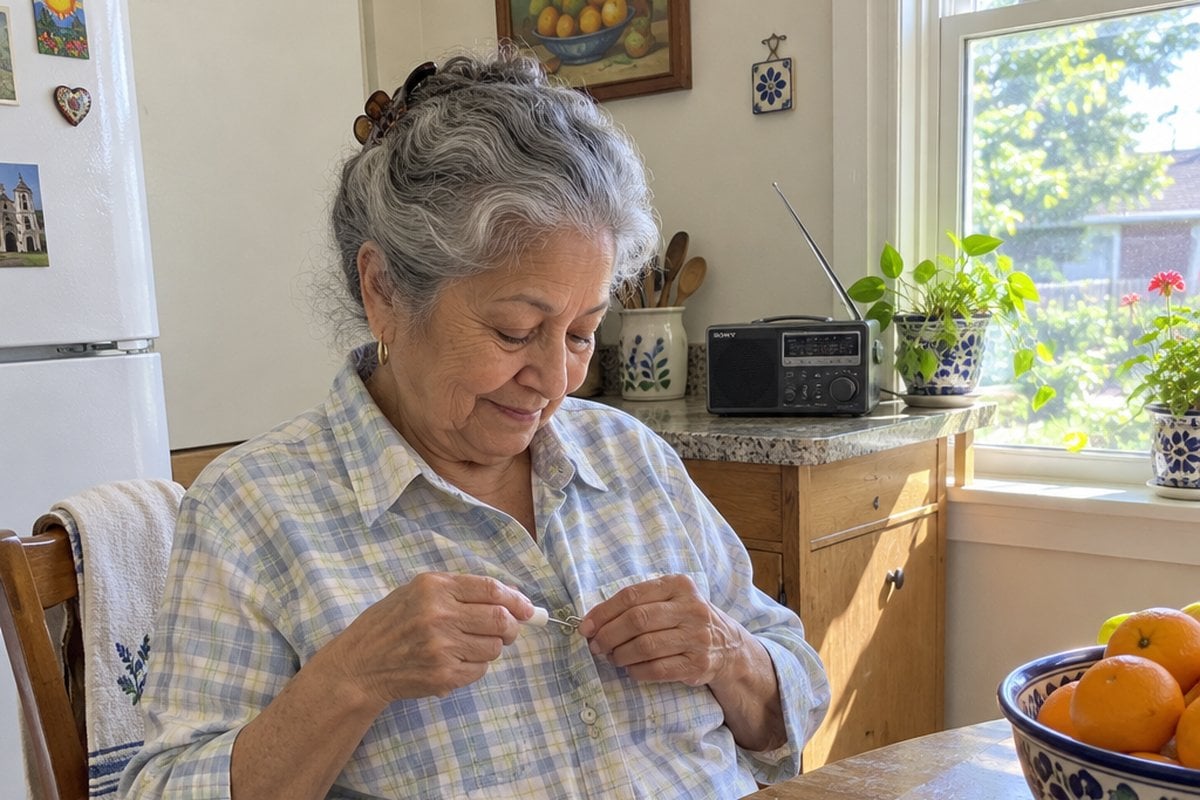
If you want the short list, these are my top dressing aid picks for mobility challenges, and you’ll find the details on each one further down.




Pulling on a sock means lifting one foot off the floor, and most of us do it without a second thought. For some people, that one-legged moment is the shakiest part of the day.
This guide to dressing aids fall prevention sorts the tools into two groups: reach problems and grip problems.
Match the group to your problem and you buy the right thing the first time. Getting dressed shouldn't feel like a balance test, and a small tool can take the test away.
Dressing Aids Shopping Checklist
Download this practical shopping checklist to identify exactly which dressing aid matches your specific challenge—reach or grip—and avoid wasting money on products that end up unused in a drawer.
What to Look For
Start with one question: is your problem reach or grip?
Reach means you can't get to your feet safely. Grip means you can't manage buttons, zips or laces. They need different tools, and the wrong one ends up in a drawer.
Then check these:
- Handle length for reach tools: Long shoehorns and dressing sticks commonly run about 18 to 32 inches. Sit down and measure from your hand to the floor. Longer reaches farther but is harder to control.
- Sock aid fit: Check the listing's stated sock size. Regular sock aids and wide-calf or compression versions are separate. Compression stockings usually need a stocking donner built for them.
- Strap length: Pull straps should reach you seated without leaning forward. Listings commonly state 25 to 35 inches, so verify each one.
- Handle grip: Foam or padded, built-up handles are easier on arthritic hands. Look for non-slip surfaces.
- Weight and rigidity: Light tools are easier to control, but a flexible shoehorn can bend under pressure. Metal or rigid plastic holds up better. Check the maker's stated limits.
- Fastener tools: A button hook loop should fit your buttons. A zipper pull needs a ring big enough for your finger. Laces should stretch enough to slip on without retying.
- One-handed use: Many sock aids need two hands to load. If one hand works better, check this first.
- Cleaning and durability: Look for washable fabric parts, no sharp edges and no loose cords.
- Price: Most dressing aids cost under $25 to $30.
If you're recovering from joint replacement or a stroke, ask your care provider or occupational therapist before you buy. They may have movement precautions that affect which tool is safe for you.
Sock Aids and Stocking Donners
Pulling on socks means balancing on one leg or bending low. A sock aid holds the sock open so you can dress seated without that risky moment.
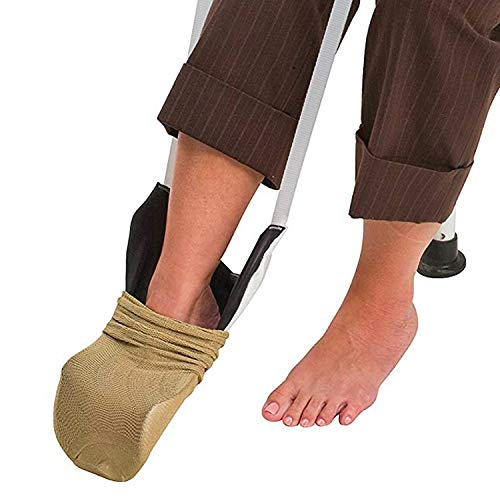
A sock aid is a trough, sleeve or frame that holds the sock open. You slide your foot in, then pull on the straps. No bending, and no lifting your foot onto the opposite knee.
This is the type that makes the fall-prevention case, because it removes the one-legged moment completely. It suits people recovering from hip or knee replacement, people with limited hip flexion, and anyone whose balance makes lifting a foot risky.
It's the wrong choice if you have significant hand weakness. Loading the sock and pulling the straps takes grip and dexterity. It's also a poor fit if only one hand works well, since most need two hands to load. Mismatched, they end up in a drawer.
It solves reach, not fasteners. And it asks more of your hands than a shoehorn does. If grip is your problem, skip ahead to the button hook section.
Expect a few tries before it feels natural. Practice seated on a firm chair before you rely on it. Dressing happens at the bed's edge for many people, so the bedroom fall traps most people don't see are worth a look too.
Stocking donners for compression stockings are a separate subtype. They take real strength to use, so they may suit a caregiver helping. For more on the basics, see our guide to sock helpers.
RMS Deluxe Sock Aid with Foam Handles
The foam handles are the reason I'd look at this one first if your hands get sore. Padding makes the straps easier to hold.
It's listed for regular socks, so it's not the pick for compression stockings. You'll also need to load it with both hands.
DMI Deluxe Sock Aid
DMI's version is a plain, widely used design with a slip-resistant surface listed. If you want a simple sock aid without extras, it's a sensible place to start.
The catch is storage bulk and grip demand. It's still a two-handed job, and the trough needs a sock size that fits it.
JFMkaer Compression Sock Aid
Compression stockings are the hard case, and this one is built for them. It comes with a silicone anti-slip mat to keep it steady while you work.
Stockings are still tight, so pulling them up takes strength. A caregiver may need to run it for you.
Long-Handled Shoehorns and Dressing Sticks
Getting shoes on usually means bending or reaching toward the floor. A long-handled shoehorn or dressing stick lets you stay upright and steady.


A long-handled shoehorn lets you slide a shoe on without bending, and it’s safest used from a sturdy chair. A dressing stick, often with a hook or push end, helps pull up pants, push off socks or tug a jacket into place.
It suits adults recovering from joint replacement, or with back stiffness or limited trunk flexibility. Sitting upright in a sturdy chair keeps your hips and spine in a better position.
It solves reach only. It does nothing for laces, buttons or zips. And it's a poor fit if hand strength is your problem, because a long handle is harder to control with a weak grip.
Compared with a sock aid, it's easier on the hands and quick to learn. But it won't help with socks. Pair it with elastic laces for a complete shoe solution.
Heavy-duty shoes with stiff backs need a sturdier blade. A flexible one can bend, and a long handle can feel awkward in a small space.
Sit in a sturdy chair, so the aid doesn't become another balance risk. If you also drop things on the floor, a reacher can help there.
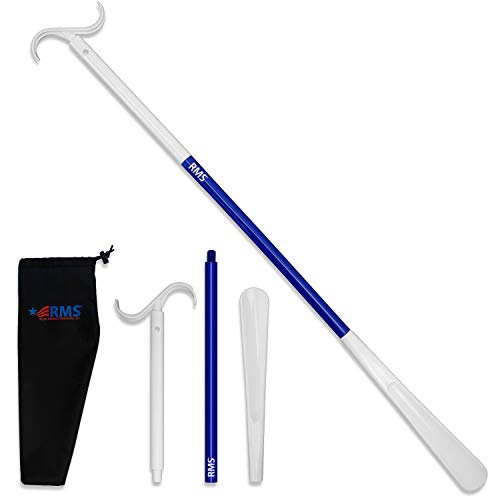
RMS 35.5 Inch Extra Long Dressing Stick
It's a dual-purpose stick, with a sock remover and a shoehorn in one. If you want one aid for several jobs, that's the appeal.
At 35.5 inches, it's longer than the usual range. That helps a taller person but can feel unwieldy in a tight bedroom.
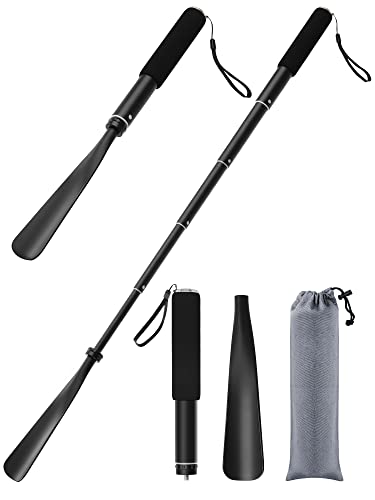
TriPro Telescopic Metal Shoehorn
This one adjusts from 15 to 37 inches, so you can set the length to your reach. The metal blade is the sturdier choice for stiff-backed shoes.
The adjustment is a moving part. Check that it locks firmly before you put weight on it.
Rehabilitation Advantage 17 Inch Plastic Shoehorns
Light plastic and a 17 inch length make this the budget pick, and it comes as a 2-pack. One can live by the bed and one by the door.
At 17 inches, it sits at the short end. It suits seated dressing better than standing, and plastic can flex under pressure.
Button Hooks and Elastic Laces
Stiff fingers make buttons, zips and laces a daily struggle. Lace locks and zipper pulls take the fiddly fastening out of the job, so stiff fingers have less to fight with.


A button hook pulls a button through its hole with a small loop, often with a zipper-pull ring on the other end. Elastic laces replace tied laces, so shoes slip on and off.
These suit adults with arthritis, stiff finger joints or changed hand function after a stroke. They remove the tying and fastening that stiff fingers struggle with.
They do nothing for reach. If bending to your feet is the hazard, these alone won't fix it. A button hook won't help someone whose hip replacement makes bending unsafe.
They're the cheapest and quickest to learn, but they only solve the grip half. A long-handled shoehorn is often the partner you need.
One note on the picks below: they are lace locks and zipper-pull ends, not button hooks. For button hooks with built-up handles, see our dressing aids for limited hand strength. Button hooks can work one-handed after a stroke, though practice helps.
For laces, see our no-tie shoelace guide. Lace the shoe once, set the tension, then leave it alone.
PERCARE Cord Locks and Spring Toggle Stoppers
I'd look at this for the quantity: there are enough locks for several pairs of shoes and a few jackets. Spring toggles let you set the tension once.
The parts are small. Threading them takes finger dexterity, so ask a family member to set them up.
CooBigo Plastic Zipper Pull Cord Ends
A 12 pack of plastic pull ends gives you something bigger to grab than a bare zipper tab. It's a small change for stiff fingers.
Plastic pulls are lighter duty, and they only help if the zipper is the problem. Very stiff fabric can still be tricky.
RJ-Sport Nylon Cord Ends
Made of nylon, these clips are listed as elastic shoelace ends. They suit someone who wants a firmer, more durable lock.
They won't fit every shoe style. Check that your laces and eyelets suit elastic before you swap.
Frequently Asked Questions
Do sock aids work with weak hands? They take grip to load and pull, so they suit stronger hands better. With weak hands, ask an occupational therapist about another approach.
How do I put on socks after hip replacement? A sock aid lets you do it without bending. Follow your surgeon's or therapist's movement precautions first.
Can I use a button hook with one hand? Often yes, with practice.
Do I need both a shoehorn and elastic laces? Not always. Together they cover reach and fasteners for shoes.
Hacks and Advice
- Sit down for dressing: Use a sturdy chair or the bed's edge, with your back supported, before you buy anything.
- Try the reach test: Notice whether you struggle to reach or to grip. That decides your purchase.
- Practice before you need it: Try a new aid a few times, seated, when you're not rushed.
- Check your footing: Dress away from slippery floors and loose rugs, and wear non-slip socks.
- Check once a year: Look at straps, cords, handles and blades for wear. Re-check the fit if your needs change, such as after surgery.
Dressing Aids Shopping Checklist
Download this practical shopping checklist to identify exactly which dressing aid matches your specific challenge—reach or grip—and avoid wasting money on products that end up unused in a drawer.
Conclusion
Dressing aids can be a real part of fall prevention. Work out whether your problem is reach or grip, pick the matching type, and expect a short learning curve.
It's a small change that protects real independence. For the bathroom side of the day, I walk through 18 bathroom safety products.
Want a second set of eyes? Take the Home Safety and Independent Living Assessment.
Then try this tomorrow morning. Ask a family member to stay close enough to steady you while you get dressed and count how many times you balance on one foot.
Bring that count to your next conversation with a care provider or home safety specialist.
Which part of getting dressed feels least steady for you? Tell me in the comments.