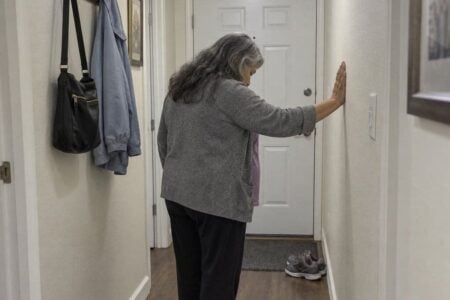
Maybe you trimmed your work hours to drive your mom to appointments. Maybe you left your job altogether, and now you also manage her meals, medications and paperwork.
Did anyone tell you that you might be able to get paid to care for your parent? Sometimes you can, and it depends on three things: your parent's state, income and veteran status.
There's a simple order to look in that can save you weeks of phone calls. Let's walk through it together.

Roadmap to Getting Paid as a Family Caregiver
Get a step-by-step roadmap that cuts through state-by-state confusion and shows you exactly which offices to call to find out if you can be paid as a family caregiver—plus a simple call log to track your progress.
Why the Answer Is "It Depends" (And Why That Stops People)
Pay for family caregivers exists, but there is no single national program. Each program has its own office, its own rules and its own form.
That's why so many families give up. One call sends you to another office, and that office sends you to a third.
Here's what I want you to know before you pick up the phone. Asking whether you can be paid is a practical question, not a selfish one. Caregiving is real work.
I'm a Certified Senior Advisor, not an attorney or a benefits counselor. I've spent more than 20 years working with older adults and their families, and this is the map I wish every family had. Rules vary by state and change every year, so confirm current details with the official offices I name along the way.
The Six Places to Look
- Medicaid self-directed programs
- Medicaid home and community-based waivers
- VA Veteran Directed Care
- VA Program of Comprehensive Assistance for Family Caregivers
- Long-term care insurance
- A written caregiver agreement (when your parent pays from their own money)
Before You Read On
Jot down three facts:
- Your parent's state
- Whether they receive Medicaid or may qualify
- Whether they or a spouse served in the military
Those three notes will point you to the right sections below.

Medicaid Programs That Can Pay a Family Member
So, can Medicaid pay a family member to be a caregiver? In some states and under some programs, yes. There are two routes worth knowing.
Self-Directed Programs
A self-directed program (some states call it "consumer-directed") lets your parent, or a representative, choose and hire their own caregiver. In many states, that caregiver can be a family member.
Think of it as your parent being the employer. They pick who helps, and the program handles the payment.
Home and Community-Based Waivers
A home and community-based services (HCBS) waiver is a program that helps people get care at home instead of in a facility. Some states let family members be paid providers under certain waivers.
Others have waiting lists or limits on who can be hired. I can't tell you how your state handles it, but I can tell you the names to search.
Program names differ from state to state. Try your state's name plus "self-directed personal care" or "HCBS waiver" as a starting point.
One caution: some states restrict whether a spouse or a particular relative can be paid. Ask before you assume.
Ask This Exact Question
Here's a made-up example. A daughter calls her mother's state Medicaid office and asks, "Do you pay caregivers?" She gets a vague answer and hangs up discouraged.
The next day she tries, "Does a self-directed option let my mother hire me?" A specific question tends to reach the right person.
Your action point: call your state Medicaid office and use that exact question. Then check the state's official Medicaid website for current rules.

If Your Parent Is a Veteran: Two VA Programs
Veteran status opens two separate doors, and they work differently.
- Veteran Directed Care: A veteran can manage a flexible budget for services and, in many cases, hire people they choose. That can include family.
- Program of Comprehensive Assistance for Family Caregivers: A VA program that supports the family caregivers of eligible veterans.
Eligibility for both is specific, and the VA makes the decision. Details change, so I won't list criteria here. Your best sources are the VA caregiver support website, the VA's caregiver support line, and the caregiver support coordinator at your local VA medical center.
A veteran's spouse may also have options. The VA can tell you what applies.
Picture a son who assumed his father's service "didn't count." He only learned which options applied by asking the VA directly.
Your action point: if your parent served, ask the VA caregiver support team before assuming you don't qualify.

Long-Term Care Insurance and Written Caregiver Agreements
These two routes involve private money rather than public programs.
Long-Term Care Insurance
Some long-term care policies pay for care from a family member, and others do not. Policies differ on who counts as an eligible caregiver, how benefits begin and what paperwork is needed.
Here's how to check:
- Find your parent's policy.
- Read the benefits and definitions sections.
- Call the insurer and ask three questions.
The three questions:
- Does the policy cover a family caregiver?
- Does the caregiver need to be licensed or employed by an agency?
- What does the claim process require?
The policy's own language controls, so get the answers in writing if you can.
A Written Caregiver Agreement
If your parent pays you from their own funds, put the arrangement in writing. It shows the payment is for real work. It helps avoid family disagreements about money, which can get painful, as I describe in what to do when a sibling is taking advantage of a parent. It can also matter later if your parent applies for Medicaid.
Where I Draw the Line
Payments to a family member can affect taxes and Medicaid eligibility. I'm not the right person to advise on that, and neither is a friend who did something similar.
Talk to an elder law attorney or tax professional before the first payment. If cost is a worry, these free legal resources for older adults are a good place to begin.
Your action point: pull out your parent's long-term care policy this week and call the insurer with the three questions above. If your parent is paying you privately, see an elder law attorney before any agreement is put in place.

Where to Start: Two Phone Calls
You don't need to chase six programs. Two calls will point you to the right ones.
Call 1: Your Area Agency on Aging
This is the local office that knows which programs exist in your parent's area. It can often help with applications too.
To find it, use the Eldercare Locator, run by the federal government. Or search "Area Agency on Aging near me."
Call 2: The State Medicaid Office
Call this office about self-directed programs and waivers, and to ask whether your parent may qualify.
Questions to Ask Before Applying
- Can a family member be paid under any program my parent qualifies for?
- What does my parent need to qualify, and where do I see the current rules?
- Is there a waiting list?
- What paperwork or training does the caregiver need?
- Will payment affect my parent's other benefits?
Write down the name, date and answer from every call. Future you will be grateful.
Making these calls isn't giving up on your own plans. It protects your family's finances and your own. If you're also raising kids, this guide for the sandwich generation may help. And if siblings are involved, shared tools for family caregiver coordination keep everyone on the same page.

Roadmap to Getting Paid as a Family Caregiver
Get a step-by-step roadmap that cuts through state-by-state confusion and shows you exactly which offices to call to find out if you can be paid as a family caregiver—plus a simple call log to track your progress.
Your Next Step
Here's the map again: Medicaid self-directed programs and waivers, two VA programs, long-term care insurance, a written agreement for private pay, and two starting calls.
Giving up work hours to care for a parent is a real sacrifice. Looking for help is a sign of good planning, not greed. Rules vary and change, so the official sources and a qualified professional have the final say.
I know how tiring this is. You don't have to figure this out alone, and what professional caregivers know can lighten the load while you sort out the paperwork.
Make one call this week, to your Area Agency on Aging. If your parent resists the idea of help, these three words can open the conversation.
Has anyone in your family found a program that helped? What do you wish you had known sooner? Share it in the comments, and send this article to a sibling or friend who is caring for a parent.