You’re standing in your parent’s new room at the assisted living facility, surrounded by labeled boxes and half-assembled furniture.
The big decisions are handled. Medications are organized. Clothes are hung.
But somewhere between signing the paperwork and carrying in the last box, a quiet worry surfaces: did you pack the things she’ll need to take care of herself?
The move to assisted living is one of the most emotionally layered transitions a family navigates together. Even when it’s clearly the right decision, the fear that your parent might lose pieces of who they are — including control over small, private daily routines — is real and completely valid.
Here’s what I’ve seen matter most in my two decades of working with families through this transition: a small set of carefully chosen grooming tools can directly determine how much independence your parent holds onto from day one.
This isn’t a shopping list. It’s a dignity checklist — five practical items with outsized impact on your parent’s sense of self-sufficiency in their new home.

Assisted Living Move-In Grooming Checklist
Download this practical checklist to ensure your parent has the right grooming tools within reach on move-in day—simple items that restore daily independence and dignity during a major life transition.
Why Grooming Independence Matters More Than You Might Think
Personal grooming is one of the last private domains older adults hold onto. It signals — to themselves and to everyone around them — that they are still capable, still self-directed, still themselves.
Assisted living staff are skilled and dedicated, but they manage many residents. There is rarely enough time in a care worker’s day to help every resident with every small grooming task. Nail care, hair brushing, and personal hygiene finishing touches often fall into a gap between what staff have time for and what your parent can manage alone.
The right tools close that gap.
When your parent can clip her own nails, brush her own hair, and see clearly enough to do it, those moments belong entirely to her. That matters deeply in an environment where so much else has changed. Packing the right small tools isn’t a minor errand at the end of a stressful move. It’s one of the most dignity-preserving decisions you’ll make during the transition.
The five tools below address the most common grooming challenges older adults face in assisted living, specifically where grip strength, dexterity, and close-up vision make standard tools difficult or impossible to use independently.
Nail Clippers That Aging Hands Can Actually Operate Alone




Why Standard Clippers Fail
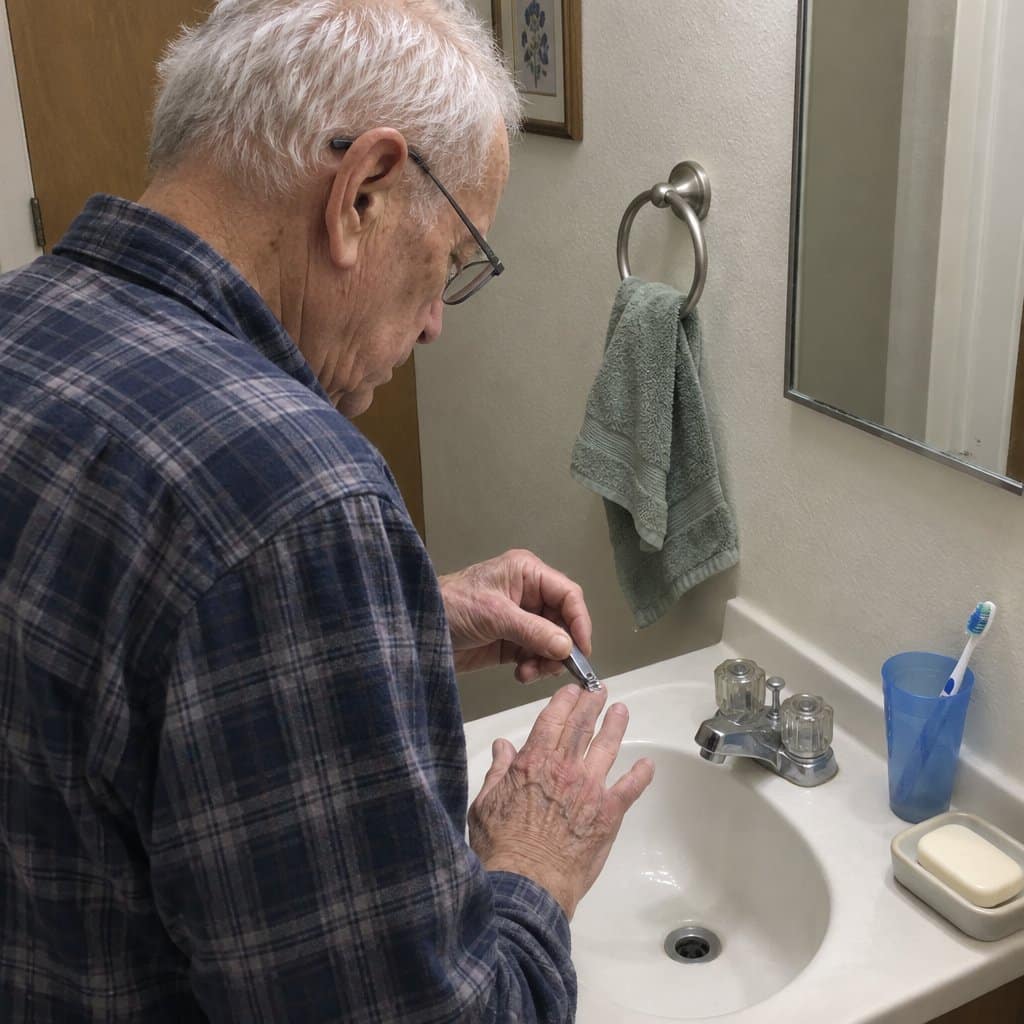
The lever action on a standard nail clipper requires simultaneous grip strength and fine motor coordination. For older adults dealing with arthritis, reduced hand strength, or mild tremors, that combination is often simply beyond what their hands can produce anymore.
The result is a small but demoralizing loss. Nail care is one of the first grooming tasks to slip when the tools aren’t right — and it’s one of the first to be restored when they are.
What to Look For in Nail Clippers for Fingernails
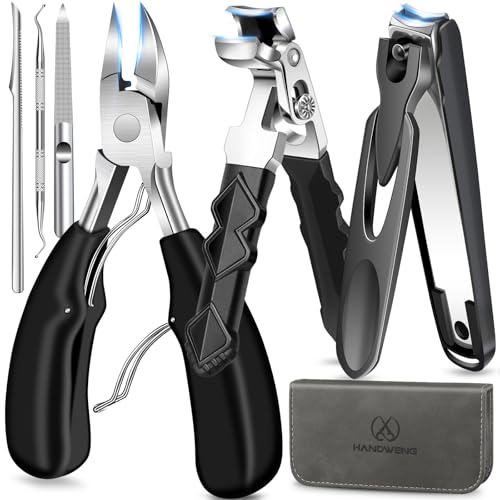
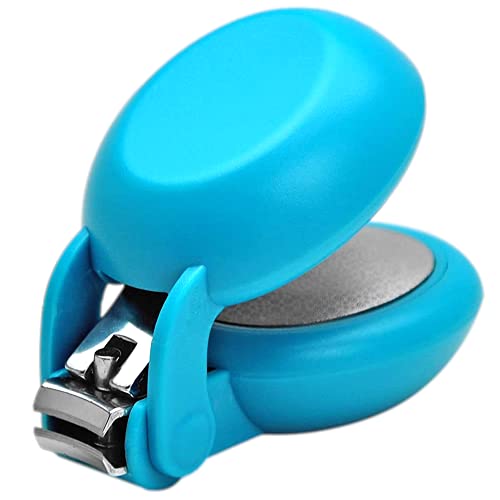
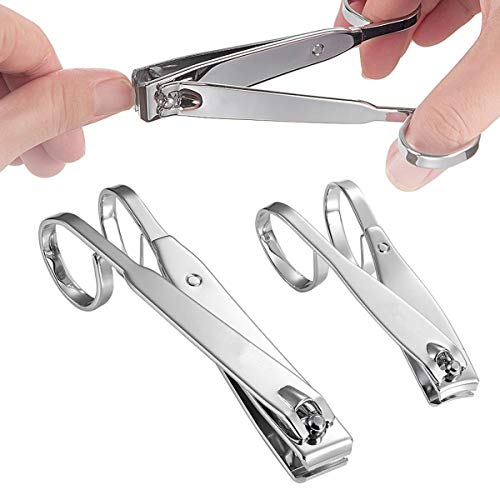
When you’re choosing nail clippers for fingernails your parent can use alone, the design details matter far more than the brand name. Look for these features:
- Wide, cushioned lever: More surface area means less pinching force required per square inch of finger contact.
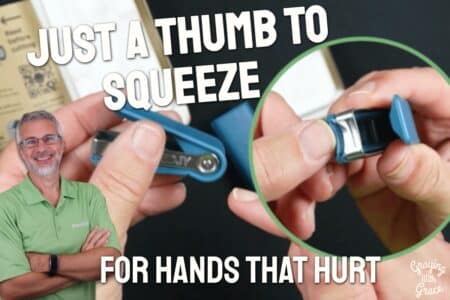
- Soft squeeze action: The clipper should close with minimal required force — look for clippers described as “easy squeeze” or “low-force.”
- Ergonomic grip: A handle your parent can hold steady matters as much as the cutting mechanism.
- Single-squeeze mechanism: Traditional pinch levers demand coordination between two fingers; a single-squeeze style asks for one motion.
Fingernails vs. Toenails
It’s worth drawing this distinction clearly: fingernail care is often the task a parent can still handle independently with the right nail clippers for weak hands. Toenail care is a different story. Thick toenails, limited flexibility, and the challenge of reaching the feet make professional podiatry care the safer path for most older adults in assisted living.
Focus your energy on finding nail clippers for fingernails your parent can press closed herself. That one win keeps a meaningful piece of her daily routine in her own hands.
You can explore options specifically designed around these features — the goal is nail clippers for aging hands that your parent can actually use without asking for help.

A Magnifying Mirror That Makes Close-Up Grooming Visible Again
The Vision Problem Nobody Talks About
Vision changes after 70 make close-up grooming genuinely difficult in a way that’s easy to underestimate until you’re trying to clip a nail or check a skin spot in dim light. Standard mirrors at arm’s length simply don’t provide the resolution older eyes need for detail work.
Clipping nails accurately, plucking stray hairs, applying makeup, checking skin changes — all of these require detail the aging eye often can’t resolve without help. And the room lighting in most assisted living facilities was not designed with close-up grooming in mind.
What Makes a Magnifying Mirror Worth Packing
A well-chosen magnifying mirror restores visibility to tasks that would otherwise require a staff member or family visit to manage. Here’s what to prioritize:
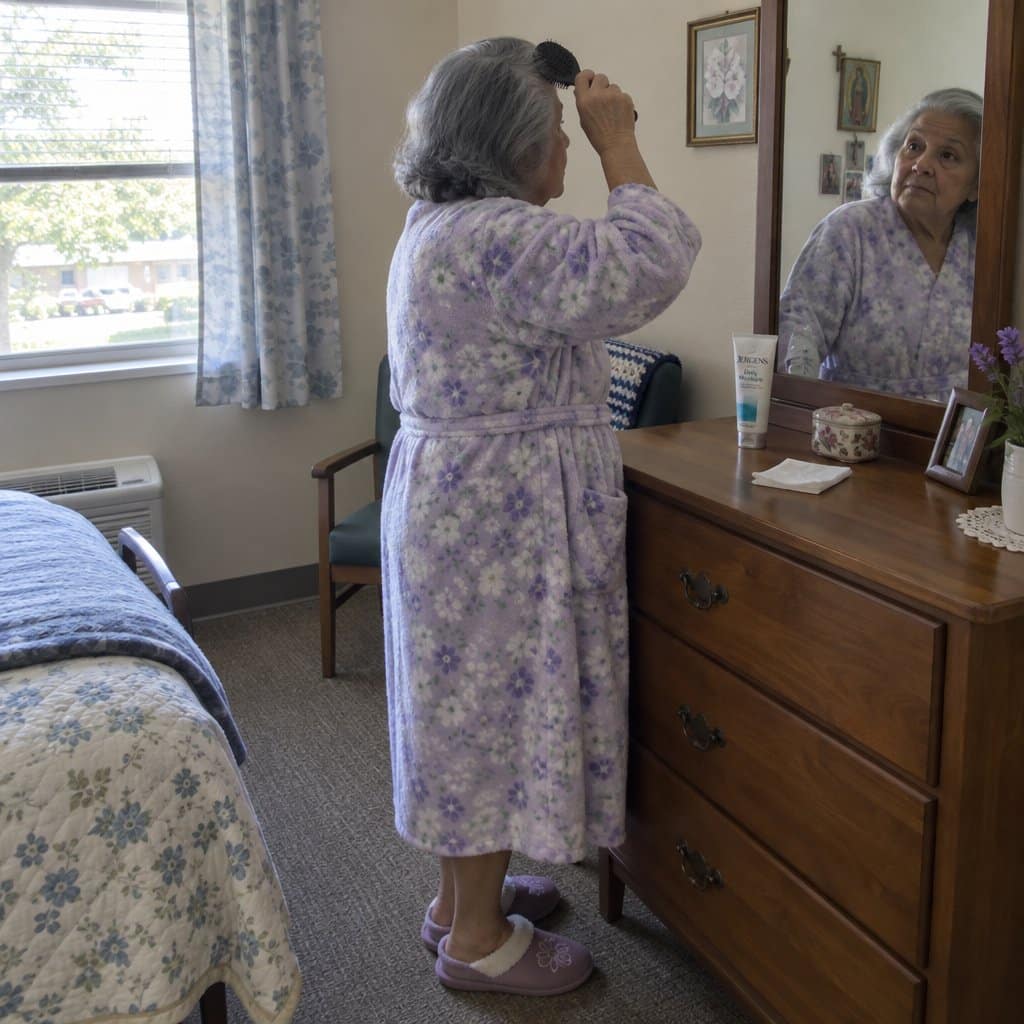
- Meaningful magnification: 5x to 10x is the useful range for grooming tasks. Lower than 5x won’t resolve enough detail; higher than 10x narrows the field of view too much to be practical.
- Built-in light source: This is the single most important feature for assisted living use. Room lighting is often insufficient — a mirror with its own LED ring or built-in lamp solves that problem directly.
- Freestanding or wall-mountable design: Freestanding works well on a nightstand or bathroom ledge; wall-mounted is more stable if your parent’s room permits it.
- Compact footprint: Assisted living rooms are smaller than a home bedroom. A mirror that doesn’t take up significant counter or nightstand space will actually get used.
The Independence This Restores
A magnifying mirror is one of those tools that seems like a small luxury until your parent genuinely can’t see well enough to clip her own nails or notice a skin change that needs attention. Then it becomes essential.
A parent who can see what she’s doing can manage her own grooming tasks. That independence is worth the footprint the mirror takes up in a nightstand drawer.
Subscribe to our newsletter for more tips: Join here


A Long-Handle Hair Brush That Reaches Without Straining


Why Standard Brushes Become Difficult
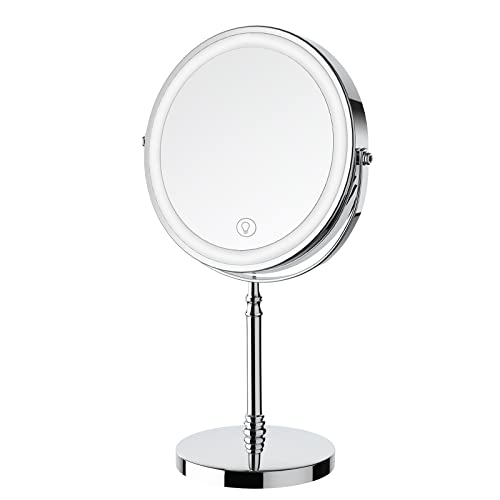
Brushing the back of your head requires lifting your arm above shoulder height and rotating it behind your head. That motion is painful or impossible for many older adults dealing with arthritis, rotator cuff issues, or simply reduced range of shoulder motion.
The result is that hair care — one of the most visible and personally meaningful parts of grooming — quietly slips out of a parent’s hands, not because of general decline, but because the tool requires a physical movement that her body can no longer make comfortably.
How a Long-Handle Hair Brush Solves This
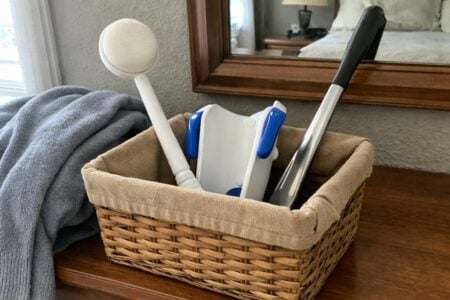
A long-handle hair brush extends the reach of the arm without requiring full overhead elevation. The extended handle does the work that the shoulder no longer can, allowing your parent to brush the back and sides of her hair with her arm at a comfortable, lower angle.
This is not a specialized medical device. It’s a practical reach extension that keeps a private, daily routine private. Many older adults find that switching to a long-handle version of a brush they already know feels natural rather than medicalized.
What to Look For
- Handle length: Long enough to reach the back of the head without straining, typically 12 to 18 inches depending on your parent’s height and reach.
- Grip comfort: A non-slip or cushioned grip matters when hand strength is reduced.
- Bristle type: Match the bristle style to your parent’s hair texture — fine hair and thick hair have different needs, and the wrong bristle type will frustrate rather than help.
Hair appearance is one of the first things a person notices about herself and one of the first things others notice. Keeping this task independent matters enormously to many older adults. A long-handle hair brush is one of the most straightforward ways to protect that.
For more on how the right tools help older adults stay active and self-sufficient, the guide on choosing the best mobility aids for seniors covers this independence-first framing across a wider range of daily challenges.



A Nail File and Basic Grooming Kit to Round Out the Routine


The Role of a Nail File in Daily Independence
Even when clipping is managed well, rough nail edges are a persistent problem. They catch on clothing and bedding, cause minor skin tears, and create daily frustration. A nail file is a simple fix — and it’s a task most older adults can handle entirely on their own with an easy-grip file, long after other grooming tasks become more difficult.
This is one of the most overlooked tools on any assisted living packing list. It’s inexpensive, it takes up almost no space, and it keeps one more small finishing task in your parent’s own hands.
What to Include in a Compact Grooming Kit
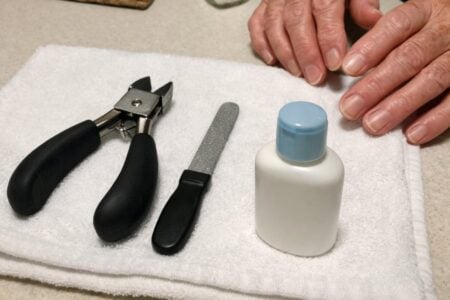
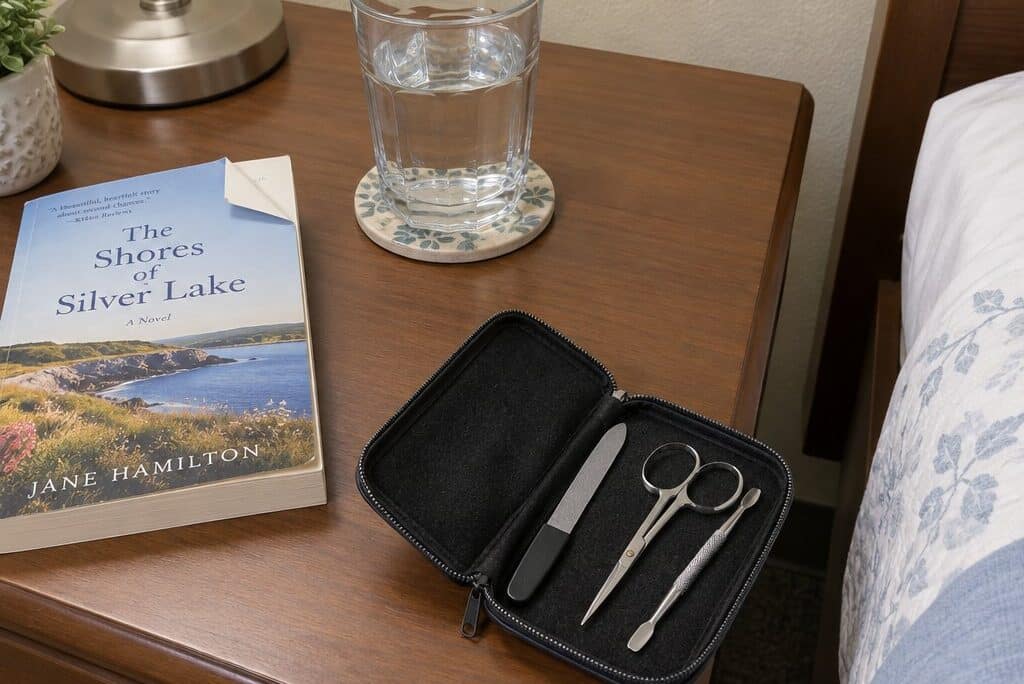
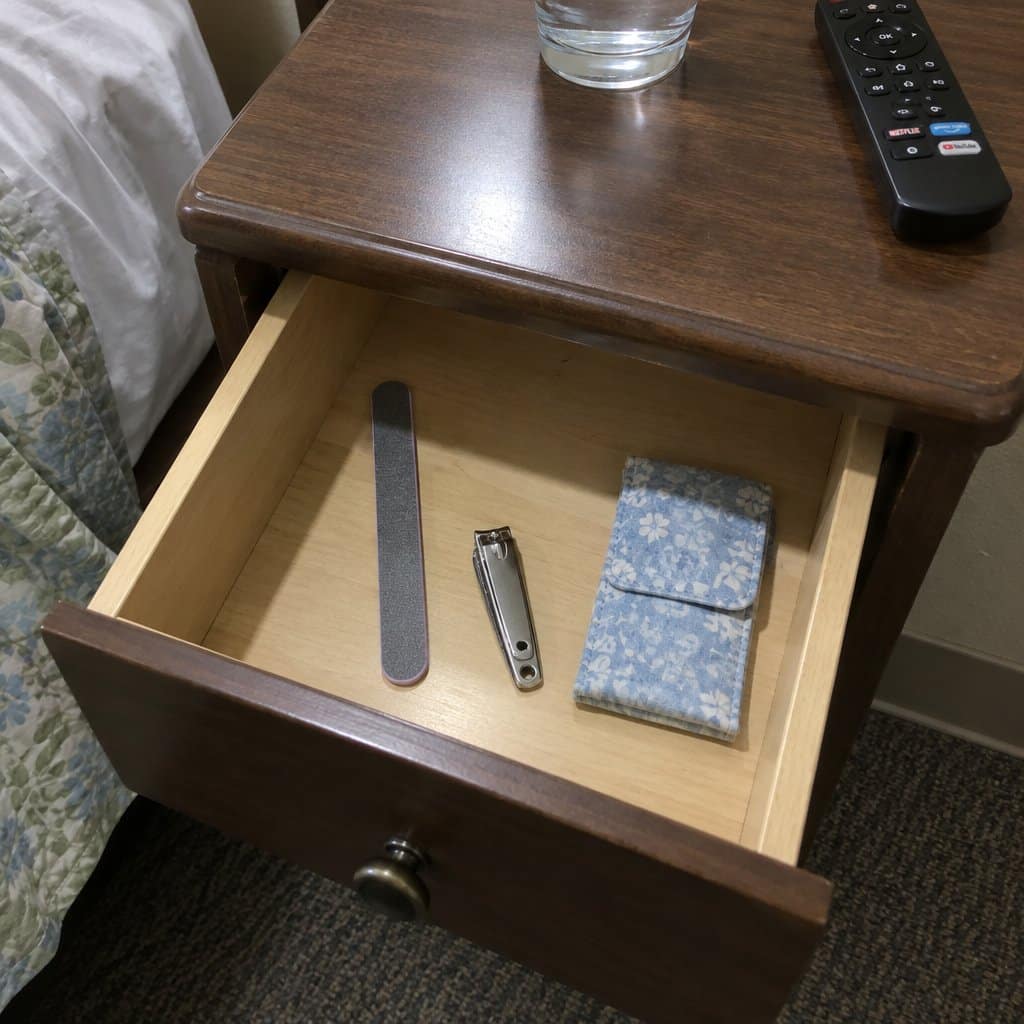
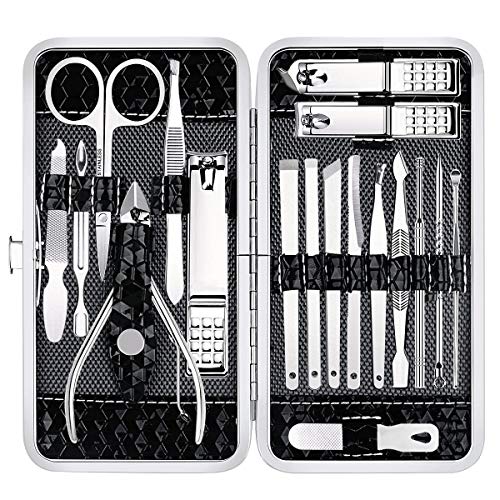
A well-chosen grooming kit suited to assisted living doesn’t need to be comprehensive. It needs to be right-sized: everything your parent actually uses, in one organized case that fits in a nightstand drawer. A practical kit includes:
- Nail file: Emery board or cushioned file — whichever your parent is already comfortable using.
- Small scissors with rounded tips: For small trimming tasks without sharp points that pose a risk in a smaller space.
- Soft-grip cuticle tool: Low pressure, easy to hold.
- Easy-open storage case: This matters more than it sounds. A case with a stiff latch or a zipper that requires two-handed coordination will go unused. Look for a simple flip-top or snap-close design.
The Practical Argument for a Kit Over Individual Tools
One organized case means everything is in one place. In a smaller room, and especially for anyone with mild memory concerns, “I know exactly where my grooming tools are” is a meaningful source of daily comfort. Individual tools scattered across a nightstand become a frustrating search every morning.
What to avoid: overly comprehensive kits with tools your parent will never use, or cases that are difficult to open with stiff or arthritic fingers. The goal is a kit your parent can open, use, and close without asking anyone for help.
Pack the kit before move-in day with the most-used tools already organized inside. Reducing setup friction from the start means the kit gets used from day one — not discovered at the bottom of a box two weeks later.
For older adults managing arthritis specifically, the article on nail clippers for arthritis sufferers goes deeper on what makes a low-force design worth the search. And if your parent enjoys cooking as part of her routine, kitchen utensils for arthritic hands applies the same principle — the right tool keeps one more task in her hands.


Assisted Living Move-In Grooming Checklist
Download this practical checklist to ensure your parent has the right grooming tools within reach on move-in day—simple items that restore daily independence and dignity during a major life transition.
These Small Tools Represent Something Larger
What You’re Really Packing
The five tools in this roundup — nail clippers for fingernails, a magnifying mirror, a long-handle hair brush, a nail file, and a basic grooming kit — are not expensive. They don’t take up much space. They won’t be the things anyone notices when they walk into your parent’s new room.
But they represent the daily moments of independence your parent can hold onto in an environment where much feels new and uncertain. The morning she clips her own nails without asking for help. The afternoon she brushes her hair the way she always has. The small finishing touches she handles herself before you arrive for a visit.
Attending to These Details Is Genuine Caregiving
You’re making thoughtful, loving decisions under real pressure. Attending to these details isn’t overthinking — it’s exactly the kind of caregiving that makes a difference in how capable and dignified your parent feels in her new home from the very first day.
The move to assisted living doesn’t have to mean handing over every aspect of personal care. The right small tools make a real difference. What fits in a nightstand drawer can matter more than you’d expect.
For more on supporting a parent’s independence and safety through practical tools, the fall prevention checklist covers the home safety side of the same transition. And if your parent is navigating mobility changes at the same time, the guide on the best walking canes for seniors approaches that independence question from a different angle.
What grooming items made the biggest difference when your parent moved — or if you’re planning ahead, what are you most uncertain about packing? Share your experience in the comments. This is one of those conversations where caregivers learn more from each other than from any checklist.