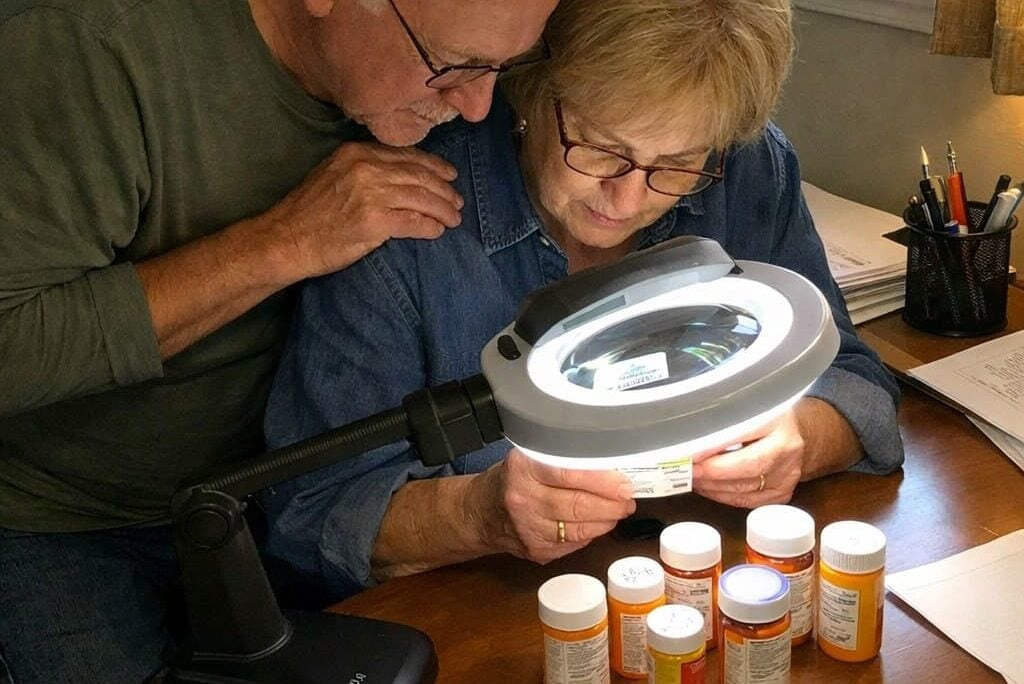
It’s Sunday evening. You’re at the kitchen counter, pill organizer open in front of you, seven bottles lined up. You pick up the one you take at night and tilt it toward the light. The label says something — 20 mg or 200 mg, you’re not quite sure.
You bring it closer. You tilt it again.
You’re pretty sure you’ve been reading it right all along, but that moment of uncertainty? That’s not a minor inconvenience. That’s a medication safety event waiting to happen.
If you’ve ever squinted at a prescription label or held a bottle up to the window trying to read the fine print, you already know what I’m talking about. Most people managing multiple prescriptions quietly absorb these moments without addressing them directly. But if vision changes are making medication labels harder to read, the solution isn’t better lighting overhead — it’s the right magnification tool matched to the right task.
Here’s the thing most people get wrong when shopping for a magnifier: they chase the highest magnification number on the box. That number tells you almost nothing useful on its own.
The question that actually determines whether you pick up the right tool is simpler than that — do your hands need to be free while you’re doing this?
A lighted handheld magnifier that works perfectly for checking a label at the pharmacy is completely wrong for sorting fourteen tablets into a weekly pill organizer when both hands are occupied.
This guide covers three types of lighted magnifiers, explains what each one is actually good for, and helps you match the tool to the task before you spend a dollar on any of them.
Lighted Magnifier Shopping Guide: Match the Tool to the Task
Download this printable shopping guide to find the exact lighted magnifier that fits your home, your task, and your budget—without the trial-and-error of buying the wrong tool.
What to Look For
Before you look at any specific product, these are the criteria that actually separate a useful magnifier from one that ends up in a drawer.
Magnification power — and why more isn’t better
Prescription bottle labels and pill imprints are typically printed at 6 to 8 point type. Reading that comfortably with mild to moderate vision loss generally requires 3x to 5x magnification. Going higher — 7x, 10x, 10x-plus — narrows the field of view so dramatically that you see one or two characters at a time instead of a full word or dosage. A 3x to 5x magnifier with good lighting will outperform a 10x magnifier with poor lighting for nearly every label-reading task. Stop chasing the highest number on the shelf.
Lens size and field of view
Lens diameter directly affects how much text is visible at once. For reading labels, a minimum of 3 inches in diameter is a practical threshold. Smaller lenses force you to move the magnifier constantly, which increases the chance of losing your place on a label and misreading a number. Desktop magnifiers often offer 5-inch or larger lenses, which is a real advantage for pill-organizer sorting tasks where you’re looking at several items simultaneously.
Lighting type, color temperature, and aim
LED lighting is the current standard. What varies considerably is color temperature and how the light is aimed. Daylight-spectrum LEDs (5000K to 6500K) provide better contrast for fine print than warm-white LEDs (2700K to 3000K), which can wash out the distinction between similar colors — relevant when two tablets look nearly identical. Look for magnifiers where the light source surrounds the lens rather than shining from a single point; ring LED arrangements reduce shadow on the object being viewed. Adjustable brightness is worth having, especially if you have light sensitivity.
Power source and runtime
Handheld magnifiers typically run on AA or AAA batteries or via USB charging. A 30- to 60-minute continuous-use runtime is sufficient for most label-reading tasks. Desktop models often require a power outlet, which affects placement — consider whether every location where you use medications has accessible power before committing to a plug-in model.
Hands-free stability
Desktop and stand-alone magnifiers vary significantly in how well they hold position. A flexible-neck magnifier that drifts every time you touch the pill organizer is useless for sorting tasks. Look for models with weighted bases or locking joints. If a model has a foldout stand, the real question is whether that stand holds the lens angle under light contact — not just whether it opens.
Durability and grip
For handheld magnifiers, handle material matters for people with reduced hand strength or arthritis. A rubberized grip or a contoured handle makes a meaningful difference compared to a flat acrylic handle. Weight also matters: most lighted handhelds run 2 to 6 ounces, and toward the upper end of that range, fatigue becomes a factor during extended use.
Lighted Handheld Magnifiers
When you need to verify a label at the pharmacy or check a single tablet before you take it, a lighted handheld magnifier gives you immediate, portable magnification with built-in illumination. These are the right tool for quick, one-handed label checks — and the wrong tool the moment both hands need to be free.
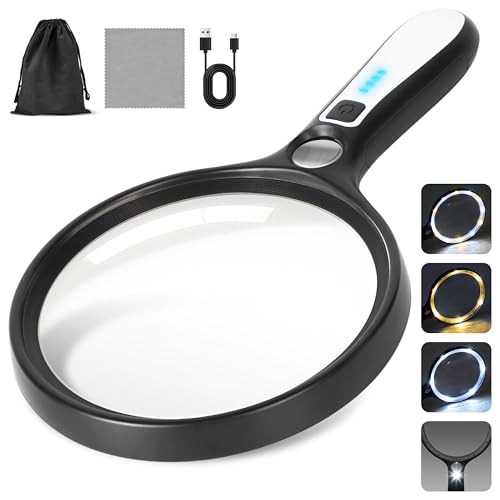
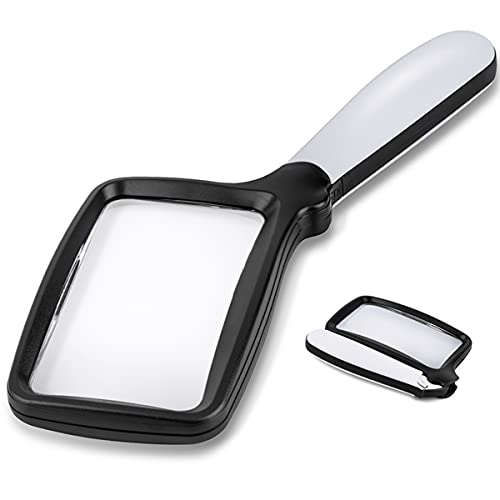


A lighted handheld magnifier is the right tool when you need to read a single label — a bottle just handed to you at the pharmacy, an expiration date on packaging, the imprint on one tablet you’re verifying before you take it. It requires one hand to hold, which means it is the wrong tool the moment your task requires both hands.
The core trade-off is worth stating plainly: handheld means portable and immediately available, but it imposes a one-hand constraint on every task you use it for. For a quick label check, that’s fine. For filling seven compartments of a weekly pill organizer, it creates a stop-start workflow — set down magnifier, open compartment, pick up tablet, pick up magnifier again — that most people abandon after a few attempts.
The right first purchase for someone who primarily needs to verify a label in the moment is a handheld model. It is not the right primary tool for someone whose main task is sorting medications. If you find yourself in that situation — managing multiple prescriptions and filling an organizer each week — go directly to the desktop section below.
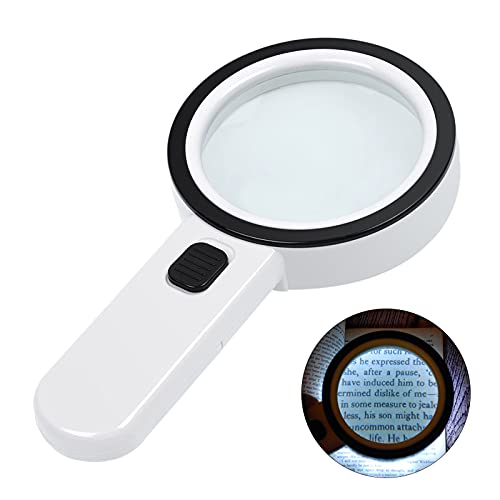
AIXPI Magnifying Glass with Light
The AIXPI uses a double-layer glass lens rather than acrylic, which reduces chromatic distortion at the edges of the lens — practically, this means the print near the edge of your field of view stays legible instead of bending. For reading a label that runs to the edge of a bottle, that matters.
The LED ring surrounds the lens perimeter, which gives more even illumination than a single-point or side-mounted light. Less shadow on the label means less guessing whether that smudge is a printing artifact or part of a number.
This is a solid choice for someone who wants a dependable grab-and-go tool for label checks. The glass lens adds a little weight compared to acrylic options, so if grip strength is a concern, factor that in before purchasing.
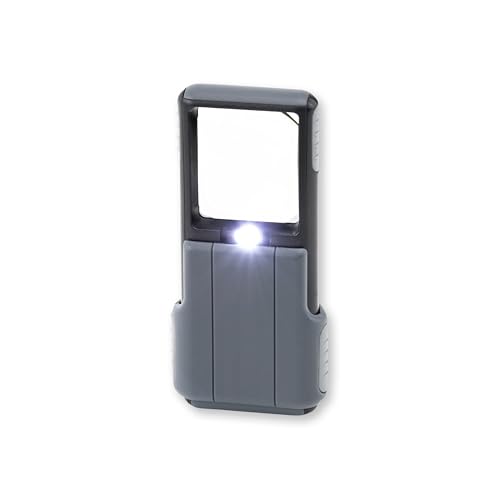
Carson MiniBrite LED Lighted Slide-Out Magnifier
The Carson MiniBrite is a compact, pocket-sized magnifier that slides out of a protective sleeve — the sleeve also functions as a basic stand, which gives it limited hands-free capability on a flat surface. The magnification level is modest, which keeps the field of view wide enough to read a full line of label text at once.
Its size is genuinely useful for portability: it can live in a medication bag, a purse, or a bedside drawer without taking up meaningful space. This makes it a practical companion magnifier — something you keep where a larger model can’t go.
The honest limitation is that the compact lens size means you’re working with a smaller viewing area than a full-size handheld. If your primary need is reading labels in good light with occasional use, this works well. If you’re reading in dim light or need to cover more label text at a glance, a larger lens will serve you better.
Yuftechs Large Magnifying Glass with Light
The Yuftechs offers a 5-inch lens diameter with a 13-LED ring light arrangement — the larger lens is the primary advantage here. More lens area means more label text visible at one glance, which reduces the back-and-forth scanning that causes people to lose their place on a line of small print.
The 10x/30x dual-magnification design gives flexibility, though the 30x setting narrows the field of view considerably. For medication label reading, the lower setting is the more practical one for most people. The higher setting is more useful for examining pill imprints or fine detail on a single small area.
This is a good fit for someone who wants a handheld option with meaningful lens coverage. The 13-LED ring provides even illumination, which is a real advantage over models with fewer or unevenly placed lights.
Tobegiga Folding Handheld Magnifying Glass with Light
The Tobegiga’s distinguishing feature is its folding design and built-in stand, which converts it from handheld to a limited hands-free configuration. That’s a meaningful option for a task where you need one hand free — checking a label while holding a bottle with the other, for example — without requiring a full desktop setup.
The rectangular lens shape, rather than round, provides a wider horizontal field of view. For reading text on a label, horizontal coverage is more useful than vertical coverage, so this design choice is functionally sensible.
The stand’s stability under light contact is the variable to watch with fold-out stand designs. This works best on a flat, stable surface. It is not a substitute for a weighted desktop magnifier for sustained sorting tasks, but it offers more flexibility than a standard handheld.
YJZXXLSH Lighted Magnifying Glass
The YJZXXLSH offers a 10x/25x configuration with LED illumination. At 10x, the field of view is narrower than a 3x to 5x magnifier — you’re seeing fewer characters at once — but the image is larger, which can help when a label’s print is genuinely very small or when contrast is poor.
This is better suited to examining a single tablet’s imprint or reading one specific piece of information than to scanning a full label line by line. If your primary challenge is very fine print rather than reading speed, the higher magnification may be more useful than it would be for general label reading.
For arthritis or reduced grip strength, weight and handle design are worth checking before purchasing. Higher-magnification handhelds sometimes sacrifice handle ergonomics for lens housing.
MagniPros Rechargeable Magnifying Glass
The MagniPros distinguishes itself with a USB rechargeable battery and three color light modes. The anti-glare lens coating is a genuine functional feature — standard LED lighting on a reflective label surface can produce glare that makes reading harder rather than easier, and an anti-glare coating reduces that effect.
The three color modes (typically warm white, cool white, and daylight) allow you to match the lighting to the label and your own visual preferences. Daylight mode (higher Kelvin) will generally provide better contrast for reading fine print; warm mode may be more comfortable for extended use.
Rechargeable power means no battery-swapping, which is a convenience worth noting for a tool you’ll use regularly. This is a practical choice for someone who wants a reliable, feature-complete handheld without managing disposable batteries.
Recant Large Magnifying Glass with Light
The Recant offers three magnification levels — 10x, 25x, and 45x — with LED illumination. The 10x setting is the practical range for medication label reading; the higher settings are for examining very fine detail on small areas, such as a pill imprint or the tiny print on a medication information sheet.
The multi-level magnification design makes this a versatile tool if you have tasks across a range of scales — checking a label, then examining a specific character you couldn’t quite make out, for example. The trade-off is that the highest settings narrow the field of view significantly, so they’re not suitable for reading running text.
This is a reasonable choice for someone who wants one handheld that covers multiple levels of detail. For straightforward label-reading tasks, the lower magnification setting will be the one in regular use.
Desktop and Hands-Free Magnifiers
Filling a weekly pill organizer requires both hands — picking up tablets, pressing compartment lids, cross-checking labels — and none of that is possible while holding a magnifier. A desktop or hands-free magnifier solves this by providing a stable, lit field of view you look through, leaving both hands completely free to do the work.


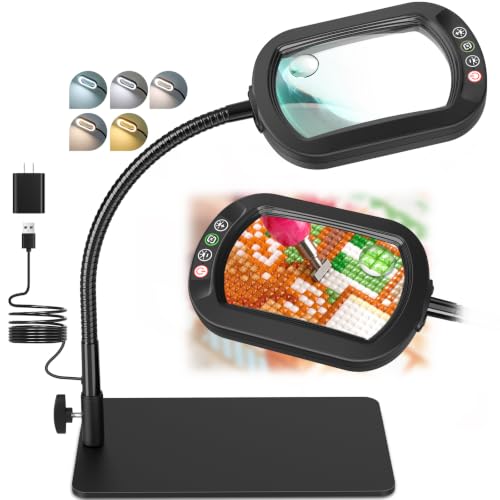
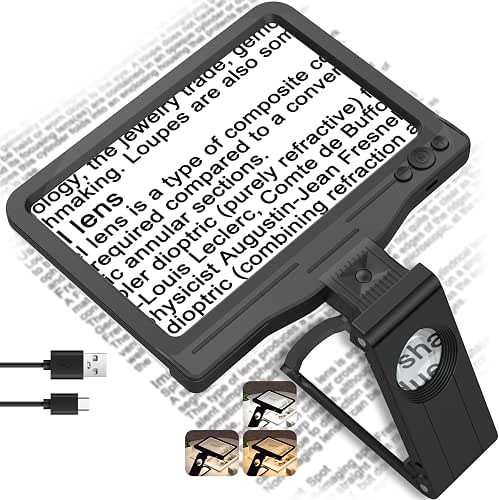

A desktop or hands-free magnifier is the right tool when the task requires both hands and sustained close vision. Filling a weekly pill organizer is the clearest example: you are picking up individual tablets, pressing compartment lids, cross-checking labels, and counting — none of which you can do one-handed while holding anything. A desktop magnifier solves this by providing a stable, lit field of view you look through, leaving both hands free to do the work.
This is also the right category for fine-detail tasks that take more than a few seconds: reading the fine print on a prescription information sheet, examining whether two tablets look identical, checking expiration dates across multiple bottles at once. If you find yourself struggling with medication safety at home, the desktop magnifier is often the most impactful single change you can make to your medication routine.
The honest trade-off: desktop magnifiers are not portable. They live in one place — wherever your medication routine happens. For many people, this is actually a feature. The magnifier is always where it’s needed, fully charged or plugged in, not misplaced. But if medications are stored or used in multiple rooms, you may need more than one tool — or a desktop unit plus a handheld.
Haotor 5-Inch Magnifying Glass with Light and Stand
The Haotor 5-inch model offers a large optical-grade HD lens with five color modes and stepless dimming. The 5-inch lens diameter is the primary functional advantage for pill-organizer tasks — more lens area means more label or organizer compartment visible at once, which reduces the repositioning that breaks your workflow.
Five color modes with stepless dimming means you can dial in exactly the light level and temperature that works for your vision and your room’s ambient light. That flexibility is genuinely useful; one fixed brightness setting often means either too dim for dim rooms or too harsh for sensitive eyes.
This is a strong candidate for someone filling a weekly pill organizer at a fixed location. The larger lens and adjustable lighting address the two most common reasons magnifiers get abandoned: inadequate coverage and poor illumination.
RunSenFo Magnifying Glass with Light and Stand
The RunSenFo is a direct competitor to the Haotor in the 5-inch optical-grade lens category, also offering five color modes with stepless dimming. The distinction between these two models comes down to build quality details — base weight, neck stability, and how well the lens holds position when you touch the surface below it.
For sustained pill-sorting tasks, neck stability is more important than it might seem. A flexible-neck magnifier that drifts when you press a compartment lid means you’re constantly repositioning rather than working. Look at the base construction and joint design when comparing this to similar models.
This is a practical choice for a hands-free label-reading setup where both adjustable lighting and a large lens field are priorities.
Krstlv Magnifying Glass with Light and Stand
The Krstlv offers a 10x magnifying glass with five color modes and stepless dimmable LED lighting on a stand. At 10x, the field of view is narrower than the 5x to 6x range — you’ll see a smaller area of the label at once, but the text will appear larger.
This is a better fit for tasks that involve reading very small print on a specific spot rather than scanning a full label. If the challenge is a particular section of text — the dosage line, the refill instructions — rather than reading the whole label, the higher magnification may suit the task.
For general pill-organizer sorting where you need to see multiple compartments and multiple labels, a lower magnification with a larger field of view will typically be more efficient.
MagnieOpti Rectangle Magnifying Glass with Light and Stand
The MagnieOpti uses a rectangular lens rather than a round one. For reading text on labels — which runs horizontally — a rectangular lens provides a wider horizontal field of view, which means more words visible per pass. That’s a functionally sensible design choice for label-reading tasks specifically.
The real glass lens (rather than acrylic) reduces distortion at the lens edges, keeping text legible across the full viewing area rather than just the center. This matters most when you’re reading a full line of label text rather than a single word.
This is a good option for someone whose primary use is reading running text on labels and prescription information sheets, where the rectangular field and real glass construction provide a practical advantage.
Haotor Rechargeable Full Page Magnifier with Folding Stand
The Haotor rechargeable model offers a full-page lens with a folding stand — the large lens area is the key feature here. A full-page magnifier provides a wider viewing field than a standard round or rectangular lens, which is particularly useful when reading a prescription information sheet or a label with multiple sections.
Rechargeable power removes the outlet-proximity requirement, which means this model can be positioned anywhere in a room — on a nightstand, at a kitchen table, wherever the routine happens — without needing a power cord. That flexibility is worth considering if your medication storage location doesn’t have an easily accessible outlet.
The folding stand design affects portability — this model can be stored flat when not in use, which is convenient if counter space is limited. The stability of the folded stand under contact is the variable to evaluate for sorting tasks.
Toolhelper Full Page Magnifying Glass with Light and Stand
The Toolhelper 5x full-page magnifier with light and stand offers a large lens at a lower magnification level. The 5x range keeps the field of view wide while still providing meaningful magnification for standard label print sizes — this is the range where most people with mild to moderate vision loss find the best balance between enlargement and coverage.
Full-page magnifiers are particularly useful for reading prescription information inserts, which are often printed in very small type across a full page of text. Having enough lens coverage to read a full line without repositioning reduces reading fatigue considerably.
This is a practical choice for someone who wants a desktop solution that handles both pill label reading and longer-form prescription text without the narrow field of view that comes with higher magnification levels.
Magnifying Mirrors with Light
Applying topical medication accurately, monitoring a wound that is healing, or examining a skin change all require seeing yourself clearly with good illumination — tasks a standard bathroom mirror cannot reliably support. A lighted magnifying mirror provides the magnified, evenly lit reflection needed for safe, precise personal care at the vanity.


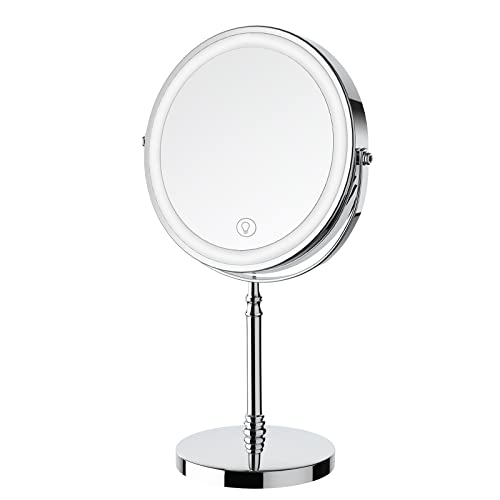


A magnifying mirror with light is a personal-care tool. Its job is to provide a lit, magnified reflection for tasks like skin checks, wound care, applying topical medication, checking the back of the neck, or any grooming task that requires precise close vision. It is not a reading tool, and it is not a substitute for a handheld or desktop magnifier for pill labels.
That distinction matters. If your primary concern is reading medication labels, solve that problem with one of the two types above. A magnifying mirror won’t help you read the print on a prescription bottle — you’d be looking at a reversed reflection of the label, not the label itself.
Where this type genuinely serves a medication-related purpose is applying topical medication accurately: a cream applied to a skin area you’re monitoring, an eye drop, an ointment that needs to go on a specific site. Being able to see the application area clearly — with good light and meaningful magnification — reduces the chance of misapplication. For bathroom safety and independent personal care, a well-positioned lighted magnifying mirror is a genuine tool, not a luxury.
B Beauty Planet Magnifying Mirror with Light 30X
The B Beauty Planet offers a double-sided design — one standard (1x) side and one 30x magnified side. The 30x magnification is at the high end of what’s useful for personal care; it’s suitable for examining a very small, specific area of skin in close detail, such as a wound site or a skin change you’re monitoring over time.
The trade-off with 30x is that the field of view is narrow and the depth of field is shallow — small movements shift what’s in focus. For wound monitoring or checking a specific spot, this is workable. For broader personal-care tasks like applying a cream over a larger area, a lower magnification setting provides more practical coverage.
The double-sided design is the key practical feature: use the 1x side for general orientation and the 30x side when you need fine detail on a specific point.
MIYADIVA Makeup Mirror with Lights and Touch Switch
The MIYADIVA offers 20x magnification with a touch switch for lighting control. The touch-activated switch reduces the dexterity required to operate the light, which is a practical advantage for people with arthritis or reduced fine motor control — no small buttons to press or switches to flip.
At 20x, this mirror provides high magnification with a corresponding narrow field of view. It’s well suited for precise personal-care tasks where you need to see a small area in detail: checking a spot, verifying that a wound is healing cleanly, or applying medication to a defined area.
The vanity stand design positions this as a countertop tool — it lives at the bathroom vanity and is always available for the daily care routine. This predictability is an advantage over a portable mirror that might not be at hand when needed.
DEIOVWXS Rechargeable Vanity Mirror with 3 Lights
The DEIOVWXS offers a dual-sided 1x/10x design with three lighting modes and a rechargeable battery. The three lighting modes — typically warm, cool, and daylight — allow adjustment for different tasks and ambient conditions. Daylight mode provides the best contrast for skin checks; warm mode may be more comfortable for general use.
Rechargeable power means no cord to manage and flexible placement — the mirror can be positioned anywhere at the vanity without being tethered to an outlet. For a bathroom where outlet access is limited, this is a practical advantage.
At 10x, the magnification level is high enough for personal-care detail work while maintaining enough field of view to stay oriented. This is a more versatile daily-use option than the 20x to 30x models for people who use the mirror across a range of tasks rather than for one specific high-detail application.
VESAUR 8.5″ Large Lighted Makeup Mirror
The VESAUR is notable for its 8.5-inch mirror size — significantly larger than most compact vanity mirrors. The larger surface area provides more context around the area being examined, which matters for skin checks where you want to see the surrounding tissue as well as the specific point of concern.
The 1x/10x double-sided design follows the standard pattern, with the 10x side for close detail and the 1x side for broader orientation. The larger overall mirror size makes the 1x side more useful than it would be on a compact mirror — you can see more of your face or neck at once, which helps with positioning before moving to the magnified view.
This is a good fit for someone who does regular skin self-checks, where seeing the broader context matters as much as the magnified detail.
HUONUL 2X/3X/10X Trifold Magnifying Vanity Mirror
The HUONUL trifold offers three magnification levels across its panels — 2x, 3x, and 10x — in a trifold configuration with lighting. The graduated magnification is the distinguishing feature: you can check orientation at lower magnification before moving to the detail view, rather than switching between two extreme ends (1x and 10x) as most double-sided mirrors require.
The trifold design also provides side views, which is useful for checking the sides of the face or neck — areas that are difficult to see with a straight-on mirror. For wound monitoring on the side of the face or neck, this configuration is practically more useful than a flat single-panel mirror.
The lower magnification range (2x, 3x) on the side panels provides better coverage for broader personal-care tasks than a single high-magnification panel would. This is a good option for someone who wants graduated magnification rather than a binary 1x/10x choice.
Auxmir 9″ Magnifying Mirror with 5000mAh Battery
The Auxmir stands out for two specifications: a 9-inch mirror size and a 5000mAh rechargeable battery. The battery capacity is the most notable feature here — at 5000mAh, runtime is considerably longer than most rechargeable vanity mirrors, which typically offer 1000mAh to 2000mAh. For daily use without wanting to remember to recharge frequently, this matters.
The 9-inch size provides a large viewing area, similar to the VESAUR — more context visible around the point of interest during skin checks or wound monitoring. The 1x/30x double-sided design follows the same pattern as other models in this category.
The chrome finish and 30x magnification on the detail side make this a good candidate for someone who wants a high-capacity rechargeable option with a large mirror surface and doesn’t want to charge it more than once a week or so.
Frequently Asked Questions
What magnification power do I actually need to read medication labels?
For most prescription label print, 3x to 5x is the practical range. This keeps the field of view wide enough to read a full line of text at once while still providing meaningful enlargement. Going above 5x narrows the field of view so that you see only a character or two at a time — reading becomes slower, not faster. More importantly, good lighting often matters more than an extra 1x or 2x of magnification. A 4x magnifier with daylight-spectrum LEDs will outperform a 10x magnifier with a dim, warm bulb for reading label text.
Can a handheld magnifier work for filling a pill organizer?
Technically yes, practically no. Filling a pill organizer requires both hands — picking up tablets, pressing compartment lids, holding bottles steady. Holding a magnifier takes one hand out of the rotation. The result is a stop-start workflow: set the magnifier down, do the task, pick the magnifier up again. Most people abandon this after a few sessions. For pill-organizer sorting, a desktop magnifier that keeps both hands free is the right tool. A handheld is for quick label checks in the moment, not for sustained two-handed tasks.
What should I look for in a magnifier’s lighting?
Look for daylight-spectrum LEDs in the 5000K to 6500K range — they provide better contrast for fine print than warm-white LEDs, which can wash out the distinction between similar colors. A ring LED arrangement that surrounds the lens perimeter reduces shadow more effectively than a single-point or side-mounted light. Adjustable brightness is worth having, especially if you have light sensitivity or use the magnifier in varying ambient conditions. Washed-out or poorly aimed light is one of the most common reasons magnifiers end up unused.
I have arthritis in my hands. Which type is easiest to use?
For handheld magnifiers, look for rubberized grips and lighter weight — under 4 ounces if possible. For significant arthritis, a desktop magnifier is the better choice because it removes the grip requirement entirely; you look through it rather than hold it. Magnifying mirrors are hands-free by design and require no grip at all for their intended personal-care use. If arthritis is a factor, the desktop type is generally the most comfortable option for sustained tasks like medication sorting.
Is a magnifying mirror with light the same as a lighted magnifier?
No. A magnifying mirror provides a magnified reflection and is designed for looking at yourself — skin checks, wound care, applying topical medication, grooming. A lighted magnifier is designed for viewing an object you’re holding or working with, like a prescription bottle or a tablet. A magnifying mirror cannot substitute for a lighted magnifier when reading a label: you’d be looking at a reversed reflection of the print, not the label itself. They are different tools for different tasks, and neither replaces the other.
My parent keeps forgetting where they put their magnifier. What helps?
The best magnifier is the one that’s always where it’s needed. For a pill-sorting routine that happens at a specific location — the kitchen counter, a bedroom dresser — a desktop magnifier that permanently lives there beats a handheld magnifier that migrates around the house. If a handheld is preferred, a bright case color or a designated storage spot directly next to the pill bottles reduces the search. The goal is to make reaching for the magnifier automatic, not a decision.
Hacks and Advice
Put the magnifier where the medications are, not where it seems convenient. The biggest predictor of whether a magnifier gets used is whether it’s within arm’s reach when needed. If the medication routine happens at the kitchen counter, the magnifier lives at the kitchen counter — not in a drawer, not in another room. Proximity is the only habit that sticks.
Test the lighting before you need it. Many lighted magnifiers have LEDs that look impressive in a well-lit store or in a product photo but provide inadequate illumination in the lower-light conditions where you’d actually read a pill bottle label. Before relying on any magnifier for a safety-critical task, test it under the actual lighting conditions in your home — at night, in the room where you take your medications.
The print on the label matters — so does the background. Dark print on a white background reads most easily. Some generic prescriptions use gray print or smaller type than brand-name labels. If certain bottles are consistently harder to read than others, mention this to your pharmacist. Many pharmacies can print large-type labels on request, and that’s a free solution worth asking about before purchasing any equipment.
Replace batteries before they get low, not after. A handheld lighted magnifier with dying batteries produces dimmer, yellower light — which makes fine print harder to read, not easier. Set a reminder to swap batteries on a regular schedule (every three months is a reasonable default) rather than waiting for the light to visibly dim. This is a safety habit, not just a convenience one.
Use natural daylight as a supplement, not a substitute. A magnifier with adequate lighting reduces your dependence on window light, but if you’re near a window during your medication routine, use it. North-facing indirect daylight — or any position that avoids direct sun glare — provides even illumination that complements artificial LED light well.
Try before committing to a fixed wall mount. For magnifying mirrors with wall-mount designs, use the countertop stand version first for a few weeks to establish exactly where you want it positioned at eye level. Drilling into tile or drywall to fix a mirror at the wrong height is an avoidable frustration.
If you’re buying for someone else, ask about their routine first. The most common mistake adult children make is choosing a handheld magnifier because it seems like the obvious tool — when their parent’s actual challenge is filling a weekly pill organizer, which requires the desktop type. A five-minute conversation about how and where the medication routine actually happens saves a return trip and genuinely reduces medication risk.
Lighted Magnifier Shopping Guide: Match the Tool to the Task
Download this printable shopping guide to find the exact lighted magnifier that fits your home, your task, and your budget—without the trial-and-error of buying the wrong tool.
Conclusion
The question was never which magnifier has the highest power. It was whether your hands need to be free for the task you’re doing.
Three types, three tasks. A lighted handheld magnifier for quick label checks in the moment — at the pharmacy, at a doctor’s office, when a single bottle needs verification. A desktop or hands-free magnifier for the weekly pill-organizing routine, where both hands need to do the work and the magnifier needs to hold steady while you do it. A magnifying mirror with light for personal care at the vanity — skin checks, wound monitoring, applying topical medication accurately.
Here’s a concrete action you can take today. Walk through every location in your home where medications are stored or used. At each one, ask one question: with the light that’s actually available in that spot, can you read the smallest print on any label there without uncertainty? If the answer is no — even once — you’ve identified exactly where a lighted magnifier needs to live.
Matching the tool to the task is a safety decision. Getting it right reduces the chance of a medication error before it happens.
If you want to apply this same kind of structured attention to every room in your home — not just where the medications are — the Home Safety and Independent Living Assessment walks through each area with the same question: does what’s here actually support safe, independent living? It’s worth taking once you’ve thought carefully about magnification and lighting. And if you’re a caregiver or family member thinking through safety tools more broadly, this fall prevention checklist is a practical companion resource for extending that same safety thinking throughout the home.
Ready to discover more practical strategies for safe, independent aging? Subscribe to our newsletter for expert-tested tips and product recommendations designed specifically for older adults.


![Older woman cane glasses chain kitchen safety[1]](https://www.grayingwithgrace.com/wp-content/uploads/2026/05/older_woman_cane_glasses_chain_kitchen_safety1-e1778601056307-450x300.jpg)